Jesus' baptism site to be cleared of mines


Landmines to be cleared near site of Jesus' baptism 02:00
Story highlights
- Almost 5,000 landmines cover the area near the Jordan River, remnants of the 1967 Six-Day War
- The HALO Trust wants to rid the area of mines within 18 months
West Bank (CNN)On
a sunburnt stretch of desert near the Jordan River, a weather-beaten
Romanian Orthodox church waits for its first visitor in 50 years.
The
gated entrance has long since fallen apart, its marble column leaning
toward the morning sun. The path to the church -- if it ever was a path
-- is a thick quilt of shrubs and thistles.
Despite
being long abandoned, the church retains much of its historic beauty. A
colorful mural of a scene from the Bible, half-visible above the
entrance to the church, has dulled over time, but is still magnificent.
The church door stands open as if ready to welcome the faithful.
The land on which the church sits is near one of the holiest Christian sites in the world -- the place where Christians believe Jesus Christ was baptized in the Jordan River.
There
are several other churches at the site, but no one has come near them
in decades because they are surrounded by nearly 5,000 landmines.
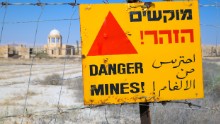
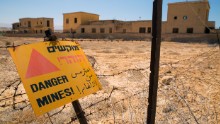
Barbed-wire
fences keep visitors far away, with signs warning "DANGER MINES!" in
Arabic, English, and Hebrew. When the Six-Day War ended in an uneasy
ceasefire in 1967, the Israeli and Jordanian armies laid mines across the area.
The
Jordan River at this point is only a few feet wide -- an easy crossing
point for an army. The two countries signed a peace agreement in 1994,
but the mines were never removed.
Making a holy site safe again
From
the safety of the dirt road, a row of anti-tank mines is visible,
resting on top of the dry, cracked soil. Nearby, anti-personnel mines
sit above the ground, scattered across an empty field. Unexploded
ordnance could still be anywhere, and the churches could be
booby-trapped.
8 photos: Abandoned churches by the Jordan River
The
Franciscan church is the closest to the modern tourist center, which
was set up in 2011 and is now visited by close to 300,000 people every
year. In 18 months, if the fields surrounding it are cleared, the church
might reopen for visits.
Hide Caption
5 of 8
8 photos: Abandoned churches by the Jordan River
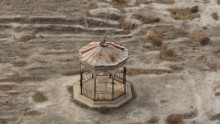
A
lone gazebo stands at the site of the Greek Orthodox church. The
patriarch, Theophilos III of Jerusalem, remembers visiting the site as a
young teenager before it became a restricted military zone.
Hide Caption
6 of 8
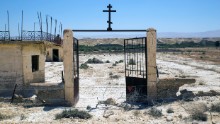
8 photos: Abandoned churches by the Jordan River
The
rusted gate of the Russian Orthodox church looks out onto the Jordan
River and the Jordanian mountains beyond. After the fields are cleared,
each church will have its own walking path to the river.
Hide Caption
7 of 8
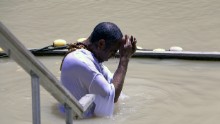
8 photos: Abandoned churches by the Jordan River
A
pilgrim immerses himself in the waters of the Jordan River. UNESCO
recognizes the official site of Jesus' baptism as the east bank of the
river in Jordan, called Al-Maghtas ("baptism").
Hide Caption
8 of 8
8 photos: Abandoned churches by the Jordan River
Seven
churches sit where Christians believe Jesus Christ was baptized in the
Jordan River, but they're surrounded by a barbed-wire fence and 5,000
landmines. The Ethiopian Orthodox church, seen here, is one of the
largest at the site. By 2018, the fields around it might be mine-free.
Hide Caption
No comments:
Post a Comment