I was also thinking about where human knowledge actually comes from and I realized today it comes from technology, research and visionary people in combination. So what people believe in any given era depends upon what they hear and who they believe and who they don't. So, you have a wide variety of belief systems in any given country on earth.
However, now with things like Wikipedia and other mass research devices worldwide that are (Self selected by group) in how the knowledge comes out you have the democratizing of all knowledge which is both good and bad. In other words enough people have to agree on any single item of knowledge for it to be left in place and this is almost impossible and will become even more impossible on into the future for a variety of reasons. So, competing belief systems might be the single cause in the end of the end of human civilization I'm thinking at this point. Especially when one group wants to force all other groups to share their beliefs about what is going on here on earth.
So, what is the truth? It is whatever you believe it is right then.
So, this is how people have lived and died and been killed all along throughout human history.
However, what you believe is the truth is not necessarily the truth. So, if you kill someone what happens when you find out you were wrong about doing that? This isn't something you can take back ever.
So, being a non-violent person might allow you to stay alive and sane a whole lot longer.
This is what I was taught through people I met in the religion I was raised in and through James Churchward's books on Mu which predated Lemuria.
Basically, Lemuria (I was told) was a colony of Mu before it sank into the pacific Ocean that was in the area of the present Hawaiian Islands. So, Lemuria was a civilization that came after Mu sort of like the United States came after Europe had been there for some time. So, if you think of Lemuria sort of like the United States as a colony of Europe then you get the idea of where and what Lemuria was. So, people from Mu came and colonized the area from Baja California up through what is Oregon today. So, when Mu sank Lemuria remained (even though the huge waves and tsunamis might have wiped clean the lower elevations as Mu sunk into the Pacific Ocean. It also might have killed millions and millions of people in the Pacific Basin that lived below about 5000 to 10,000 feet in elevation to the point where only people in the Sierras, Cascades and Andes and Himalayas and other high mountain areas might have been the only ones to survive this at the time.
I also thought to myself that Lemuria might also mean "The people of Mu that have survived the sinking of Mu".
However, recently it also occurred to me that Antartica also could have been MU but rather than sink beneath the waves it might have just endured a severe polar shift and somehow everyone froze to death there in the process. The reason I have toyed with this idea is that Antarctica once was a continent (it still is) but now it is just covered with snow and Ice. But, here is the strange thing: Antarctica it doesn't snow much at all because it is also the driest place on earth (everything is freeze dried) which is another unusual quality of antarctica). also, now people are skiing in Antarctica and flying people there to do this more and more because of it's amazing quality. However, if it isn't snowing there this brings up a lot of questions too. Because if it isn't snowing that means the snow is just blowing around and not coming out of the sky there much. So, what happens over time with people skiing in snow where it never melts and it doesn't come out of the sky and just blows around all the time in the wind? Because now because of Global Climate change at some point it likely is going to melt off if we don't have another ice age first.
Here is what Wikipedia has to say about Lemuria right now:
- Lemuria /lᵻˈmjʊəriə/ is the name of a hypothetical "lost land" variously located in the Indian and Pacific Oceans. The concept's 19th-century origins lie in ...First it is how it scientifically began to have credence (Lemuria).
Scientific origins
In 1864 the zoologist and biogeographer Philip Sclater wrote an article on "The Mammals of Madagascar" in The Quarterly Journal of Science. Using a classification he referred to as lemurs but which included related primate groups,[4] and puzzled by the presence of their fossils in both Madagascar and India but not in Africa or the Middle East, Sclater proposed that Madagascar and India had once been part of a larger continent (he was correct in this; though in reality this was the supercontinent Pangaea).
The anomalies of the Mammal fauna of Madagascar can best be explained by supposing that ... a large continent occupied parts of the Atlantic and Indian Oceans ... that this continent was broken up into islands, of which some have become amalgamated with ... Africa, some ... with what is now Asia; and that in Madagascar and the Mascarene Islands we have existing relics of this great continent, for which ... I should propose the name Lemuria![4]
Sclater's theory was hardly unusual for his time: "land bridges", real and imagined, fascinated several of Sclater's contemporaries. Étienne Geoffroy Saint-Hilaire, also looking at the relationship between animals in India and Madagascar, had suggested a southern continent about two decades before Sclater, but did not give it a name.[5] The acceptance of Darwinism led scientists to seek to trace the diffusion of species from their points of evolutionary origin. Prior to the acceptance of continental drift, biologists frequently postulated submerged land masses in order to account for populations of land-based species now separated by barriers of water. Similarly, geologists tried to account for striking resemblances of rock formations on different continents. The first systematic attempt was made by Melchior Neumayr in his book Erdgeschichte in 1887. Many hypothetical submerged land bridges and continents were proposed during the 19th century, in order to account for the present distribution of species.
After gaining some acceptance within the scientific community, the concept of Lemuria began to appear in the works of other scholars. Ernst Haeckel, a Darwinian taxonomist, proposed Lemuria as an explanation for the absence of "missing link" fossil records. According to another source, Haeckel put forward this thesis prior to Sclater (but without using the name "Lemuria").[6] Locating the origins of the human species on this lost continent, he claimed the fossil record could not be found because it sunk beneath the sea.
Other scientists hypothesized that Lemuria had extended across parts of the Pacific oceans, seeking to explain the distribution of various species across Asia and the Americas.
Lemuria (continent)
From Wikipedia, the free encyclopediaFor other uses, see Lemuria (disambiguation).
This article needs additional citations for verification. (December 2011) (Learn how and when to remove this template message)
Lemuria /lᵻˈmjʊəriə/[1] is the name of a hypothetical "lost land" variously located in the Indian and Pacific Oceans. The concept's 19th-century origins lie in attempts to account for discontinuities in biogeography; however, the concept of Lemuria has been rendered obsolete by modern theories of plate tectonics. Although sunken continents do exist – like Zealandia in the Pacific as well as Mauritia[2] and the Kerguelen Plateau in the Indian Ocean – there is no known geological formation under the Indian or Pacific Oceans that corresponds to the hypothetical Lemuria.[3]Lemuria Type Hypothetical lost continent Race(s) Lemurians
Though Lemuria is no longer considered a valid scientific hypothesis, it has been adopted by writers involved in the occult, as well as by some Tamil writers in India. Accounts of Lemuria differ, but all share a common belief that a continent existed in ancient times and sank beneath the ocean as a result of a geological, often cataclysmic, change, such as pole shift.
Contents
Scientific origins
In 1864 the zoologist and biogeographer Philip Sclater wrote an article on "The Mammals of Madagascar" in The Quarterly Journal of Science. Using a classification he referred to as lemurs but which included related primate groups,[4] and puzzled by the presence of their fossils in both Madagascar and India but not in Africa or the Middle East, Sclater proposed that Madagascar and India had once been part of a larger continent (he was correct in this; though in reality this was the supercontinent Pangaea).
The anomalies of the Mammal fauna of Madagascar can best be explained by supposing that ... a large continent occupied parts of the Atlantic and Indian Oceans ... that this continent was broken up into islands, of which some have become amalgamated with ... Africa, some ... with what is now Asia; and that in Madagascar and the Mascarene Islands we have existing relics of this great continent, for which ... I should propose the name Lemuria![4]
Sclater's theory was hardly unusual for his time: "land bridges", real and imagined, fascinated several of Sclater's contemporaries. Étienne Geoffroy Saint-Hilaire, also looking at the relationship between animals in India and Madagascar, had suggested a southern continent about two decades before Sclater, but did not give it a name.[5] The acceptance of Darwinism led scientists to seek to trace the diffusion of species from their points of evolutionary origin. Prior to the acceptance of continental drift, biologists frequently postulated submerged land masses in order to account for populations of land-based species now separated by barriers of water. Similarly, geologists tried to account for striking resemblances of rock formations on different continents. The first systematic attempt was made by Melchior Neumayr in his book Erdgeschichte in 1887. Many hypothetical submerged land bridges and continents were proposed during the 19th century, in order to account for the present distribution of species.
After gaining some acceptance within the scientific community, the concept of Lemuria began to appear in the works of other scholars. Ernst Haeckel, a Darwinian taxonomist, proposed Lemuria as an explanation for the absence of "missing link" fossil records. According to another source, Haeckel put forward this thesis prior to Sclater (but without using the name "Lemuria").[6] Locating the origins of the human species on this lost continent, he claimed the fossil record could not be found because it sunk beneath the sea.
Other scientists hypothesized that Lemuria had extended across parts of the Pacific oceans, seeking to explain the distribution of various species across Asia and the Americas.
Superseded
The Lemuria theory disappeared completely from conventional scientific consideration after the theories of plate tectonics and continental drift were accepted by the larger scientific community. According to the theory of plate tectonics (the current accepted paradigm in geology), Madagascar and India were indeed once part of the same landmass (thus accounting for geological resemblances), but plate movement caused India to break away millions of years ago, and move to its present location. The original landmass, the supercontinent Gondwana, broke apart; it did not sink beneath sea level.
In 1999, drilling by the JOIDES Resolution research vessel in the Indian Ocean discovered evidence[7] that a large island, the Kerguelen Plateau, was submerged about 20 million years ago by rising sea levels. Samples showed pollen and fragments of wood in a 90-million-year-old sediment. Although this discovery might encourage scholars to expect similarities in dinosaur fossil evidence, and may contribute to understanding the breakup of the Indian and Australian land masses, it does not support the concept of Lemuria as a land bridge for mammals.
In 2013, the study of grains of sand from the beaches of Mauritius led to the conclusion that a similar landmass would have existed between 2,000 and 85 million years ago.[2]
Blavatsky, Elliot, and Bramwell
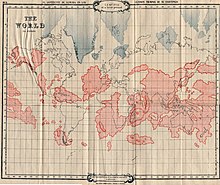 "Lemuria" entered the lexicon of the occult through the works of Helena Blavatsky, who claimed that the Mahatmas had shown her an ancient, pre-Atlantean Book of Dzyan. Lemuria is mentioned in one of the 1882 Mahatma Letters to A. P. Sinnett.[8] According to L. Sprague de Camp, Blavatsky's concept of Lemuria was influenced by other contemporaneous writers on the theme of lost continents, notably Ignatius L. Donnelly, American cult leader Thomas Lake Harris and the French writer Louis Jacolliot.[9]Map of Lemuria superimposed over the modern continents from Scott-Elliott's The Story of Atlantis and Lost Lemuria.
Within Blavatsky's complex cosmology, which includes seven "Root Races", the "Third Root Race" occupied Lemuria. She describes them as about 7 feet (2.1 m) tall, sexually hermaphroditic, egg-laying, mentally undeveloped and spiritually more pure than the following "Root Races". Before the coming of the Lemurians, the second "Root Race" is said to have dwelled in Hyperborea. After the subsequent creation of mammals, Mme Blavatsky revealed to her readers, some Lemurians turned to bestiality. The gods, aghast at the behavior of these "mindless" men, sank Lemuria into the ocean and created a "Fourth Root Race" – endowed with intellect – on Atlantis.[citation needed]
The later theosophical author William Scott-Elliot gave one of the most elaborate accounts of lost continents. The English theosophist received his knowledge from Charles Webster Leadbeater, who communicated with the Theosophical Masters by "astral clairvoyance".[10] In 1896 he published The Story of Atlantis, followed in 1904 by The Lost Lemuria, in which he included a map of the continent of Lemuria as stretching from the east coast of Africa across the Indian and the Pacific Oceans.[11]
James Bramwell portrayed Lemuria in his book, Lost Atlantis, as "a continent that occupied a large part of what is now the South Pacific Ocean".[12] He described the people of Lemuria in detail and characterised them as one of the "root-races of humanity". According to Bramwell, Lemurians are the ancestors of the Atlanteans, who survived the period "of the general racial decadence which affected the Lemurians in the last stages of their evolution". From "a select division of" the Atlanteans – after their promotion to decadence – Bramwell claims the Aryan race arose. "Lemurians, Atlanteans, and Aryans are root-races of humanity", according to Bramwell.[13]
Lemuria and Mount Shasta
In 1894, Frederick Spencer Oliver published A Dweller on Two Planets, which claimed that survivors from a sunken continent called Lemuria were living in or on Mount Shasta in northern California. Oliver claimed the Lemurians lived in a complex of tunnels beneath the mountain and occasionally were seen walking the surface dressed in white robes.
In 1931 Harvey Spencer Lewis using the pseudonym Wisar Spenle Cerve[14] wrote a book (published by the Rosicrucians) about the hidden Lemurians of Mount Shasta that a bibliography on Mount Shasta described as "responsible for the legend's widespread popularity."[15] This belief has since been repeated by Guy Warren Ballard, followers of the Ascended Masters and the Great White Brotherhood, and Bridge to Freedom, The Summit Lighthouse, Church Universal and Triumphant, and Kryon.[citation needed]
Kumari Kandam and Lemuria
 Some Tamil writers such as Devaneya Pavanar have tried to associate Lemuria with Kumari Kandam, a legendary sunken landmass mentioned in the Tamil literature, claiming that it was the cradle of civilization."Lemuria" in Tamil nationalist mysticist literature, connecting Madagascar, South India and Australia (covering most of the Indian Ocean).
In popular culture
Main article: Lemuria in popular cultureSee also
- Atlantis
- Doggerland
- Evolution of lemurs, primate from Madagascar
- Kumari Kandam
- Lost city
- Legends of Mount Shasta
- Mauritia (microcontinent)
- Mu (lost continent)
- Phantom island
- Ramtha
- Jane Roberts
- Thule
References
- OED


- Meisse, William C. (1993). Mount Shasta: an annotated bibliography. College of the Siskiyous. p. 146.
Further reading
- Ramaswamy, Sumathi (2004). The Lost Land of Lemuria: Fabulous Geographies, Catastrophic Histories. University of California Press. ISBN 0-520-24032-4.
- Ramaswamy, Sumathi. (1999). "Catastrophic Cartographies: Mapping the Lost Continent of Lemuria". Representations. 67: 92-129.
- Ramaswamy, Sumathi. (2000). "History at Land’s End: Lemuria in Tamil Spatial Fables". Journal of Asian Studies. 59(3): 575-602.
- Frederick Spencer Oliver, A Dweller on Two Planets, 1905
External links
|
|||||||||||||||||||||||||||||||||||||


Madame Blavatsky's lost-continent doctrine seems to be based largely on the works of Donnelly, Harris and Jacolliot
- end quote from Wikipedia.So, in the end we are left with many many people expressing their opinions. However, you and I have to make up our minds which opinions or not which we believe.I remember being upset as a young man because then the big deal was either believing in Darwinism or believing in Creationism. I felt torn apart by this because my parents even though my father was also very scientific because he was an Electrical Contractor and thought a great deal of Nicola Tesla he also believed in Creationism to some degree.So, because he was a valedictorian of his High School class and very capable of debate to a fine degree I was having trouble reconciling creationism with darwinism around 1966 to 1969, especially when I went into a Social Science class and I telepathically realized that most people in this class believed in Darwinism whether or not they also believed in God or not.So, at the time this upset me a lot. But, by age 21 I decided that both Creationism and Darwinism were theories and not laws so I didn't need to believe in either of them but just to think of them as theories as such not really proven fully yet.This is where I have been ever since. It has helped me a lot because I find in life around the world multiple realities. What I mean by this is that there are competing belief systems around the world and ones survival often is based while traveling of acting like whatever belief systems are in place are the ones you either are putting up with or believing in too. Otherwise people might kill you there.So, it is better to hold your beliefs close to your chest and not reveal them necessarily while traveling the whole world because you are more likely to stay alive that way.So, only the people you trust with your life do you reveal most of your truths too.This is also one reason why I use intuitivefred888 instead of my full name and address here at this blog site because I see it as much safer while I explore everything I find interesting on earth and beyond.So, this can be a logical and scientific search for truth that we all are sharing every day. While we try to make sense (each of us) of a very very very mysterious universe. So mysterious that we still know likely less than 1% to 3% that we need to know as humans here on earth if we wish to travel to other planets and solar systems.So, learning is important and testing our ideas and theories is also important and question other peoples ideas and our own is also important or we all stay like ostriches with our heads in the sand and all go extinct together.
No comments:
Post a Comment