A much more readable rendition of machine language, called assembly language, uses mnemonic codes to refer to ...
Machine code
From Wikipedia, the free encyclopedia
Machine code or
machine language is a set of
instructions executed directly by a
computer's
central processing unit (CPU). Each instruction performs a very specific task, such as a load, a
jump, or an
ALU operation on a unit of data in a
CPU register or memory. Every program directly executed by a CPU is made up of a series of such instructions.
Numerical machine code (i.e., not
assembly code) may be regarded as the lowest-level representation of a
compiled or
assembled computer program or as a primitive and
hardware-dependent
programming language.
While it is possible to write programs directly in numerical machine
code, it is tedious and error prone to manage individual bits and
calculate numerical addresses and constants manually. It is thus rarely
done today, except for situations that require extreme optimization or
debugging.
Almost all practical programs today are written in higher-level languages or
assembly language and translated to executable machine code by utilities such as
compilers,
assemblers and
linkers. Programs in
interpreted languages[1] are not translated into machine code although their
interpreter
(which may be seen as an executor or processor) typically consists of
directly executable machine code (generated from assembly or high level
language source code).
Machine code instructions
Every processor or
processor family has its own machine code
instruction set. Instructions are patterns of
bits
that by physical design correspond to different commands to the
machine. Thus, the instruction set is specific to a class of processors
using (mostly) the same architecture. Successor or derivative processor
designs often include all the instructions of a predecessor and may add
additional instructions. Occasionally, a successor design will
discontinue or alter the meaning of some instruction code (typically
because it is needed for new purposes), affecting code compatibility to
some extent; even nearly completely compatible processors may show
slightly different behavior for some instructions, but this is rarely a
problem. Systems may also differ in other details, such as memory
arrangement,
operating systems, or
peripheral devices.
Because a program normally relies on such factors, different systems
will typically not run the same machine code, even when the same type of
processor is used.
A machine code instruction set may have all instructions of the same
length, or it may have variable-length instructions. How the patterns
are organized varies strongly with the particular architecture and often
also with the type of instruction. Most instructions have one or more
opcode fields which specifies the basic instruction type (such as arithmetic, logical,
jump, etc.) and the actual operation (such as add or compare) and other fields that may give the type of the
operand(s), the
addressing mode(s),
the addressing offset(s) or index, or the actual value itself (such
constant operands contained in an instruction are called
immediates).
[2]
Not all machines or individual instructions have explicit operands. An
accumulator machine
has a combined left operand and result in an implicit accumulator for
most arithmetic instructions. Other architectures (such as 8086 and the
x86-family) have accumulator versions of common instructions, with the
accumulator regarded as one of the general registers by longer
instructions. A
stack machine
has most or all of its operands on an implicit stack. Special purpose
instructions also often lack explicit operands (CPUID in the x86
architecture writes values into four implicit destination registers, for
instance). This distinction between explicit and implicit operands is
important in machine code generators, especially in the register
allocation and live range tracking parts. A good code optimizer can
track implicit as well as explicit operands which may allow more
frequent
constant propagation,
constant folding
of registers (a register assigned the result of a constant expression
freed up by replacing it by that constant) and other code enhancements.
Programs
A computer program is a sequence of instructions that are executed by
a CPU. While simple processors execute instructions one after another,
superscalar processors are capable of executing several instructions at once.
Program flow
may be influenced by special 'jump' instructions that transfer
execution to an instruction other than the numerically following one.
Conditional jumps
are taken (execution continues at another address) or not (execution
continues at the next instruction) depending on some condition.
Assembly languages
A much more readable rendition of machine language, called
assembly language, uses
mnemonic codes to refer to machine code instructions, rather than using the instructions' numeric values directly. For example, on the
Zilog Z80 processor, the machine code
00000101, which causes the CPU to decrement the
B processor register, would be represented in assembly language as
DEC B.
Example
The
MIPS instruction set
provides a specific example for a machine code whose instructions are
always 32 bits long. The general type of instruction is given by the
op (operation) field, the highest 6 bits. J-type (jump) and I-type (immediate) instructions are fully specified by
op. R-type (register) instructions include an additional field
funct to determine the exact operation. The fields used in these types are:
   6      5     5     5     5      6 bits
[  op  |  rs |  rt |  rd |shamt| funct]  R-type
[  op  |  rs |  rt | address/immediate]  I-type
[  op  |        target address        ]  J-type
rs,
rt, and
rd indicate register operands;
shamt gives a shift amount; and the
address or
immediate fields contain an operand directly.
For example, adding the registers 1 and 2 and placing the result in register 6 is encoded:
[  op  |  rs |  rt |  rd |shamt| funct]
    0     1     2     6     0     32     decimal
 000000 00001 00010 00110 00000 100000   binary
Load a value into register 8, taken from the memory cell 68 cells after the location listed in register 3:
[  op  |  rs |  rt | address/immediate]
   35     3     8           68           decimal
 100011 00011 01000 00000 00001 000100   binary
Jumping to the address 1024:
[  op  |        target address        ]
    2                 1024               decimal
 000010 00000 00000 00000 10000 000000   binary
Relationship to microcode
In some
computer architectures, the machine code is implemented by a more fundamental underlying layer of programs called
microprograms,
providing a common machine language interface across a line or family
of different models of computer with widely different underlying
dataflows. This is done to facilitate
porting of machine language programs between different models. An example of this use is the IBM
System/360
family of computers and their successors. With dataflow path widths of 8
bits to 64 bits and beyond, they nevertheless present a common
architecture at the machine language level across the entire line.
Using a
microcode layer to implement an
emulator
enables the computer to present the architecture of an entirely
different computer. The System/360 line used this to allow porting
programs from earlier IBM machines to the new family of computers, e.g.
an
IBM 1401/1440/1460 emulator on the IBM S/360 model 40.
Relationship to bytecode
Machine code should not be confused with so-called "
bytecode" (or the older term
p-code),
which is either executed by an interpreter or itself compiled into
machine code for faster (direct) execution. Machine code and assembly
code are sometimes called
native code when referring to platform-dependent parts of language features or libraries.
[3]
Storing in memory
The
Harvard architecture is a computer architecture with physically separate storage and signal pathways for the code (instructions) and
data. Today, most processors implement such separate signal pathways for performance reasons but actually implement a
Modified Harvard architecture,
[citation needed] so they can support tasks like loading an
executable program from
disk storage as data and then executing it. Harvard architecture is contrasted to the
Von Neumann architecture, where data and code are stored in the same memory which is read by the processor allowing the computer to execute commands.
From the point of view of a
process, the
code space is the part of its
address space where the code in execution is stored. In
multitasking systems this comprises the program's
code segment and usually
shared libraries. In
multi-threading environment, different threads of one process share code space along with data space, which reduces the overhead of
context switching considerably as compared to process switching.
Readability by humans
It has been said that machine code is so unreadable that the
United States Copyright Office cannot identify whether a particular encoded program is an original work of authorship;
[4] however, the US Copyright Office
does allow for copyright registration of computer programs.
[5] Douglas Hofstadter compares machine code with the
genetic code: "Looking at a program written in machine language is vaguely comparable to looking at a
DNA molecule atom by atom."
[6]
See also
Notes and references
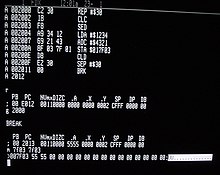 Machine code or machine language is a set of instructions executed directly by a computer's central processing unit (CPU). Each instruction performs a very specific task, such as a load, a jump, or an ALU operation on a unit of data in a CPU register or memory. Every program directly executed by a CPU is made up of a series of such instructions.Machine language monitor in a W65C816S single-board computer, displaying code disassembly, as well as processor register and memory dumps.

No comments:
Post a Comment