To the best of my ability I write about my experience of the Universe Past, Present and Future
Sunday, April 30, 2017
Mastodon Bone Findings Could Upend Our Understanding of Human History
My daughter was asking if human time travel is changing human history as more people go back in time and do things like Hunt mastodons and other adventures? Just like the modern day tennis shoes found in a Mummy site recently I believe from 13,000 years ago?
3 days ago ... A mastodon carcass from 130000 years old suggests that humans were in America tens of thousands of years before the history books say they ...
Mastodon Bone Findings Could Upend Our Understanding of Human History
byMaggie Fox
Mastodon Bones Could Rewrite North American History0:30
Paleontologists have dug up a 130,000-year-old
mastodon skeleton that looks like it was smashed apart by humans. But
they found it in America, where people were not supposed to have arrived
for another 100,000 years.
How could that have happened?
The researchers say they think early humans
must have come to America much, much earlier than anyone ever thought.
They suggest that other scientists start looking for evidence of people
in places they never bothered looking before.
San
Diego Natural History Museum Paleontologist Don Swanson pointing at
rock fragment near a large horizontal mastodon tusk fragment. San Diego Natural History Museum
If the conclusions are confirmed, they will turn North American archaeology upside down.
"I know people will be skeptical of this
because it is so surprising and I was skeptical when I first looked at
the material itself. But it's definitely an archaeological site," said
Steven Holen of the Center for American Paleolithic Research in South
Dakota.
The site includes a skeleton that looks like
it was taken apart and broken with stone tools, which are left in place
alongside the bones they smashed. One tusk appears to have been stuck
upright into the ground.
"It appears to be impossible that a mastodon
could somehow force its own tusk into the underlying deposits," the
research team noted in their report, published in the journal Nature. Related: DNA Links Ancient Americans to their Living Descendants
The only reasonable explanation, they say, is that humans did it.
Uranium dating puts the site at around 130,000 years old.
"My first reaction on reading this paper was
'No. This is wrong. Something's wrong,'" said stone tool expert John
McNabb of the University of Southampton in Britain.
"If it does turn out to be true, it changes absolutely everything."
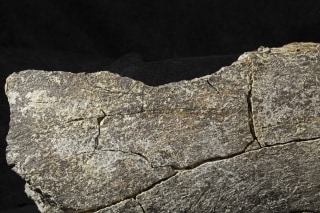
The surface of mastodon bone showing half impact notch on a segment of femur. Tom Dem?r? / San Diego Natural History Museum
Current wisdom holds that modern humans
arrived in the Americas no earlier than about 15,000 years ago. The
oldest widely accepted site for the first Americans dates to just 13,000
years ago.
The main theory is that people crossed a land
bridge across the Bering Strait between modern-day Alaska and Siberia
during the last Ice Age, when sea levels were lower, and then migrated
down the west coast. Related: DNA Points to Prehistoric Hanky-Panky
Some other researchers have challenged this idea, but their findings are hotly disputed.
If the San Diego finding holds up, it likely
means that Homo erectus, Neanderthals or a related early human species,
the Denisovans, crossed much, much earlier. They could have crossed on
foot during a previous Ice Age much earlier than 130,000 years ago, the
researchers say, or come by boat.
It's slightly possible that modern humans made
the crossing, the researchers say. But no human remains were found at
the site, so it's impossible to say who butchered the mastodon.
"This discovery is rewriting our understanding
of when humans reached the New World," Judy Gradwohl, president and CEO
of the San Diego Natural History Museum, said in a statement.
The site was first found in 1992 when road
crews were putting up a sound berm — a wall of dirt to quiet traffic
noise — along State Route 54 near San Diego. Paleontologists carefully
excavated the mastodon skeleton, along with large, oddly-shaped rocks
and the bones of other extinct animals such as dire wolf, horse, camel,
mammoth and ground sloth.
They also got a good estimate of how old the site is.
What's now a busy road was a stream bed
130,000 years ago, the researchers said. "It was a meandering stream
close to sea level," Thomas Deméré of the San Diego Natural History
Museum told reporters in a conference call.
"It was a very nice place to live, I would think, 130,000 years ago — not far from the coastline." Related: 400,000-Year-Old Human DNA Adds to Tangled Knowledge
The smash patterns on the mastodon bones and
the stones left nearby look as if humans used the stones as tools to
break apart bone to use for more tools, and perhaps to get at the
nutritious bone marrow inside the large leg bones, the research team
said.
Strangely, it does not look like they cut meat off the bones -- something that gives pause to experts like McNabb.
Most of the site was preserved under many feet
of dirt and the Natural History Museum team carefully excavated and
examined it by hand, documenting where each piece was and saving samples
of dirt and rock alongside the bones and big stones.
It was not until years later that Holen and
colleagues, looking for just this kind of evidence, set out to see if
humans may have been at work at the ancient site.
"Of course, extraordinary claims like this require extraordinary evidence," said Deméré.
The team believes they have assembled just such evidence.
They got together experts in dating ancient geological deposits and
bones. They compared the stones to stone tools from the same period in
other, better documented sites in Africa. They looked at various other
mastodon carcasses to see if natural processes could have broken and
spread the bones in the same patterns. Related: First Americans Mays Have Been Stuck in Snow for Millennia
They made their own stone tools and smashed
elephant bones to see if it was even possible to do it, and to see if
the smashed bones looked the same. They ruled out the possibility that
scavenging animals broke the bones apart or that the trucks at the road
site could have done the damage.
Unbroken
mastodon ribs and vertebrae, including one vertebra with a large
well-preserved neural spine found in excavation unit J4. San Diego Natural History Museum
The geology of the site strongly suggests it
was buried gently, with fine-grained silt covering the bones and stones,
leaving them undisturbed for tens of thousands of years.
"These patterns, taken together, have led us
to the conclusion that humans were processing mastodon limb bones … and
that this was occurring at the site of burial … 130,000 years ago,"
Deméré said.
James Paces, a geologist with the U.S.
Geological Survey, used radiometric dating methods to determine that the
mastodon bones were 130,000 years old. "We believe we have a robust,
defensible age," he said.
"The dates are truly remarkable," said
University of Wollongong archaeologist Richard Fullagar, part of the
study team. "But it's hard to argue with the clear and remarkable
evidence that we can see in all of this material."
Common wisdom holds that the first Americans
didn't arrive until 13,000 years ago in what's called the Clovis
culture, named after a site in New Mexico where distinctive stone tools
were found in the 1920s.
There are other sites in the Americas that
have been dated to before 13,000 years ago, but there is debate about
the conclusions. DNA evidence suggests that humans were in the Americas long before even 15,000 years ago, but there is no physical evidence to support the idea. Related: Underwater Site Shows 15,000-Year-Old Floridians
And the archaeology mainstream is very
unforgiving of researchers who challenge the accepted dates, said Al
Goodyear of the University of South Carolina, who's been working to
prove for years that stone tools found in a South Carolina site date to
as long as 50,000 years ago.
"There is a lot of ignorance and arrogance
about just how little we know about the Western hemisphere," said
Goodyear, who was not involved in the San Diego discovery.
"These things are very controversial." But Goodyear says the San Diego team's evidence is compelling.
"I think they've done their homework," he
said, noting that Holen is one of the world's leading experts on what
mastodon bones look like when they are broken naturally versus when they
are smashed open by humans.
"I think these sites are a wake up call to the profession," Goodyear added.
Now the researchers want paleontologists and
archaeologists to take another look at ancient sites to see if they can
find any evidence of human activity. It won't be easy — ancient human
remains are notoriously difficult to find.
They also invite other scientists to examine
and question their findings. That's how scientists work — by publicizing
discoveries and theories and inviting their rivals to pick them apart.
With enough evidence, that's how common beliefs are changed.
"Well, maybe it's not completely impossible," McNabb said.
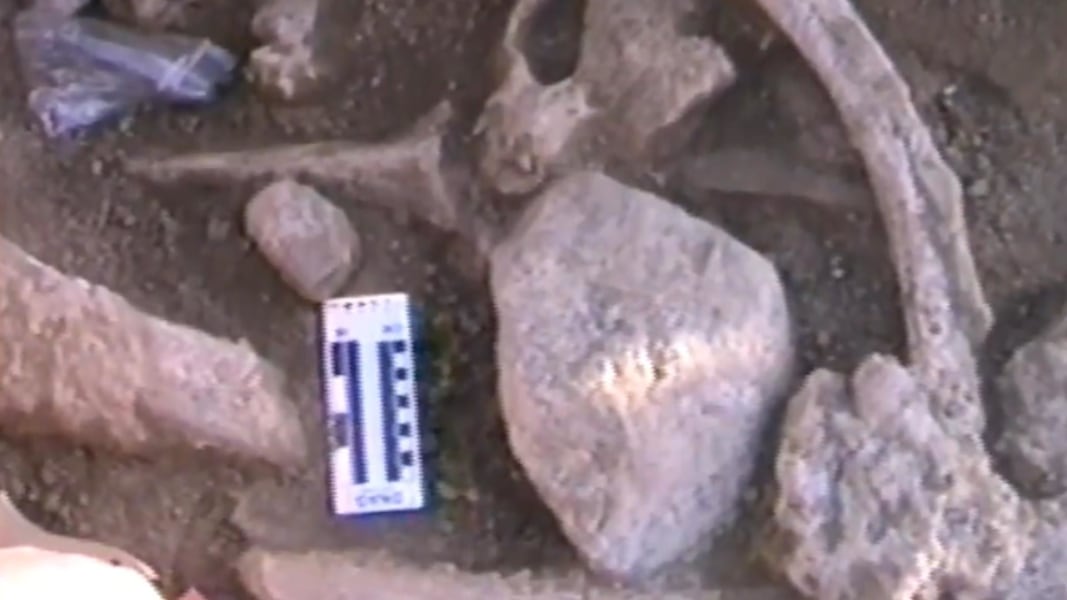 Paleontologists have dug up a 130,000-year-old mastodon skeleton that looks like it was smashed apart by humans. But they found it in America, where people were not supposed to have arrived for another 100,000 years.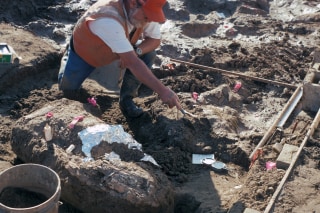


No comments:
Post a Comment