Krishna and Arjuna - Summary of the Bhagavad-Gita - AwesomeStories
https://www.awesomestories.com/.../Krishna-and-Arjuna-Summary-of-the-Bhagavad-...
Apr 13, 2016 - As
the Bhagavad-Gita begins, in Chapter 1, a blind King—called
Dhritarashtra—asks Sanjaya, his secretary, to tell him what happens in a
battle between his sons (the Kauravas) and their cousins (the
Pandavas).
Arjuna - Wikipedia
https://en.wikipedia.org/wiki/Arjuna
Arjuna (in Devanagari: अर्जुन arjuna) along with Krishna is the protagonist of the ancient Indian epic Mahabharata and plays a key role in the Bhagavad Gita ...
People also ask
The Bhagavad Gita's Story of Arjuna & Krishna: The Three Paths to ...
study.com/.../the-bhagavad-gitas-story-of-arjuna-krishna-the-three-paths-to-salvation....



Krishna and Arjuna - Summary of the Bhagavad-Gita
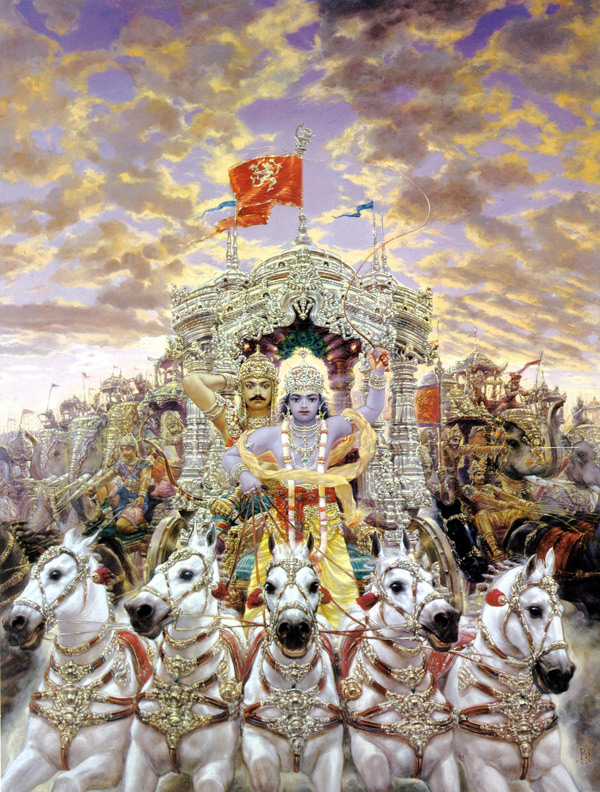
As the Bhagavad-Gita begins, in Chapter 1, a blind
King—called Dhritarashtra—asks Sanjaya, his secretary, to tell him what
happens in a battle between his sons (the Kauravas) and their cousins
(the Pandavas).
Arjuna, a Pandava Prince, is preparing for the battle at Kurukshetra (in today’s northern India). Krishna (in Hindu belief the Supreme Personality of the Godhead) agrees to be Arjuna’s charioteer. Taking up his bow, and preparing to fight, Arjuna sees Dhritarashtra’s sons who are also preparing to do battle.
Arjuna realizes that these friends and near-relatives will be his battle opponents.
Krishna, adhering to Arjuna’s wishes, drives the chariot in between the two fighting forces. When he is between both armies, Arjuna becomes very upset. With his mind reeling, he foresees not just a battle between people who know each other, he also foresees the imminent death of people who are (or have been) close to him: his teachers; his relatives; his friends.
Throwing down his bow and his arrows, Arjuna decides he will not participate in this battle. He will not fight this day (or any other) if the battle requires him to fight against such people.
All of those events occur, however, before Arjuna realizes the true nature of his charioteer. He recognizes that Krishna is very knowledgeable about life, but he doesn’t know that Krishna is an avatar for Vishnu (a supreme being in Hindu religious teachings).
Once Krishna has shown Arjuna his four-armed and universal forms, the Pandava Prince is stunned at the power of his charioteer. Far more than a man of knowledge, Krishna is all-powerful. Not only does he hold the reins of Arjuna’s chariot, he holds the reins of the entire universe.
He is not just a leader, he is the Supreme Being whom Arjuna should not just respect but should worship. All of this fundamentally changes Arjuna’s perspective.
Initially, the Prince put-down his bow and arrows because he thought it would be sinful to battle his friends, teachers and near-relatives. After seeing Krishna’s universal form, and understanding Krishna's teachings, Arjuna realizes that Krishna would not encourage him to fight if engaging in this battle would result in sinful actions.
Arjuna has learned something else. A person can only know Krishna by surrendering to him in devotional service. In chapter 18 of the Bhagavad-Gita, Krishna tells Arjuna (in English translation):
As Sanjaya relates all of this to King Dhritarashtra, the secretary predicts that Arjuna will win. Not only is the Padavan Prince a supremely good archer, Arjuna has surrendered himself to Krishna. Under such circumstances, how could he lose?
Sanjaya’s prediction comes true. On this day, and in this battle, Arjuna and his side prevails.
Without the support of Krishna, Arjuna could not face the battle at Kurukshetra. With Krishna by his side, and driving his chariot, Arjuna can do more than fight in battle—he can live his life in a much better way.
Click on the image for a full-page view.
end quote.
Was Arjuna right to throw down his bow and arrows when he saw his relatives he was going to have to fight?
Of course because he thought killing his relatives would be a sin.
But, was he also right to proceed at Krishna's direction once he realized that Krishna was the God of the universe in physical form?
This I think each of you have to answer for yourselves.
Arjuna, a Pandava Prince, is preparing for the battle at Kurukshetra (in today’s northern India). Krishna (in Hindu belief the Supreme Personality of the Godhead) agrees to be Arjuna’s charioteer. Taking up his bow, and preparing to fight, Arjuna sees Dhritarashtra’s sons who are also preparing to do battle.
Arjuna realizes that these friends and near-relatives will be his battle opponents.
Krishna, adhering to Arjuna’s wishes, drives the chariot in between the two fighting forces. When he is between both armies, Arjuna becomes very upset. With his mind reeling, he foresees not just a battle between people who know each other, he also foresees the imminent death of people who are (or have been) close to him: his teachers; his relatives; his friends.
Throwing down his bow and his arrows, Arjuna decides he will not participate in this battle. He will not fight this day (or any other) if the battle requires him to fight against such people.
All of those events occur, however, before Arjuna realizes the true nature of his charioteer. He recognizes that Krishna is very knowledgeable about life, but he doesn’t know that Krishna is an avatar for Vishnu (a supreme being in Hindu religious teachings).
Once Krishna has shown Arjuna his four-armed and universal forms, the Pandava Prince is stunned at the power of his charioteer. Far more than a man of knowledge, Krishna is all-powerful. Not only does he hold the reins of Arjuna’s chariot, he holds the reins of the entire universe.
He is not just a leader, he is the Supreme Being whom Arjuna should not just respect but should worship. All of this fundamentally changes Arjuna’s perspective.
Initially, the Prince put-down his bow and arrows because he thought it would be sinful to battle his friends, teachers and near-relatives. After seeing Krishna’s universal form, and understanding Krishna's teachings, Arjuna realizes that Krishna would not encourage him to fight if engaging in this battle would result in sinful actions.
Arjuna has learned something else. A person can only know Krishna by surrendering to him in devotional service. In chapter 18 of the Bhagavad-Gita, Krishna tells Arjuna (in English translation):
Become My devotee, always think of Me, act for Me, worship Me, and offer all homage unto Me. Surrender unto Me alone. Do not fear sinful reactions.Hearing all of this, how could Arjuna do anything but fight? He retrieves his bow and arrows and engages his military opposition.
As Sanjaya relates all of this to King Dhritarashtra, the secretary predicts that Arjuna will win. Not only is the Padavan Prince a supremely good archer, Arjuna has surrendered himself to Krishna. Under such circumstances, how could he lose?
Sanjaya’s prediction comes true. On this day, and in this battle, Arjuna and his side prevails.
Without the support of Krishna, Arjuna could not face the battle at Kurukshetra. With Krishna by his side, and driving his chariot, Arjuna can do more than fight in battle—he can live his life in a much better way.
Click on the image for a full-page view.
end quote.
Was Arjuna right to throw down his bow and arrows when he saw his relatives he was going to have to fight?
Of course because he thought killing his relatives would be a sin.
But, was he also right to proceed at Krishna's direction once he realized that Krishna was the God of the universe in physical form?
This I think each of you have to answer for yourselves.
No comments:
Post a Comment