begin quote from:
https://www.cnn.com/2023/07/25/world/gulf-stream-atlantic-current-collapse-climate-scn-intl/index.html
A crucial system of ocean currents is heading for a collapse that ‘would affect every person on the planet’













A vital system of ocean currents could collapse within a few decades if the world continues to pump out planet-heating pollution, scientists are warning – an event that would be catastrophic for global weather and “affect every person on the planet.”

A new study published Tuesday in the journal Nature, found that the Atlantic Meridional Overturning Current – of which the Gulf Stream is a part – could collapse around the middle of the century, or even as early as 2025.
Scientists uninvolved with this study told CNN the exact tipping point for the critical system is uncertain, and that measurements of the currents have so far showed little trend or change. But they agreed these results are alarming and provide new evidence that the tipping point could occur sooner than previously thought.
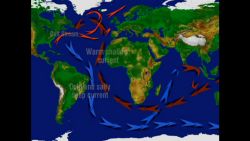
The AMOC is a complex tangle of currents that works like a giant global conveyor belt. It transports warm water from the tropics toward the North Atlantic, where the water cools, becomes saltier and sinks deep into the ocean, before spreading southwards.
It plays a crucial role in the climate system, helping regulate global weather patterns. Its collapse would have enormous implications, including much more extreme winters and sea level rises affecting parts of Europe and the US, and a shifting of the monsoon in the tropics.
For years, scientists have been warning of its instability as the climate crisis accelerates, threatening to upset the balance of temperature and salinity on which the strength of these currents depend.
As the oceans heat up and ice melts, more freshwater flows into the ocean and reduces the water’s density, making it less able to sink. When waters become too fresh, too warm or both, the conveyor belt stops.
It has happened before. More than 12,000 years ago, rapid glacier melt caused the AMOC to shut down, leading to huge Northern Hemisphere temperature fluctuations of 10 to 15 degrees Celsius (18 to 27 Fahrenheit) within a decade.
A shutdown “would affect every person on the planet – it’s that big and important,” said Peter de Menocal, the president of the Woods Hole Oceanographic Institution, who was not involved in the study.
A 2019 report by the UN’s Intergovernmental Panel on Climate Change predicted that the AMOC would weaken over this century, but that its full collapse before 2100 was unlikely.
This new study comes to a much more alarming conclusion.

As the AMOC has only been continuously monitored since 2004, the study authors looked to a much larger dataset, and one which could show how the currents behaved in a period without human-caused climate change.
“We needed to go back in time,” said Peter Ditlevsen, a professor of climate physics at the University of Copenhagen and one of the authors of the report. The scientists analyzed sea surface temperatures in the North Atlantic in an area south of Greenland over a period of 150 years between 1870 and 2020.
This part of the ocean is warmed by the water transported north from the tropics by the AMOC, Ditlevsen said, “so if it cools, it’s because the AMOC is weakening.” The authors then subtracted the impacts of human-caused global warming on the water temperature to understand how the currents were changing.
They found “early warning signals” of critical changes in the AMOC, which led them to predict “with high confidence” that it could shut down or collapse as early as 2025 and no later than 2095. The likeliest point of collapse is somewhere between 2039 and 2070, Ditlevsen said.
“It’s really scary,” he told CNN. “This is not something you would lightly put into papers,” he said, adding, “we’re very confident that this is a robust result.”
De Menocal said the study results were “both surprising and alarming.”
It’s been clear for a while that the AMOC will weaken in the coming decades, he told CNN. In 2021, a study found the AMOC was showing signs of instability due to climate change.
But until now, we haven’t had a time frame.
The new study “provides a novel analysis that focuses on when the AMOC tipping point will occur,” de Menocal said, and the study’s prediction the collapse will occur around 2050 “is alarmingly soon given the globally disruptive impact of such an event.” Although, he added, it is important to note that there is no observational evidence yet that the AMOC is collapsing.
Stefan Rahmstorf, professor of physics of the oceans at the University of Potsdam in Germany, who was also not involved in the study, said the research helps bolster previous research.
“There is still large uncertainty where the tipping point of the AMOC is, but the new study adds to the evidence that it is much closer than we thought just a few years ago,” he told CNN. “The scientific evidence now is that we can’t even rule out crossing a tipping point already in the next decade or two.”
The report calls for fast and effective measures to cut planet-heating pollution to zero, to reduce global temperatures and slow melting in the Arctic.
“The key point of this study is that we don’t have much time at all to do this,” de Menocal said. “And the stakes just got higher.”
No comments:
Post a Comment