BEGIN QUOTE FROM:
https://www.cnn.com/2021/01/21/success/self-driving-car-technology-2021/index.html
The real self-driving revolution remains years away

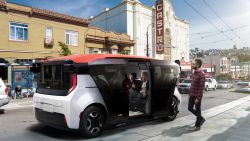
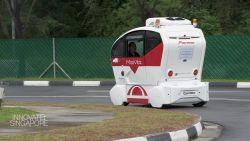
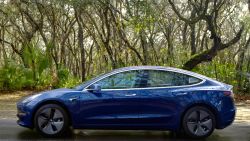
This year, new technologies will enable more drivers to take their hands off the wheel while on the road. But that doesn’t mean their cars will be fully self-driving – that day still remains far in the future.
Automakers like General Motors (GM), Ford (F) and Stellantis (the company formed in the recent merger of Fiat Chrysler and Groupe PSA) are introducing – or upgrading existing – technologies that allow drivers to completely take their hands off the steering wheel and pull their feet away from the pedals for long stretches of time. But these systems will still be limited in their capabilities.
Drivers will still be required to pay constant attention to the road, for instance. In the words of automated driving experts, these systems are “feet off” and “hands off,” but they will not be “eyes off” or “mind off.”
For the time being, these systems will only be used on limited-access divided highways with on-ramps and off-ramps. On these roadways, there are no pedestrians, bicyclists, or double parked trucks. Vehicles with this technology will be able to drive at relatively high speeds, but only in simple traffic situations.
Bryan Reimer, a transportation researcher with the Massachusetts Institute of Technology’s AgeLab, said it will be decades before people can buy truly self-driving cars in which humans ride solely as passengers.
Until then, people will experience greater levels of “collaborative driving,” in which people still play a critical role by overseeing the computers and machinery operating the vehicle and by driving themselves in complex situations, he said.
Keep your eyes on the road
Still, the technology that will be rolled out by the major automakers this year will do more than most so-called Advanced Driver Assistance Systems, or ADAS, do now.
Tesla’s Autopilot – currently considered one of the most advanced systems – still requires drivers to regularly grasp the steering wheel, even though the car will hold a lane, change lanes and even take highway interchange ramps on its own. Driver assistance systems in cars from other automakers like Mercedes, BMW, Audi and Nissan, also require drivers to regularly grip the steering wheel.
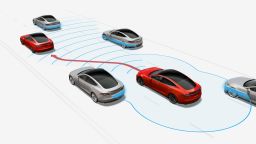
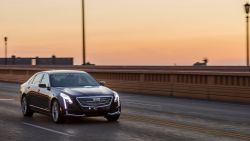
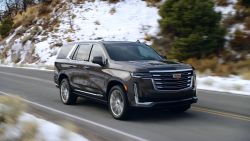
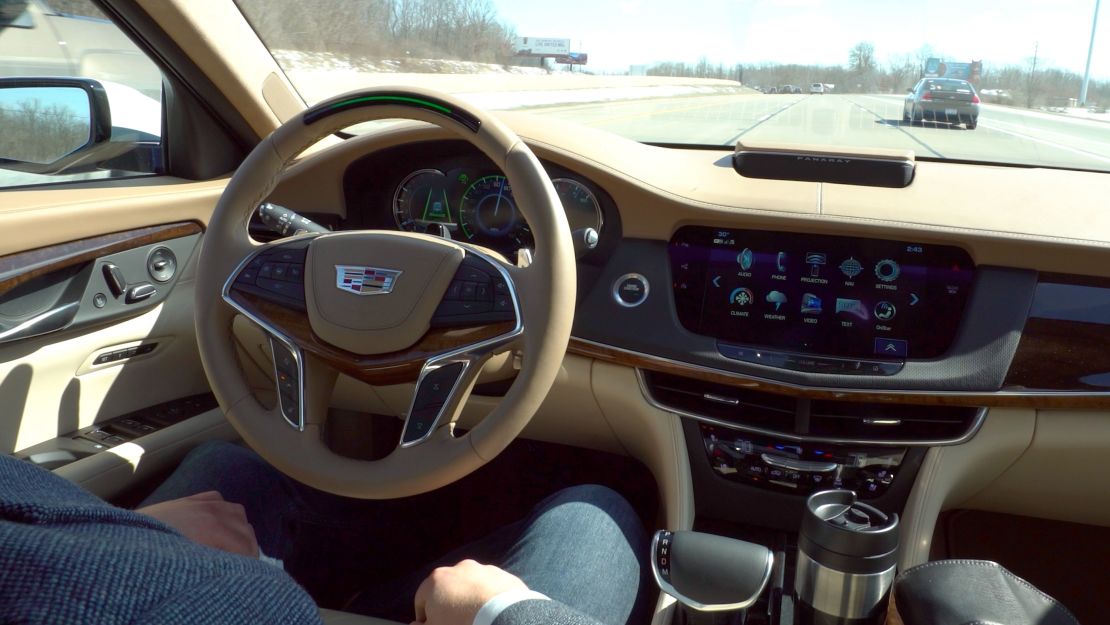
GM’s Super Cruise system allows drivers to completely let go of the steering wheel while driving on selected highways. It was introduced in 2017 on the Cadillac CT6 sedan, which was discontinued last year. An improved version is coming this year on the Cadillac Escalade SUV and the Cadillac CT4 and CT5 sedans.
This new Super Cruise system will handle lane changes on its own when requested by the driver using the turn signal. It will also be easier to turn the system on, according to GM.
Super Cruise only works on highways that have been previously laser-mapped in three dimensions by the company. That detailed 3D map data is combined with “regular” digital maps to allow the vehicles to stay in their lanes even while navigating curves and avoiding other vehicles. GPS positioning and the vehicles’ radar sensors and cameras are used to enable drivers to unhand – and unfoot – all the controls.
Drivers still need to pay attention, however. A camera above the speedometer and tachometer makes sure the driver is looking at the road at all times. Or, at least, almost all the time. If the driver looks away from the road for more than a few seconds, the system will stop working.
That’s important because Super Cruise, like other ADAS, isn’t intended to replace a human driver. It’s just supposed to relieve the driver of the mundane tasks of maintaining a lane position and avoiding other cars. But it can be tempting to think the machine has it all under control.
“We’re human. I mean, I’m no longer fully engaged in this,” said MIT’s Reimer. “I’m willing to, you know, perhaps trust the automation a little more than I should until something goes disastrously wrong.”
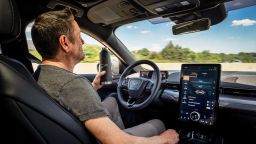
There have been fatal crashes when Tesla drivers ignored warnings to keep their hands on the wheel while using Autopilot. With Super Cruise, Reimer said, GM has done a good job of guarding against driver inattention by requiring that drivers watch the road. Tesla cars do not have the sort of driver monitoring in place.
Consumer Reports has ranked the Super Cruise system as the best and safest of the ADAS they’ve tested, largely because of that driver-facing camera, said Kelly Funkhouser, head of connected and automated vehicles at the consumer group. Tesla’s Autopilot would rank higher than Super Cruise, she said, if Tesla vehicles also directly monitored driver attention.
A similar system, called Active Drive Assist, will be introduced by Ford on the new F-150 and Mustang Mach-E. Stellantis, which makes Jeep vehicles, will offer its own hands-free driving system on the new Jeep Grand Cherokee L later this year. This system also seems like it will operate largely the same way as Super Cruise, although Stellantis is not revealing technical details yet.
Too good to be true?
These hands-free driving systems are probably as close as car buyers will get to a real self-driving vehicle for a long time – despite some automakers’ claims to the contrary, experts say.
Tesla has said it will roll out its Full Self-Driving software in the early part of this year and has been beta testing a version of the software. But Tesla’s claim has been met with skepticism by many. Tesla has blown past several of its self-imposed deadlines before and there are doubts about whether the technology will even be “self-driving.”
“They will oversell their features for sure,” Funkhouser said.
Tesla has claimed that its Full Self-Driving software, which adds capabilities to Autopilot, will allow a vehicle to steer itself even in urban environments.
For now, Tesla still warns that drivers must pay attention at all times while any of its vehicles’ driver assistance systems are operating.
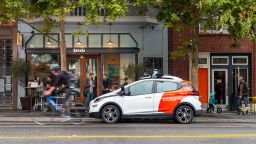
Reimer said the sensors in Tesla’s cars simply will not allow for genuine self-driving in complex environments in the near future. Specifically, Teslas lack the lidar sensors most experts say are needed for a true self-driving car. Lidar bounces laser light off surrounding objects, and times how long the light waves take to return to sensor. In this way, it builds a three-dimensional image of a vehicle’s surroundings moment-by-moment. Radar does the same thing with radio waves, but lidar provides a much more detailed picture.
“To complete the ability, to get what I would call a robust and reliable model of the environment around the vehicle, you would need to add a fourth sensing technology, in addition to cameras, radar and ultrasonics,” said Kay Stepper, senior vice president for automated driving and driver assistance engineering at the auto parts supplier Bosch. “Now [you’d have to add] lidar.”
MIT’s Reimer agrees. Without the accuracy of lidar, it just isn’t possible to completely release humans from the task of driving.
“Doing it successfully nine out of 10 times is probably feasible,” said Reimer. “Doing it reliably enough that I’m willing to walk on the street [with these cars around]? Different story.”
GM and Ford’s hands-free systems do not use lidar sensors, but they still require a human driver to pay attention at all times.
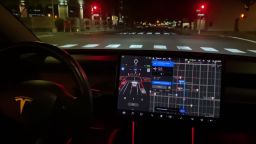
Tesla, which generally does not respond to media inquiries, did not answer emails and calls about its plans for its Full Self-Driving system. Tesla CEO Elon Musk has said in the past, though, that the system will be reliable and safe thanks to advanced artificial intelligence software that has “learned” from the millions of miles driven by Tesla vehicles. With drivers’ permission, Tesla’s self-driving software runs continuously in a background “shadow mode.”
“They will not release an actual full self-driving product for some time, possibly several years, barring major breakthroughs,” Brad Templeton, an autonomous driving industry consultant, said of Tesla. “Even with a major breakthrough they won’t do it this year or next.”
Funkhouser pointed to Tesla’s other recent advancements, such as giving its cars the ability to recognize and respond to stoplights and stop signs. In Consumer Reports’ testing, she said that technology was found to be unreliable, failing to stop at some stop signs and then slamming to a halt needlessly at some yield signs. She expects Full Self-Driving to be something similar.
“So what I have been expecting to see is a little bit more of this gimmicky type of stuff that’s not actually very useful,” she said.
No comments:
Post a Comment