
8:55


Lower classifications.


People also ask
Key Classifying Characteristics:
- Life Cycle: Most undergo metamorphosis from aquatic larvae (gills) to terrestrial adults (lungs, limbs).
Adaptations & Vulnerabilities:
- Land/Water: Adapted to live in both environments, requiring moist habitats.
National Wildlife Federation
National Geographic

Commonwealth of Pennsylvania (.gov)
The Animal Medical Center
Quora
Twinkl
Science News Explores
Wikipedia
Give me examples of amphibians
Explain their dual life cycle
Feedback

Amphibians are ectothermic, anamniotic, four-limbed vertebrate animals that constitute the class Amphibia.
Interactive diagrams
Amphibian
View diagram
Frog Eggs
Feedback

There are about 5,500 known amphibian species, divided into three main groups: salamanders and newts, caecilians, and frogs and toads. The largest amphibian is ...
Videos
8:55
4:22
17:47
Feedback

Amphibians are cold-blooded vertebrates (vertebrates have backbones) that don't have scales. They live part of their lives in water and part on land.

Amphibians are a class of cold-blooded vertebrates made up of frogs, toads, salamanders, newts, and caecilians (wormlike animals with poorly developed eyes).
7:26
Amphibians are usually recognized by their moist sometimes slimy skin which can be smooth or bumpy.
6 key moments in this video


10:47
Amphibians & Reptiles in Winter
1.2K+ views · 1 week ago


KSTP 5 Eyewitness News · YouTube
Twin Cities-based broadcasting company


1:18
Glass
frogs are small, fascinating amphibians known for their translucent
skin, which makes many of their internal organs—like the heart and
intestines—visible through their belly. They belong to the family
Centrolenidae and are mostly found in the rainforests of Central and
South America, especially near streams where they lay their eggs. The
transparency helps them camouflage from predators by blending in with
leaves and light
1.4K+ likes · 6 days ago


didyouknow
Instagram

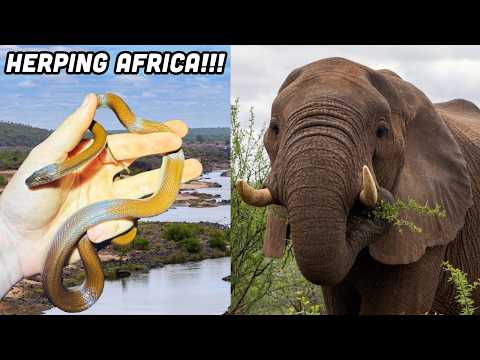
28:24
Herping South Africa! Rubber Frogs, Crocodiles, and Mega Fauna!
18.1K+ views · 1 week ago

NKFherping · YouTube
Amphibian & reptile enthusiast
0:09
No
toads were harmed in the making of this video. 📏
This baby Arizona toad, or toadlet, was measured by ARC Biologists as a
part of our standard procedures for collecting data during wildlife
surveys. But you might be wondering, why does the measurement of a
toadlet matter? Isn’t just knowing that it’s a baby enough?
While it’s always delightful to find the young of any native species
while surveying, knowing the precise measurements of the individuals is
necessary for a number of reasons, like:
1. Some species have known growth rates. Therefore, if we know frogs can
get to be 1 inch in length by the time they’re a year old, depending on
conditions, measuring them can help us estimate their ages and the time
that they hatched.
2. Knowing the season that hatchlings emerged is helpful for
understanding when adults in that region are opting to breed. Are all of
the young we spot in the fall about 6 months old? Well then, we can
investigate more to see if the adults mainly breed in t
22.6K+ likes · 2 weeks ago

arcprotects · Instagram
Amphibian & reptile conservation org


Disturbing amphibian: *Atretochoana eiselti*. Social
media users find the *Atretochoana eiselti* amphibian, with its unusual
appearance, to be quite disturbing and unsettling.
Cane toads: an invasive species. Cane
toads are highlighted as destructive invasive pests in Australia,
threatening native wildlife and causing ecological damage, even death,
to crocodiles.
Identifying frog and toad species. Users
seek help identifying various frog and toad species, with discussions
including new species discoveries and unique characteristics like the
pumpkin toadlet.
Show 3 more

Connecting people around the world by synthesizing and sharing information about amphibians to enable research, education, and conservation.

Amphibians - frogs, toads, salamanders - are a critical part of nature as both predator and prey. Many species of amphibians migrate to new habitat and ...

Most amphibians live their lives in two different stages in two different environments...water and land, first as tadpoles and then as terrestrial adult frogs.
Things to know
Characteristics. What are the characteristics of amphibians?
Classification. What is the scientific classification of amphibians?
Diet. What is the diet of amphibians?
Habitat. What is the habitat of amphibians?
People also ask
Feedback
People also search for
Overview
Amphibians
are ectothermic, anamniotic, four-limbed vertebrate animals that
constitute the class Amphibia. In its broadest sense, it is a
paraphyletic group encompassing all tetrapods, but excluding the
amniotes. Wikipedia
Scientific name: Amphibia
Phylum: Chordata
Class: Amphibia; Gray 1825
Kingdom: Animalia
Clade: Batrachomorpha
Feedback
People also search for


No comments:
Post a Comment