Did Trump comments break the law?











Story highlights
- Donald Trump caused controversy with remarks interpreted by many as a threat of violence against Hillary Clinton
- Danny Cevallos: Comments raise questions about the protections of the First and Second Amendments
Danny Cevallos (@CevallosLaw) is a CNN Legal Analyst and a personal injury and criminal defense attorney practicing in Pennsylvania and the U.S. Virgin Islands. The opinions expressed in this commentary are his.
(CNN)Donald Trump's latest controversial comments
are creating a constitutional stir, raising questions about the
protections of the First and Second Amendments -- and whether a
presidential candidate crossed a legal line.
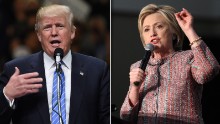
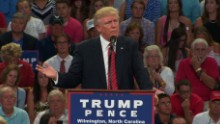
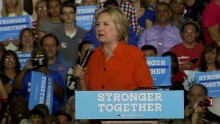
Speaking at an event on Tuesday, Trump said:
"Hillary
wants to abolish -- essentially abolish the Second Amendment. By the
way, if she gets to pick, if she gets to pick her judges, nothing you
can do, folks. Although the Second Amendment people, maybe there is, I
don't know."
Many were quick to
interpret the remarks as an incitement of violence against his
Democratic rival, Hillary Clinton. But were the comments unlawful? Or
just protected political hyperbole?

Danny Cevallos
The
Supreme Court since 1969 has held that the freedoms of speech and press
do not permit the government to criminalize comments by someone who
advocates violence or breaking the law. There are some very important
exceptions to this rule, but encouraging violence may actually be constitutionally protected speech.
In the years since, courts have gone further,
holding that political speech may not be punished "just because it
makes it more likely that someone will be harmed at some unknown time in
the future by an unrelated third party."
It
sounds harsh, but the rationale is this: if the First Amendment
protects speech advocating violence, then the First Amendment must also
at least protect speech that makes violence somewhat more probable.
Scary, but that's our constitution sometimes.
Naturally, there must be limitations on speech advocating violence. Aggressive speech is protected, according to the Supreme Court, unless it "is directed to inciting or producing imminent lawless action and is likely to incite or produce such action."
That's
a helpful exception in theory, but in practice, it doesn't give us a
lot of practical guidance. For starters, what exactly is "imminent"
lawless action? Apparently there's a difference between "Let's riot right now!" and "let's riot...next October!"
"Now"
is immediate, which in turn is "imminent," and not protected. On the
other hand, something happening a year from now is probably not
"imminent." This exercise in absurdity could go on forever -- what about
something in the middle? "Let's riot in a fortnight!" Or something
purely contingent? "Let's riot if -- and only if -- the Phillies win the
World Series!"
"Imminence" is
necessarily a function of the actual language, the surrounding facts,
and the individual courts reviewing these cases.

Next, there's the "directed to" language in the exception;
both must be satisfied to divest speech of its protections. "Directed
to" means speech is designed to induce others to break the law. It's
really a two-part exercise in linguistics: First, look at the speaker,
and whether the utterance was intended as an order or a demand ("go
riot, everyone!"), or if it was just an assertion of fact ("I love
riots!"), or even a question ("should we riot?").
Second,
you have to look at the effect of the utterance on the person who heard
it. The hearer might have thought it was just a persuasive argument
("I now agree riots are good"), or he might have just been scared by the
rhetoric ("I'm leaving; there's going to be a riot"). But he might
also take it as an order to do something ("Okay, I'm convinced. I'll
riot").
So, speech advocating
violence may be protected, unless it is 1) "directed to" inciting 2)
"imminent" unlawful action. If those elements are present -- whatever
those elements actually are -- the speech is no longer protected.
Let's apply these principles to Trump's recent comments.
Start
with the presumption that even speech encouraging violence is presumed
protected, unless it is 1) "directed to" inciting 2) "imminent" unlawful
action.
First, the "directed to"
prong. Is there an order or a request by Trump directing violence?
Only Trump's second sentence could potentially direct anyone to do
anything. Many have understandably interpreted it as encouraging gun
owners to shoot Hillary Clinton.
But
Trump falls far short of giving an order or requesting action; instead,
his words vaguely suggest what others' options are, should certain
events occur. Reasonable minds have already differed on this
interpretation, though. Trump also sprinkles in words like "maybe",
punctuated with a non-committal "I don't know." Also, to conclude the
statement directs violence requires an additional assumption that
"Second Amendment People" only "do" things with their guns, and that's
the only thing they "do."
As much
as critics have a strong argument that Trump was making a not-so-subtle
suggestion, Trump's statement probably does not meet the Supreme Court's
test for "directing" unlawful action.
Yet even assuming Trump's statement was speech encouraging unlawful violence, it might not meet the "imminent" prong,
either. "If [Hillary] gets to pick her judges" can only mean a future
contingent event -- one that is not just uncertain, but that Trump
himself has insisted will not happen. Trump believes more than anyone
that he's "gonna win so big."
Should
Hillary in fact be elected president, the earliest she could "pick her
judges" would be some time well into in 2017. It seems that Trump's
statement could not incite imminent action.
The
exception requires both prongs to apply: It must be directed to
imminent unlawful action. It appears Trump's statement doesn't meet
either.
There's also the fact that it's a federal offense to threaten a president, as well as a presidential candidate. Here courts have also held that only "true" threats will be outside the protections of the First Amendment.
In
one Supreme Court case, a protester was at a public rally in 1966
speaking about his opposition to the Vietnam War and the draft. He was
convicted under a presidential threat statute for saying: "If they ever
make me carry a rifle, the first man I want to get in my sights is
[President Lyndon Johnson]."

The Supreme Court reversed,
holding that the defendant had not made a "true 'threat,'" but had
rather engaged in mere "political hyperbole." Moreover, "debate on
public issues should be uninhibited, robust, and wide-open, and it may
well include vehement, caustic, and sometimes unpleasantly sharp attacks
on government and public officials."
To the court,
the "language of the political arena . . . is often vituperative,
abusive, and inexact, [and that the only crime committed] here was a
kind of very crude offensive method of stating a political opposition to
the President."
Sound familiar?
Perhaps
even more telling is the procedural path this case took: The Supreme
Court reversed where two lower courts had convicted. If nothing else,
even to learned judges, true threats are in the eye of the beholder.
Some legal scholars have observed
that Trump has engaged in "stochastic terrorism," using language and
other forms of communication "to incite random actors to carry out
violent or terrorist acts that are statistically predictable but
individually unpredictable."
It's
scary, and probably true. Speech like this could someday influence some
violence somewhere, especially in the aggregate, with so many other
disparaging comments about political opponents. It's hard to predict or
measure the effect with any certainty.
It's
not a good idea for presidential candidates to talk this way. But it's
likely not criminal speech; it is protected because it doesn't direct
others to imminent unlawful action. This is apparently the political
dialogue we, and the Supreme Court, have chosen to protect.
If
you don't agree with Supreme Court justices and the presidents who pick
them, there's nothing you can do folks ... although the people who get
out and vote for presidents, maybe there is, I don't know.


No comments:
Post a Comment