The last glacial period, popularly known as the Ice Age was the most recent glacial period within the current ice age occurring during the last one hundred thousand ...
Last glacial period
From Wikipedia, the free encyclopedia
For the most recent period cooler than present but without significant glaciation, see
Little Ice Age.
"The Ice Age" redirects here. For the generic geological period of temperature reduction, see
Ice age.
"Last glacial" redirects here. For the period of maximum glacier extent during this time, see
Last Glacial Maximum.
The
last glacial period, popularly known as the
Ice Age was the most recent
glacial period within the
current ice age occurring during the last one hundred thousand years of the
Pleistocene, from approximately 110,000 to 12,000 years ago.
[1]
Scientists consider this "ice age" to be merely the latest glaciation
event in a much larger ice age, one that dates back over two million
years and has seen multiple glaciations.
During this period, there were several changes between glacier advance and retreat. The
maximum extent of
glaciation
within this last glacial period was approximately 22,000 years ago.
While the general pattern of global cooling and glacier advance was
similar, local differences in the development of glacier advance and
retreat makes it difficult to compare the details from continent to
continent (see picture of ice core data below for differences).
From the point of view of human
archaeology, it falls in the
Paleolithic and
Mesolithic periods. When the glaciation event started,
Homo sapiens was confined to
Africa and used tools comparable to those used by
Neanderthals in
Europe and the
Levant and by
Homo erectus in
Asia. Near the end of the event,
Homo sapiens spread into Europe, Asia, and
Australia. The retreat of the glaciers allowed groups of Asians to migrate to the
Americas and populate them.
An artist's impression of the last glacial period at glacial maximum.
[2]
Origin and definition
The last glacial period is sometimes colloquially referred to as the "last ice age", though this use is incorrect because an
ice age is a longer period of cold temperature in which
ice sheets cover large parts of the Earth, such as
Antarctica. Glacials, on the other hand, refer to colder phases within an ice age that separate
interglacials.
Thus, the end of the last glacial period is not the end of the last ice
age. The end of the last glacial period was about 10,500 BCE, while the
end of the last ice age has not yet come: little evidence points to a
stop of the glacial-interglacial cycle of the last million years.
The last glacial period is the best-known part of the current ice age, and has been intensively studied in
North America,
northern Eurasia, the
Himalaya
and other formerly glaciated regions around the world. The glaciations
that occurred during this glacial period covered many areas, mainly in
the
Northern Hemisphere and to a lesser extent in the
Southern Hemisphere. They have different names, historically developed and depending on their geographic distributions:
Fraser (in the
Pacific Cordillera of North America),
Pinedale (in the
Central Rocky Mountains),
Wisconsinan or
Wisconsin (in central North America),
Devensian (in the
British Isles),
Midlandian (in
Ireland),
Würm (in the
Alps),
Mérida (in
Venezuela),
Weichselian or
Vistulian (in
Northern Europe and northern
Central Europe),
Valdai in
Eastern Europe and
Zyryanka in
Siberia,
Llanquihue in
Chile, and
Otira in
New Zealand. The geochronological
Late Pleistocene comprises the late glacial (Weichselian) and the immediately preceding
penultimate interglacial (Eemian) preiond.
Overview
The last glaciation centered on the huge ice sheets of North America
and Eurasia. Considerable areas in the Alps, the Himalaya and the Andes
were ice-covered, and Antarctica remained glaciated.
Canada was nearly completely covered by ice, as well as the northern part of the United States, both blanketed by the huge
Laurentide ice sheet. Alaska remained mostly ice free due to
arid climate conditions. Local glaciations existed in the
Rocky Mountains and the
Cordilleran ice sheet and as
ice fields and
ice caps in the
Sierra Nevada in northern California.
[3] In
Britain, mainland
Europe, and northwestern
Asia, the
Scandinavian ice sheet once again reached the northern parts of the British Isles,
Germany,
Poland, and
Russia, extending as far east as the
Taimyr Peninsula in western Siberia.
[4] The maximum extent of western Siberian glaciation was reached approximately 16,000 to 15,000
BCE and thus later than in Europe (20,000–16,000 BCE).
[5] Northeastern Siberia was not covered by a continental-scale ice sheet.
[6]
Instead, large, but restricted, icefield complexes covered mountain
ranges within northeast Siberia, including the Kamchatka-Koryak
Mountains.
[7][8]
The
Arctic Ocean
between the huge ice sheets of America and Eurasia was not frozen
throughout, but like today probably was only covered by relatively
shallow ice, subject to seasonal changes and riddled with
icebergs calving from the surrounding ice sheets. According to the sediment composition retrieved from deep-sea
cores there must even have been times of seasonally open waters.
[9]
Outside the main ice sheets, widespread glaciation occurred on the
Alps-
Himalaya
mountain chain. In contrast to the earlier glacial stages, the Würm
glaciation was composed of smaller ice caps and mostly confined to
valley glaciers, sending glacial lobes into the Alpine
foreland. To the east the
Caucasus and the mountains of
Turkey and
Iran were capped by local ice fields or small ice sheets.
[10] In the
Himalaya and the
Tibetan Plateau, glaciers advanced considerably, particularly between 45,000–25,000 BCE,
[11] but these datings are controversial.
[12][13] The formation of a contiguous ice sheet on the Tibetan Plateau
[14][15] is controversial.
[16]
Other areas of the Northern Hemisphere did not bear extensive ice sheets, but local glaciers in high areas. Parts of
Taiwan, for example, were repeatedly glaciated between 42,250 and 8,680 BCE
[17] as well as the
Japanese Alps. In both areas maximum glacier advance occurred between 58,000 and 28,000 BCE
[18] (starting roughly during the
Toba catastrophe). To a still lesser extent glaciers existed in Africa, for example in the
High Atlas, the mountains of
Morocco, the
Mount Atakor massif in southern
Algeria, and several mountains in
Ethiopia. In the Southern Hemisphere, an ice cap of several hundred square kilometers was present on the east African mountains in the
Kilimanjaro Massif,
Mount Kenya and the
Ruwenzori Mountains, still bearing remnants of glaciers today.
[19]
Glaciation of the Southern Hemisphere was less extensive because of current configuration of continents.
Ice sheets existed in the Andes (
Patagonian Ice Sheet), where six glacier advances between 31,500 and 11,900 BCE in the Chilean Andes have been reported.
[20] Antarctica
was entirely glaciated, much like today, but the ice sheet left no
uncovered area. In mainland Australia only a very small area in the
vicinity of
Mount Kosciuszko was glaciated, whereas in
Tasmania glaciation was more widespread.
[21] An ice sheet formed in
New Zealand, covering all of the Southern Alps, where at least three glacial advances can be distinguished.
[22] Local ice caps existed in
Irian Jaya,
Indonesia, where in three ice areas remnants of the Pleistocene glaciers are still preserved today.
[23]
Named local glaciations
Antarctica glaciation
During the last glacial period
Antarctica
was blanketed by a massive ice sheet, much as it is today. The ice
covered all land areas and extended into the ocean onto the middle and
outer continental shelf.
[24][25] According to ice modelling, ice over central
East Antarctica was generally thinner than today.
[26]
Europe
Devensian & Midlandian glaciation (Britain and Ireland)
The name
Devensian glaciation is used by British
geologists and
archaeologists and refers to what is often popularly meant by the latest
Ice Age. Irish
geologists,
geographers, and
archaeologists refer to the
Midlandian glaciation as its effects in
Ireland are largely visible in the
Irish Midlands. The name Devensian is derived from the
Latin Dēvenses, people living by the
Dee (
Dēva in Latin), a river on the Welsh border near which deposits from the period are particularly well represented.
[27]
The effects of this glaciation can be seen in many geological features of
England,
Wales,
Scotland, and
Northern Ireland. Its deposits have been found overlying material from the preceding
Ipswichian Stage and lying beneath those from the following
Flandrian stage of the
Holocene.
The latter part of the Devensian includes
Pollen zones I-IV, the
Allerød and
Bølling Oscillations, and the
Older and
Younger Dryas climatic stages.
Weichselian glaciation (Scandinavia and northern Europe)
Europe during the last glacial period
Alternative names include:
Weichsel glaciation or
Vistulian glaciation (referring to the Polish river
Vistula or its German name Weichsel). Evidence suggests that the ice sheets were at their
maximum size for only a short period, between 25,000 to 13,000
BP. Eight
interstadials
have been recognized in the Weichselian, including: the Oerel, Glinde,
Moershoofd, Hengelo and Denekamp; however correlation with
isotope stages is still in process.
[28][29] During the
glacial maximum in Scandinavia, only the western parts of
Jutland were ice-free, and a large part of what is today the
North Sea was dry land connecting Jutland with Britain (see
Doggerland). It is also in Denmark that the only Scandinavian ice-age animals older than 13,000 BC are found.
[citation needed]
The
Baltic Sea, with its unique
brackish water,
is a result of meltwater from the Weichsel glaciation combining with
saltwater from the North Sea when the straits between Sweden and Denmark
opened. Initially, when the ice began melting about 10,300
BP, seawater filled the
isostatically depressed area, a temporary
marine incursion that geologists dub the
Yoldia Sea. Then, as
post-glacial isostatic rebound
lifted the region about 9500 BP, the deepest basin of the Baltic became
a freshwater lake, in palaeological contexts referred to as
Ancylus Lake,
which is identifiable in the freshwater fauna found in sediment cores.
The lake was filled by glacial runoff, but as worldwide sea level
continued rising, saltwater again breached the sill about 8000 BP,
forming a marine
Littorina Sea
which was followed by another freshwater phase before the present
brackish marine system was established. "At its present state of
development, the marine life of the Baltic Sea is less than about 4000
years old," Drs. Thulin and Andrushaitis remarked when reviewing these
sequences in 2003.
Overlying ice had exerted pressure on the Earth's surface. As a
result of melting ice, the land has continued to rise yearly in
Scandinavia, mostly in northern
Sweden and
Finland where the land is rising at a rate of as much as 8–9 mm per year, or 1 meter in 100 years. This is important for
archaeologists since a site that was coastal in the
Nordic Stone Age now is inland and can be dated by its relative distance from the present shore.
Würm glaciation (Alps)
Extent of Alpine glaciation during the Würm ice age. Blue: extent of the early ice ages
The term
Würm
is derived from a river in the Alpine foreland, approximately marking
the maximum glacier advance of this particular glacial period. The Alps
were where the first systematic scientific research on ice ages was
conducted by
Louis Agassiz at the beginning of the 19th century. Here the Würm glaciation of the last glacial period was intensively studied.
Pollen analysis, the statistical analyses of
microfossilized
plant pollens found in geological deposits, chronicled the dramatic
changes in the European environment during the Würm glaciation. During
the height of Würm glaciation,
c. 24,000–10,000 BP, most of western and central Europe and Eurasia was open steppe-tundra, while the Alps presented solid
ice fields and montane glaciers. Scandinavia and much of Britain were under ice.
During the Würm, the
Rhône Glacier
covered the whole western Swiss plateau, reaching today's regions of
Solothurn and Aarau. In the region of Bern it merged with the Aar
glacier. The
Rhine Glacier
is currently the subject of the most detailed studies. Glaciers of the
Reuss and the Limmat advanced sometimes as far as the Jura. Montane and
piedmont glaciers formed the land by grinding away virtually all traces
of the older Günz and Mindel glaciation, by depositing base moraines and
terminal moraines of different retraction phases and
loess
deposits, and by the pro-glacial rivers' shifting and redepositing
gravels. Beneath the surface, they had profound and lasting influence on
geothermal heat and the patterns of deep groundwater flow.
North America
Pinedale or Fraser glaciation (Rocky Mountains)
The Pinedale (central Rocky Mountains) or Fraser (Cordilleran ice sheet) glaciation was the last of the major
glaciations to appear in the
Rocky Mountains
in the United States. The Pinedale lasted from approximately 30,000 to
10,000 years ago and was at its greatest extent between 23,500 and
21,000 years ago.
[30]
This glaciation was somewhat distinct from the main Wisconsin
glaciation as it was only loosely related to the giant ice sheets and
was instead composed of mountain glaciers, merging into the
Cordilleran Ice Sheet.
[31] The Cordilleran ice sheet produced features such as
glacial Lake Missoula, which would break free from its ice dam causing the massive
Missoula floods.
USGS
Geologists estimate that the cycle of flooding and reformation of the
lake lasted an average of 55 years and that the floods occurred
approximately 40 times over the 2,000 year period between 15,000 and
13,000 years ago.
[32] Glacial lake outburst floods such as these are not uncommon today in
Iceland and other places.
Wisconsin glaciation
The
Wisconsin Glacial Episode was the last major advance of
continental glaciers in the North American
Laurentide ice sheet. At the height of glaciation the
Bering land bridge potentially permitted migration of
mammals, including
people, to North America from
Siberia.
It radically altered the geography of North America north of the
Ohio River. At the height of the Wisconsin Episode glaciation, ice covered most of
Canada, the
Upper Midwest, and
New England, as well as parts of
Montana and
Washington. On
Kelleys Island in
Lake Erie or in New York's
Central Park, the
grooves left by these glaciers can be easily observed. In southwestern Saskatchewan and southeastern Alberta a suture zone between the
Laurentide and
Cordilleran ice sheets formed the
Cypress Hills, which is the northernmost point in North America that remained south of the continental ice sheets.
The
Great Lakes
are the result of glacial scour and pooling of meltwater at the rim of
the receding ice. When the enormous mass of the continental ice sheet
retreated, the Great Lakes began gradually moving south due to isostatic
rebound of the north shore.
Niagara Falls is also a product of the glaciation, as is the course of the Ohio River, which largely supplanted the prior
Teays River.
With the assistance of several very broad glacial lakes, it released floods through the
gorge of the
Upper Mississippi River, which in turn was during an earlier glacial period.
In its retreat, the Wisconsin Episode glaciation left
terminal moraines that form
Long Island,
Block Island,
Cape Cod,
Nomans Land,
Martha's Vineyard,
Nantucket,
Sable Island and the
Oak Ridges Moraine in south central Ontario, Canada. In Wisconsin itself, it left the
Kettle Moraine. The
drumlins and
eskers formed at its melting edge are landmarks of the Lower
Connecticut River Valley.
Tahoe, Tenaya, and Tioga, Sierra Nevada
In the
Sierra Nevada, there are three named stages of glacial maxima (sometimes incorrectly called
ice ages) separated by warmer periods. These glacial maxima are called, from oldest to youngest,
Tahoe,
Tenaya, and
Tioga.
[33]
The Tahoe reached its maximum extent perhaps about 70,000 years ago.
Little is known about the Tenaya. The Tioga was the least severe and
last of the Wisconsin Episode. It began about 30,000 years ago, reached
its greatest advance 21,000 years ago, and ended about 10,000 years ago.
Greenland glaciation
In Northwest Greenland, ice coverage attained a very early maximum in
the last glacial period around 114,000. After this early maximum, the
ice coverage was similar to today until the end of the last glacial
period. Towards the end, glaciers readvanced once more before retreating
to their present extent.
[34]
According to ice core data, the Greenland climate was dry during the
last glacial period, precipitation reaching perhaps only 20% of today's
value.
[35]
South America
Mérida glaciation (Venezuelan Andes)
The extent of the glaciers in
Venezuelan Andes area during the last glacial period.
The name
Mérida Glaciation is proposed to designate the alpine glaciation which affected the central
Venezuelan Andes
during the Late Pleistocene. Two main moraine levels have been
recognized: one between 2600 and 2700 m, and another between 3000 and
3500 m elevation. The snow line during the last glacial advance was
lowered approximately 1200 m below the present snow line (3700 m). The
glaciated area in the
Cordillera de Mérida was approximately 600 km
2;
this included the following high areas from southwest to northeast:
Páramo de Tamá, Páramo Batallón, Páramo Los Conejos, Páramo Piedras
Blancas, and Teta de Niquitao. Approximately 200 km
2 of the total glaciated area was in the
Sierra Nevada de Mérida, and of that amount, the largest concentration, 50 km
2, was in the areas of
Pico Bolívar,
Pico Humboldt (4,942 m), and
Pico Bonpland
(4,893 m). Radiocarbon dating indicates that the moraines are older
than 10,000 years B.P., and probably older than 13,000 years B.P. The
lower moraine level probably corresponds to the main Wisconsin glacial
advance. The upper level probably represents the last glacial advance
(Late Wisconsin).
[36][37][38][39]
Llanquihue glaciation (Southern Andes)
The Llanquihue glaciation takes its name from
Llanquihue Lake in
southern Chile which is a fan-shaped
piedmont glacial lake.
On the lake's western shores there are large moraine systems of which
the innermost belong to the last glacial period. Llanquihue Lake's
varves are a node point in southern Chile's varve
geochronology. During the last glacial maximum the
Patagonian Ice Sheet extended over the Andes from about 35°S to
Tierra del Fuego at 55°S. The western part appears to have been very active, with wet basal conditions, while the eastern part was cold based.
Palsas seems to have developed at least in the unglaciated parts of
Isla Grande de Tierra del Fuego. The area west of Llanquihue Lake was ice-free during the
LGM, and had sparsely distributed vegetation dominated by
Nothofagus.
Valdivian temperate rainforest was reduced to scattered remnants in the western side of the Andes.
[40]
Modelled maximum extent of the Antarctic ice sheet 21,000 years before present
See also
References
 An artist's impression of the last glacial period at glacial maximum.[2]
 Vegetation types at time of last glacial maximum
 The last glaciation centered on the huge ice sheets of North America and Eurasia. Considerable areas in the Alps, the Himalaya and the Andes were ice-covered, and Antarctica remained glaciated.
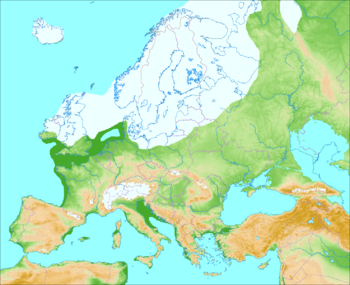 Alternative names include: Weichsel glaciation or Vistulian glaciation (referring to the Polish river Vistula or its German name Weichsel). Evidence suggests that the ice sheets were at their maximum size for only a short period, between 25,000 to 13,000 BP. Eight interstadials have been recognized in the Weichselian, including: the Oerel, Glinde, Moershoofd, Hengelo and Denekamp; however correlation with isotope stages is still in process.[28][29] During the glacial maximum in Scandinavia, only the western parts of Jutland were ice-free, and a large part of what is today the North Sea was dry land connecting Jutland with Britain (see Doggerland). It is also in Denmark that the only Scandinavian ice-age animals older than 13,000 BC are found.[citation needed]Europe during the last glacial period
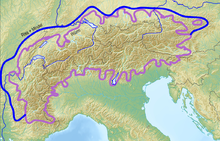 The term Würm is derived from a river in the Alpine foreland, approximately marking the maximum glacier advance of this particular glacial period. The Alps were where the first systematic scientific research on ice ages was conducted by Louis Agassiz at the beginning of the 19th century. Here the Würm glaciation of the last glacial period was intensively studied. Pollen analysis, the statistical analyses of microfossilized plant pollens found in geological deposits, chronicled the dramatic changes in the European environment during the Würm glaciation. During the height of Würm glaciation, c. 24,000–10,000 BP, most of western and central Europe and Eurasia was open steppe-tundra, while the Alps presented solid ice fields and montane glaciers. Scandinavia and much of Britain were under ice.Extent of Alpine glaciation during the Würm ice age. Blue: extent of the early ice ages
 The name Mérida Glaciation is proposed to designate the alpine glaciation which affected the central Venezuelan Andes during the Late Pleistocene. Two main moraine levels have been recognized: one between 2600 and 2700 m, and another between 3000 and 3500 m elevation. The snow line during the last glacial advance was lowered approximately 1200 m below the present snow line (3700 m). The glaciated area in the Cordillera de Mérida was approximately 600 km2; this included the following high areas from southwest to northeast: Páramo de Tamá, Páramo Batallón, Páramo Los Conejos, Páramo Piedras Blancas, and Teta de Niquitao. Approximately 200 km2 of the total glaciated area was in the Sierra Nevada de Mérida, and of that amount, the largest concentration, 50 km2, was in the areas of Pico Bolívar, Pico Humboldt (4,942 m), and Pico Bonpland (4,893 m). Radiocarbon dating indicates that the moraines are older than 10,000 years B.P., and probably older than 13,000 years B.P. The lower moraine level probably corresponds to the main Wisconsin glacial advance. The upper level probably represents the last glacial advance (Late Wisconsin).[36][37][38][39]The extent of the glaciers in Venezuelan Andes area during the last glacial period.
 The Llanquihue glaciation takes its name from Llanquihue Lake in southern Chile which is a fan-shaped piedmont glacial lake. On the lake's western shores there are large moraine systems of which the innermost belong to the last glacial period. Llanquihue Lake's varves are a node point in southern Chile's varve geochronology. During the last glacial maximum the Patagonian Ice Sheet extended over the Andes from about 35°S to Tierra del Fuego at 55°S. The western part appears to have been very active, with wet basal conditions, while the eastern part was cold based. Palsas seems to have developed at least in the unglaciated parts of Isla Grande de Tierra del Fuego. The area west of Llanquihue Lake was ice-free during the LGM, and had sparsely distributed vegetation dominated by Nothofagus. Valdivian temperate rainforest was reduced to scattered remnants in the western side of the Andes.[40]Map showing the extent of the Patagonian Ice Sheet in the Strait of Magellan area during the last glacial period. Selected modern settlements are shown with yellow dots.
 Modelled maximum extent of the Antarctic ice sheet 21,000 years before present


No comments:
Post a Comment