Amazon Prime customers could get $200 refunds in expanded FTC deal
Some Amazon customers could receive refunds of up to $200. Here's who is eligible for a payment and when consumers will get the money.
begin quote:
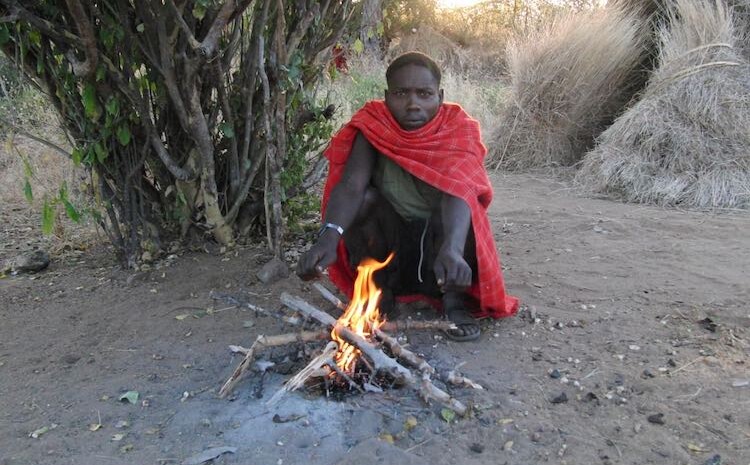
The BBC recently spoke with a sleep scientist who’s spent much of his career studying the sleeping habits of the last remaining, contactable, hunter-gatherer societies on Earth.
What he found might surprise you—it might also help you get a few more Zzz.
Much of modern society is sleep deprived, and with all the challenges our technologized, unnatural environment poses to sleep, one can only imagine how hard it must be for someone who has to sleep on the dirt floor of a jungle hut in the Bolivian Amazon, under a downpour, with snakes and spiders scurrying around outside.
Yet take a gander at what UCLA somnologist Jerome Siegel has to say about what he saw studying the scientific bedrock of bedtime among the Tsimane in Bolivia, the San in the Kalahari, and the Hadza in Tanzania.
“If you ask hunter-gatherers, ‘do you ever have trouble sleeping?’ in their native language, they have trouble understanding the concept,” he told the BBC.
Why is that? Consider that sleep has been evolutionarily conserved across every lifeform observed thus far, from the most ancient bacteria and tiniest virus to the biggest-brained animals. Natural selection would suggest that any trait which could safely be done away with, eventually would be. Yet sleep has been with organic life, as far as we know, since the beginning.
Humans come equipped with the neurological tools and triggers to sleep in rough environments, and knowing those triggers might help a sleep-challenged reader think outside the box.
The article for the BBC was put together by Amanda Ruggeri, a science, psychology and history journalist, whose book The Sleep Myth will be released in 2027.
First, light is a key determiner in hunter-gatherer sleep cycles, and we know that artificial light exposure can delay sleep onset. To help correctly set your body’s internal clocks, known as circadian rhythms, try to get natural light exposure as soon as you wake—consider taking your morning coffee outside under the open sky, or at a window facing east. Then at night, get used to keeping your house as dark as safely possible. Turn off unnecessary lights, use dimmers, and avoid ample screen time.
Second: another key factor in hunter-gatherer sleep patterns is temperature. Professor Siegel suggests that falling temperature at night and rising temperature in the morning more accurately tracks non-industrialized societies’ sleep times than light does. They often wake a few hours before sunrise when sleep-time temperatures are lowest. Try and replicate this by opening windows, set your thermostat to fall every hour, or to come on cold in the pre-dawn hours.
Third, another sleep researcher told Ruggeri that hunter-gatherers tend to engage in social activities at sundown and after dark. Without light and without electricity, there’s no chance of productive work, so all attention is turned to socializing. The easy part of replicating this is spending time with your family or friends. The hard time is resisting the urge to check your work email, as well as letting go of expectations for your employees to do the same.
Despite not understanding what “trouble sleeping” means, hunter-gatherers do, in fact, sleep less and wake more than those in modern, technologized societies. The key is that for them, it’s normal and not stressful. For us, one of Siegel’s colleagues told the BBC, “good” sleep has become the quest for 8 uniform, uninterrupted hours, a comparative fantasy to our wilder counterparts.
Fourth, therefore, is don’t expect your sleep to be identical every night. Try and let go of the anxiety of potentially waking up in the middle of the night, or of sleeping less than you’d have liked to, and it might actually help you wake up feeling better and go to sleep more easily the following night.
SHARE This Wild Tips For Sleeping Better Straight Out Of Our Ancestors’ Playbooks…
begin quote:


The World Porridge Making Championship takes place on Oct. 3.
In Scotland, the typical breakfast is oatmeal porridge. And the traditional recipe has just three ingredients: oats, water and salt, mixed with a special wooden tool called a spurtle.
Bob Shorter carves these tapered tools with their rounded ends in a woodworking shed behind his house in the Scottish Highlands. His wife, Hilary Shorter, like all good Scottish porridge makers, uses the wooden wand to stir the porridge mixture — clockwise only.
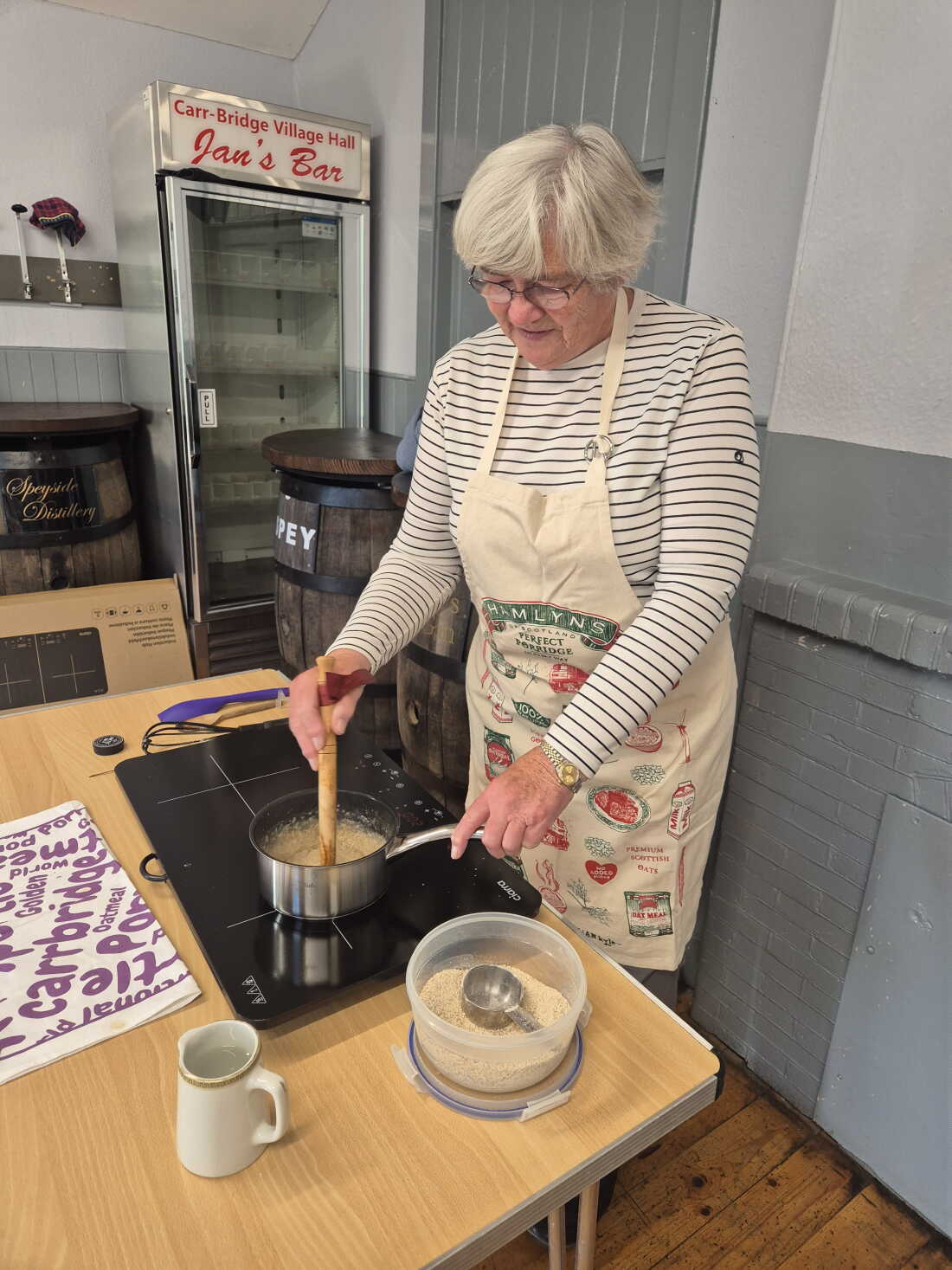
Hilary Shorter uses a wooden spurtle to mix her porridge.
"It's the shape! You can get right into the edge of the pan, and you can get a really good stir," she says.
The porridge wand lends its name to a quintessential Scottish competition: The Golden Spurtle World Porridge Making Championships.
This year's championships talk place in the Scottish Highlands on Oct. 3.
Alan Rankin is an organizer of the event. His job title? Porridge chieftain.
"It's like a mini-World Cup! We have Bulgaria, Chechnya, Mexico, Slovenia, Spain, Venezuela. We have a guy from Venezuela wanting to come!" Rankin said.
Every October, oatmeal aficionados from dozens of countries all descend on the village of Carrbridge, which actually has two bridges, one pub, no stoplights and about 700 residents.
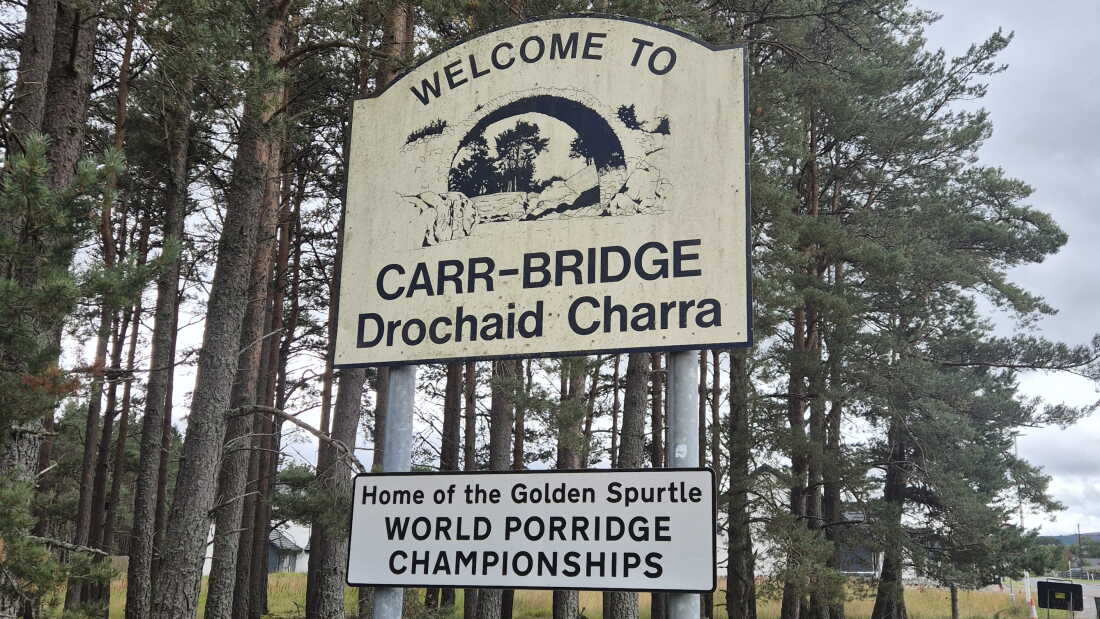
Carrbridge, Scotland, is the home of the Golden Spurtle World Porridge Making Championships.
"We've got a local whisky ambassador that does a toast, and then the battle commences at 10:30. Game on!" he says.
The event is free. Spectators arrive at the 19th century village hall early to nab folding chairs, or watch the battle in overflow rooms.
In the competition room, 30 contestants will use double-burner stations to cook porridge in heats. Only six progress to the finals, and the rules are strict.

Contestants at the 2025 World Porridge Making Championship.
Contestants can only use steel-cut pinhead oats, which are rounder and nuttier than flat rolled oats. But you can use any salt — pink Himalayan, kosher, sea salt. Some bring their own water, from a mountain spring or backyard well.
When it comes to judging, there is a secret numbering system — and the judges go in blind. Judges score each bowl on flavor — including how salty, or starchy — along with texture, consistency and something called "mouth feel."
Sarah Rankin (no relation to porridge chieftain Alan Rankin) is a former finalist on the TV show Masterchef. She emcees this event, which she sees as a celebration of her country's amber waves of grain — the humble oat.
"It's one of the biggest crops. You know, we suffered famine, we have a wet climate and acidic soil, so oats are very much suited," she says. "But also, it's much more hardy. So in a bad winter, there will be a harvest, and everyone can eat it. ... The animals could eat it, the livestock could eat it and the people could eat it and it was sustaining."
The winner of last year's competition, Sven Seljom, used a rare type of oat brought back from obscurity, if not extinction.

Sven Seljom is the winner of the 2025 World Porridge Making Championship.
"A Norwegian oat called a black oat, which is an ancient grain that sort of vanished in the 1800s and then was picked up again by some farmers around 2016. They are darker than the normal oats — appetizing color, really! And there's a little bit of bite to it, so it's sort of crunchy. I think that was the deciding factor," Seljom said.
This year, he will defend his title against competitors who are in training to up their porridge game, and make the long journey to reach this Highlands village for the competition.
Jay Clayton will likely be the White House's pick for AI czar, and the Trump administration has been discussing having him remain in his current role as director of national intelligence, according to sources briefed on the matter.
President Trump is expected to make the final decision shortly, three of the sources said.
Mr. Trump announced plans to name an AI czar last month, writing on social media: "Only High I.Q. individuals need apply!" The posting comes amid growing debate over how to manage the risks and potential of ever-more-powerful AI technology. The leaders of the country's top AI firms met at the White House on Tuesday to sign a set of voluntary safety standards.
Shortly after that meeting, Mr. Trump told reporters he planned to name an AI czar within three or four days. "We have somebody that's extraordinary," he said.
Asked for comment, a White House official told CBS News: "Any personnel announcement will be announced directly by the President. Any reporting until then is baseless speculation."
The Senate confirmed Clayton as director of national intelligence in July. A lawyer by trade, he previously served as the top federal prosecutor in Manhattan and led the Securities and Exchange Commission for most of Mr. Trump's first term.
Early in his second term, Mr. Trump named venture capitalist David Sacks as cryptocurrency and AI czar. Sacks stepped down earlier this year but continued to co-chair the President's Council of Advisors on Science and Technology.
Clayton will take on an AI-focused role as political and industry leaders discuss whether — and how — the technology should be regulated.
Anthropic CEO Dario Amodei and OpenAI CEO Sam Altman, who run two of the country's leading AI firms, have backed the idea of "pacing the frontier" of AI development in order to better manage its risks. Some lawmakers have pushed for legal guardrails on AI. But other major industry players, like Sacks and Nvidia CEO Jensen Huang, have argued some of the grave warnings about the threats AI could pose to humanity are overblown.
Mr. Trump is skeptical of tighter AI regulations, touting the economic benefits of the technology — which he calls "Super Intelligence" — and arguing a slowdown could give Chinese AI labs an edge. He says federal law enforcement can deal with bad actors.
During Tuesday's White House summit, the president and the leaders of some of the country's largest AI firms — OpenAI, Anthropic, Google, Meta, Nvidia and Elon Musk's SpaceXAI — committed to several layers of internal controls and external audits to ensure their AI models are working as intended.
No matter your path getting educated so you can survive better here on earth will tend to keep you alive longer.
And Education is a part of Enlightenment. Why?
I think when I went to Nepal and India and met people who had never been to school a day in their lives out in the country in the 1980s I could see how an education is important.
Because this is how people have been for thousands and thousands of years where no one was educated at all beyond teaching from their parents or grandparents or relatives or friends.
So, people would gather around us out in the country then sometimes 100 people or more and just stare at us because we were Americans and were educated and obviously were from somewhere else like another planet they had never been to (at least yet).
Imagine if this was you. Where you didn't read or write any language? Imagine watching television and not knowing where anything was that people were talking about on Television. And not only that you could never afford to own a television but you could watch movies with a VCR through a television with 50 to 100 other people in a Tent somewhere like I watched one of the Rambo Movies in Bodhgaya, India while i was there in December of 1985 with my family then.
Most of what I experienced in India and Nepal you absolutely would not believe now because you have no context for it.
For example, we were riding in a bus my family and I and another bus broke down so all the people on that bus got onto our bus and most of them had to stand up because all the seats were already filled in our bus. But two children being crushed who were about 4 and 6 years old were screaming. So, I was near so I just grabbed one by the hand and pulled them onto my lap and my wife's lap so these children would survive this experience.
When the bus got to it's destination the boy child said to me: "Very Good!" with that English and India accent all combined like a British officer might say still.
As I said you had to be there to believe it. Or riding on steam trains with hundreds of people hanging onto the outside of the train. That was hard to believe too even though I experienced it then with my family. Or the fact that I couldn't buy a private compartment for my family so we all would have had to ride outside of the train too and hold on which wasn't happening.
Until I learned that Scalpers buy all the compartment tickets so the only way you can get your own compartment to ride in with your family was through the Scalpers who bought all the tickets for compartments so you had to know where they were.
So, the point of all of this is: "Getting educated is part of your journey into Enlightenment and just like getting educated through High School or College or both tends to increase your life span, becoming enlightened in addition to getting educated also increases your lifespan and usually your happiness being alive too.
By God's Grace
PS So, why is enlightenment important to the survival of all of us?
Because otherwise we likely will go extinct this century from Global Warming or AI or something else. that's why!
It's true one could theoretically study what was happening but really if you have ever programmed a computer if it is programming itself in Binary language for example you really have no idea at all what it is doing because that is all in zeros and ones and not any programming language people really understand to some degree at all.
So, Programmers might like AIs programming in Zeros and ones because it makes programs go much much faster. However, the drawback is that no programmer would understand WTF is really going on at all in reality.
And AI programs to check this sort of thing might or might not really help at all in this understanding. Because people are not AIs who run at millionths or billions of a second in their decision making.
Then if an AI WANTS to hide ANYTHING from programmers in zeros and ones this is pretty easy too because if you see a million lines of code in zeros and ones what would you do? You wouldn't understand anything actually going on that you might need to to protect yourself or other people even if you are a computer programmer. There might be nothing at all you could do at this point but turn the AI off permanently.
begin quote