begin quote:
How Scotland turns humble oats into world-class oatmeal porridge


The World Porridge Making Championship takes place on Oct. 3.
In Scotland, the typical breakfast is oatmeal porridge. And the traditional recipe has just three ingredients: oats, water and salt, mixed with a special wooden tool called a spurtle.
Bob Shorter carves these tapered tools with their rounded ends in a woodworking shed behind his house in the Scottish Highlands. His wife, Hilary Shorter, like all good Scottish porridge makers, uses the wooden wand to stir the porridge mixture — clockwise only.
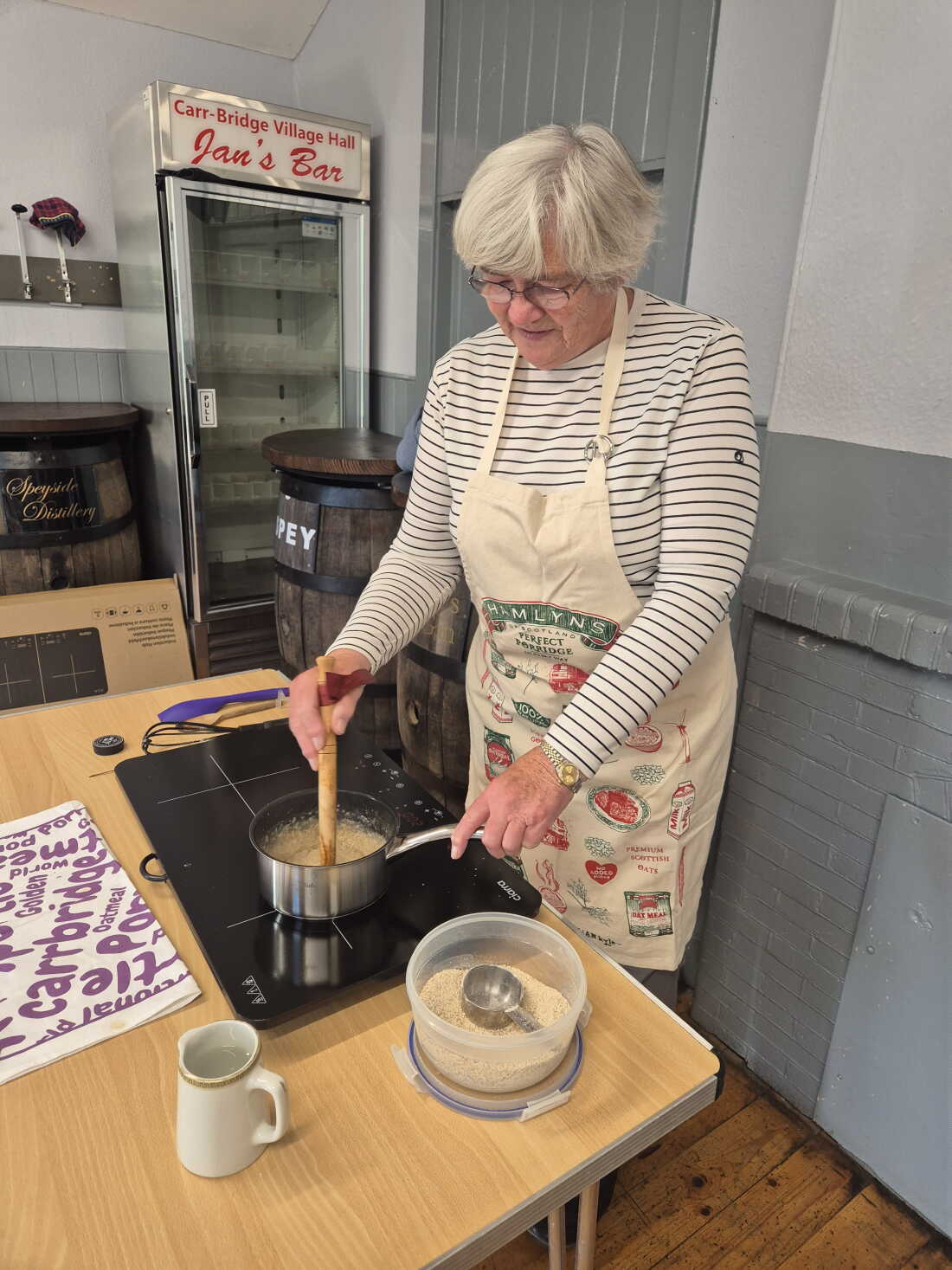
Hilary Shorter uses a wooden spurtle to mix her porridge.
"It's the shape! You can get right into the edge of the pan, and you can get a really good stir," she says.
The porridge wand lends its name to a quintessential Scottish competition: The Golden Spurtle World Porridge Making Championships.
This year's championships talk place in the Scottish Highlands on Oct. 3.
Alan Rankin is an organizer of the event. His job title? Porridge chieftain.
"It's like a mini-World Cup! We have Bulgaria, Chechnya, Mexico, Slovenia, Spain, Venezuela. We have a guy from Venezuela wanting to come!" Rankin said.
Every October, oatmeal aficionados from dozens of countries all descend on the village of Carrbridge, which actually has two bridges, one pub, no stoplights and about 700 residents.
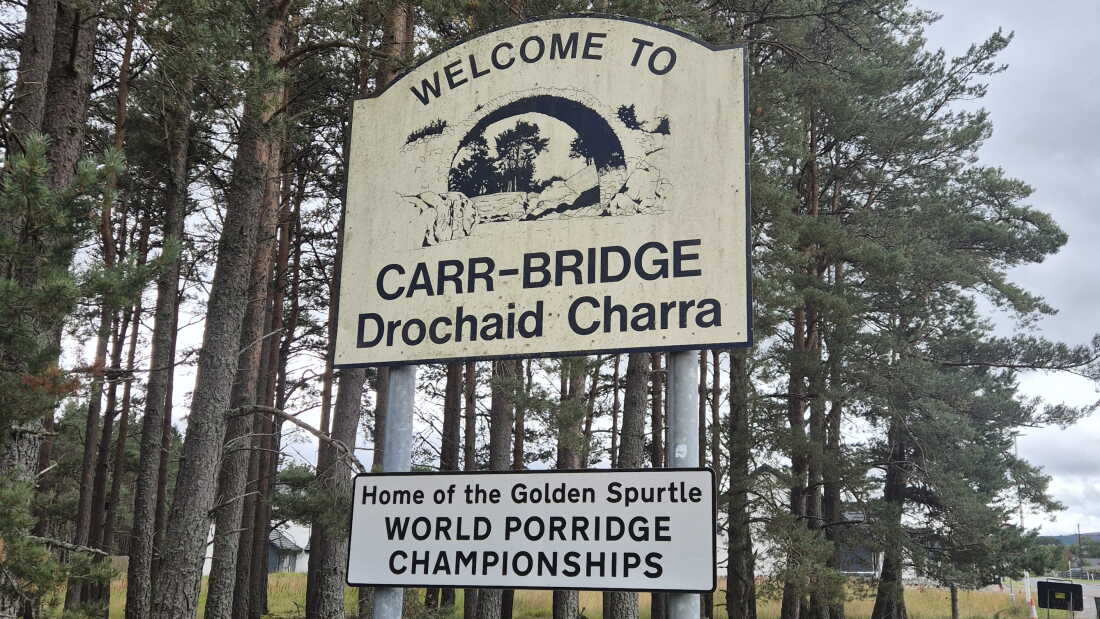
Carrbridge, Scotland, is the home of the Golden Spurtle World Porridge Making Championships.
"We've got a local whisky ambassador that does a toast, and then the battle commences at 10:30. Game on!" he says.
The event is free. Spectators arrive at the 19th century village hall early to nab folding chairs, or watch the battle in overflow rooms.
In the competition room, 30 contestants will use double-burner stations to cook porridge in heats. Only six progress to the finals, and the rules are strict.

Contestants at the 2025 World Porridge Making Championship.
Contestants can only use steel-cut pinhead oats, which are rounder and nuttier than flat rolled oats. But you can use any salt — pink Himalayan, kosher, sea salt. Some bring their own water, from a mountain spring or backyard well.
When it comes to judging, there is a secret numbering system — and the judges go in blind. Judges score each bowl on flavor — including how salty, or starchy — along with texture, consistency and something called "mouth feel."
Sarah Rankin (no relation to porridge chieftain Alan Rankin) is a former finalist on the TV show Masterchef. She emcees this event, which she sees as a celebration of her country's amber waves of grain — the humble oat.
"It's one of the biggest crops. You know, we suffered famine, we have a wet climate and acidic soil, so oats are very much suited," she says. "But also, it's much more hardy. So in a bad winter, there will be a harvest, and everyone can eat it. ... The animals could eat it, the livestock could eat it and the people could eat it and it was sustaining."
The winner of last year's competition, Sven Seljom, used a rare type of oat brought back from obscurity, if not extinction.

Sven Seljom is the winner of the 2025 World Porridge Making Championship.
"A Norwegian oat called a black oat, which is an ancient grain that sort of vanished in the 1800s and then was picked up again by some farmers around 2016. They are darker than the normal oats — appetizing color, really! And there's a little bit of bite to it, so it's sort of crunchy. I think that was the deciding factor," Seljom said.
This year, he will defend his title against competitors who are in training to up their porridge game, and make the long journey to reach this Highlands village for the competition.

