
1. Early British Presence (1600s - 1857):
- East India Company:The East India Company, a trading entity, arrived in India in the 1600s and established trading posts. They initially sought to trade with local rulers, gaining permission to own land, fortify holdings, and trade duty-free.
Expansion and Control:
As the Mughal Empire
weakened, the East India Company gradually increased its influence and
began to control territories, eventually overthrowing local rulers.
Battle of Plassey (1757):
This
battle was a turning point, establishing the East India Company's
military and commercial power, leading to the annexation of Bengal.
Warren Hastings (1770s):
Hastings consolidated the company's control over Bengal by bringing the nawab's administrative offices under his oversight.
Sepoy Mutiny (1857):
This rebellion led to the end of the East India Company's rule and the establishment of British Crown rule.
2. British Raj (1858 - 1947):
- Following the Sepoy Mutiny, the British government directly ruled India, a period known as the British Raj.
Infrastructural Developments:
The
British Raj brought significant infrastructural developments, including
the construction of railroads, which are believed to have benefited the
economy and improved life expectancy.
Modernization Efforts:
The
British also implemented modernization efforts, including educational
reforms, legal reforms, and advancements in technology.
Social and Economic Impact:
The
British Raj had a significant impact on Indian society, with some
arguing that it led to increased poverty and famines while others point
to improvements in certain areas.
Indian National Congress:
The foundation of the Indian National Congress in 1885 marked a key turning point in the movement towards independence.
Independence (1947):
India gained independence from British rule in 1947, with the partition of the country into India and Pakistan.
3. Key Aspects of British Rule in India:
- The British sought to exploit India's resources, including textiles and other raw materials, for their own economic benefit.
Political and Social Divides:
The British Raj is also criticized for exacerbating existing social and religious divisions within India, contributing to the partition of 1947.
Legacy:
The
British Raj left a complex legacy, with its influence on India's
administrative, legal, and educational systems still evident today.
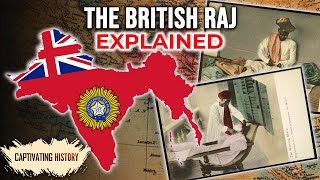
This video provides an overview of the British Raj:


History of the British Raj - Wikipedia
The
British Raj was the period of British Parliament rule on the Indian
subcontinent between 1757 and 1947, for around 200 years o...
Wikipedia

The British Impact on India, 1700–1900 - Association for Asian Studies
The
British took advantage of the instability and the resulting regional
tensions, especially in 1757 at the Battle of Plassey in ...

Association for Asian Studies

- Show all
AI responses may include mistakes. Learn more

The
British Raj was the period of British Parliament rule on the Indian
subcontinent between 1757 and 1947, for around 200 years of British
occupation. The system of governance was instituted in 1858 when the
rule of the East India Company was transferred to the Crown in the
person of Queen Victoria.

Feedback
People also ask
In exchange for trading rights the English brought European products to India.
Throughout the 1600s English trade in India expanded and English
traders built many trading posts. and factories across India. However,
by the end of the century relations with the Mughal rulers had worsened.

Feedback
The British Raj was the colonial rule of the British Crown on the Indian subcontinent, lasting from 1858 to 1947. It is also called Crown rule in India, ...

Jun 2, 2025 — British raj, period of direct British rule over the Indian subcontinent from 1858 until the independence of India and Pakistan in 1947.


No comments:
Post a Comment