Ukraine's massive drone attack deep inside Russia shows how the battlefield has changed
Ukraine's massive drone attack deep inside Russia highlights how both have changed battlefield tactics
Ukraine's massive drone attack deep inside Russia highlights how both have changed battlefield tactics

Dubbed operation “Spiderweb,” Ukraine’s audacious drone attack Sunday on four Russian air bases — one of them deep inside Siberia — has brought the use of unmanned aerial vehicles in modern warfare sharply into focus.
While accounts differ on the extent of the damage caused by the drones, which were reportedly smuggled to the perimeter of the bases in the backs of trucks, Ukraine’s security service, the SBU, put the estimated cost to the Kremlin at $7 billion. Russia has said little about the attacks, although its Defense Ministry acknowledged in a statement that some planes caught fire.
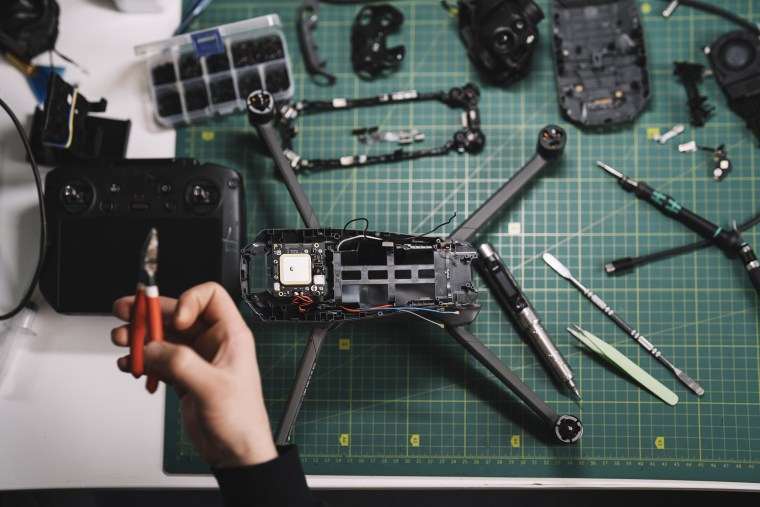
The strikes have highlighted the increasing importance of drones for both Russia and Ukraine in the war, which entered its fourth year in February. And experts told NBC News that both sides are increasingly turning to cheap, commercially available first-person view or quadcopter drones that can often be purchased from online retailers and easily converted into deadly weapons — simple technology that is having a huge impact on the battlefield in Ukraine and farther afield.
Their use is “going to become very, very common,” Robert Lee, a senior fellow at the Philadelphia-based Foreign Policy Research Institute think tank, said in an interview.
Drones were used when Syrian President Bashar al-Assad’s regime was overthrown in December, he said. “They’re here ... because they’re ubiquitous, because they are quite useful, and they’re demonstrating that every day in Ukraine,” he said.
“There’s no doubt that they’re going to be used by all sorts of groups, whether it’s criminal groups or terrorist groups, and they pose a quite significant threat,” he said, adding, “I think we’re a little bit behind the power curve on this and actually getting ready to counter them.”
Targeting civilians
Anastasia Pavlenko, 23, said she noticed a drone “hunting” her as she was riding her bicycle to a cosmetology appointment in Antonivka, a rural community in Ukraine’s southern Kherson region.
“It took off, followed me, and I zigzagged on the bike,” Pavlenko, the mother of two, said of the attack in September, adding that a second drone suddenly appeared with “a shell attached to it.”
Despite her best attempts to escape, she said, the second drone dropped the shell “right on my head,” and it bounced down onto her thigh and exploded on the asphalt next to her.
“Blood was coming from my neck, and there were fragments under my ribs,” Pavlenko said, adding she somehow managed to keep cycling and take cover under a bridge, where she screamed for help until she started to lose consciousness.
“I just had a small purse, shorts, a T-shirt and long loose hair, so it was clear that I was a girl,” she said, adding that she was not wearing military colors or carrying any weapons when she was hit.
Doctors were unable to remove shrapnel fragments from her neck, ribs or leg, she said, adding she had been unable to return to work at her coffee shop because she “can’t handle physical stress.”
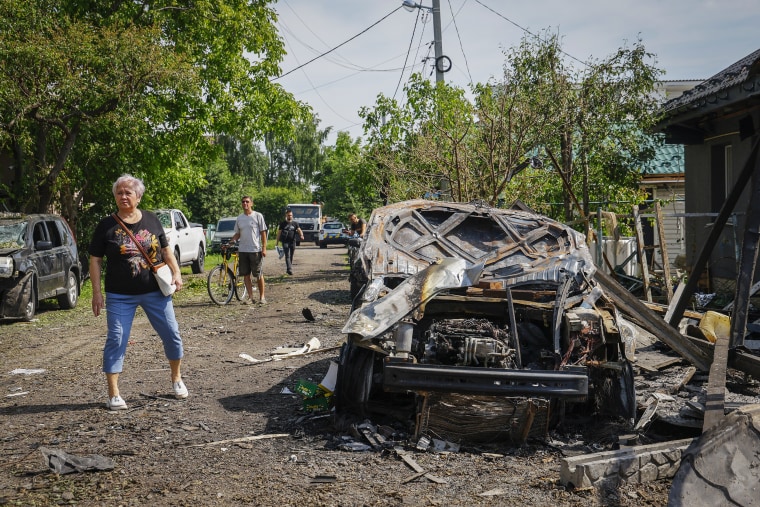
Russia has repeatedly denied that it targets civilians in Ukraine. The Defense Ministry did not respond to a request for comment about whether its forces or groups allied with them had used commercial drones to carry out strikes on nonmilitary targets in the Kherson region.
But drone video posted on a Russian military blogger’s Telegram channel appears to show the attack on Pavlenko.
Recommended


NBC News was able to determine that the video was taken in late September and geolocate it to a specific section of a road in Antonivka where Pavlenko said everything went dark.
‘Hunted from above’
The strike on Pavlenko was one of at least 45 Russian attacks on civilians and civilian infrastructure in Ukraine from June to December that Human Rights Watch has documented.
Belkis Wille, an associate director in the nongovernmental organization’s Crisis, Conflict and Arms Division, said it was the first time it had “ever documented the use of these commercial quadcopter drones used at wide scale in a precise campaign to target civilians.”
The majority of the attacks were carried out with modified commercial drones manufactured by the Chinese companies DJI and Autel Robotics, according to a report co-authored by Wille and released Monday, called “Hunted from Above: Russia’s Use of Drones to Attack Civilians in Kherson, Ukraine.”
Lee, of the Foreign Policy Research Institute, analyzed pictures of some of the drones posted to Telegram channels associated with bloggers affiliated with Russia’s military.
Some were “all homemade” munitions, he said, adding that some of the parts, including a plastic tail, could be created with 3D printers. Another photo showed parts of a rocket-propelled grenade attached to a drone with duct tape, Lee said.
But despite their DIY appearance, he said, “you have a guided weapon that operates at significantly greater distances, and this can be operated at a very tactical level, in a very cheap way.”
Both Autel Robotics and DJI have policies on their websites that explicitly prohibit using their drones in combat. Autel Robotics say all customers are required to sign a “compliance commitment letter” and “end-user statement” to that effect. DJI says that, as part of its terms of use, users “agree not to: attempt to ‘hack,’ ‘crack,’ reverse engineer or modify the product.”
Both companies stopped direct sales in Russia when the full-scale invasion of Ukraine began in 2022, and DJI says it stopped direct sales in Ukraine. Autel Robotics says it added geofencing restrictions “to prevent the operation” of Autel drones “in Russia, Ukraine, and other embargoed regions.”
DJI did not respond to a question about geofencing capabilities of its drones. It said in a statement that it “does not manufacture military-grade products, nor does it market or sell its products for use in combat,” and that it strongly opposes “any outside attempts to modify our products for combat.”
“Just like any global consumer electronics company selling off-the-shelf products, we cannot control how our products are used once purchased,” the statement added. “However, we have taken proactive steps to mitigate the use of our products for harm.”
Autel Robotics did not respond to a request for additional comment.
Since Russian forces invaded it in February 2022, Ukraine has also been retrofitting cheap and readily available commercial drones so they can be deployed on the battlefield.
While Russia has accused Ukrainian forces of targeting civilians, HRW has said there was no verifiable evidence of their doing so.
Changing warfare
Lee and Wille said the availability of cheap, easy-to-use drones is changing the nature of warfare, making once-expensive strikes far easier to pull off. They also expressed concerns that criminal organizations, like Mexican drug cartels, were able to use them for nefarious purposes, too.
“They’re changing the nature of the fight,” said Lee, adding that in the future, artificial intelligence could lead to a point “where one pilot can operate maybe four or five UAVs at a time.”
He added that AI could “replace some of those targeting functions where AI can locate a target on its own,” with a pilot operating it.
For Wille, the fear is that others will be able to copy the methods used by Russians and Ukrainians to create drones “cheap and easy to operate” and subject them to similar attacks.
“These drones are ubiquitous,” she said.


No comments:
Post a Comment