Trump sends war powers notification to Congress
Just now16m agoTrump sent a war powers notification to Senate President pro Tempore Chuck Grassley, R-Iowa, to apprise Congress about “military action taken on February 28, 2026, against the Government of the Islamic Republic of Iran.”
NYPD will deploy extra resources to 'Jewish sites and neighborhoods'
Just now36m agoThe New York Police Department said it will be “out in full force” tonight to ensure Jewish New Yorkers can safely celebrate the Purim holiday.
To the best of my ability I write about my experience of the Universe Past, Present and Future
Top 10 Posts This Month
- Cancer rates 1900 to 2000 and beyond
- Dolly Parton on English version of Wikipedia
- Ballard's work with the I AM Movement is considered a predecessor to the current new age movement.
- Finalists Win Big Laughs in The Comedy Wildlife Photography Awards – LOOK
- Hurricane Simon pounds resorts and vulnerable towns along Mexico's Pacific coast
- Israelis mourn on the anniversary of the Oct. 7 as Palestinians grapple with war it sparked
- 8 killed, including 2 children, in Pennsylvania mass shooting; suspect also dead
- Wikipedia under the heading: Magical thinking
- Writing to save the world
- Michael Douglas talks to Bill Maher about his life: Video Several different videos on Kimmel and The View Too I guess
Tuesday, July 28, 2026
Monday, March 23, 2026
Monday, March 2, 2026
Trump, who campaigned against 'endless' wars, enters Iran with no end date
begin quotes:

Saturday, November 15, 2025
Sunday, December 1, 2024
Angela Merkel on Putin, Trump, and a post-Cold War world still divided
We met former German Chancellor Angela Merkel in a fitting place for her: the museum in Berlin dedicated to the Wall, that great symbol of the Cold War division between East and West. Parts of the wall have been preserved as a reminder of those hard times, especially for someone who lived through them.
She said images of the wall still conjure up highly emotional memories for her.
I asked, "When you look at the wall, what comes to mind to you immediately?"
"Between the ages of seven and 35, I had to live with this wall," she replied. "I was, so to speak, behind the wall, and couldn't come to this side. And of course, that's still very moving."
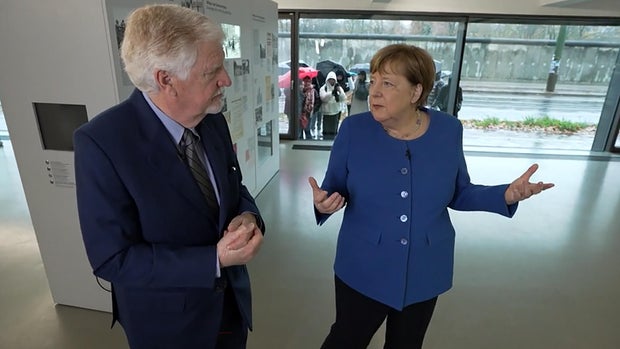
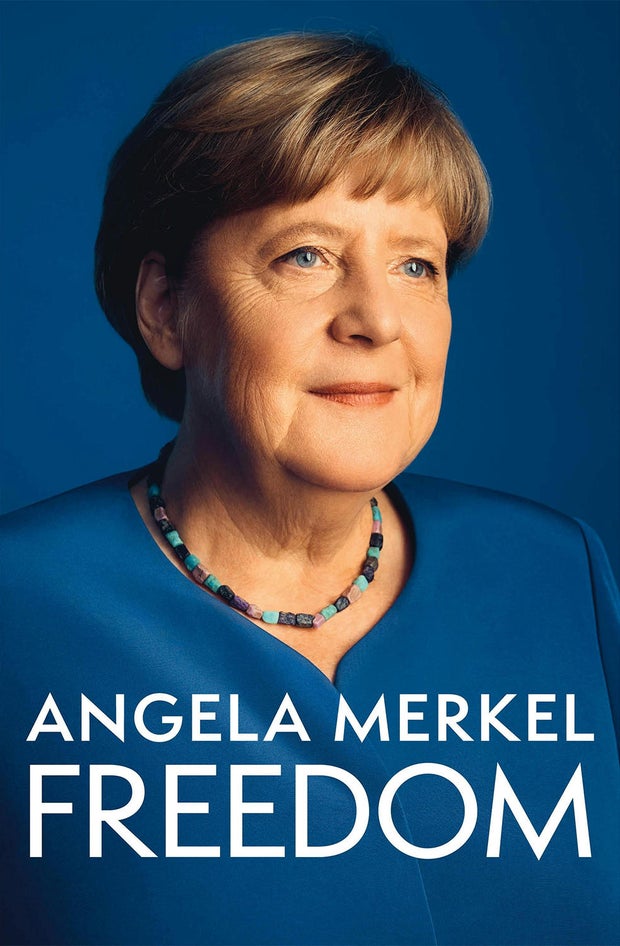
Merkel's new book, "Freedom: Memoirs 1954-2021" (published by St. Martin's Press), is filled with moving memories of what it was like growing up in the Communist-controlled police state that was East Germany. Her family had moved there when she was an infant because her father, a Protestant pastor, was assigned to a church there. But it was the fall of the wall that spurred her political awakening, and jump-started a career nobody would have bet on: A woman, from the East, who would not only become Chancellor of Germany, but who would hold the job for 16 years; who would be called the most powerful woman in the world, and who would deal with its most powerful men.
It turns out, life in the East actually had given her one advantage for dealing with all those men in dark suits: Those bright pant suits of hers weren't an accident. "In my book I write that maybe my love for colorful clothes is due to the fact that in the East, everything was very gray," she said.
Merkel's uniform became part of her identity, and helped her break through the American pop-cultural barrier, on "Saturday Night Live," the way few European leaders could.
Merkel left power three years ago this week, and has gone into a kind of self-imposed political radio silence since then, keeping her recollections and opinions to herself.
Not anymore.
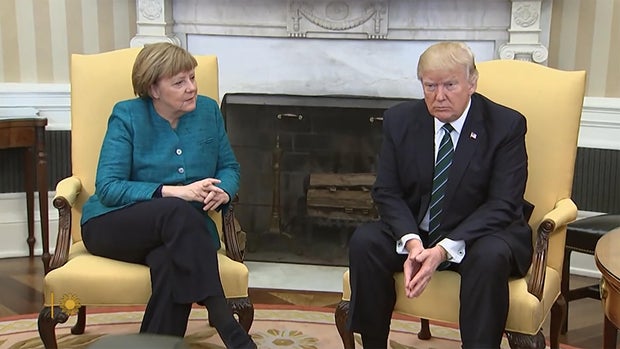
Among the more awkward memories: that first shocking, even embarrassing, meeting with President Donald Trump in 2017.
I said, "I think it's fair to say your most difficult relationship with an American president was with President Trump in his first term. You talk about your first encounter in the Oval Office where he refused to shake your hand, and you say that it occurred to you that he was fascinated with Putin and with politicians with authoritarian and dictatorial traits. Why did you say that?"
"Why he didn't want to shake my hand, that, you'd have to ask him," Merkel replied. "I think he often conveyed a message with a handshake. With some men he shook hands for a long time."
"What were you thinking? Should I reach over? Will we shake hands? Won't we shake hands? What's he trying to do?"
"I describe it in my book because it was so interesting. I whispered to him, 'I think they want us to shake hands.' And at that moment when I said it, I noticed that he wanted to convey a message. And I was quite naïve, telling him that they want us to shake hands."
"But did you get what he was trying to do?" I asked. "Did you think, Oh, he's going to play it that way, that's how we're going to do it?"
"Yeah, that's the way it was. I left being convinced that multilateral cooperation would be difficult with Donald Trump," Merkel replied. "You can make deals with Donald Trump because he always thinks in terms of advantage and disadvantage. But in my experience, win-win situations are not only good for one side, but for both sides. That's not really his way of thinking."
Merkel's book, which is being released around the world, went to press before last month's election. In it, she wrote that she wishes "with all my heart that Kamala Harris defeats her competitor and becomes president."
Of the election results, she said, "I was sad. First of all, I wanted a woman to win. I was also in favor of Hillary Clinton. And secondly, I'm closer to Kamala Harris' political conviction. But the American voters have decided, and it was a democratic election."
Merkel has come in for her own share of criticism since she left office. Her decision to allow more than a million refugees and migrants fleeing Syria into Germany is now often cited as a reason for the rise of anti-immigrant, right-wing political parties in Europe. She says those forces were on the rise anyway.
Her decision to allow the German economy to become too dependent on Russian natural gas is seen as another reason for Germany's economic decline since the flow was stopped.
She says staying engaged with Vladimir Putin seemed like the right idea at the time, difficult though it was. And it didn't stop him from invading Ukraine.
I asked, "You dealt a lot with Vladimir Putin. I take it, reading between the lines of your book, that you found him a very difficult and manipulative character as well, even an intimidating character at times. Famously, you don't like dogs; he'd bring his dog to the meeting. Do you think he did that in an intimidating kind of way? And how would you suggest people deal with him, especially as things are heating up again?"
"Without fear," she replied. "Of course, there are attempts to see how people react under a certain amount of pressure. And Putin can do that, too. And with the dog he expressed exactly that. But it all depends on how I manage the situation. I'm used to political pressure since childhood, so that did not shock me."
Despite all her experience, Merkel says she now refrains from giving advice. But she does give hints. She says that, in general, she is worried about developments in the world: "I've always said that fear is not a good advisor. Times have become rougher. We are now sitting in a place where the world was divided in the Cold War, and then there was 1990. We had great hopes that things would become easier after the end of the Cold War. Things have not become easier."
READ AN EXCERPT: "Freedom: Memoirs 1954-2021" by Angela Merkel
Watch an extended interview with Angela Merkel about growing up in East Germany:
For more info:
- "Freedom: Memoirs 1954-2021" by Angela Merkel (St. Martin's Press), in Hardcover, eBook and Audio formats, available via Amazon, Barnes & Noble and Bookshop.org
- Angela Merkel, Council of Women World Leaders
- Berlin Wall Memorial, Berlin
Story produced by Erin Lyall and Anna Noryskiewicz. Editor: Jack Howell.
Sunday, August 21, 2022
Trump's turbulent White House years culminate in Fla. search
begin quote from:
https://www.msn.com/en-us/news/politics/trumps-turbulent-white-house-years-culminate-in-fla-search/ar-AA10V614
Trump's turbulent White House years culminate in Fla. search
NEW YORK (AP) — Mounds of paper piled on his desk. Framed magazine covers and keepsakes lining the walls. One of Shaquille O’Neal's giant sneakers displayed alongside football helmets, boxing belts and other sports memorabilia, crowding his Trump Tower office and limiting table space.
Well before he entered politics, former President Donald Trump had a penchant for collecting. And that lifelong habit — combined with his flip disregard for the rules of government record keeping, his careless handling of classified information, and a chaotic transition borne from his refusal to accept defeat in 2020 — have all culminated in a federal investigation that poses extraordinary legal and political challenges.
The search of Trump's Mar-a-Lago club earlier this month to retrieve documents from his White House years was an unprecedented law enforcement action against a former president who is widely expected to run for office once again. Officials have not revealed exactly what was contained in the boxes, but the FBI has said it recovered 11 sets of classified records, including some marked “sensitive compartmented information,” a special category meant to protect secrets that could cause “exceptionally grave” damage to U.S. interests if revealed publicly.
Why Trump refused to turn over the seized documents despite repeated requests remains unclear. But Trump’s flouting of the Presidential Records Act, which outlines how materials should be preserved, was well documented throughout his time in office.
He routinely tore up official papers that later had to be taped back together. Official items that would traditionally be turned over to the National Archives became intermingled with his personal belongings in the White House residence. Classified information was tweeted, shared with reporters and adversaries — even found in a White House complex bathroom.
John Bolton, who served as Trump’s third national security adviser, said that, before he arrived, he'd heard "there was a concern in the air about how he handled information. And as my time went on, I could certainly see why.”
Others in the Trump administration took more care with sensitive documents. Asked directly if he kept any classified information upon leaving office, former Vice President Mike Pence told The Associated Press on Friday, “No, not to my knowledge.”
The investigation into Trump's handling of documents comes as he's facing mounting legal scrutiny on multiple fronts. A Georgia investigation into election interference has moved closer to the former president, with former New York City Mayor Rudy Giuliani, a top defender, informed earlier this month that he is a target of a criminal probe.
Meanwhile, Trump invoked his Fifth Amendment protection against self-incrimination as he testified under oath in the New York attorney general’s long-running civil investigation into his business dealings. A top executive at the business pleaded guilty last week in a tax fraud case brought by the Manhattan district attorney.
But few legal threats have galvanized Trump and his most loyal supporters like the Mar-a-Lago search. The former president and his allies have argued the move amounts to political persecution, noting the judge who approved the warrant has given money to Democrats. The judge, however, has also supported Republicans. And White House officials have repeatedly said they had no prior knowledge of plans to search the estate.
Trump allies have tried to claim the presidency granted him unlimited power to unilaterally declassify documents without formal declaration. But David Laufman, the former chief of the Justice Department’s counterintelligence section, said that's not how it works.
“It just strikes me as a post hoc public affairs strategy that has no relationship to how classified information is in fact declassified," said Laufman, who oversaw the investigation into Hillary Clinton's personal email server during her tenure as secretary of state. While he said it is true that there is no statue or order that outlines procedures the president must abide by to declassify information, “at the same time it's ludicrous to posit that a decision to declassify documents would not have been contemporaneously memorialized in writing.”
It's "not self executing," he added. "There has to be some objective, contemporaneous, evidence-based corroboration of the claims that they're making. And of course there won't be because they’re making it all up."
The decision to keep classified documents at Mar-a-Lago — a property frequented by paying members, their guests and anyone attending the weddings, political fundraisers, charity dinners and other events held on site — was part of a long pattern of disregard for national security secrets. Former aides described a “cavalier” attitude toward classified information that played out in public view.
There was the dinner with then-Japanese Prime Minister Shinzo Abe on Mar-a-Lago's patio, where fellow diners watched and snapped cellphone photos as the two men reviewed details of a North Korean missile test.
There was the time Trump revealed highly classified information allegedly from Israeli sources about Islamic State militants to Russian officials. And there was the time he tweeted a high-resolution satellite image of an apparent explosion at an Iranian space center, which intelligence officials had warned was highly sensitive. Trump insisted he had “the absolute right" to share it.
Former White House press secretary Stephanie Grisham said Trump was “careless” with sensitive and classified information and “seemed never to bother with why that was bad.”
Grisham recalled one incident involving Conan, a U.S. military dog hailed as a hero for his role in the raid that killed Islamic State leader Abu Bakr al-Baghdadi. She said that before the dog's arrival at the White House, staff had received a briefing in which they were told the dog could not be photographed because the images could put his handlers in danger. But when the dog arrived, Trump decided he wanted to show it off to the press.
“Because he wanted the publicity, out went Conan," she said. “It's an example of him not caring if he put lives in danger. ... It was like its his own shiny toy he’s showing off to his friends to impress them."
Bolton said that, during his time working for Trump, he and others often tried to explain the stakes and the risks of exposing sources and methods.
“I don’t think any of it sank in. He didn’t seem to appreciate just how sensitive it was, how dangerous it was for some of our people and the risks that they could be exposed to," he said. "What looks like an innocuous picture to a private citizen can be a gold mine to a foreign intelligence" entity.
“I would say over and over again, ‘This is really sensitive, really sensitive.’ And he’d say, ‘I know’ and then go and do it anyway.”
Bolton said that top intelligence officials would gather before briefings to discuss how best to handle sensitive subjects, strategizing about how much needed to be shared. Briefers quickly learned that Trump often tried to hang onto sensitive documents, and would take steps to make sure documents didn't go missing, including using iPads to show them to him.
“Sometimes he would ask to keep it and they'd say, ‘It’s really sensitive.' Sometime he just wouldn’t give it back.”
Trump’s refusal to accept his election loss also contributed to the chaos that engulfed his final days in office. The General Services Administration was slow to acknowledge President Joe Biden’s win, delaying the transition process and leaving little time to pack.
While other White House staff and even the former first lady started making arrangements, Trump largely refused. At the same time, White House staff were departing in droves as part of the regular “offboarding process,” while morale among others had cratered in the aftermath of the Jan. 6 attack on the U.S. Capitol.
Bolton said he doubted that Trump had taken documents for nefarious reasons, and instead thought Trump likely considered them “souvenirs” like the many he’d collected through his life.
“I think he just thought some things were cool and he wanted them,” Bolton said. “Some days he liked to collect french fries. Some days he liked to collect documents. He just collected things.”
The Washington Post first reported in February that the National Archives had retrieved 15 boxes of documents and other items from Mar-a-Lago that should have been turned over to the agency when Trump left the White House. An initial review of that material concluded that Trump had brought presidential records and several other documents that were marked classified to Mar-a-Lago.
The investigation into the handling of classified material intensified in the spring as prosecutors and federal agents interviewed several people who worked in the Trump White House about how records — and particularly classified documents — were handled during the chaotic end of the Trump presidency, a person familiar with the matter told The Associated Press. Around the same time, prosecutors also issued a subpoena for records Trump was keeping at Mar-a-Lago and subpoenaed for surveillance video from Mar-a-Lago showing the area where the records were being stored, the person said.
A top Justice Department official traveled to Mar-a-Lago in early June and looked through some of the material that was stored in boxes. After that meeting, prosecutors interviewed another witness who told them that there were likely additional classified documents still stored at Mar-a-Lago, the person said. The person was not authorized to discuss the matter publicly and spoke on condition of anonymity.
The Justice Department later sought a search warrant and retrieved the additional tranches of classified records.
___
Balsamo reported from Washington.

