begin quote:
Kyiv monastery set on fire in night of Russian attacks across Ukraine
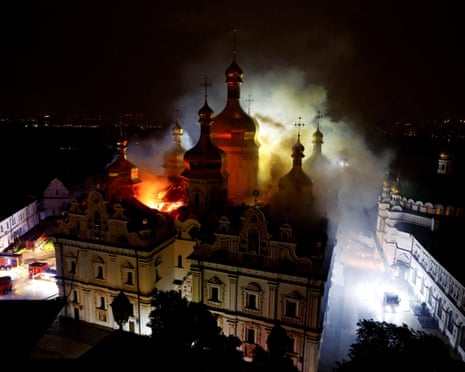
Kyiv monastery set on fire in night of Russian attacks across Ukraine
Dormition Cathedral of Kyiv Pechersk Lavra, one of Ukraine’s most significant religious sites, and residential buildings hit across capital
Ukraine has come under a massive Russian missile and drone attack with waves of explosions echoing through the capital, Kyiv, in the early hours of Monday as air raids killed at least nine people across the country.
Among targets hit in the sustained wave of strikes were the city’s historic Dormition Cathedral within the Kyiv Pechersk Lavra, one of Ukraine’s most significant religious sites, as well as residential buildings across the city.
Footage from the Perchersk Lavra, a Unesco world heritage site, showed towering flames licking up towards its domes. Six people were reported injured.
“[T]he roof of one of the holiest places in the Christian world – the Dormition Cathedral of the Kyiv Pechersk Lavra – is burning,” Metropoliton Epiphanius, head of the Orthodox Church of Ukraine, wrote on X.
Yulia Svyrydenko, the prime minister, posted a picture of the monastery building in flames and wrote: “A brutal assault on our people and our heritage. This is the true face of Russia’s Orthodox values.
“We ask for prayers for the salvation of the shrine from destruction. Another Russian crime against humanity, against history, against Christianity.”
Damage was reported at 16 locations across the capital amid the sound of interceptor launches and explosions that shook windows in the city centre.
“New launches targeting the capital keep being recorded,” said Tymur Tkachenko, head of Kyiv’s military administration, urging people to remain in shelters.
Four people were killed and 23 injured in Kyiv, Tkachenko said. Outside the capital, at least five people were killed in the city of Kharkiv in what appeared to be a double tap strike targeting emergency responders.
Attacks across Ukraine came after the Russian president, Vladimir Putin, had warned that Moscow would target Ukraine with “systemic” strikes, and amid evidence of mounting battlefield setbacks for Russia.
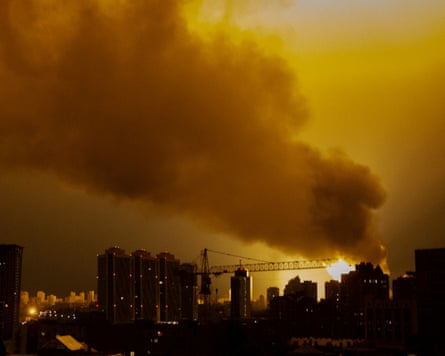
The strikes follow a period of relative quiet in Kyiv in recent days as Moscow prepared its drone and missile forces for the latest in a recent series of massive air attacks.
Poland, an EU and Nato member, scrambled fighter jets and put ground-based air defence systems and radar reconnaissance on a state of readiness, the Polish armed forces said on Monday morning.
The strikes came after the Ukrainian president, Volodymyr Zelenskyy, said on Sunday that he had spoken to Donald Trump ahead of a G7 meeting in France this week and discussed efforts to achieve an end to the more than four-year war.
Trump also told Putin on Sunday that ending the conflict in Ukraine was vital and he was ready to help, the Kremlin said.
Progress towards a peace agreement in Ukraine has been slow, with US officials and mediators concentrating on the conflict in the Middle East. US and Iranian officials said on Sunday they had agreed on a peace framework to end their war, with the pact expected to be officially signed on Friday in Switzerland.
At this dangerous time
We hope you appreciated this article. Before you close this tab, we want to ask if you could support the Guardian at this dangerous time for journalism in the US.
According to a leading global watchdog, American democracy is now more imperiled than at any point since the 1960s, marked by a precipitous decline in press freedom – driven by mounting pressure from the Trump administration in the form of threats, criminal investigations, politicized regulation, frivolous lawsuits and, for public media, catastrophic funding cuts.
Meanwhile, organizations that are supposed to be independent like the FBI and the FCC, our radio and television regulator, have also been targeting press freedom under Trump-aligned leadership, with the FBI raiding a reporter’s home and the FCC threatening ABC’s TV licenses after Jimmy Kimmel made a joke about Melania Trump.
The response from some ultra-wealthy and corporate media owners, keen to appease the president, has been chilling: CBS News has been taken over by a Trump ally; CNN is poised to be taken over by the same billionaire; Jeff Bezos has continued to impose cuts and editorial interventions at the Washington Post; and multiple outlets have settled multimillion-dollar lawsuits from the administration to protect their business interests.
Democracy is best served by a robust, thriving free press. But when that freedom is under attack, it falls to a determined few news organizations to ensure the full truth still reaches the public. Owned neither by a billionaire nor a corporation, the Guardian remains dedicated to covering this administration with uncompromising moral and factual clarity – and to keeping trustworthy journalism paywall-free for the world.


No comments:
Post a Comment