Of course it is also true that the counters here for years only went to around two million 500,000 so these kept resetting to zero a lot too. So, i figure that I have had somewhere between 30 and 50 million visits to this site since 2007 in the Fall when I first started it here. Before this I had a site at geocities.com when that existed starting in June of 1999 up until somewhere between 2007 and 2010. However, there was no counter for those sites that I know of and also there was no Encoder to program the site pages for us then either so I had to program all the pages myself personally. So, what I did then is to give people URLs mostly because I wasn't proficient yet with Links in creating link pages then because I was still teaching myself the HTML language at that point (before 2007). However, since then I make Links pages using blank HREF (links) coding that looks a lot like this:
However, this is in a Compose encoder format not for execution of commands. To actually run this blank HREF code you would need there to be red, green, blue and black writing and be in an actual HTML programming language page not in a compose page created by Compose Encoder here at blogspot (blogger.com).
However, it might be important to note that I studied and learned to program in Fortran and Cobol computer languages in College starting in 1966 and also taught myself the Basic Language and used MSDOS on my computer which was also a go between between programming and Windows 95 which was the first really user friendly operating system for IBM Clones then.
More
than 43 million children have been driven from their homes by floods,
storms, droughts and wildfires over the six years between 2016 and 2021,
according to new data from UNICEF. That works out to 20,000 children displaced every single day due to extreme weather fueled by climate change.1 hour ago
There hasn't been a disaster this bad now since the 2004 Tsunami and Earthquake killed 250,000 people in the Pacific Ocean and sent tidal waves all the way to California and the west coast of the U.S., Mexico and South America and Canada.
This tragedy is likely the perfect storm of the timing of the earthquake, the size of the earthquakes, the buildings who are older and not reinforced but likely made of cement and blocks or rocks where the Cement shatters from a 7.8 or a 7.8 and crumbles. This is the worst Quake to hit Turkey since 1939 when 300,000 people died. And at the present rate of deaths mostly caused now by the Freezing cold and discovering new bodies under the rubble could easily now go to 30,000 to 50,000 over the next 2 months time.
begin quote from: https://www.nbcnews.com/news/world/earthquake-turkey-syria-updates-anger-death-toll-grows-rcna69854
Anger grows in Turkey as earthquake death toll passes 20,000 and rescue hopes dwindle
Thousands spent the night in the debris-encrusted streets of Adiyaman with little shelter and huddled around small fires.
00:17 /02:26
Create your free profile or log in to save this article
By Alex Holmes, Ziad Jaber and Aina J. Khan
ADIYAMAN, Turkey — As the temperatures plunged, anger started to rise in Turkey over the government’s response to two massive earthquakes this week.
On Thursday, the number of those killed by the tremors in Turkey and neighboring Syria passed 20,000.
With
their homes destroyed, thousands spent a freezing Wednesday night amid
the debris in the streets of Adiyaman, huddled around small fires and
with little shelter. Electricity and water were nonexistent in the
southern city.
Fearful of another earthquake, some chose
to stay out in the open, avoiding buildings that appeared intact, and
to brave the subzero temperatures.
Some grieved silently,
while others shouted their despair as the quakes continued to claim
more victims. One man burst into an aid organization center and demanded
loudly that officials rescue his family.
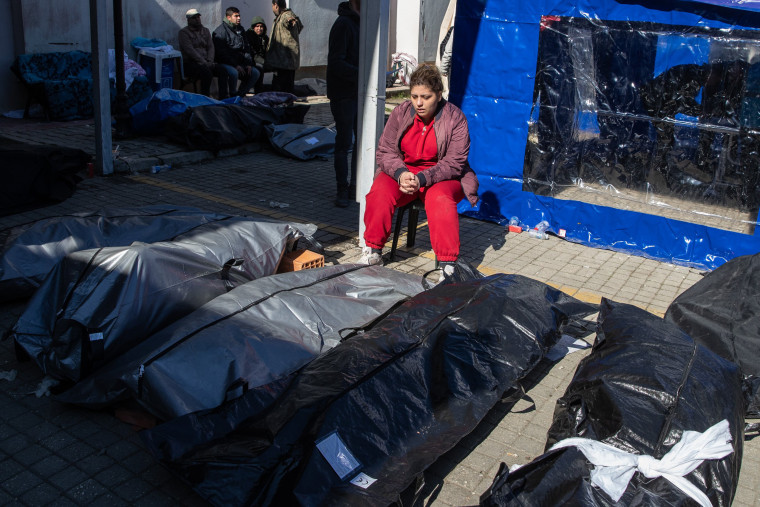
A woman grieves next to the bodies of earthquake victims in Hatay, Turkey. Burak Kara / Getty Images
Perihan Sayar, 60, said she had lost her 10-year-old granddaughter, Ulku, as well as her home.
“I lived alone, in a one-room house,” she said. “Now my house is also gone.”
Others
in Adiyaman said they were furious at what they claim is a slow
response from the government, and said rescue teams had arrived in the
city with the wrong equipment to dig through the rubble. NBC News could
not independently confirm this assertion.
“Nobody was
here to help us, I have complaints about all the authorities here,” said
Nursen Guler on Wednesday, adding that she had one son in the hospital
and another who was still trapped under the rubble.
“There are no teams here, everyone is waiting for rescue teams,” she said.
Guler added that people in Adiyaman had supported Recep Tayyip Erdogan,
who has served as either Turkey's prime minister or its president for
the past 20 years, “but now we don’t see him by our side.”
The
government’s response has been questioned too in several other cities,
where residents also have been forced to sleep in the open, in tents or
in temporary accommodation.
“Where
is the state? Where have they been for two days? We are begging them.
Let us do it, we can get them out,” Sabiha Alinak told Reuters amid the
rubble in the city of Malatya on Wednesday.
But the sheer scale of the disaster appeared to overwhelm authorities.
The
first of Monday's devastating quakes struck Turkey and neighboring
Syria in the early hours, and registered at magnitude-7.8. It qualified
as “major” on the official magnitude scale. Hours later, a second quake,
registering at 7.6-magnitude, struck nearby.
More than 17,130 people have died in Turkey, according to the country’s disaster management agency. In Syria, over 3,800 people have been killed, according to officials there.
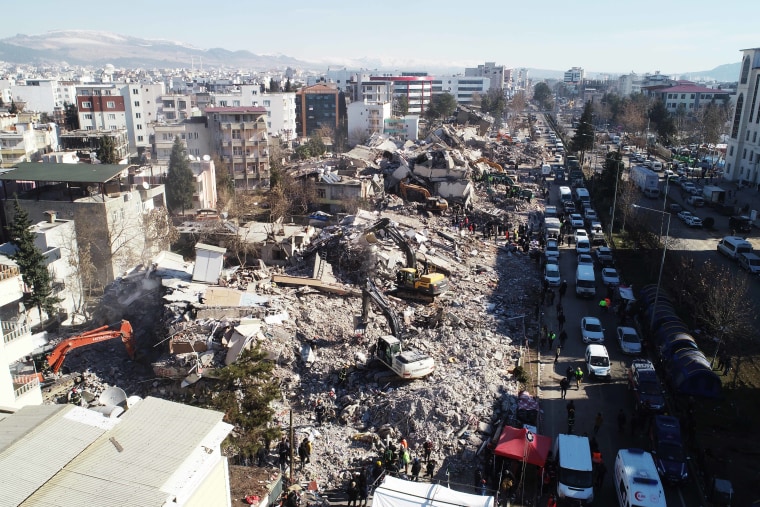
Collapsed buildings in the city of Van, Turkey on Thursday. Ozkan Bilgin / Anadolu Agency via Getty Images
Osman
Yıldırım, a civil engineer, said that after the last major earthquake
hit Turkey in 1999, a torrent of new regulations were introduced to make
buildings more resistant, but the government didn’t go far enough.
“This
could have been prevented with the right steps starting 25 years
ago,” said Yıldırım, 55, adding that unregistered construction work,
corruption and poor enforcement of regulations had put people in danger.
“The government didn’t take necessary steps to
minimize risks through urban planning, low-rise buildings, construction
codes and strict control,” he said, adding that as a result “new
buildings and old buildings collapsed.”
Faced with
mounting criticism, President Erdogan said on a visit to the disaster
zone on Wednesday that operations were now working normally and promised
no one would be left homeless.
Opposition leaders and
some social media users also blasted his government’s decision to block
access to Twitter for about 12 hours, from Wednesday afternoon to early
Thursday, as people scrambled to find loved ones and share information
on arriving aid and the location of those still trapped in rubble.
Turkish President Recep Erdogan speaks to the media as he visits the city of Kahramanmaras on Wednesday. AP
Turkish
authorities said they were targeting disinformation and, on Thursday,
Erdogan, who has come under scrutiny amid a cost-of-living crisis ahead
of a general election in May, hit back at critics saying “dishonorable
people” were spreading “lies and slander” about the government’s
actions.
Attempts to control the narrative "are likely
to fail," according to Yaprak Gürsoy, a professor of European politics
and chair of contemporary Turkish studies at the London School of
Economics.
“To assume that there will not be any socioeconomic and political consequences of this collective trauma is naivete,” she added.
Alex Holmes reported from Adiyaman, Ziad Jaber from Gaziantep and Aina J. Khan from London.
In the Pacific Ocean between Hawaii and California floats a massive collection of debris that has long been accumulating trash — from fishing nets to microplastics — known to be harmful to the marine environment. For years, researchers said it might not be possible to remove the Great Pacific Garbage Patch, but now, one non-profit is proving them wrong.
In July, The Ocean Cleanup, which has been developing a system to help clean up the Great Pacific Garbage Patch, took its first large-scale cleanup system, called System 002, or Jenny, to the Pacific. They conducted a series of tests over the course of 12 weeks, each one consisting of the system being taken offshore to safely gather plastic from the ocean.
The organization completed its final test of the system last week, and on Thursday, The Ocean Cleanup tweeted it had gathered 9,000 kilograms — more than 19,841 pounds — of debris.
"Holy mother of god," Boyan Slat, the founder of Ocean Cleanup, tweeted after the organization recovered its massive trash haul on October 8. "It all worked!!! Massive load."
Slat said that 10 years ago, when he first learned about the Great Pacific Garbage Patch, everyone told him "there was no hope of ever cleaning it up."
"They were right then; no method existed to do it," he tweeted. "Proud (and relieved!) to say that now there is."
The Ocean Cleanup says the Great Pacific Garbage Patch is one of the largest marine debris patches in the world. In 2018, research estimated that there are at least 79,000 tons of plastic inside a 1.6 million-square-kilometer area. Microplastics — plastic materials smaller than 5 centimeters — make up roughly 8% of the mass, but 94% of the estimated 1.8 trillion pieces of debris floating in the area, researchers found.
Marine garbage patches such as the one in the Pacific are large areas where debris collects, according to the National Oceanic and Atmospheric Administration. The aquatic piles are formed by rotating currents called "gyres," which are like "big whirlpools that pull objects in."
There are five gyres in the ocean — one in the Indian, two in the Atlantic and two in the Pacific — and each gyre contains garbage patches of different sizes. The Great Pacific Garbage Patch is the most famous of these piles.
Jenny works by two boats slowly guiding a U-shaped barrier through the polluted area. According to the organization, the circulating currents in the garbage patch move the plastic around, and their system helps guide that plastic into the system's retention zone. Once the system is full, workers empty the plastic on the marine vessel. After they gather as much debris as they can during the excursion, workers take the plastic to shore to recycle, and The Ocean Cleanup reuses some of the materials gathered to make products.
The system is designed to gather even microplastics, which are just millimeters in size.
The Ocean Cleanup also designed the system to be animal friendly. The boats tow it at roughly 1.5 miles per hour, so that marine life can easily swim in, out and around, and there are quick release systems, escape routes, cameras and lights to help animals escape the netting. Crew members also monitor marine life interactions.
Slat believes that about 10 upscaled systems could clean up the Great Pacific Garbage Patch, and that they could remove 50% of it in the first 5 years.
Slat said that many aspects need to be finessed, but that a fleet of The Ocean Cleanup's systems could clean it up. If properly deployed, the organization predicts it could remove 90% of all floating ocean plastic by 2040.
But the organization's mission has been met with some criticism from fellow climate activists and experts.
In September, Miriam Goldstein, director of ocean policy at the Center for American Progress, told Reuters that The Ocean Cleanup is "coming from a good place," but that priorities should be set on preventing plastic from entering the ocean.
"Once plastic has gotten into open ocean, it becomes very expensive and fossil-fuel intensive to get it back out again," Goldstein said.
While the organization was able to scoop up a massive haul of trash, more than 24 trillion pounds of plastic is dumped into oceans ever year, according to a 2020 study from the Pew Charitable Trusts. And without immediate and sustained action, the annual flow of pollution could nearly triple by 2040 — when The Ocean Cleanup says it could have the majority of floating plastics removed — the study said.
"Without meaningful change, about 4 billion people worldwide are likely to be without organized waste collection services by 2040, contributing significantly to the projected amount of ocean plastic pollution," Pew said in a press release. "Closing this gap would require connecting more than 500,000 people to collection services per day until 2040."
Microsoft and partners may be compensated if you purchase something through recommended links in this article.
(CNN)The US has surpassed 20,000 new Covid-19 cases for the fourth day in a row as the highly contagious Delta variant persists in its track in being the most common form of the coronavirus in the country.
The last time the country had back-to-back days of cases topping 20,000 was in May, according to the data.
Dr. Rochelle Walensky, who heads the US Centers for Disease Control and Prevention, said Thursday that more than 9 million people live in counties where cases are rising and where the vaccination rates are lower than 40%.
"Many of these counties are also the same locations where the Delta variant represents the large majority of circulating virus," she said.
Dr. Anthony Fauci, director of the National Institute of Infectious Diseases, said the variant could bring about mini-surges in infections in those areas.
"I'm concerned as this variant becomes more dominant, those select areas of the country that have a very low level of vaccination, like 30% or so, you're going to start seeing mini-surges that are localized to certain regions," he said Friday.
Enter your email to subscribe to the Results Are In Newsletter with Dr. Sanjay Gupta.
"You don't want to see two separate Americas, one that's vaccinated and protected and yet another that's unvaccinated and very much at risk," Fauci said.
Overall, 47.8% of the US population is fully vaccinated while 20 states have fully vaccinated more than half of their residents.
Sounding the alarm in Mississippi
The surge has alarmed officials in Mississippi, where only a third of the population is fully vaccinated.
"We're seeing a lot of outbreaks. We're seeing a lot of outbreaks in youth. We're seeing a lot of outbreaks in summer activities. We're also seeing a lot of outbreaks in nursing homes, where we have our most vulnerable people," he said.
Case numbers and hospitalizations are trending upward because of the spread of the virus mostly among those who are unvaccinated, State Epidemiologist Dr. Paul Byers said.
While the number of deaths hasn't risen, Byers said they anticipate that to change because death numbers tend to lag behind case numbers.
The state is advising seniors aged 65 and older to avoid mass gatherings until July 26, regardless of vaccination status.
People who are immunocompromised -- whose immune system is weaker -- are also recommended to follow the new guidance issued Friday.
Respiratory therapist Robert Blas administers the Covid-19 vaccine at a mobile clinic to residents in an East Los Angeles neighborhood which has a low vaccination rates, especially among the young, on July 9, 2021. Los Angeles County has been seeing exponential growth in Covid-19 cases in recent weeks.
Advice for those with upper respiratory symptoms
As cases rise, the CDC is urging all adults and children who exhibit upper respiratory symptoms to be tested for Covid-19, regardless of their vaccination status, Walensky told CNN on Friday.
While there is considerable overlap between symptoms of the common cold and Covid-19 as they are both respiratory diseases, not everyone will experience the same symptoms for either illness -- and some people might not experience any symptoms at all.
However, she said that people who are fully vaccinated should continue to feel very protected against serious illness.
A breakthrough infection should be thought of as "vaccine success" as opposed to vaccine failure, Walensky said, because the vaccine is doing what it was developed to do: prevent severe disease and death.
Breakthrough infections occur when fully vaccinated people contract the virus.
Early studies have also confirmed that most people who develop breakthrough infections do not replicate enough virus in their bodies to become contagious, she said. Even though people might test positive, they are not likely a source of the spread of the virus.
Will a booster be needed in the future?
After Pfizer announced Thursday that it's working to develop a third vaccine booster shot, questions emerged about the long-term effectiveness of vaccines.
In response, Fauci said people should take booster advice from federal health officials.
"Certainly, they need to listen to the CDC and the FDA, the FDA being the regulatory authority that has control over this. And the CDC, in accordance with their advisory committee on immunization practices, will make the recommendation," he said.
"We respect what the pharmaceutical company is doing, but the American public should take their advice from the CDC and the FDA," he said.
Dr. Peter Hotez, chair of tropical pediatrics at Texas Children's Hospital, said the current vaccines offer high protection.
"It looks like the two doses of the current vaccine are pretty robust against the Delta variant," Hotez said Friday. "So yes, we'll need a booster, but nothing to worry about right now in terms of vaccination."
Pfizer said it was seeing waning immunity from its vaccine -- manufactured in partnership with BioNTech -- and was picking up its efforts to develop a booster shot to offer further protection against variants.
Dr. Stephen Thomas, coordinating principal investigator for Pfizer/BioNTech's vaccine trial, said it wasn't unusual for vaccine-induced immunity to wane over time.
"What is the crucial point though, and which we don't know the answer to right now is, even though that immunity wanes over time, does it remain above a level which we need to protect people," he told CNN's Erin Burnett.
"I would kind of focus people on the point here, that the public health burden of Covid is severe disease, hospitalization and death," he said. "Even though these vaccine immune responses wane over time, they are very, very effective at preventing those three outcomes."
Federal guidance on school in fall encourages in-person learning
Meanwhile, the CDC on Friday said schools should prioritize in-person schooling in the fall but it was crucial to layer safety strategies such as masking and physical distancing, and most importantly, vaccinations for everyone eligible.
Schools that are ready to transition away from pandemic precautions as community transmission reaches low levels should do so gradually, the agency said in a draft of the guidance obtained by CNN.
"If localities decide to remove prevention strategies in schools based on local conditions, they should remove them one at a time and monitor closely (with adequate testing) for any increases in COVID-19 cases before removing the next prevention strategy," the guidance says, adding that schools need to be transparent with families, staff and the community as they do so.
Fauci agrees, adding that unvaccinated children should wear masks.
"I think that the message from the CDC is clear and I totally agree with them," Fauci told CNN. "We want all the children back in in-person classes in the fall term."
CNN's Deanna Hackney, Virginia Langmaid, Deidre McPhillips,Lauren Mascarenhas and Brisa Colón contributed to this report.