Saturday, September 6, 2025

I might have my own definition of enlightenment that has evolved during my life of 77 years so far. However, this is what I found online regarding what enlightenment is

begin quotes on Enlightenment: 

"Enlightenment" can refer to a European intellectual movement (c. 1637–1804) focused on using reason and logic to understand the natural world and improve human society, or to a state of spiritual wisdom and deep understanding achieved through religious practice. The European Enlightenment challenged traditional authorities, promoted ideas like natural rights and limited government, and influenced revolutions. Spiritual enlightenment, conversely, involves a profound personal realization of truth and unity with all things, a central goal in traditions like Buddhism and Hinduism.  
The European Enlightenment (17th-19th Century)
  • Core Principles:
    Thinkers emphasized rationalism and empiricism, using reason and observation to discover laws governing society. 

  • Key Ideas:
    The movement promoted ideas such as individual rights, religious tolerance, the social contract, and the importance of scientific progress and education. 

  • Impact:
    It led to the questioning of absolute monarchies, the development of democratic ideas, and the influence of figures like John Locke and Jean-Jacques Rousseau on the American and French Revolutions. 

  • Motto:
    The German philosopher Immanuel Kant summarized the era's philosophy with "Dare to know! Have courage to use your own understanding!". 

    Spiritual Enlightenment (Religious Context)
    • Definition:
      In a religious context, enlightenment means gaining wisdom, understanding, or spiritual awakening. 

  • Goal:
    It involves a deep, non-conceptual realization of the truth of existence, often leading to liberation from suffering and a sense of unity. 

  • Traditions:
    This concept is central to spiritual paths like Buddhism and Hinduism, where it is known by terms such as bodhi or moksha. 

  • Nature:
    It is described as a profound state of clarity and peace, where one transcends ego and sees the true nature of reality and interconnectedness. 

    • What is Enlightenment?[1] IMMANUEL KANT (1784)
      1. Enlightenment is man's emergence from his self-imposed immaturity. [2] Immaturity is the inability to use one's understanding w...
      The New York Public Library
    • Show all
    Dive deeper in AI Mode
    AI responses may include mistakes. Learn more
    Feedback
    Enlightenment is man's emergence from his self-imposed immaturity.[2] Immaturity is the inability to use one's understanding without guidance from another.
    7 pages
    Aug 19, 2025Enlightenment, a European intellectual movement of the 17th and 18th centuries in which ideas concerning God, reason, nature, and humanity were synthesized ...
    Enlightenment is man's emergence from his self-imposed nonage. Nonage is the inability to use one's own understanding without another's guidance.
    A much-cited definition of a lack of enlightenment as people's inability to think for themselves due not to their lack of intellect, but lack of courage.
    by W Bristow2010Cited by 467In the Enlightenment, philosophical thinkers confront the problem of developing ethical systems on a secular, broadly naturalistic basis for the ...
    Feb 17, 2023The Enlightenment was an intellectual movement in the seventeenth and eighteenth centuries that sought to improve society through fact-based ...
    Enlightenment is the purification of all negative states of mind, and the flourishing of all positive states of mind.
    83 answers  ·  Top answer: "finding the present moment" is how it feels to me. Being able to pause your thoughts and ...
    9:06
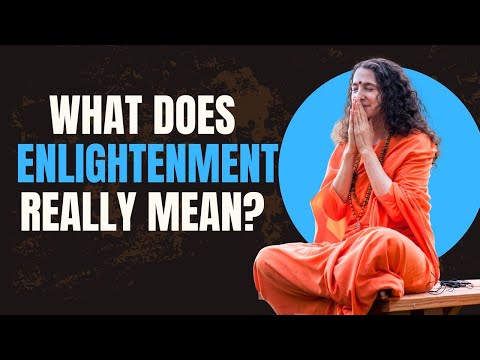
    What Does Enlightenment Really Mean
    650+ views · 1 month ago
    Sadhviji · YouTube
    Spiritual leader & author
    What is enlightenment? Is there a "path" to it?
    Top comment · Nonduality is rife with paradox. Many times two or more seemingly conflicting or incongruent things are both true. On one hand, we are already awareness itself which is fully awake. We have only to effortlessly notice it. On the other had, one glimpse of awareness isn't enough to completely dispel all illusion of separateness forever. So we keep doing it repeatedly until it becomes more and more stabilized. Eventually there's a tipping point (suddenly and/or gradually) it becomes the norm. So awakening/enlightenment can be viewed as something already is the case, but requires familiarization. From the point of view of nondual awareness, a linear progression over time is a complete illusion, so some teachers never concede to that notion. On the other hand, from the conventional, relative perspective, it seems that way, so keeping at it over time is a useful instruction. Here's the catch though: the “linear progression over time” perspective mistakenly thinks that enlightenment is some future, far off event. That can cause us to miss the obvious fact that awake awareness is already here right now. We dan spend years or decades chasing after what we already are. It's a cul de sac based on a misunderstanding. So whenever you get caught in a “one day I'm going to get enlightened” thought, get right out of it and become aware of being aware right now. “This very mind is the Buddha.” —Mazu Concentration is an exercise of sustained attention and by itself will never lead to that insight. However, it does intensify the impact of glimpses of awareness because the mind is steadier. Insights have more of a penetrative effect. So this varies by tradition and even by teacher. Some advocate not training attention and only looking right at awareness all day long. Others develop a high degree of attention and then use that to do nondual direct pointing at awareness. And some are in between those extremes. All roads lead to Rome. Whatever works. You move to direct experience by doing a nondual technique for glimpsing the awareness you already are. Rupert Spira has very clear instructions, IMO, as do several other teachers. These include, self-inquiry (looking back at the knower of experience, a la Ramana Maharshi), watching the luminous sense of presence (a la Nisargadatta, John Wheeler, Sailor Bob, Rupert Spira), watching the spaces in between thoughts, noticing the space in between the in- and out-breaths. There are many methods, all of which are good.
    .
    Latest comment · "There is no path because it's what you are already", but something prevents you from seeing what you already are. What is this thing? Isn't it the mind itself that creates this thing that prevents you from seeing what you already are? Do you think that a practice of concentrating, calming, in short, a practice of "improving" the mind will somehow transform you into what you already are?
    .
    30+ comments · Jul 4, 2025
    r/nonduality
    Reddit
    1:01
    What Actually is Enlightenment?
    3K+ views · Jun 24, 2025
    Vishrant · YouTube
    Buddhist teacher

    10:16
    A Guru Who Claims Enlightenment Is Not Enlightened - Here is Why
    3.8K+ views · Jun 13, 2025
    The Chopra Well · YouTube
    Indian-American author
    Enlightenment is the human being's emergence from his self-incurred minority. Minority is inability to make use of one's own understanding without direction ...
    2:22
    Broadly speaking, the Enlightenment was an intellectual and philosophical movement, largely based in Europe, that spanned about a century—from ...
    People also search for
    Age of Enlightenment
    The Age of Enlightenment was a European intellectual and philosophical movement that flourished primarily in the 18th century. Characterized by an emphasis on reason, empirical evidence, and scientific method, the Enlightenment promoted ideals of individual liberty, religious tolerance, progress, and natural rights.WikipediaMore
  • What Is Enlightenment? : r/Meditation - Reddit
    Sep 7, 2024 — In the context of meditation, Enlightenment refers to a profound and transformative state of awareness or realization.
    Reddit · 
    r/Meditation
  • The Enlightenment period (article) - Khan Academy
    Several ideas dominated Enlightenment thought, including rationalism, empiricism, progressivism, and cosmopolitanism. Rationalism ...
    Khan Academy
  • No comments: