begin quote from NBC NEWS:
‘Strong' El Niño may be brewing. Here's what it could mean for Southern California
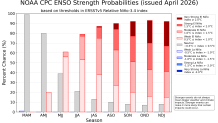
According to the National Weather Service Climate Prediction Center, there’s a 61% chance El Niño is "likely to emerge" between May and June, and "persist" through the end of 2026.
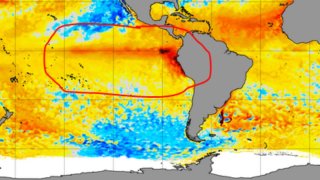
A look at water temperatures from satellite during an El Niño event, via NBCLA’s First Alert Forecast. The redder colors are warmer than average water temperatures. The stripe of warmer temps along the equator is El Niño (circled).
After two winters of La Niña, an official “El Niño Watch” is underway, the National Weather Service Climate Protection Center said Thursday.
In its latest ENSO Alert System Status report, the Climate Protection Center said there’s a 61% chance that an El Niño is “likely to emerge” between this May and June, and “persist through at least the end of 2026.”
The agency’s outlook also notes there’s a 25% chance that the Pacific seasonal variation could develop into a “strong” or “very strong” El Niño this winter.
“The possibility of a very strong El Niño largely depends on the continuation of westerly wind anomalies across the equatorial Pacific throughout the Northern Hemisphere summer months, which is not assured,” the Climate Protection Center’s report said.
What is El Niño?
“El Niño is a warming of the water in the equatorial Pacific off the coast of South America, typically peaking during the winter months,” NBCLA meteorologist David Biggar explained. "The warming of the water causes changes to atmospheric patterns.”
El Niño misconceptions
There are many myths and misconceptions about El Niño and what it means for our weather.
For starters, El Niño is not a storm.
While it may influence global weather patterns, Biggar said it does not generate storms or weather systems.
“El Niño is not a guarantee of wetter winters,” he added.
According to the Climate Prediction Center’s report, stronger El Niño events “do not always mean bigger weather and climate impacts.”
“Stronger events can make it more likely that certain impacts can occur,” the report said.
Because El Niño is not a storm, it can’t be spotted on weather radar and therefore can’t “hit” a region.
There is no such category as a “super” El Niño, but the Climate Prediction Center’s current outlook does show the possible emergence of a “strong” El Niño.
“We categorize El Niño strengths based on the how far the water temperature is from normal. The categories range from ‘weak’ to ‘very strong.’ El Niño is a seasonal variation, not an individual weather system,” Biggar explained.
Biggar also noted that this year’s El Niño isn’t arriving early, rather it’s developing “when El Niño conditions typically develop.”
2:06
What's the difference between El Niño and La Niña?
El Niño’s impact on Southern California
But what does the buzzy weather pattern mean for Southern California?
“It is hard to say,” Biggar said. “The change in ocean temperatures can affect weather patterns across the globe, but no two El Niños are alike. El Niño is just one part of an extremely complex puzzle that makes up the atmosphere and what we see with day-to-day weather.”
That also means it’s hard to predict if the emergence of El Niño this year will lead to a wet winter in SoCal.
“Our rainfall depends more on the number of atmospheric rivers, and the strength of them, through the winter,” Biggar explained. “Some El Niño seasons have been dry, some wet, and others are closer to average.”
The most recent “strong” El Niño was in 2023-2024.
The last “very strong” El Niño — one of the strongest on record — was in 2015-2016, which ended up being one of the driest years ever for Los Angeles.
Biggar said one of California’s worst drought years occurred during an El Niño in 1976-1977, but then the following year, still during an El Niño, the state had more than double its average rainfall with nearly 31 inches of rain.
Although results vary, Biggar said El Niño could bring with it an increase in Pacific hurricanes and decrease in Atlantic.
“Some parts of the globe will see dry weather, and sometimes North America will see wetter than average weather,” he said. “During the summer as El Niño develops, we may see above average temperatures in Southern California.”


No comments:
Post a Comment