Solar Orbiter captures the highest-resolution images of the sun’s surface yet

Sign up for CNN’s Wonder Theory science newsletter. Explore the universe with news on fascinating discoveries, scientific advancements and more.
New images of the sun captured by the Solar Orbiter mission showcase the highest-resolution views of our star’s visible surface ever seen, revealing sunspots and continuously moving charged gas called plasma. The images could provide heliophysicists with new clues to help unlock the secrets of the sun like never before.
The images, taken on March 22, 2023, and released Wednesday, showcase different dynamic aspects of the sun, including the movements of its magnetic field and the glow of the ultrahot solar corona, or outer atmosphere.
The spacecraft relied on two of its six imaging instruments, including the Extreme Ultraviolet Imager, or EUI, and Polarimetric and Helioseismic Imager, or PHI, to capture the images from 46 million miles (74 million kilometers) away.
The Solar Orbiter, a joint mission between the European Space Agency and NASA that launched in February 2020, orbits the sun from an average distance of 26 million miles (42 million kilometers). Missions like Solar Orbiter and NASA’s Parker Solar Probe are helping to answer key questions about the golden orb, such as what fuels its stream of charged particles called the solar wind and why the corona is so much hotter than the sun’s surface.
Parker Solar Probe is poised to make the closest approach to the sun attempted by a spacecraft in late December, while Solar Orbiter is tasked with taking the closest-ever images of the sun’s surface. The flight path of the Parker Solar Probe will take it too close to the sun to carry cameras and telescopes, but Solar Orbiter is outfitted with an array of instruments to share its unique observations of the sun.
What’s more, the Solar Orbiter and Parker Solar Probe are studying the sun at close distances at an ideal time — during the peak of its annual cycle.
“The Sun’s magnetic field is key to understanding the dynamic nature of our home star from the smallest to the largest scales,” said Daniel Müller, Solar Orbiter’s project scientist, in a statement.
“These new high-resolution maps from Solar Orbiter’s PHI
instrument show the beauty of the Sun’s surface magnetic field and
flows in great detail. At the same time, they are crucial for inferring
the magnetic field in the Sun’s hot corona, which our EUI instrument is
imaging.”
Stunning solar portraits
Together, the new images showcase the sun’s varied and complex layers.
The Polarimetric and Helioseismic Imager took the highest-resolution full views of the sun’s visible surface, or photosphere, to date. Nearly all radiation from the sun originates from the photosphere, with sizzling temperatures ranging between 8,132 and 10,832 degrees Fahrenheit (4,500 and 6,000 degrees Celsius).
Rippling beneath the photosphere layer is hot plasma that shifts around in the sun’s convection zone, similar to how hot magma moves within Earth’s mantle.
The PHI instrument’s purpose is to map the brightness of the photosphere and measure the speed and direction of the sun’s magnetic fields.
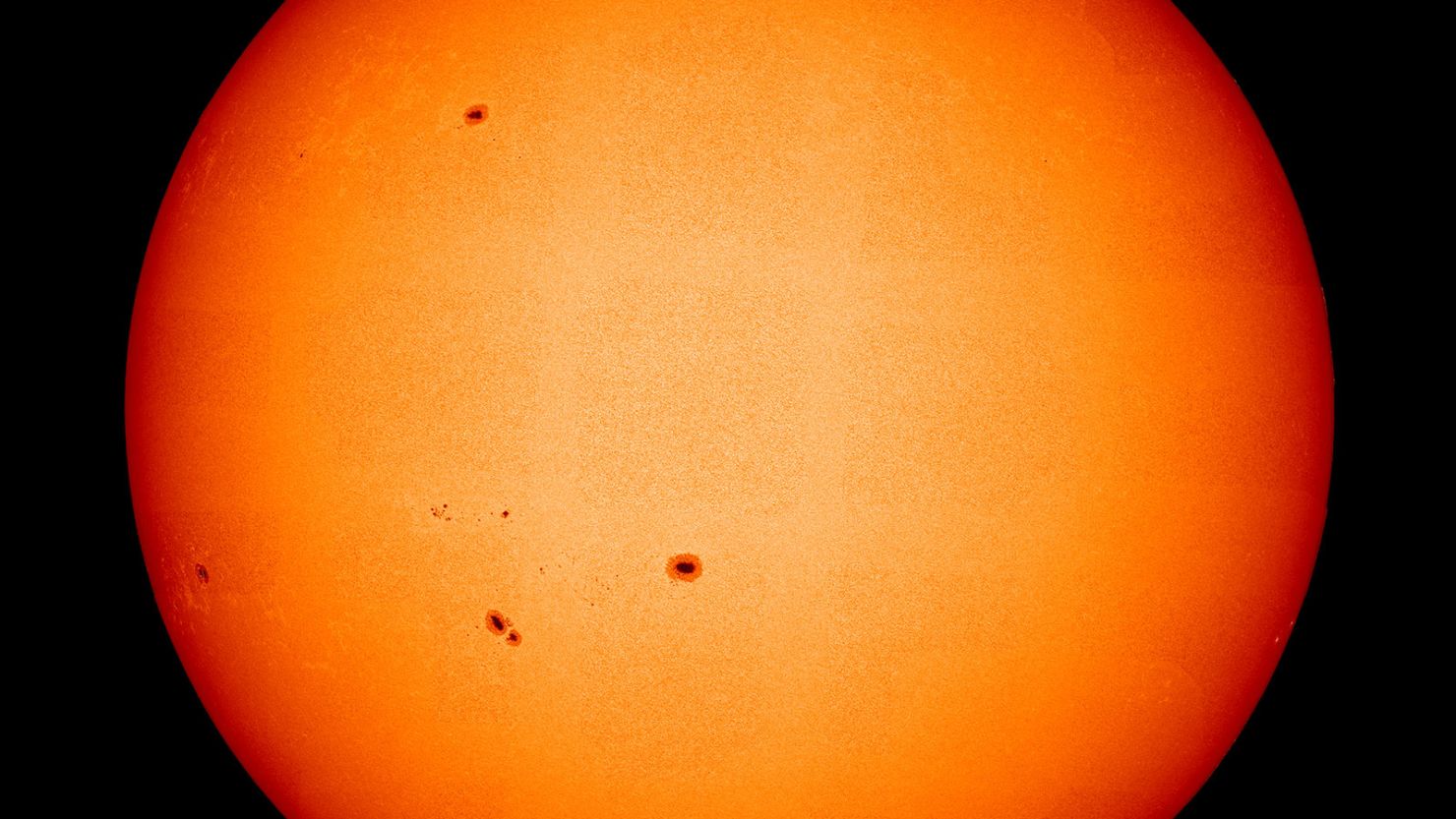
The visible light image of the photosphere showcases sunspots, which resemble holes on the solar surface. These dark regions, some of which can reach the size of Earth or larger, are driven by the sun’s strong and constantly shifting magnetic fields. The spots, regions where the sun’s magnetic field breaks through the surface, are cooler than their surroundings and give off less light.
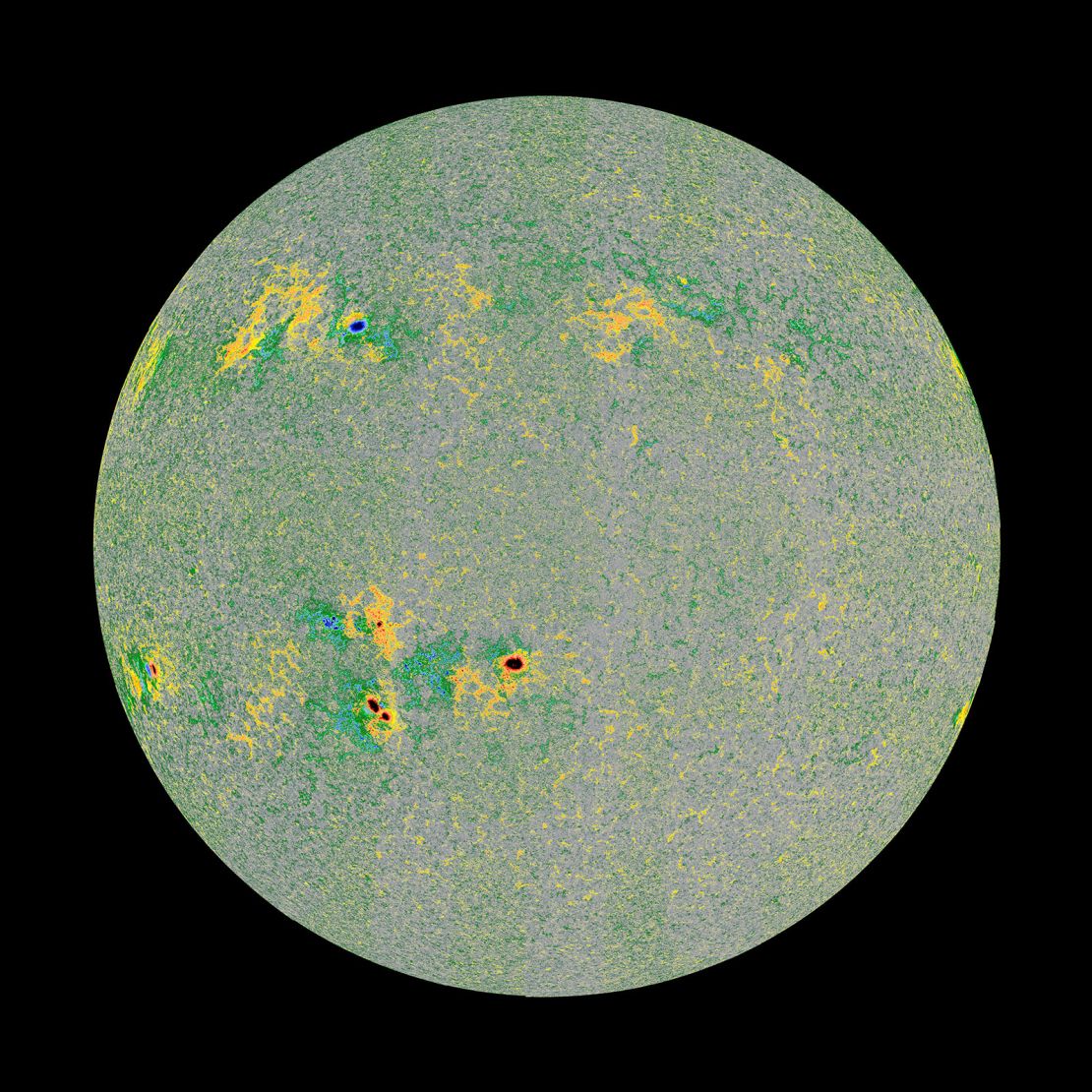
The PHI instrument also enabled scientists to take a magnetic map, or magnetogram, which shows concentrations of the sun’s magnetic field within its sunspot regions. Typically, convection helps move heat from inside the sun to the solar surface, but this process becomes disrupted when charged particles are forced to follow the magnetic field lines clustering around the sunspots.
Scientists also measured the speed and direction of material on the sun’s surface using a velocity map, or “tachogram.” The blue portions indicate movement toward Solar Orbiter, while red shows what is moving away from the spacecraft.
Charged gas on the sun’s surface generally moves in tandem with how the sun rotates on its axis, while the plasma is actually forced out around the sunspots.
Meanwhile, the Extreme Ultraviolet Imager observes the sun’s corona to help determine why it is significantly hotter than the photosphere, reaching 1.8 million degrees Fahrenheit (1 million degrees Celsius). The EUI’s image of the corona provides a snapshot of what occurs above the photosphere, and the hot, glowing plasma can be seen protruding from the sunspot regions.
Given Solar Orbiter’s proximity to the sun, the spacecraft had to be rotated after each image to capture every part of the sun’s face. As a result, each image is the result of a mosaic of 25 individual images.

Mark Miesch, research scientist at the National Oceanic and Atmospheric Administration’s Space Weather Prediction Center, appreciated that both large-scale features, like solar magnetism, and small-scale features on the surface can be seen in the images. Miesch was not involved with the image release.
“The closer we look, the more we see,” said Miesch, who is also a research scientist at the Cooperative Institute for Research in the Environmental Sciences at the University of Colorado. “To understand the elaborate interplay between large and small; between twisted magnetic fields and churning flows, we need to behold the sun in all its splendor. These high-resolution images from Solar Orbiter bring us closer to that aspiration than ever before.”
A dynamic time for the sun
Scientists from NOAA, NASA and the international Solar Cycle Prediction Panel announced in October that the sun has reached solar maximum, or the peak of activity within its 11-year cycle. At the peak of the solar cycle, the sun’s magnetic poles flip, causing the sun to transition from calm to active. Experts track increasing solar activity by counting how many sunspots appear on the sun’s surface. And the sun is expected to remain active for the next year or so.

“This announcement doesn’t mean that this is the peak of solar activity we’ll see this solar cycle,” said Elsayed Talaat, director of space weather observations at NOAA, at an October news conference. “While the sun has reached the solar maximum period, the month that solar activity peaks on the sun will not be identified for months or years.”
Solar activity, including flares or coronal mass ejections, create space weather that impacts Earth. Coronal mass ejections are large clouds of ionized gas called plasma and magnetic fields that erupt from the sun’s outer atmosphere. The solar storms generated by the sun can affect electric power grids, GPS and aviation, and satellites in low-Earth orbit. Storm activity also causes radio blackouts and even pose risks for crewed space missions.

The storms are also responsible for generating auroras that dance around Earth’s poles, known as the northern lights, or aurora borealis, and southern lights, or aurora australis. When the energized particles from coronal mass ejections reach Earth’s magnetic field, they interact with gases in the atmosphere to create different colored light in the sky.
On December 24, Parker Solar Probe will come within 3.86 million miles (6.2 million kilometers) of the solar surface, closer than any human-made object to the sun. The flyby could help scientists study the origins of space weather directly at the source, as the probe will zoom close enough to sail through plasma plumes and solar eruptions connected to the sun.
12 comments


No comments:
Post a Comment