begin quote from:
Trump reverses course on 20% fee for Strait of Hormuz cargo
U.S.-Iran War Latest: Trump reverses course on 20% fee for Strait of Hormuz cargo, citing trade deals
What to know about the Iran war today:
- President Trump said Tuesday he "decided to replace" a 20% fee on shipping cargo through the Strait of Hormuz, which he announced a day before, with trade and investment deals from Gulf states.
- The price of international benchmark Brent crude oil had shot up to a one-month high over $86 a barrel early Tuesday after Mr. Trump said the U.S. would charge the 20% fee and reinstate a blockade of Iranian ports. He reaffirmed his position Tuesday on the blockade, saying the strait was open to all traffic "except for Iran."
- The U.S. military said it conducted a third consecutive night of strikes on Iran Monday that included the first combat use of sea drones to hit a naval base.
European countries should step up to help reopen Strait of Hormuz, GOP senator says
The renewed fighting over the Strait of Hormuz, and subsequent closure, is another reason for European countries to aid the U.S. in reopening the strait, Republican Sen. John Hoeven of North Dakota said Tuesday.
President Trump has repeatedly called on European countries to assist in security operations in the strait, bashing NATO countries for not heeding his call when asked.
"Certainly the European countries [benefit from the strait being open], that's where they get a lot of their oil and certainly all the Middle East countries, because that's how they get their revenues as they sell oil," Hoeven told reporters on Capitol Hill. "So, now they have a choice. They either step up and work with us and we'll solve this sooner, or they can sit and watch us do it, and then they need to pay some of the freight."
Democrats continued to pan the Trump administration for the latest closure of the Strait of Hormuz and the renewed military operations.
"The ceasefires continue to break down because this administration has no clear or strategic concept what it is doing," Connecticut Sen. Richard Blumenthal told reporters. "The MOU had such gaping holes that it invited Iran to take over the Strait of Hormuz. No one should be surprised by this continuing conflict, because Iran was given every reason to believe in that document that it would continue to control the Strait of Hormuz. And bad negotiating, bad drafting, bad thinking, and total confusion and chaos are the reason why this conflict is continuing on the part of the administration."
India summons Iranian diplomat to protest after ships attacked
India summoned Iran's senior diplomat in New Delhi on Tuesday to protest against attacks on two commercial vessels in the Strait of Hormuz that killed an Indian seafarer and wounded several others.
The Indian foreign ministry said it had summoned the deputy chief of mission of the Iranian embassy to register "a strong protest" against the attacks reported early on Tuesday.
The two vessels had a total of 46 crew members aboard, including 30 Indians, one of whom has "tragically lost his life," it said in a statement.
"India is deeply concerned by the attacks on two vessels, MT Al Bahiyah and MT Mombasa, during their transit through the Strait of Hormuz today," it said.
The Iranian embassy declined to comment when contacted by AFP.
Hormuz closure could have rights impact, United Nations says
The United Nations on Tuesday condemned the renewed hostilities in the Middle East, warning that closing the Strait of Hormuz again would have a dire impact on human rights beyond the region.
U.N. rights chief Volker Turk called renewed fighting "a huge setback for civilians in the region and beyond." He warned of the "impact on human rights far beyond the region" of Iran's announced closure of the Strait of Hormuz, a crucial shipping route through which one-fifth of the world's oil passed before the war erupted in February.
The strait "is a vital lifeline on which millions are reliant," Turk said in a statement.
"Disruptions to the flow of food, medicines, and other necessary commodities have severe socioeconomic and humanitarian consequences," he said.
Turk called for Washington and Tehran to halt attacks "immediately" and return to their ceasefire.
Strikes hit Iran's Gulf island of Qeshm, says Iranian state TV
Projectiles hit Iran's Gulf island of Qeshm near the Strait of Hormuz on Tuesday, Iran's state broadcaster reported, citing local officials who blamed the U.S.
"At 19:00, a location on Qeshm Island was struck by projectiles from the American enemy," Hormozgan governor's office said, according to IRIB.
Fars news agency earlier reported that explosions were heard on the island.
"Around 6:45 pm, the sound of several explosions was heard on Qeshm Island," Fars said. "In recent days, the Masan area of Qeshm has been attacked several times by the American enemy."
It comes after the U.S. launched a fresh wave of strikes on Iran and Mr. Trump vowed to reimpose a naval blockade on Iran, prompting Tehran to respond with strikes on targets in countries around the region.
Blasts heard in Kuwait as army says it's intercepting "aerial targets"
Explosions were heard in Kuwait City on Tuesday, an AFP journalist reported, as the Gulf nation's army announced for the second time in less than half an hour that it was intercepting "hostile" targets.
"The General Staff of the Kuwait Armed Forces announces that any explosions are the result of the Air Defense systems intercepting hostile attacks," the army said in its statements, without providing further details.
Flightradar24 said flights to Kuwait were holding amid reports of ongoing missile launches from Iran.
—CBS/AFP
Trump says he reversed course on 20% fee after other countries called him: "I don't think anybody should be able to charge a fee"
President Trump said Tuesday he changed his mind on charging 20% Strait of Hormuz cargo fees after many countries called him. European allies and others were highly critical of the idea.
"I was called by different people, different countries," the president told reporters shortly after announcing the fee reversal. "Kings and emirs ... and they said, 'We'd love to do it a different way. We'd love to invest in the United States with billions and billions of dollars.'"
"I like that actually because I don't think anybody should be able to charge a fee for the strait," said the president, who had proposed the fee on Monday.
Still, the president said the U.S. should benefit in some way from securing the strait, which was open before the U.S. and Israel launched the Iran war.
55 Iranian fishermen freed from UAE custody, Reuters reports
Fifty-five Iranian fishermen have been released from custody in the United Arab Emirates, according to the Reuters news agency.
Citing the Telegram channel of the Iranian embassy in the Emirates, Reuters said the mariners were detained by the Emirati coast guard in the last few months due to "special conditions" in the region, in what presumably is a reference to the war in Iran.
The embassy added that the procedure for sending the fishermen home has begun.
Trump maintains position on Iran blockade
President Trump maintained his position Tuesday on the reinstatement of the Iran blockade, which he announced a day before.
He said on Truth Social "the Strait of Hormuz is open to ALL Ship traffic except for Iran - and that is because of their lying, violent, malicious leadership, which is taking them down the path of TOTAL DESTRUCTION."
"We will therefore have a FULL Blockade, but only on Ships coming to and from Iranian ports, or carrying anything have to do with Iranian cargo," he said.
He made the comments as he announced the reversal of a 20% fee on cargo shipped through the strait, saying he decided to replace that fee with investment and trade made by Gulf states. The president said he made that decision "based on highly productive conversations with Middle East leadership."
Trump reverses course on 20% fee for Strait of Hormuz cargo
President Trump said Tuesday that he "decided to replace the 20%" fee he said the U.S. would charge shippers on cargo transported via the Strait of Hormuz with trade and investment deals that Gulf States will make.
"Based on highly productive conversations with Middle East leadership, I have decided to replace the 20% United States Reimbursement Fee with Trade and Investment Deals that the various Gulf States will be making into the United States," the president said Tuesday on Truth Social.
The announcement marked a reversal of a policy he announced a day earlier on Truth Social, amid widespread backlash from shippers. Mr. Trump had said Monday that the U.S. would "take" the strait, control it, and "get paid for guarding it, a lot of money."
Shipping industry analysts and logistics companies balked on Tuesday at Mr. Trump's stated intention to impose a fee to cover U.S. security costs incurred as the "guardian" of the strait, calling it illegal and estimating the cost per ship at upwards of $30 million for large tankers.
Netanyahu warns Iran: "Do not count on things remaining quiet if you attack us"
Israeli Prime Minister Benjamin Netanyahu warned Iran Tuesday that Israel would hit back if attacked.
"Do not count on things remaining quiet if you attack us," Netanyahu said at a conference in Dimona, in Israel's southeast, in a video released by his office. "The days are over when someone strikes us and we don't hit back with a decisive blow."
Israeli troops have been fighting Iranian-backed Hezbollah in southern Lebanon since the Iran war began.
Iran has warned that any peace deal with the U.S. must include an Israeli withdrawal from the country, which Israel has refused to do until Hezbollah is disarmed. Hezbollah, a powerful Iranian proxy group long classified as a terrorist group by the U.S. and Israel, has flatly rejected calls to lay down its arms voluntarily.
Former Iran leader Ahmadinejad's office rejects New York Times report about Israeli contact
The office of former Iranian President Mahmoud Ahmadinejad denied on Tuesday a New York Times story alleging he was in contact with Israeli intelligence agents who had been grooming him to be installed as Iran's new leader.
In a statement posted to his Telegram channel, Ahmadinejad's team said the report was "completely false" and "an effort to sow discord."
It said the newspaper had first published the claims 55 days ago and was now repeating the "same disgraceful scenario" with additional fabricated details.
"We announce to the noble and honorable people of great Iran that their beloved and devoted son remains, as always, steadfast and actively engaged in his daily affairs and in the service of each and every one of them," the statement added.
U.S. military says blockade of Iran's ports to resume today at 4 p.m. Eastern
The U.S. military will reimpose its naval blockade of Iranian ports Tuesday at 4 p.m. Eastern on President Trump's orders, Central Command said in a statement.
CENTCOM said it would "resume blockading maritime traffic entering and exiting Iranian ports," reviving the blockade that was in place from mid-April to mid-June, until the U.S. and Iran signed a memorandum of understanding intended to completely reopen the Strait of Hormuz.
During that time, CENTCOM said its forces "redirected more than 140 compliant vessels, disabled nine non-compliant ships, and allowed over 50 commercial vessels supporting humanitarian aid to pass through."
U.S. forces also attacked Iranian-linked commercial vessels, with one strike killing three Indian mariners.
The statement said the U.S. military would "support traffic flow" for non-Iranian linked vessels, and it advised mariners to contact U.S. naval forces when in the vicinity of the strait and the Gulf of Oman to coordinate passage.
The United Arab Emirates said Monday that Iranian cruise missiles hit two oil tankers in the Strait of Hormuz, killing one crew member and wounding eight.
Israel says ready to "move forward" on Lebanon "pilot zones" in Rome talks
Israel's foreign minister said Tuesday that he expected ongoing negotiations with Lebanon taking place in Rome to help implement an agreement on two "pilot zones" in the south of the country, from which Israeli forces could be withdrawn.
Under an agreement reached between the two countries in late June, Israel will slowly withdraw troops from areas of southern Lebanon as Lebanese forces are able to move in and secure the ground. The two small "pilot zones" would be taken over by the Lebanese army.
"We are ready to move forward implementing these two pilot zones," Gideon Saar told journalists in Jerusalem. "I hope and tend to believe that this round of discussions in Rome will promote it."
Iran made the withdrawal of Israeli forces from Lebanon a key demand in its recent direct and indirect peace talks with the U.S.
Israel has said it will not withdraw its troops, who currently control a wide section of southern Lebanon, extending at least six miles from the northern Israeli border, until Hezbollah is disarmed. The Iranian-backed group has flatly refused to lay down its arms.
CBS/AFP
Iran's "Gulf Strait Authority" claims more than 200 foreign vessels coordinated for transit before closure
Iran's Persian Gulf Strait Authority claimed Tuesday that, before Iran declared the Strait of Hormuz closed again over the weekend after "provocations" by U.S. forces in the region, more than 200 foreign vessels had coordinated their movements with the PGSA during the three weeks following the signing of a memorandum of understanding with the U.S.
The U.S. has rejected Iran's assertion of a closure, and President Trump has continued insisting the strait is open, via a southern route close to Oman's coast, and that the U.S. will maintain control of the strategic waterway.
According to the PGSA statement on Tuesday, the vessels that sought and received permission to use the other, northern route through the strait included tankers, bulk carriers, container ships, liquefied natural gas carriers and other commercial vessels. Most were tankers, it said.
It added that the coordination process covered both inbound and outbound traffic through the Strait of Hormuz, which is the sole maritime gateway to the Persian Gulf.
Shipping company says any fees imposed in Strait of Hormuz would be "fundamentally wrong"
Any imposition of fees on the transport of cargo through the Strait of Hormuz would be "fundamentally wrong," German logistics company Hapag-Lloyd said Tuesday, after President Trump declared that the U.S. would charge a 20% fee on shipments through the vital waterway to cover security costs .
"It would be fundamentally wrong to charge tolls for passage through international waters," a spokesperson for the shipping giant told CBS News. "Tolls for infrastructure such as the Suez Canal or Panama Canal are different, because they reflect major infrastructure investments. That is not the case in the Strait of Hormuz."
Mr. Trump said Monday that the U.S. would be the "guardian" of the strait, which is the only route for cargo ships and tankers to access the ports of major energy producers in the Persian Gulf.
He also said the U.S. was reinstating its naval blockade of Iranian ports and associated vessels, and that the U.S. would be "reimbursed" for costs associated with providing security in the strait by imposing a 20% fee on all cargo shipped through the narrow passage.
Oman says it is working with all parties to restore freedom of navigation in Strait of Hormuz
Oman's Foreign Ministry said Tuesday that the country - which has held talks with Iran about a possible joint mechanism to control maritime traffic in the Strait of Hormuz — that it remained in cooperation with "all parties" as part of efforts to restore free use of the vital waterway.
"Oman continues its transparent and neutral cooperation with all parties to restore freedom of navigation in the Strait, in full compliance with international law," the ministry said in a statement shared on social media.
The statement added that Oman was "fully committed to its obligations as a State Party to the United Nations Convention on the Law of the Sea and calls on all parties to respect and abide by international law."
President Trump said Monday that the U.S. would take and maintain control over the Strait of Hormuz and charge a 20% fee to cover security costs on all cargo transported through the vital waterway.
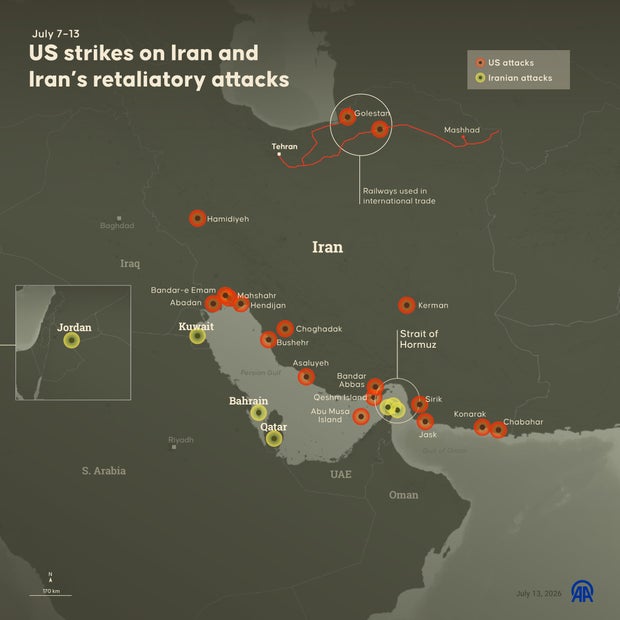
Map shows sites of U.S. strikes and Iran's retaliation from July 7 to 13
A map released by Anadolu via Getty Images shows shows the locations of U.S. strikes on Iran and Tehran's retaliatory attacks across the region.
U.S. strikes reportedly hit Iranian port city
U.S. strikes on Tuesday hit the port city of Bushehr, which hosts Iran's only civilian nuclear power plant, local authorities said.
"Four points in the city of Bushehr were hit by enemy projectiles," deputy provincial governor Ehsan Jahanian was quoted by official news agency IRNA as saying, blaming the attacks on the United States.
The U.S. did not immediately claim the attacks, and U.S. Central Command (CENTCOM) said Monday evening that it had completed its latest round of strikes on Iran, which lasted around five hours.
Other unclaimed airstrikes hit Iran last week after the U.S. said it had finished attacks, raising questions of who else may be targeting the Islamic Republic.
India condemns Iranian attack on tanker that killed a sailor
India has condemned Iranian attacks on two commercial vessels near the Strait of Hormuz that killed an Indian national and injured 10 others.
The United Arab Emirates' Ministry of Defense said Monday that Iranian cruise missiles hit the oil tankers near Oman's coast.
"We strongly condemn these attacks and acts of violence targeting seafarers and disrupting free and safe navigation through international waterways like the Strait of Hormuz," India's Ministry of External Affairs said in a statement Tuesday.
The MT Al Bahiyah and MT Mombasa vessels came under attack during their transit through the strait, the ministry said, adding that an Iranian diplomat in New Delhi was summoned Tuesday to hear a "strong protest" over the incident.
In June, three Indian mariners were killed in a U.S. strike on an Iranian tanker, prompting India's government to summon a senior U.S. diplomat to register a "strong protest"
Oil price surges to a one-month high
The price of Brent crude, considered the international benchmark for the price of oil, rose to a one-month high of over $86 on Tuesday, still well below the nearly $120 reached at the height of the war but threatening to make costs everywhere higher.
The price spike comes as the region appears to return to a full-scale war, with the U.S. carrying out three consecutive days of strikes on Iran and Iran retaliating with repeated attacks targeting commercial vessels in the Strait of Hormuz and U.S. allies in the Persian Gulf.
Bahrain sounds missile alert siren as Iran retaliates for U.S. strikes
Bahrain sounded its missile alert siren for the third time Tuesday morning as Iran retaliated over U.S. strikes targeting it.
The island kingdom, home to the U.S. Navy's 5th Fleet, urged the public to take shelter.
There was no immediate information on any damage or casualties caused by the attacks.
Iran claimed multiple rounds of attacks targeting Bahrain on Tuesday.
Iran also targeted Jordan and two tankers associated with the United Arab Emirates traveling through the Strait of Hormuz, killing one mariner and wounding eight others.
Trump says "we control" Strait of Hormuz
In an interview on Newsmax, President Trump insisted the U.S. controls the Strait of Hormuz, as Iran presses for control over the waterway and strikes ships that do not comply.
"They can make trouble, they can do things that are not nice, but we control it," Mr. Trump said.
The president said earlier Monday the U.S. will serve as "guardian angel" of the Strait of Hormuz and charge for transit. But Iran has not ruled out charging tolls of its own, and earlier this year, many shippers essentially complied with Iran's threats against vessels that sail through the strait without its permission, causing traffic through the strait to grind to a virtual halt.
At its narrowest point, the Strait of Hormuz is split between Iranian and Omani waters, but passage through the strait — which normally carries one-fifth of the world's oil — has traditionally been open and free of charge.
Mr. Trump also reiterated on Newsmax that he plans to revive a U.S. blockade on Iranian ports.
"We're going to let everyone get through, except if you're doing business with Iran," he said.
CENTCOM says latest round of strikes on Iran is complete
The U.S. military hit Iranian targets in a more than five-hour-long operation Monday evening, U.S. Central Command said on X.
CENTCOM said its targets included missile and drone sites. It said it struck areas including the ports of Bandar Abbas and Bushehr.
Iran targeted 2 oil tankers, killing 1 crew member and injuring 8, UAE says
Iranian cruise missiles hit two oil tankers in the Strait of Hormuz, killing one crew member and injuring eight, the United Arab Emirates' Ministry of Defense said Monday.
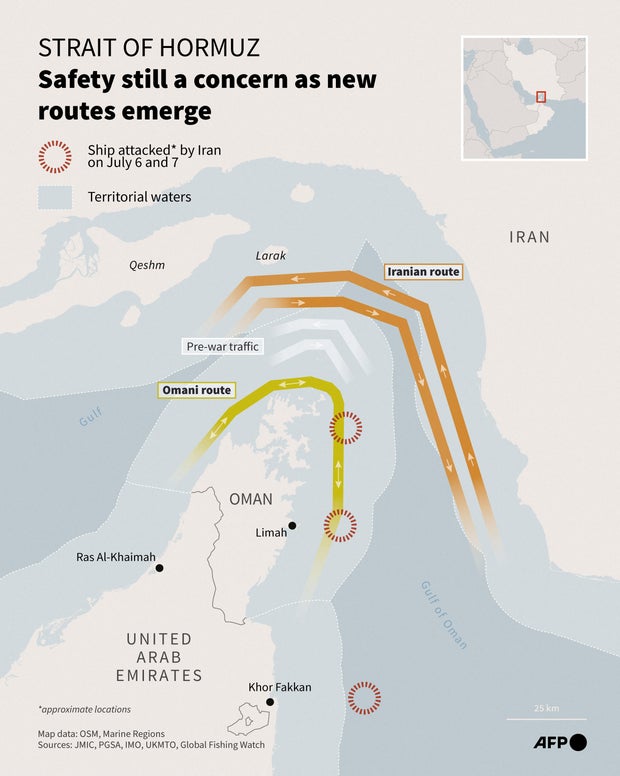
The attacks took place when the tankers — Mombasa and Al Bahiyah — were sailing through the strait's southern shipping lane, which hugs the coast of Oman, the defense ministry said. Iran has insisted that commercial ships use a separate lane near the Iranian coastline and seek permission from Iranian authorities. Iran has not publicly commented on the apparent attacks.
The deceased crew member and six injured crew members were Indian nationals, and two of those injured were from Ukraine, according to the United Arab Emirates.
The vessels were also damaged due to fires that have "since been brought under control."
The defense ministry called the strikes "a serious violation and a clear breach of international law that threatens the security and stability of the region," and said the country "reserves its full right to respond to this escalation."
Explosions heard in Iran, state media says
Explosions were audible in several locations in Iran, including on Kish Island, which is located in the Strait of Hormuz, according to Iranian state media outlets.
Oil prices shoot up 9% as U.S.-Iran hostilities heat up
Oil futures spiked Monday following multiple rounds of strikes between the U.S. and Iran, ending a brief stint earlier this month when oil prices returned to near prewar levels.
The international Brent Crude benchmark was trading at just over $83 per barrel for September deliveries as of 5 p.m. ET, and the U.S.-based West Texas Intermediate benchmark traded at $78 per barrel for August deliveries. Both benchmarks fell to around $70 in early August, after peaking at more than $110 in late March and early April.
U.S. launches another night of strikes against Iran at Trump's direction
Moments after President Trump told talk show host Hugh Hewitt the U.S. would be launching more strikes against Iran, U.S. Central Command announced the U.S. began its third consecutive night of strikes.
"At 4:45 p.m. ET today, U.S. Central Command began launching the third consecutive night of strikes against Iran, at the Commander in Chief's direction," U.S. Central Command announced on X. "These strikes will continue imposing a heavy cost on Iranian forces and degrade their ability to attack innocent civilians and commercial shipping in the Strait of Hormuz."
Trump says U.S. will hit Iran hard tonight and tomorrow, "take out" mountainous alleged nuclear site
Speaking to conservative talk host Hugh Hewitt, President Trump said the U.S. will hit Iran hard Monday and Tuesday. The president said the U.S. will "take out" Pickaxe Mountain, a deeply buried site that analysts believe could be part of Iran's nuclear program.
"We're going to take out Pickaxe Mountain," he said. "Tell the Iranians to be ready. Let them know we're coming, okay? There's not a damn thing they can do about it."
Trump notified Congress that fighting with Iran resumed
President Trump formally notified Congress that "military action" against Iran "commenced on July 7," according to a letter obtained by CBS News on Monday. The letter was dated July 10.
"United States Armed Forces remain postured to take further action, as necessary and appropriate, to address further threats and attacks upon the United States or its allies and partners and to ensure the Government of the Islamic Republic of Iran ceases being a threat to the United States and to our allies and partners," the letter says.
The letter adds that he's providing the notification "as part of my efforts to keep the Congress fully informed, consistent with the War Powers Resolution."
Under the War Powers Resolution of 1973, the president must notify Congress within 48 hours of the start of military hostilities. The Trump administration's position had been that hostilities against Iran began in late February and formally ended on April 7, when the two sides agreed to a ceasefire, but Mr. Trump declared last week that the ceasefire was "over." The U.S. has launched several rounds of strikes against Iran over the last week, starting on July 7.
Both the House and Senate passed a war powers resolution last month, seeking to limit Mr. Trump's ability to carry out further military action against Iran without congressional authorization. Democrats have said they're considering their legal options to force Mr. Trump to comply. The president has argued that he is acting under his constitutional authority.
Trump to address nation on Thursday
President Trump will give a primetime address Thursday, he announced on Truth Social Monday amid heightened hostilities with Iran.
"President Trump will be making a Speech to the Nation on Thursday evening, at 9 P.M. Eastern. Thank you for your attention to this matter!" he wrote.
He did not immediately provide other details on the address.
U.S. will resume naval blockade against Iran Tuesday, at Trump's direction
The U.S. will continue blocking maritime traffic from entering and exiting Iranian ports at the direction of President Trump, U.S. Central Command announced Monday.
The naval blockade will resume Tuesday at 4 p.m. ET.
The U.S. military will continue to support traffic flow through the area for other permissible vessels, U.S. Central Command said.
The formal announcement comes after Mr. Trump said on Truth Social that the U.S. would resume the blockade, the latest effort to manage an uncompliant Iran.
"We are reinstating the THE IRANIAN BLOCKADE, so named because it is only stopping Iran's ships or customers from entering or leaving," the president posted on Truth Social Monday morning. "All other countries will have fair and open use of the Strait."
In the same post, the president said the U.S. would "probably run" the Strait of Hormuz and impose a 20% fee on cargo shipments.
Iranian foreign minister weighs in on proposed cargo fee
Iranian Foreign Minister Abbas Araghchi weighed in on Mr. Trump's suggestion that the U.S. will impose a 20% fee on cargo transiting the Strait of Hormuz, writing in a social media post that Iran would "be fair" in determining what such a toll might look like.
"POTUS is absolutely right. Whoever provides secure and safe passage of commercial vessels through the Strait of Hormuz should be compensated for this service," Araghchi wrote. He added: "Iran has always been the GUARDIAN of the Strait and will remain so FOREVER. 20% is of course too much. We will be fair."
U.N. agency says "no legal basis" to introduce mandatory tolls
The International Maritime Organization, the United Nations agency overseeing international shipping, said Monday that it was waiting to find out more about Mr. Trump's proposal but remained opposed to tolls for passage through international waterways.
"There is no legal basis through which to introduce mandatory tolls simply to transit through a strait," it said in a statement.
It said in a separate statement Monday that the agency's executive body "stressed that any arrangement between the littoral States of the region shall guarantee the non-discriminatory and unimpeded right of transit passage of all ships."
The Council of the International Maritime Organization has also "reaffirmed that passage through the Strait should remain free of any tolls and charges, in accordance with international law, including the IMO Convention."
The council also condemned attacks on commercial ships and called for the de-escalation of tensions in the region.
CBS/AP
U.N. chief warns over U.S. strikes on Iran, and over Tehran targeting shipping
United Nations Secretary-General Antonio Guterres raised the alarm Monday over U.S. strikes on Iran as well as Tehran's attacks on shipping in the Strait of Hormuz and its neighbors.
Guterres expressed "deep concern at the serious escalation of renewed military confrontation in the Gulf region, including Iranian attacks on ships on the Strait of Hormuz, attacks by the United States on the Islamic Republic of Iran, and attacks by Iran on targets in neighboring countries," his spokesman Stephane Dujarric said.
Some ships still crossing Hormuz despite security threat
Just 14 vessels – half of which were commercial ships – crossed the Strait of Hormuz on Sunday, according to data from maritime tracker Kpler, suggesting the waterway was not completely closed as Iran had announced.
At least three commodity vessels crossed so far on Monday, according to Kpler.
However, traffic is significantly disrupted by security risks.
Sunday recorded the lowest daily number of transits since June 13, before a memorandum of understanding outlining a fragile truce between the U.S. and Iran briefly boosted traffic through the strait. Half of the vessels that crossed on Sunday were Iran-flagged.
Amongst the non-Iranian traffic, only two vessels crossed with their transponders switched on – one crossed through the Iranian route and another passed through the peacetime shipping corridor, which the International Maritime Organization has warned is currently unsafe because of the risk of sea mines.
According to Kpler, no ship over the weekend passed through the Omani route with its transponder switched on.
But the U.S.-supported corridor in the southern part of the strait remains in use, according to Barun Gupta, an analyst at maritime intelligence provider Vanguard Tech.
He told AFP on Monday that some Vanguard Tech clients crossed through that route with U.S. support.
"The U.S. is able to provide support to vessels by, for example, shooting down projectiles or advising them on the best time to cross," Gupta said.
However, the risk is high.
"Any vessel that Iran perceives to be U.S.- or Israeli-affiliated, or that transits without coordination with Iranian authorities or outside Iran-designated routes, could attract heightened scrutiny," he said.
Iran and Oman continue talks on the Strait of Hormuz, says Iranian foreign minister
Iran and Oman are to continue political and technical talks on the management of the Strait of Hormuz, according to the Iranian foreign minister.
In a post on his Instagram page Monday, Abbas Araghchi said he had briefly visited Muscat, the Omani capital, to meet his counterpart Badr al-Bousaidi, "and together with the legal and technical boards, we discussed the coordination of the two coastal countries of the Strait of Hormoz for managing the Strait."
"These talks will continue at the political and technical levels," he added.
One of the points of the memorandum of understanding signed by Iran and the U.S. is that Iran will define with Oman "the future administration" of the crucial waterway.
Qatar condemns Iranian attacks on Jordan, Bahrain and Kuwait
Qatar condemned Iranian strikes on Jordan, Bahrain and Kuwait Monday as tension between the U.S. and Iran appeared to mount after the latest exchange of attacks.
Iran claimed it had struck facilities in several Gulf countries Monday, while the Jordanian military said it had shot down several Iranian missiles in its airspace. Tehran called the attacks retaliation for U.S. strikes and said they had targeted U.S. military installations - though American officials reported no damage.
In a statement posted on X Monday, the Qatari foreign ministry stressed "the need to spare the region the consequences of these unjustified attacks and to advance the path of dialogue, diplomacy, and de-escalation."
Qatar and Pakistan have been acting as the lead mediators between Iran and the U.S., and indirect talks between the two countries were held in June and early July, before being paused for the funeral of Iran's slain supreme leader, Ali Khamenei.
President Trump has since said the memorandum of understanding signed by himself and his Iranian counterpart in mid-June is, in his view, "over," and even returning to meaningful peace talks looked unlikely Monday as Mr. Trump declared unilateral U.S. control over the Strait of Hormuz and a reimposition of the American naval blockade of Iran's ports.
U.K. to designate Iran's IRGC a terrorist group, says it "almost certainly directed" antisemitic arson attacks
The U.K. will seek to proscribe Iran's Islamic Revolutionary Guard Corps as a terrorist organization under a new law set to be voted on by lawmakers this week in parliament, the government said Monday.
"If approved by Parliament later this week, those conducting acts of sabotage including arson on behalf of these groups could face life imprisonment," the Home Office said in a statement. "The move will step up the government's ability to counter state threats linked to foreign powers including espionage, foreign interference in our democracy, sabotage and physical attacks. "
The Islamic Movement of Companions of the Right (IMCR), which has claimed seven attacks targeting the Jewish community in the U.K., and Russia's GRU Volunteer Corps, will be included in the ban.
Analysts told CBS News early this year that the IMCR attacks appeared to have been carried out by an "Iran-aligned network," but U.K. Security Minister Angela Eagle went further Monday, saying the group was linked to the IRGC.
"Sitting behind IMCR were members of Iran's Islamic Revolutionary Guard Corps Qods Force, who almost certainly directed IMCR attacks across Europe," she said.
A common factor in many cases linked to IMCR and similar incidents was the alleged involvement of intelligence agencies linked to Iran's close ally, Russia, according to research by the The Royal United Services Institute for Defense and Security Studies.
CENTCOM says Iranian sub and ship maintenance facility hit in first U.S. combat use of sea drones
The U.S. military's Central Command said Monday that the latest attacks on Iran hit "a submarine and ship maintenance facility" at Bandar Abbas Naval Base on the country's southwest coast in the Strait of Hormuz.
CENTCOM said in its social media post that the strikes were carried out using "three Corsair unmanned surface vessels … marking the first time American forces have employed sea drones in combat operations."
"Last night's strikes degraded Iran's ability to continue attacking commercial shipping," CENTCOM said.
The post was accompanied by black and white video, labeled "unclassified," that showed a small watercraft approaching a raised dock structure holding what appeared to be a submarine before blowing up.
Trump says U.S. blockade of Iran's ports and shops being reinstated, declares 20% fee for security on cargo
"The Hormuz Strait is OPEN, and will remain OPEN, with or without Iran," President Trump insisted again Monday in a Truth Social post, announcing a reinstatement of the U.S. military blockade of Iranian ports and associated vessels.
"We are reinstating the THE IRANIAN BLOCKADE, so named because it is only stopping Iran's ships or customers from entering or leaving. All other countries will have fair and open use of the Strait."
Mr. Trump declared that the U.S. would henceforth be "known as 'THE GUARDIAN OF THE HORMUZ STRAIT,' but as such, and as a matter of FAIRNESS, will be reimbursed, at the rate of 20% on all cargo shipped, for any and all costs necessary to do the job of providing safety and security to this very volatile section of the World. The process and formation will begin immediately."
Iran's "Strait Authority" declares Strait of Hormuz closed again
"Due to recent hostile actions by the US forces, passage through the Strait of Hormuz is currently unfeasible," Iran's Persian Gulf Strait Authority declared in a social media post Monday.
"As soon as stability and calm are restored, all applications will be reviewed in accordance with the scheduled timeline, and the permitting process will resume," the PGSA added, reminding vessels that in Iran's view, "the sole means of obtaining a passage permit" to transit the strait is through its website.
The PGSA was created by Iran during the war and Tehran insists that all commercial vessels wishing to transit the waterway seek permission via the agency and then use a northern route, close to Iran's coast.
Iran does not recognize the legitimacy of a southern route through the strait, close to the Omani coast, that the U.S. insists is open and available. Iranian forces have attacked multiple vessels trying to use the route.
Iranian and U.S. authorities have argued publicly, via social media, for days about whether the strait is open or closed, with President Trump insisting it remains open via the Omani route, and declaring on Monday that the U.S. will "keep" control of the waterway "and we'll probably run it."
After condemning Iran for weeks over suggestions that it would charge commercial ships for passage, President Trump told Fox News on Monday that the U.S. was "going to get paid for guarding it, a lot of money."
Top aide to Iran's supreme leader says Strait of Hormuz has "irreplaceable strategic value" to the country
Mohammed Mokhber, a senior aide to Iran's Supreme Leader Mojtaba Khamenei, said Monday in a post on social media that the Strait of Hormuz "has irreplaceable strategic value as well as security and economic importance for the Iranian nation," stressing that the Islamic Republic would not back down on its demand to have control over the strategic waterway.
"The Strait of Hormuz, with its historical lessons, is today our 'Battle of Uhud,' he said, equating the importance of the shipping lanes to an existential battle led by the Prophet Muhammad in the early days of Islam.
"We will defend it, so that in the future, our ships will not be forced to pay concessions to the enemy in order to pass through," Mokhber said. "Retreating from this important matter has no place in the mind of anyone who loves Iran."
The strait was always a free and open shipping passage - the only way to access the gas and oil ports of the Persian Gulf - before the U.S. and Israel launched their joint war on Iran on Feb. 28. That prompted Iran to attack ships and Gulf states, and to demand that all vessels seek permission for transit.
Trump says U.S. "going to get paid for guarding" Strait of Hormuz, "a lot of money"
President Trump said Monday, speaking with Fox News, that the U.S. would not only take control of the Strait of Hormuz, but that other countries - which he did not name but he implied were the Persian Gulf energy producers - would pay the U.S. for securing it.
"We'll become the guardian of the strait. Maybe we'll call it 'the Guardian Angel of the Strait,' and we should be reimbursed for that. When we do that, we're going to be reimbursed, because the other nations are very wealthy; they're on our side, and we can't be expected to do that for nothing," Mr. Trump said in the phone interview.
He claimed the U.S. had "guarded the strait for 50 years, more, and we never got paid for it," saying other nations "made all the money … We guarded it for nothing, and now we're going to guard it. We're going to get paid for guarding it, a lot of money."
The strait was completely open to all vessels before the U.S. and Israel launched their joint war on Iran on Feb. 28, prompting Iran to attack ships and threaten any that attempt to transit the waterway without seeking permission.
Trump says U.S. "going to keep" Strait of Hormuz, "and we'll probably run it"
President Trump told Fox News on Monday that the U.S. was "going to keep the Strait, and we'll probably run it. We'll become the guardian of the Strait. Maybe we'll call it the 'Guardian Angel of the Strait'. And we should be reimbursed for that."
He reiterated during the phone interview, a few times, that the U.S. should be paid for securing the Middle Eastern waterway, which Iran insists it has control over.
The two countries' dispute over control of the shipping lanes, through which maritime traffic has been significantly reduced since the U.S. and Israel launched their joint war on Iran on Feb. 28, has derailed attempts to reach a lasting peace deal.
Referring to the latest round of U.S. strikes on Iran, Mr. Trump said "we hit them very hard last night," adding: "Every time they send a drone, we hit them very hard … We have them on the run."
U.S. strikes reportedly kill 2 in Iran, as Tehran claims it fired "warning shots" at ships in Strait of Hormuz
U.S. strikes killed two people Monday in southwest Iran, in an oil-producing region near Kuwait and Iraq, Iran's semi-official Fars and Tasnim news agencies reported.
"At this time, two people have been reported dead and three wounded," the agencies said, citing a Khuzestan province official, who mentioned strikes in "three different locations" on the outskirts of the city of Abadan.
Meanwhile, Iranian state TV reported Iranian forces fired "warning shots" at two ships attempting to transit the Strait of Hormuz.
Iran's U.K. embassy insists "temporary safe & secure maritime corridor" exists in Strait of Hormuz
Iran's embassy in the U.K. said Monday that the Islamic Republic had "established a temporary safe & secure maritime corridor, free of technical & military barriers" through the Strait of Hormuz, indicating a reopening of the crucial shipping lanes from Tehran's perspective.
It was not clear if the embassy's post on social media, in referring to a lack of "technical & military barriers," was suggesting an easing of Iran's own demand for ships to coordinate with its military to use a northern route, close to its coast, through the strait, or speaking about a more southerly route that the U.S. has urged vessels to use over the last couple weeks.
The U.S. military on Sunday contradicted a claim by Tehran' that the Strait of Hormuz was again closed, insisting that "Iran does not control" the vital shipping lanes amid an ongoing disagreement between the nations over commercial access to the waterway.
In its statement, the embassy accused the U.S. of having "done nothing but violate the MoU since day one," specifically by "pushing vessels toward a dangerous southern parallel route" through the strait, close to Oman's coast, that it called "not only legally questionable but also unsafe, unreliable, and prone to accidents."
Iran attacked several ships attempting to use that southern route last week, and on Saturday it also struck a container vessel near the western entrance to the strait, prompting the U.S. to launch multiple rounds of airstrikes on Iranian targets.
Iran has long argued that the vaguely worded MoU signed in mid-June with the U.S. gave it the right to control shipping through the strait, and it balked at the U.S. government and military's calls for ships to use the southern route close to Oman, which President Trump has insisted is open.
"U.S. military aggression, including attacks on Iran's port & tower infrastructure, has turned the Strait of Hormuz into a tense, high-risk zone for maritime traffic," the Iranian embassy in London said Monday, adding a jab that appeared to be directed at Oman: "Those who enabled this perilous situation must reconsider their stance, if they truly seek safe passage through the Strait of Hormuz. Security is a two-way street."
Bahrain army accuses Iran of targeting civilians
Bahrain's military on Monday accused Iran of targeting civilians with its latest attacks on the kingdom, after Tehran said it had struck U.S. military facilities and infrastructure there.
"Iran continues its systematic hostile approach through its heinous attacks with missiles and drones that target civilians in the Kingdom of Bahrain," the general command of Bahrain's military said in a statement, adding that air defences "intercepted and destroyed a number of Iranian aerial attacks" on Monday morning.
Iran says it will not allow nuclear inspections
Iran said Monday it would not agree to a resumption of international inspections at some of the country's nuclear facilities.
In response to a question on whether Iran would accept theUnited Nations' International Atomic Energy Agency's (IAEA) request to access nuclear facilities, Foreign Ministry spokesman Esmail Baqaei said the regime would not.
The memorandum of understanding signed with the U.S. calls for negotiations to take place between both parties on the future of Tehran's nuclear program, but it doesn't bind the regime to any specific terms or schedule.
After the first of just two days of direct negotiations between U.S. and Iranian officials since the MoU was signed, Vice President JD Vance said he expected IAEA inspections to resume within days. But two days later, a senior Iranian negotiator said any such arrangements would only be solidified as part of a final agreement with the U.S.
The IAEA regularly carried out inspections and had cameras installed to monitor Iran's enrichment work for years under the previous nuclear deal negotiated by the Obama administration, known as the JCPOA.
Iran slowly denied that access in the wake of President Trump withdrawing the U.S. from the JCPOA during his first term, while ramping up its uranium enrichment to produce its first-ever near-weapons-grade material.
Iranian media report blasts near Strait of Hormuz
Explosions of unknown origin were heard in southern Iran near the Strait of Hormuz on Monday, a news agency reported, following an exchange of attacks between Tehran and Washington.
"Media and residents reported having heard on Monday at midday explosions near Bandar Abbas and the island of Qeshm," the semi-official Mehr news agency said, adding that the blasts "appear to be coming from the West Coast of Bandar Abbas."
Iran indicates indirect talks with U.S. will continue after calling talks "futile"
Iran said Monday it was continuing talks with mediators from Qatar, Pakistan and Oman in an effort to prevent any further escalation with the United States.
"The role of the mediators is to continue their efforts to prevent an escalation of tensions," said Iranian foreign ministry spokesman Esmaeil Baqaei, stressing that Tehran would pursue diplomacy along with military measures.
"Wherever necessary, we will use military means to defend our interests, and wherever circumstances require, wherever the country's interests dictate, we will use the tool of diplomacy," the spokesperson said.
Iran's foreign ministry said Sunday the latest wave of U.S. attacks on its territory had rendered recent diplomatic efforts "futile."
Iran blames U.S. for recent escalation
Iran has blamed the U.S. for escalation of attacks over the last week over control of the Strait of Hormuz.
"Everything that has happened over the past several weeks, especially in the past few days, is the direct responsibility of the United States, because they cheated from the very first day," Esmail Baqaei, a spokesperson for Iran's foreign ministry, said Monday.
He claimed the U.S. did not allow Iran to carry out the work which would make the Strait of Hormuz safe to transit, as set out in the fifth clause of the memorandum of understanding, and instead created other routes in the waterway that Tehran claims are not safe.
The U.S. resumed major strikes on Iran on June 7, calling them retaliation for Iranian attacks on oil tankers in the Strait of Hormuz, which were hit in the south of the strategic waterway, near the Omani coast.
UN chief warns of "catastrophic consequences" of fighting
The United Nations Secretary-General warned of "catastrophic consequences" for the region if fighting resumes.
"A return to full-scale hostilities would have catastrophic consequences - for the peoples of the region, for international peace & security & for the global economy," António Guterres said in a statement.
The UN chief expressed his concern for the recent escalation and said the attacks "must all stop."
Oil prices jump after weekend of fighting over Strait of Hormuz
The price of Brent crude, the international standard, gained 4.7% to $79.59 per barrel, while U.S. benchmark crude oil added 4.8% to $74.85 per barrel.
Prices for both types of crude oil recently had slipped back to around the levels they were at before the war with Iran began, after the two sides set an interim agreement on ending the conflict and ships resumed transporting oil through the Strait of Hormuz.
However, the United States launched several waves of strikes on Iran into Monday morning over an Iranian attack on a container ship in the strait that set it ablaze and left a crew member missing over the weekend. Iran retaliated by targeting countries across the Middle East.
Latest U.S. strikes have "rendered futile" recent diplomacy, Iran says
Iran has condemned the latest wave of U.S. attacks on its territory, saying they had "rendered futile" all the diplomatic efforts of the last few months.
The United States has also "caused the return of insecurity in the Strait of Hormuz and disruption of international commercial shipping by openly interfering in the process of Iran implementing the necessary arrangements in the Strait of Hormuz," a foreign ministry statement said Sunday.
Iran attacks Bahrain, Oman and Jordan
Iran's Revolutionary Guards on Monday claimed strikes against Bahrain and Oman, saying they destroyed radar systems in Oman and targeted U.S. military facilities on the southern edge of Manama.
Additionally, the Jordanian military said on Monday it had shot down four Iranian missiles over the country, which Tehran said were intended as retaliation for U.S. strikes.
"At dawn today, air defence systems intercepted and shot down four missiles that had entered Jordanian airspace from Iranian territory," an official source from the Jordanian General Staff said, adding that there were no reports of injuries or damage to property.
U.S. conducts more strikes on Iran
U.S. Central Command (CENTCOM) said it struck dozens of Iranian targets on Sunday.
"Forces struck Iranian military air-defense systems, coastal radar sites, missile and drone capabilities, and small boats using U.S. fighter aircraft, naval vessels, one-way attack aerial drones, and one-way attack sea drones for the first time," CENTCOM said in a statement.
It added that Iran "does not control" the Strait of Hormuz, in response to earlier claims by Tehran that the vital waterway was effectively closed.


No comments:
Post a Comment