This particular rendition of the story of Milarepa is not one I wholeheartedly recommend. But, it is a starting place for many of you to study about Milarepa. Basically, what happened to him is his father was rich and then died. His father's brother was given the estate and made Milarepa and his sister and mother his slaves instead of giving them the estate when his father died. His mother saved money to send Milarepa to a sorcerer to kill his Uncle and Aunt. Milarepa did this but then was horrified at the result in his life. As a penance he studied with Marpa most of the rest of his life to overcome this obstacle in his life by meditating in caves and learning to fly and developing many Magical Siddhis (God Like Powers).
He is so loved by the people of Tibet because he overcame his initial obstacles through diligence and practices. So, everyone can relate to him and love him because he succeeded.
Two lifetimes back I was born around 1850 in Nepal in the Himalayas and used Milarepa's flying puja to learn to fly in that lifetime. Now (as well as then) however, it takes about 2 to 5 years alone in a cave to learn this even if you have all the right abilities and attributes. To me, it makes more sense now to buy a plane ticket to fly anywhere you want to on earth now rather than spend 2 to 5 years in a cave to fly somewhere by yourself. Then as now both compassion and practicality are infinitely important in all our lives.
By the way, even in this lifetime I have seen someone change the weather. For example, at the end of the Kalachakra Tantric Initiation in Bodhgaya by the Dalai Lama with 500,000 people in attendance in 1985 I witnessed a cloud form on a dry day with not a cloud in the sky at about 90 degrees and maybe less than 20 percent humidity. I had heard this was supposed to happen but was completely blown away when the little cloud formed only above the 500,000 and the it rained on us which is also supposed to happen. So, all this stuff is real.
en.wikipedia.org/wiki/MilarepaCached
Jetsun
Milarepa
(c. 1052 – c. 1135 CE) is generally considered one of Tibet's most
famous yogis and poets. He was a student of Marpa Lotsawa, and a major
figure in ..
Milarepa
From Wikipedia, the free encyclopedia
A statue of Jetsun Milarepa from the Milarepa Gompa, Helambu valley, Hyolmo,
Nepal.
Jetsun Milarepa (
Tibetan:
རྗེ་བཙུན་མི་ལ་རས་པ,
Wylie:
rje btsun mi la ras pa) (c. 1052 – c. 1135
CE) is generally considered one of
Tibet's most famous
yogis and poets. He was a student of
Marpa Lotsawa, and a major figure in the history of the
Kagyu school of
Tibetan Buddhism.
[citation needed]
Early life
Born in the village of Kya Ngatsa – also known as Tsa – in
Gungthang, a province of western Tibet, to a prosperous family, he was named
Mila Thöpaga (Thos-pa-dga'), which means "A joy to hear." His family name, Josay, indicates noble descent, a
sept of the
Khyungpo or eagle clan.
[1]
Sorcery
When his father died, Milarepa's uncle and aunt took all of the
family's wealth. At his mother's request, Milarepa left home and studied
sorcery.
While his aunt and uncle were having a party to celebrate the impending
marriage of their son, he took his revenge by summoning a giant
hailstorm to demolish their house, killing 35 people, although the uncle
and aunt are supposed to have survived. The villagers were angry and
set off to look for Milarepa, but his mother got word to him, and he
sent a hailstorm to destroy their crops.
[citation needed]
Many of Milarepa's deeds took place in the homeland of Chö kyi Drönma, the
Samding Dorje Phagmo, and his life and songs were compiled by
Tsangnyön Heruka, sponsored by her brother, the Gungthang king Thri Namgyal De.
[2]
Milarepa later lamented his evil ways in his older years in
conversation with Rechungpa: "In my youth I committed black deeds. In
maturity I practised innocence. Now, released from both good and evil, I
have destroyed the root of
karmic action
and shall have no reason for action in the future. To say more than
this would only cause weeping and laughter. What good would it do to
tell you? I am an old man. Leave me in peace."
[3]
Supernatural running
The nine storey tower that Milarepa single-handedly built, Sekhar Gutok, Lhodrag, Tibet.
According to the book
Magic and Mystery in Tibet by French explorer
Alexandra David-Néel, Milarepa boasted of having "crossed in a few days, a distance which, before his training in
black magic,
had taken him more than a month. He ascribes his gift to the clever
control of 'internal air'." David-Néel comments "that at the house of
the lama who taught him black magic there lived a trapa [monk] who was
fleeter than a horse" using the same skill.
[4] After witnessing such a monk David-Néel described how:
He seemed to lift himself from the ground.. His steps had the
regularity of a pendulum ... the traveller seemed to be in a trance.[5]
This esoteric skill, which is known as
Lung-gom-pa[6]
in Tibet, is said to allow a practitioner to run at an extraordinary
speed for days without stopping. This technique could be compared to
that practised by the
Kaihōgyō monks of
Mount Hiei and by practitioners of
Shugendō,
Japan.
[7]
Tutelage under Marpa
Knowing that his revenge was wrong, Milarepa (Then known by his boyhood name 'Fortuitous') set out to find a
lama and was led to
Marpa the Translator.
Marpa proved a hard taskmaster. Before Marpa would teach Milarepa he
had him build and then demolish three towers in turn. Milarepa was asked
to build one final multi-story tower by Marpa at Lhodrag: this 11th
century tower still stands.
[8]
When Marpa still refused to teach Milarepa, he went to Marpa's wife,
who took pity on him. She forged a letter of introduction to another
teacher,
Lama Ngogdun Chudor, under whose tutelage he practiced
meditation.
However when he was making no progress, he confessed the forgery and
Ngogdun Chudor said that it was vain to hope for spiritual growth
without the guru Marpa's approval.
[citation needed]
Milarepa returned to Marpa, and was finally shown the spiritual
teachings. Milarepa then left on his own, and after protracted diligence
for 12 years he attained the state of
Vajradhara
(complete enlightenment). He then became known as Milarepa. 'Mila' is
Tibetan for; 'great man', and 'repa' means; 'cotton clad one.' At the
age of 45, he started to practice at
Drakar Taso (White Rock Horse Tooth) cave – "
Milarepa's Cave", as well as becoming a wandering teacher. Here, he subsisted on
nettle
tea, leading his skin to turn green with a waxy covering, hence the
greenish color he is often depicted as having, in paintings and
sculpture.
[citation needed]
Monastery
Pyenzhangling Monastery, also known as Pelgye Ling Gompa, is a small
Tibetan Buddhist monastery in a tiny village called
Zhonggang,
Tibet that is consecrated to Milarepa. It is built around the
cave
where he once lived. "It was destroyed but has now been rebuilt and
decorated by Nepali artisans. This is one of many caves associated with
Milarepa between
Langtang and
Jomolungma."
[9]
Lineage
Milarepa statue, Pango Chorten,
Gyantse, Tibet.
Milarepa's lama was Marpa Lotsāwa, whose guru was
Naropa, whose guru in turn was
Tilopa. Milarepa is famous for many of his songs and poems, in which he expresses the profundity of his realization of the
dharma.
His songs were impulsive, not contrived or written down, and came about
while he was immersed in enlightened states of consciousness.
[citation needed]
Milarepa's life represented the ideal
bodhisattva, and is a testament to the unity and interdependency of all Buddhist teachings –
Theravada,
Mahayana and
Vajrayana.
He showed that poverty is not a deprivation, but rather a component of
emancipating oneself from the constrictions of material possessions;
that Tantric practice entails discipline and steadfast perseverance;
that without resolute renunciation and uncompromising discipline, as
Gautama Buddha
Himself stressed, all the sublime ideas and dazzling images depicted in
Mahayana and Tantric Buddhism are no better than magnificent illusions.
[10] He also had many disciples, male and female,
[11][12] including
Rechung Dorje Drakpa and
Gampopa His female disciples include Rechungma, Padarbum, Sahle Aui and Tsheringma.
[13]
It was Gampopa who became Milarepa's spiritual successor, continued his
lineage, and became one of the main lineage masters in Milarepa's
tradition.
[citation needed]
Gallery
-
Bhutanese painted thanka of Milarepa (1052-1135), Late 19th-early 20th century, Dhodeydrag Gonpa, Thimphu, Bhutan
-
-
Tibetan or Nepalese painted thanka of Milarepa, 19th century, mineral pigments and gold on cotton cloth
See also
References
Gtsang-smyon He-ru-ka, The life of Milarepa, tr. Lobsang Phuntshok Lhalungpa, Viking Press, 1979, p.12
Further reading
- Liberation in One Lifetime: Biographies and Teachings of Milarepa, by Francis Tiso. Berkeley: North Atlantic Books, June 2014. ISBN 978-1-58394-793-7.
- The Yogin and the Madman: Reading the Biographical Corpus of Tibet's Great Saint Milarepa, by Andrew Quintman. New York: Columbia University Press, 2013. ISBN 978-0-231-16415-3.
- Life Story of Milarepa, by Ken Albertsen, adapted from the translation by Lobsang P.Lhalungpa, Adventure1 Publications, 2008, ISBN 978-1-879338-07-4 also available as audio-book.
- The Life of Milarepa, translated by Andrew Quintman, Penguin Classics, 2010, ISBN 978-0-14-310622-7
- The Life of Milarepa, translated by Lobsang P. Lhalungpa, Book Faith India, 1997, ISBN 81-7303-046-4
- Milarepa: Songs on the Spot, translated by Nicole Riggs, Dharma Cloud Press, 2003, ISBN 0-9705639-3-0
- Milarepa, The Hundred Thousand Songs of Milarepa, translated by Garma C.C. Chang, City Lights Books, 1999, ISBN 1-57062-476-3
- Tibet's Great Yogī Milarepa: A Biography from the Tibetan. Edited by W. Y. Evans-Wentz. 1928. Oxford University Press. Paperback reprint 1974.
- The Yogi's Joy: Songs of Milarepa Sangharakshita, Windhorse Publications, 2006, ISBN 1-899579-66-4
- The Shadows of the Masters, Leonardo Vittorio Arena, ebook, 2013.
- Drinking the Mountain Stream: Songs of Tibet’s Beloved Saint, Wisdom Publications, ISBN 0-86171-063-0
External links
 |
Wikiquote has quotations related to: Milarepa |
The Life of Milarepa: A New Translation from the Tibetan translator Lobsang P. Lhalungpa written by He-Ru-Ka
The Life of Milarepa: A New Translation from the Tibetan translator Lobsang P. Lhalungpa written by He-Ru-Ka p.12
David-Neel, Alexandra. Magic and Mystery in Tibet. New York: Dover Publications, Inc., 1971 (ISBN 0-486-22682-4)
David-Néel, Alexandra (1932). Magic and Mystery in Tibet. pp. 202, 203. OCLC 1330945. Unknown ID 141797754. Gogle preview of alternate edition WorldCat list of 60 versions
Magic and Mystery in Tibet p.212
The run of a lifetime
prm.ox.ac.uk: Sekhar Gutog monastery in Lhodrag near Bhutan
Dowman, Keith. 1988. The Power-places of Central Tibet: The Pilgrim's Guide. Routledge & Kegan Paul, London & New York. ISBN 0-7102-1370-0, p. 282.
The
Hundred Thousand Songs of Milarepa: The Life-Story and Teaching of the
Greatest Poet-Saint Ever to Appear in the History of Buddhism
Women in Tibet
Rechungma
end quote from:


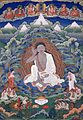 Bhutanese painted thanka of Milarepa (1052-1135), Late 19th-early 20th century, Dhodeydrag Gonpa, Thimphu, Bhutan
 Milarepa, Tempera on cotton, 21x30 cm, 2008 Otgonbayar Ershuu
 Tibetan or Nepalese painted thanka of Milarepa, 19th century, mineral pigments and gold on cotton cloth


No comments:
Post a Comment