Saudi Arabia has never liked the United Nations, but the spat with Ban Ki-moon over the child casualties of the war in Yemen this week marks a new low. It was extraordinary to hear the secretary-general admit publicly on Thursday that he had had his ...
Saudi Arabia's row with Ban Ki-moon over Yemen marks new low in UN relationship
Kingdom angry at being criticised for violations of children’s rights in country where it is fighting Houthi rebels
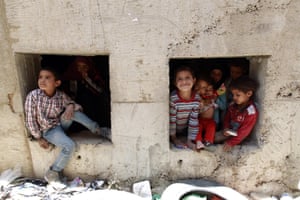
Children in the Yemeni capital, Sana’a, taking shelter after their
houses were destroyed by air strikes carried out by the Saudi-led
alliance last year.
Photograph: Mohammed Huwais/AFP/Getty Images
Saudi Arabia has never liked the United Nations, but the spat with Ban Ki-moon over the child casualties of the war in Yemen this week marks a new low.
It was extraordinary to hear the secretary-general admit publicly on Thursday that he had had his arm twisted to change tack in the wake of anger from Riyadh. The row began
when the UN published a report about global violations of children’s
rights and listed the Saudi-led military coalition’s actions in Yemen,
where it is backing the restoration of the legitimate president and
fighting Houthi rebels.
It is a controversial war that reflects regional tensions,
especially with Iran. And Saudi Arabia has both powerful friends and
many enemies. It has also been in assertive mood under King Salman –
with key policies run by his ambitious son Mohammed, the deputy crown
prince.
The UN report
released last week attacked both coalition and rebel forces for a “very
large number of violations” including attacks on schools and hospitals,
but said the coalition was responsible for 60% of the child deaths and
injuries in Yemen last year.
So there was outrage on Monday
when the UN said it had removed the coalition from its annual child
rights blacklist pending a joint review by the world body and the
coalition of those deaths and injuries. Human rights groups protested,
complaining of a “shocking flip-flop”, “blatant pandering” and a “moral
failure.” All agreed that the credibility of the UN had been damaged.
Anonymous diplomats complained of bullying, threats and blackmail.
Ban then said publiclythat
there had been “unacceptable” and “undue” pressure. He did not
specifically say the Saudis had threatened to cut off funding but
clearly implied that they had: “Children already at risk in Palestine,
South Sudan, Syria, Yemen and so many other places would fall further
into despair,” he told reporters.
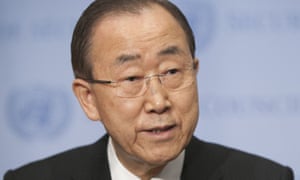
Ban Ki-moon has faced criticism over the removal of Saudi Arabia from the blacklist. Photograph: Rex Shutterstock
Saudi allies, including Jordan, the United Arab Emirates, Egypt,
Kuwait and Qatar – all coalition members – protested too. Still, the
kingdom’s ambassador to the UN denied making any threats, which
reportedly included leaving the UN altogether. Saudi sources said they
suspected the US of leaking damaging details of private diplomatic
exchanges.
The Saudi military insists that reports by human rights organisations
of civilian deaths caused by coalition air strikes are based on
inadequate investigation. It has said the same about allegations about
the use of cluster bombs supplied by the UK, but its own promised
investigation has not yet been forthcoming.
Yet overall, Saudis are not only unrepentant but angry. Social media
in the kingdom has been overloaded with complaints that western rights
watchdogs are failing to apply the same rigorous standards to their own
governments and armed forces, or to Russia and Israel, never mind to
Syria – where far more civilians have been killed than in Yemen.
“We know that the hospital at Kunduz [in Afghanistan]
was attacked by the US and that thousands are being killed by the
Russian air force in Syria, where the Iranian revolutionary guards are
deployed,” fumed one Saudi analyst. “That’s what is ridiculous. This is
about double standards, not about a powerful country paying to silence
its critics.”
Back in 2013 the late King Abdullah caused a stir when he declined to
take up a non-permanent seat on the UN security council – in protest at
the failure of international policy towards Bashar al-Assad, whom the
Saudis want to overthrow. Now the UN is being lambasted as a “terrorist
organisation”.
Advertisement
Defiant
Twitter users have posted pictures of Saudi soldiers hugging Yemeni
children; people being hanged from cranes in Ahwaz, where Iran’s Arab
minority lives, and an anxious-looking Ban sitting on a pile of corpses
in Syria and expressing his “concern”.
It remains to be seen whether the promised joint review of child
casualties will produce a different result, but this very public row has
been damaging. “This is part of an emerging trend in terms of the way
the Saudis approach their foreign policies,” said Peter Salisbury, a
Chatham House expert on the Gulf.
“This isn’t the first time they have applied pressure to the UN to
limit criticism of their actions, especially in Yemen. The problem is
that rather than improving their image it has only reinforced the idea
that they use the bully pulpit of their money to get what they want.
“In the long run it’s hard to see how that won’t lead to pushback
from some UN member states and the public in countries like Britain and
the US that have defended their alliance with the Saudis – when it comes
to such an emotive issue as the protection of children in war.”


No comments:
Post a Comment