Antisemitism is hostility, prejudice or discrimination against Jews. A person who holds such ... The...
Antisemitism
From Wikipedia, the free encyclopedia
Antisemitism (also spelled
anti-Semitism or
anti-semitism) is hostility, prejudice or discrimination against
Jews.
[1][2][3] A person who holds such positions is called an
antisemite. Antisemitism is widely considered to be a form of
racism.
[4][5]
The root word
Semite gives the
false impression that antisemitism is directed against all
Semitic people. However, the compound word
antisemite was popularized in Germany in 1879 as a scientific-sounding term for
Judenhass "Jew-hatred",
[11] and that has been its common use since then.
[13]
Antisemitism may be manifested in many ways, ranging from expressions
of hatred of or discrimination against individual Jews to organized
pogroms
by mobs, state police, or even military attacks on entire Jewish
communities. Although the term did not come into common usage until the
19th century, it is now also applied to historic anti-Jewish incidents.
Notable instances of
persecution include the
Rhineland massacres preceding the
First Crusade in 1096, the
Edict of Expulsion from England in 1290, the
massacres of Spanish Jews in 1391, the persecutions of the
Spanish Inquisition, the
expulsion from Spain in 1492, the
Cossack massacres in Ukraine of 1648–1657, various
anti-Jewish pogroms in the Russian Empire between 1821 and 1906, the 1894–1906
Dreyfus affair in France,
the Holocaust in
German-occupied Europe, official
Soviet anti-Jewish policies and Arab and Muslim involvement in the
Jewish exodus from Arab and Muslim countries.
Origin and usage in the context of xenophobia
Etymology
1879 statute of the Antisemitic League
The origin of "antisemitic" terminologies is found in the responses of
Moritz Steinschneider to the views of
Ernest Renan. As
Alex Bein
writes: "The compound anti-Semitism appears to have been used first by
Steinschneider, who challenged Renan on account of his 'anti-Semitic
prejudices' [i.e., his derogation of the "Semites" as a
race]."
[14] Avner Falk similarly writes: 'The German word
antisemitisch was first used in 1860 by the Austrian Jewish scholar Moritz Steinschneider (1816-1907) in the phrase
antisemitische Vorurteile
(antisemitic prejudices). Steinschneider used this phrase to
characterise the French philosopher Ernest Renan's false ideas about how
"
Semitic races" were inferior to "
Aryan races"'.
[15]
Pseudoscientific
theories concerning race, civilization, and "progress" had become quite
widespread in Europe in the second half of the 19th century, especially
as
Prussian nationalistic historian
Heinrich von Treitschke
did much to promote this form of racism. He coined the phrase "the Jews
are our misfortune" which would later be widely used by
Nazis.
[16]
According to Avner Falk, Treitschke uses the term "Semitic" almost
synonymously with "Jewish", in contrast to Renan's use of it to refer to
a whole range of peoples,
[17] based generally on linguistic criteria.
[18]
According to Jonathan M. Hess, the term was originally used by its
authors to "stress the radical difference between their own
"antisemitism" and earlier forms of antagonism toward Jews and Judaism."
[19]
Cover page of Marr's The Way to Victory of Germanicism over Judaism, 1880 edition
In 1879 German journalist
Wilhelm Marr published a pamphlet,
Der Sieg des Judenthums über das Germanenthum. Vom nicht confessionellen Standpunkt aus betrachtet (
The Victory of the Jewish Spirit over the Germanic Spirit. Observed from a non-religious perspective) in which he used the word
Semitismus interchangeably with the word
Judentum to denote both "Jewry" (the Jews as a collective) and "jewishness" (the quality of being Jewish, or the Jewish spirit).
[20][21][22]
This use of
Semitismus was followed by a coining of "Antisemitismus" which was used to indicate opposition to the Jews as a people
[citation needed] and opposition to the Jewish spirit, which Marr interpreted as infiltrating German culture. His next pamphlet,
Der Weg zum Siege des Germanenthums über das Judenthum (
The Way to Victory of the Germanic Spirit over the Jewish Spirit, 1880), presents a development of Marr's ideas further and may present the first published use of the German word
Antisemitismus, "antisemitism".
The pamphlet became very popular, and in the same year he founded the
Antisemiten-Liga (League of Antisemites),
[23] apparently named to follow the "Anti-Kanzler-Liga" (Anti-Chancellor League).
[24]
The league was the first German organization committed specifically to
combating the alleged threat to Germany and German culture posed by the
Jews and their influence, and advocating their
forced removal from the country.
So far as can be ascertained, the word was first widely printed in 1881, when Marr published
Zwanglose Antisemitische Hefte, and
Wilhelm Scherer used the term
Antisemiten in the January issue of
Neue Freie Presse.
The
Jewish Encyclopedia reports, "In February 1881, a correspondent of the
Allgemeine Zeitung des Judentums
speaks of 'Anti-Semitism' as a designation which recently came into use
("Allg. Zeit. d. Jud." 1881, p. 138). On 19 July 1882, the editor says,
'This quite recent Anti-Semitism is hardly three years old.'"
[25]
The related term "philosemitism" was coined around 1885.
[citation needed]
Usage
From the outset the term anti-Semitism bore special racial connotations and meant specifically prejudice against
Jews.
[2][13]
The term is confusing, for in modern usage 'Semitic' designates a
language group, not a race. In this sense, the term is a misnomer, since
there are many speakers of
Semitic languages (e.g.
Arabs,
Ethiopians, or
Assyrians)
who are not the objects of anti-Semitic prejudices, while there are
many Jews who do not speak Hebrew, a Semitic language. Though
'antisemitism' has been used to describe
bigotry against people who speak other Semitic languages, the validity of such usage has been questioned.
[26][27][28]
The term may be spelled with or without a hyphen (antisemitism or
anti-Semitism). Some scholars favor the unhyphenated form because, "If
you use the hyphenated form, you consider the words 'Semitism',
'Semite', 'Semitic' as meaningful" whereas "in antisemitic parlance,
'Semites' really stands for Jews, just that."
[29][30][31][32] For example,
Emil Fackenheim
supported the unhyphenated spelling, in order to "[dispel] the notion
that there is an entity 'Semitism' which 'anti-Semitism' opposes."
[33]
Others endorsing an unhyphenated term for the same reason include
Padraic O'Hare, professor of Religious and Theological Studies and
Director of the Center for the Study of Jewish-Christian-Muslim
Relations at
Merrimack College;
Yehuda Bauer, professor of Holocaust Studies at the Avraham Harman Institute of Contemporary Jewry at
Hebrew University of Jerusalem; and
James Carroll,
historian and novelist. According to Carroll, who first cites O'Hare
and Bauer on "the existence of something called 'Semitism'", "the
hyphenated word thus reflects the bipolarity that is at the heart of the
problem of antisemitism".
[34]
Objections to the usage of the term, such as the obsolete nature of
the term Semitic as a racial term, have been raised since at least the
1930s.
[24][35]
Definition
Though the general definition of antisemitism is hostility or
prejudice against Jews, and, according to Olaf Blaschke, has become an
"umbrella term for negative stereotypes about Jews",
[36] a number of authorities have developed more formal definitions.
Holocaust scholar and
City University of New York professor
Helen Fein
defines it as "a persisting latent structure of hostile beliefs towards
Jews as a collective manifested in individuals as attitudes, and in
culture as myth, ideology, folklore and imagery, and in actions—social
or legal discrimination, political mobilization against the Jews, and
collective or state violence—which results in and/or is designed to
distance, displace, or destroy Jews as Jews."
Elaborating on Fein's definition, Dietz Bering of the
University of Cologne
writes that, to antisemites, "Jews are not only partially but totally
bad by nature, that is, their bad traits are incorrigible. Because of
this bad nature: (1) Jews have to be seen not as individuals but as a
collective. (2) Jews remain essentially alien in the surrounding
societies. (3) Jews bring disaster on their 'host societies' or on the
whole world, they are doing it secretly, therefore the anti-Semites feel
obliged to unmask the conspiratorial, bad Jewish character."
[37]
For Sonja Weinberg, as distinct from economic and religious
anti-Judaism,
antisemitism in its modern form shows conceptual innovation, a resort
to 'science' to defend itself, new functional forms and organisational
differences. It was anti-liberal, racialist and nationalist. It promoted
the myth that
Jews conspired to 'judaise' the world;
it served to consolidate social identity; it channeled dissatisfactions
among victims of the capitalist system; and it was used as a
conservative cultural code to fight emancipation and liberalism.
[38]
Antisemitic caricature by C.Léandre (France, 1898) showing
Rothschild with the world in his hands
Bernard Lewis
defines antisemitism as a special case of prejudice, hatred, or
persecution directed against people who are in some way different from
the rest. According to Lewis, antisemitism is marked by two distinct
features: Jews are judged according to a standard different from that
applied to others, and they are accused of "cosmic evil." Thus, "it is
perfectly possible to hate and even to persecute Jews without
necessarily being anti-Semitic" unless this hatred or persecution
displays one of the two features specific to antisemitism.
[39]
There have been a number of efforts by international and governmental
bodies to define antisemitism formally. The U.S. Department of State
states that "while there is no universally accepted definition, there is
a generally clear understanding of what the term encompasses." For the
purposes of its 2005 Report on Global Anti-Semitism, the term was
considered to mean "hatred toward Jews—individually and as a group—that
can be attributed to the Jewish religion and/or ethnicity."
[40]
In 2005, the European Monitoring Centre on Racism and Xenophobia (now
Fundamental Rights Agency), then an agency of the
European Union, developed a more detailed
working definition,
which states: "Antisemitism is a certain perception of Jews, which may
be expressed as hatred toward Jews. Rhetorical and physical
manifestations of antisemitism are directed toward Jewish or non-Jewish
individuals and/or their property, toward Jewish community institutions
and religious facilities." It also adds that "such manifestations could
also target the state of Israel, conceived as a Jewish collectivity,"
but that "criticism of Israel similar to that leveled against any other
country cannot be regarded as antisemitic." It provides contemporary
examples of ways in which antisemitism may manifest itself, including:
promoting the harming of Jews in the name of an ideology or religion;
promoting negative stereotypes of Jews; holding Jews collectively
responsible for the actions of an individual Jewish person or group;
denying the Holocaust or accusing Jews or Israel of exaggerating it; and accusing Jews of
dual loyalty
or a greater allegiance to Israel than their own country. It also lists
ways in which attacking Israel could be antisemitic, and states that
denying the Jewish people their right to self-determination, e.g. by
claiming that the existence of a state of Israel is a racist endeavor,
can be a manifestation of antisemitism—as can applying double standards
by requiring of Israel a behavior not expected or demanded of any other
democratic nation, or holding Jews collectively responsible for actions
of the State of Israel.
[41]
Late in 2013, the definition was removed from the website of the
Fundamental Rights Agency. A spokesperson said that it had never been
regarded as official and that the agency did not intend to develop its
own definition.
[42]
1889 Paris, France elections poster for self-described "candidat antisémite"
Adolphe Willette: "The Jews are a different race, hostile to our own... Judaism, there is the enemy!" (see file for complete translation)
Evolution of usage
In 1879,
Wilhelm Marr founded the
Antisemiten-Liga (Anti-Semitic League).
[43]
Identification with antisemitism and as an antisemite was politically
advantageous in Europe in the latter 19th century. For example,
Karl Lueger, the popular mayor of
fin de siècle Vienna, skillfully exploited antisemitism as a way of channeling public discontent to his political advantage.
[44] In its 1910 obituary of Lueger,
The New York Times
notes that Lueger was "Chairman of the Christian Social Union of the
Parliament and of the Anti-Semitic Union of the Diet of Lower Austria.
[45] In 1895
A. C. Cuza organized the
Alliance Anti-semitique Universelle in Bucharest. In the period before
World War II,
when animosity towards Jews was far more commonplace, it was not
uncommon for a person, organization, or political party to self-identify
as an antisemite or antisemitic.
In 1882, the early Zionist pioneer
Judah Leib Pinsker
wrote that antisemitism was a psychological response rooted in fear and
was an inherited predisposition. He named the condition
Judeophobia.
[46]
Judeophobia is a variety of demonopathy with the distinction that it
is not peculiar to particular races but is common to the whole of
mankind.'...'Judeophobia is a psychic aberration. As a psychic
aberration it is hereditary, and as a disease transmitted for two
thousand years it is incurable.'... 'In this way have Judaism and
Anti-Semitism passed for centuries through history as inseparable
companions.'......'Having analyzed Judeophobia as an hereditary form of
demonopathy, peculiar to the human race, and having represented
Anti-Semitism as proceeding from an inherited aberration of the human
mind, we must draw the important conclusion that we must give' up
contending against these hostile impulses as we must against every other
inherited predisposition. (translation from German)[47]
In the aftermath of the
Kristallnacht pogrom in 1938, German propaganda minister
Goebbels
announced: "The German people is anti-Semitic. It has no desire to have
its rights restricted or to be provoked in the future by parasites of
the Jewish race."
[48]
After the 1945
victory of the Allies over Nazi Germany, and particularly after the extent of the
Nazi genocide of Jews became known, the term "anti-Semitism" acquired
pejorative
connotations. This marked a full circle shift in usage, from an era
just decades earlier when "Jew" was used as a pejorative term.
[49][50]
Yehuda Bauer wrote in 1984: "There are no anti-Semites in the world...
Nobody says, 'I am anti-Semitic.' You cannot, after Hitler. The word has
gone out of fashion."
[51]
Manifestations
Antisemitism manifests itself in a variety of ways.
René König
mentions social antisemitism, economic antisemitism, religious
antisemitism, and political antisemitism as examples. König points out
that these different forms demonstrate that the "origins of anti-Semitic
prejudices are rooted in different historical periods." König asserts
that differences in the chronology of different antisemitic prejudices
and the irregular distribution of such prejudices over different
segments of the population create "serious difficulties in the
definition of the different kinds of anti-Semitism."
[52]
These difficulties may contribute to the existence of different
taxonomies that have been developed to categorize the forms of
antisemitism. The forms identified are substantially the same; it is
primarily the number of forms and their definitions that differ.
Bernard Lazare identifies three forms of antisemitism:
Christian antisemitism, economic antisemitism, and ethnologic antisemitism.
[53] William Brustein names four categories: religious, racial, economic and political.
[54] The
Roman Catholic historian
Edward Flannery distinguished four varieties of antisemitism:
[55]
Louis Harap separates "economic antisemitism" and merges "political"
and "nationalistic" antisemitism into "ideological antisemitism". Harap
also adds a category of "social antisemitism".
[61]
- religious (Jew as Christ-killer),
- economic (Jew as banker, usurer, money-obsessed),
- social (Jew as social inferior, "pushy," vulgar, therefore excluded from personal contact),
- racist (Jews as an inferior "race"),
- ideological (Jews regarded as subversive or revolutionary),
- cultural (Jews regarded as undermining the moral and structural fiber of civilization).
Gustavo Perednik
has argued that what he terms "Judeophobia" has a number of unique
traits which set it apart from other forms of racism, including
permanence, depth, obsessiveness, irrationality, endurance, ubiquity,
and danger.
[citation needed] He also wrote in his book
Spain Derailed
that "The Jews were accused by the nationalists of being the creators
of Communism; by the Communists of ruling Capitalism. If they live in
non-Jewish countries, they are accused of double-loyalties; if they live
in the Jewish country, of being racists. When they spend their money,
they are reproached for being ostentatious; when they don't spend their
money, of being avaricious. They are called rootless cosmopolitans or
hardened chauvinists. If they assimilate, they are accused of
fifth-columnists, if they don't, of shutting themselves away."
[62]
Cultural antisemitism
Louis Harap defines cultural antisemitism as "that species of
anti-Semitism that charges the Jews with corrupting a given culture and
attempting to supplant or succeeding in supplanting the preferred
culture with a uniform, crude, "Jewish" culture.
[63] Similarly,
Eric Kandel
characterizes cultural antisemitism as being based on the idea of
"Jewishness" as a "religious or cultural tradition that is acquired
through learning, through distinctive traditions and education."
According to Kandel, this form of antisemitism views Jews as possessing
"unattractive psychological and social characteristics that are acquired
through acculturation."
[64]
Niewyk and Nicosia characterize cultural antisemitism as focusing on
and condemning "the Jews' aloofness from the societies in which they
live."
[65]
An important feature of cultural antisemitism is that it considers the
negative attributes of Judaism to be redeemable by education or
religious conversion.
[66]
Religious antisemitism
Religious antisemitism,
also known as anti-Judaism, is antipathy towards Jews because of their
perceived religious beliefs. In theory, antisemitism and attacks against
individual Jews would stop if Jews stopped practicing Judaism or
changed their public faith, especially by
conversion
to the official or right religion. However, in some cases
discrimination continues after conversion, as in the case of
Christianized
Marranos or Iberian Jews in the late 15th century and 16th century who were suspected of secretly practising Judaism or Jewish customs.
[55]
Although the origins of antisemitism are rooted in the
Judeo-Christian conflict, religious antisemitism, other forms of
antisemitism have developed in modern times. Frederick Schweitzer
asserts that, "most scholars ignore the Christian foundation on which
the modern antisemitic edifice rests and invoke political antisemitism,
cultural antisemitism, racism or racial antisemitism, economic
antisemitism and the like."
[67]
William Nichols draws a distinction between religious antisemitism and
modern antisemitism based on racial or ethnic grounds: "The dividing
line was the possibility of effective conversion... a Jew ceased to be a
Jew upon
baptism."
From the perspective of racial antisemitism, however, "... the
assimilated Jew was still a Jew, even after baptism.... From the
Enlightenment
onward, it is no longer possible to draw clear lines of distinction
between religious and racial forms of hostility towards Jews... Once
Jews have been emancipated and secular thinking makes its appearance,
without leaving behind the old Christian hostility towards Jews, the new
term antisemitism becomes almost unavoidable, even before explicitly
racist doctrines appear."
Economic antisemitism
The underlying premise of
economic antisemitism is that Jews perform harmful economic activities or that economic activities become harmful when they are performed by Jews.
[68]
Linking Jews and money underpins the most damaging and lasting
Antisemitic canards.
[69] Antisemites claim that Jews control the world finances, a theory promoted in the fraudulent
Protocols of the Elders of Zion, and later repeated by
Henry Ford and his
Dearborn Independent. In the modern era, such myths continue to be spread in books such as
The Secret Relationship Between Blacks and Jews published by the
Nation of Islam, and on the internet.
Derek Penslar writes that there are two components to the financial
canards:
[70]
- a) Jews are savages that "are temperamentally incapable of performing honest labor"
- b) Jews are "leaders of a financial cabal seeking world domination"
Abraham Foxman describes six facets of the financial canards:
- All Jews are wealthy[71]
- Jews are stingy and greedy[72]
- Powerful Jews control the business world[73]
- Jewish religion emphasizes profit and materialism[74]
- It is okay for Jews to cheat non-Jews[75]
- Jews use their power to benefit "their own kind"[76]
Gerald Krefetz
summarizes the myth as "[Jews] control the banks, the money supply, the
economy, and businesses—of the community, of the country, of the
world".
[77]
Krefetz gives, as illustrations, many slurs and proverbs (in several
different languages) which suggest that Jews are stingy, or greedy, or
miserly, or aggressive bargainers.
[78] During the nineteenth century, Jews were described as "scurrilous, stupid, and tight-fisted", but after the
Jewish Emancipation
and the rise of Jews to the middle- or upper-class in Europe were
portrayed as "clever, devious, and manipulative financiers out to
dominate [world finances]".
[79]
Léon Poliakov
asserts that economic antisemitism is not a distinct form of
antisemitism, but merely a manifestation of theologic antisemitism
(because, without the theological causes of the economic antisemitism,
there would be no economic antisemitism). In opposition to this view,
Derek Penslar contends that in the modern era, the economic antisemitism
is "distinct and nearly constant" but theological antisemitism is
"often subdued".
[80]
An academic study by Francesco D’Acunto, Marcel Prokopczuk, and
Michael Weber showed that people who live in areas of Germany that
contain the most brutal history of anti-Semitic persecution are more
likely to be distrustful of finance in general. Therefore, they tended
to invest less money in the stock market and make poor financial
decisions. The study concluded "that the persecution of minorities
reduces not only the long-term wealth of the persecuted, but of the
persecutors as well."
[81]
Racial antisemitism
Jewish Soviet soldier taken prisoner by the German Army, August 1941. At least 50,000 Jewish soldiers were shot after selection.
[clarification needed]
Racial antisemitism is prejudice against
Jews as a racial/ethnic group, rather than
Judaism as a religion.
[82]
Racial antisemitism is the idea that the Jews are a distinct and
inferior race compared to their host nations. In the late 19th century
and early 20th century, it gained mainstream acceptance as part of the
eugenics
movement, which categorized non-Europeans as inferior. It more
specifically claimed that Northern Europeans, or "Aryans", were
superior. Racial antisemites saw the Jews as part of a Semitic race and
emphasized their non-European origins and culture. They saw Jews as
beyond redemption even if they converted to the majority religion.
[citation needed]
Racial antisemitism replaced the hatred of Judaism with the hatred of Jews as a group. In the context of the
Industrial Revolution, following the
Jewish Emancipation,
Jews rapidly urbanized and experienced a period of greater social
mobility. With the decreasing role of religion in public life tempering
religious antisemitism, a combination of growing
nationalism, the rise of
eugenics, and resentment at the socio-economic success of the Jews led to the newer, and more virulent, racist antisemitism.
[citation needed]
According to William Nichols, religious antisemitism may be distinguished from modern antisemitism based on
racial or
ethnic
grounds. "The dividing line was the possibility of effective
conversion... a Jew ceased to be a Jew upon baptism." However, with
racial antisemitism, "Now the assimilated Jew was still a Jew, even
after baptism.... From the
Enlightenment
onward, it is no longer possible to draw clear lines of distinction
between religious and racial forms of hostility towards Jews... Once
Jews have been emancipated and secular thinking makes its appearance,
without leaving behind the old Christian hostility towards Jews, the new
term antisemitism becomes almost unavoidable, even before explicitly
racist doctrines appear."
[83]
In the early 19th century, a number of laws enabling emancipation of the Jews were enacted in Western European countries.
[84][85] The old laws restricting them to
ghettos,
as well as the many laws that limited their property rights, rights of
worship and occupation, were rescinded. Despite this, traditional
discrimination and hostility to Jews on religious grounds persisted and
was supplemented by
racial antisemitism, encouraged by the work of racial theorists such as
Joseph Arthur de Gobineau and particularly his
Essay on the Inequality of the Human Race of 1853–5.
Nationalist agendas based on
ethnicity, known as
ethnonationalism, usually excluded the Jews from the national community as an alien race.
[86] Allied to this were theories of
Social Darwinism,
which stressed a putative conflict between higher and lower races of
human beings. Such theories, usually posited by northern Europeans,
advocated the superiority of white
Aryans to
Semitic Jews.
[87]
Political antisemitism
| "The whole problem of the Jews exists only
in nation states, for here their energy and higher intelligence, their
accumulated capital of spirit and will, gathered from generation to
generation through a long schooling in suffering, must become so
preponderant as to arouse mass envy and hatred. In almost all
contemporary nations, therefore - in direct proportion to the degree to
which they act up nationalistially - the literary obscenity of leading
the Jews to slaughter as scapegoats of every conceivable public and
internal misfortune is spreading." |
| — Friedrich Nietzsche, 1886, [MA 1 475][88] |
William Brustein
defines political antisemitism as hostility toward Jews based on the
belief that Jews seek national and/or world power." Yisrael Gutman
characterizes political antisemitism as tending to "lay responsibility
on the Jews for defeats and political economic crises" while seeking to
"exploit opposition and resistance to Jewish influence as elements in
political party platforms."
[89]
According to Viktor Karády, political antisemitism became widespread
after the legal emancipation of the Jews and sought to reverse some of
the consequences of that emancipation.
[90]
Conspiracy theories
Holocaust denial and
Jewish conspiracy theories are also considered forms of antisemitism.
[91][92][93][94][95][95][96][97] Zoological conspiracy theories
have been propagated by the Arab media and Arabic language websites,
alleging a "Zionist plot" behind the use of animals to attack civilians
or to conduct espionage.
[98]
New antisemitism
Starting in the 1990s, some scholars have advanced the concept of
new antisemitism, coming simultaneously from the
left, the
right, and
radical Islam, which tends to focus on opposition to the creation of a Jewish homeland in the
State of Israel,
[99] and they argue that the language of
anti-Zionism and
criticism of Israel are used to attack Jews more broadly. In this view, the proponents of the new concept believe that
criticisms of Israel and
Zionism
are often disproportionate in degree and unique in kind, and they
attribute this to antisemitism. Jewish scholar Gustavo Perednik has
posited that anti-Zionism in itself represents a form of discrimination
against Jews, in that it singles out Jewish national aspirations as an
illegitimate and racist endeavor, and "proposes actions that would
result in the death of millions of Jews".
[100] It is asserted that the new antisemitism deploys traditional antisemitic motifs, including older motifs such as the
blood libel.
[99]
Critics of the concept view it as trivializing the meaning of
antisemitism, and as exploiting antisemitism in order to silence debate
and to deflect attention from legitimate
criticism of the State of Israel, and, by associating anti-Zionism with antisemitism, misused to taint anyone opposed to Israeli actions and policies.
[101]
Indology
German
indologists arbitrarily identified "layers" in the
Mahabharata and
Bhagavad Gita with the objective of fueling European anti-Semitism via the
Indo-Aryan migration theory.
[102] This identification required equating
Brahmins with
Jews, resulting in anti-Brahmanism.
[102]
History
The massacre of the
Banu Qurayza, a Jewish tribe of Medina, 627
Many authors see the roots of modern antisemitism in both pagan
antiquity and early Christianity. Jerome Chanes identifies six stages in
the historical development of antisemitism:
[103]
- Pre-Christian anti-Judaism in ancient Greece and Rome which was primarily ethnic in nature
- Christian antisemitism in antiquity and the Middle Ages which was religious in nature and has extended into modern times
- Traditional Muslim antisemitism which was—at least, in its classical form—nuanced in that Jews were a protected class
- Political, social and economic antisemitism of Enlightenment and
post-Enlightenment Europe which laid the groundwork for racial
antisemitism
- Racial antisemitism that arose in the 19th century and culminated in Nazism in the 20th century
- Contemporary antisemitism which has been labeled by some as the New Antisemitism
Chanes suggests that these six stages could be merged into three
categories: "ancient antisemitism, which was primarily ethnic in nature;
Christian antisemitism, which was religious; and the racial antisemitism of the nineteenth and twentieth centuries."
[104]
Ancient world
The first clear examples of anti-Jewish sentiment can be traced back to
Alexandria in the 3rd century BCE.
[55] Alexandria was home to the largest Jewish diaspora community in the world at the time and the
Septuagint, a Greek translation of the
Hebrew Bible, was produced there.
Manetho, an Egyptian priest and historian of that era, wrote scathingly of the Jews. His themes are repeated in the works of
Chaeremon,
Lysimachus,
Poseidonius,
Apollonius Molon, and in
Apion and
Tacitus.
[105] Agatharchides of Cnidus ridiculed the practices of the Jews and the "absurdity of
their Law", making a mocking reference to how
Ptolemy Lagus was able to invade
Jerusalem in 320 BCE because its inhabitants were observing the
Shabbat.
[105] One of the earliest anti-Jewish
edicts, promulgated by
Antiochus IV Epiphanes in about 170–167 BCE, sparked a revolt of the
Maccabees in
Judea.
In view of Manetho's anti-Jewish writings, antisemitism may have originated in Egypt and been spread by "the
Greek retelling of
Ancient Egyptian prejudices".
[106] The ancient Jewish philosopher
Philo of Alexandria describes an attack on Jews in Alexandria in 38 CE in which thousands of Jews died.
[107][108] The violence in Alexandria may have been caused by the Jews being portrayed as
misanthropes.
[109]
Tcherikover argues that the reason for hatred of Jews in the
Hellenistic period was their separateness in the Greek cities, the
poleis.
[110]
Bohak has argued, however, that early animosity against the Jews cannot
be regarded as being anti-Judaic or antisemitic unless it arose from
attitudes that were held against the Jews alone, and that many Greeks
showed animosity toward any group they regarded as barbarians.
[111] Statements exhibiting prejudice against Jews and their religion can be found in the works of many
pagan Greek and
Roman writers.
[112]
Edward Flannery writes that it was the Jews' refusal to accept Greek
religious and social standards that marked them out. Hecataetus of
Abdera, a Greek historian of the early third century BCE, wrote that
Moses "in remembrance of the exile of his people, instituted for them a
misanthropic and inhospitable way of life."
Manetho, an Egyptian historian, wrote that the Jews were expelled Egyptian
lepers who had been taught by
Moses
"not to adore the gods." Edward Flannery describes antisemitism in
ancient times as essentially "cultural, taking the shape of a national
xenophobia played out in political settings."
[55]
There are examples of
Hellenistic rulers desecrating the
Temple and banning Jewish religious practices, such as
circumcision, Shabbat observance, study of Jewish religious books, etc. Examples may also be found in anti-Jewish riots in
Alexandria in the 3rd century BCE.
The Jewish diaspora on the
Nile island
Elephantine, which was founded by mercenaries, experienced the destruction of its temple in 410 BCE.
[113]
Relationships between the Jewish people and the occupying
Roman Empire were at times antagonistic and resulted in
several rebellions. According to
Suetonius, the emperor
Tiberius expelled from Rome Jews who had gone to live there. The 18th-century English historian
Edward Gibbon identified a more tolerant period in Roman-Jewish relations beginning in about 160 CE.
[55] However, when Christianity became the state religion of the Roman Empire, the state's attitude towards the Jews
gradually worsened.
James Carroll asserted: "Jews accounted for 10% of the total population of the
Roman Empire. By that ratio, if other factors such as
pogroms and
conversions had not intervened, there would be 200 million Jews in the world today, instead of something like 13 million."
[114][115]
Persecutions in the Middle Ages
From the 9th century CE, the
medieval Islamic world classified Jews (and Christians) as
dhimmi, and allowed Jews to practice their religion more freely than they could do in
medieval Christian Europe. Under
Islamic rule, there was a
Golden age of Jewish culture in Spain that lasted until at least the 11th century.
[116] It ended when several Muslim
pogroms against Jews took place on the
Iberian Peninsula, including those that occurred in
Córdoba in 1011 and in
Granada in 1066.
[117][118][119] Several decrees ordering the destruction of
synagogues were also enacted in
Egypt,
Syria,
Iraq and
Yemen from the 11th century. In addition, Jews were forced to convert to
Islam or face death in some parts of
Yemen,
Morocco and
Baghdad several times between the 12th and 18th centuries.
[120] The
Almohads, who had taken control of the
Almoravids'
Maghribi and Andalusian territories by 1147,
[121] were far more fundamentalist in outlook compared to their predecessors, and they treated the
dhimmis harshly. Faced with the choice of either death or conversion, many Jews and Christians emigrated.
[122][123][124] Some, such as the family of
Maimonides, fled east to more tolerant Muslim lands,
[122] while some others went northward to settle in the growing Christian kingdoms.
[125]
During the
Middle Ages in Europe there was persecution against Jews in many places, with
blood libels, expulsions,
forced conversions and
massacres. A main justification of prejudice against Jews in Europe was religious.
The persecution hit its first peak during the
Crusades. In the
First Crusade (1096) hundreds or even thousands of
Jews were killed as the crusaders arrived.[126]
This was the first major outbreak of anti-Jewish violence Christian
Europe outside Spain and was cited by Zionists in the 19th century as
indicating the need for a state of Israel.
[127]
In the
Second Crusade (1147) the Jews in Germany were subject to several massacres. The Jews were also subjected to attacks by the
Shepherds' Crusades of 1251 and 1320. The Crusades were followed by expulsions, including, in 1290, the banishing of all
English Jews; in 1394, the expulsion of 100,000
[citation needed] Jews in France; and in 1421, the expulsion of thousands from Austria. Many of the expelled Jews fled to Poland.
[128]
In medieval and Renaissance Europe, a major contributor to the
deepening of antisemitic sentiment and legal action among the Christian
populations was the popular preaching of the zealous reform religious
orders, the Franciscans (especially Bernardino of Feltre) and Dominicans
(especially Vincent Ferrer), who combed Europe and promoted
antisemitism through their often fiery, emotional appeals.
[129]
As the
Black Death epidemics devastated Europe in the mid-14th century, causing the death of a large part of the population, Jews were used as
scapegoats.
Rumors spread that they caused the disease by deliberately poisoning
wells. Hundreds of Jewish communities were destroyed. Although
Pope Clement VI tried to protect them by issuing two
papal bulls in 1348, the first on 6 July and an additional one several months later, 900 Jews were burned alive in
Strasbourg, where the plague had not yet affected the city.
[130]
17th century
During the mid-to-late 17th century the
Polish–Lithuanian Commonwealth
was devastated by several conflicts, in which the Commonwealth lost
over a third of its population (over 3 million people), and Jewish
losses were counted in the hundreds of thousands. The first of these
conflicts was the
Khmelnytsky Uprising, when
Bohdan Khmelnytsky's supporters massacred tens of thousands of
Jews in the eastern and southern areas he controlled (today's
Ukraine).
The precise number of dead may never be known, but the decrease of the
Jewish population during that period is estimated at 100,000 to 200,000,
which also includes emigration, deaths from diseases and
captivity in the Ottoman Empire, called
jasyr.
[131][132]
European immigrants to the United States brought antisemitism to the country as early as the 17th century.
Peter Stuyvesant, the Dutch governor of
New Amsterdam,
implemented plans to prevent Jews from settling in the city. During the
Colonial Era, the American government limited the political and
economic rights of Jews. It was not until the
Revolutionary War
that Jews gained legal rights, including the right to vote. However,
even at their peak, the restrictions on Jews in the United States were
never as stringent as they had been in Europe.
[133]
In the
Zaydi imamate of
Yemen,
Jews were also singled out for discrimination in the 17th century,
which culminated in the general expulsion of all Jews from places in
Yemen to the arid coastal plain of
Tihamah and which became known as the
Mawza Exile.
[134]
Enlightenment
In 1744,
Frederick II of Prussia limited the number of Jews allowed to live in
Breslau to only ten so-called "protected" Jewish families and encouraged a similar practice in other
Prussian cities. In 1750 he issued the
Revidiertes General Privilegium und Reglement vor die Judenschaft: the "protected" Jews had an alternative to "either abstain from marriage or leave
Berlin" (quoting
Simon Dubnow). In the same year, Archduchess of Austria
Maria Theresa ordered Jews out of
Bohemia but soon reversed her position, on the condition that Jews pay for their readmission every ten years. This
extortion was known as
malke-geld (queen's money). In 1752 she introduced the law limiting each Jewish family to one son. In 1782,
Joseph II abolished most of these persecution practices in his
Toleranzpatent, on the condition that
Yiddish and
Hebrew were eliminated from public records and that judicial autonomy was annulled.
Moses Mendelssohn wrote that "Such a tolerance... is even more dangerous play in tolerance than open persecution."
In 1772, the empress of Russia
Catherine II forced the Jews of the
Pale of Settlement to stay in their
shtetls and forbade them from returning to the towns that they occupied before the
partition of Poland.
[135]
According to Arnold Ages,
Voltaire's
"Lettres philosophiques, Dictionnaire philosophique, and Candide, to
name but a few of his better known works, are saturated with comments on
Jews and Judaism and the vast majority are negative".
[136]
Paul H. Meyer adds: "There is no question but that Voltaire,
particularly in his latter years, nursed a violent hatred of the Jews
and it is equally certain that his animosity...did have a considerable
impact on public opinion in France."
[137] Thirty of the 118 articles in Voltaire's
Dictionnaire Philosophique concerned Jews and described them in consistently negative ways,
[138]
Islamic antisemitism in the 19th century
Historian
Martin Gilbert writes that it was in the 19th century that the position of Jews worsened in
Muslim countries.
Benny Morris
writes that one symbol of Jewish degradation was the phenomenon of
stone-throwing at Jews by Muslim children. Morris quotes a 19th-century
traveler: "I have seen a little fellow of six years old, with a troop of
fat toddlers of only three and four, teaching [them] to throw stones at
a Jew, and one little urchin would, with the greatest coolness, waddle
up to the man and literally spit upon his Jewish
gaberdine. To all this the Jew is obliged to submit; it would be more than his life was worth to offer to strike a Mahommedan."
[139]
In the middle of the 19th century,
J. J. Benjamin wrote about the life of
Persian Jews,
describing conditions and beliefs that went back to the 16th century:
"…they are obliged to live in a separate part of town… Under the pretext
of their being unclean, they are treated with the greatest severity and
should they enter a street, inhabited by Mussulmans, they are pelted by
the boys and mobs with stones and dirt…."
[140]
Secular or racial antisemitism
In 1850 the German composer
Richard Wagner – who has been called "the inventor of modern antisemitism"
[141] – published
Das Judenthum in der Musik (roughly "Jewishness in Music"
[141]) under a
pseudonym in the
Neue Zeitschrift für Musik. The essay began as an attack on Jewish composers, particularly Wagner's contemporaries, and rivals,
Felix Mendelssohn and
Giacomo Meyerbeer, but expanded to accuse Jews of being a harmful and alien element in
German culture,
who corrupted morals and were, in fact, parasites incapable of creating
truly "German" art. The crux was, of course, the manipulation and
control by the Jews of the money economy:
[141]
According to the present constitution of this world, the Jew in truth
is already more than emancipated: he rules, and will rule, so long as
Money remains the power before which all our doings and our dealings
lose their force.[141]
Although originally published anonymously, when the essay was
republished 19 years later, in 1869, the concept of the corrupting Jew
had become so widely held that Wagner's name was affixed to it.
[141]
Antisemitism can also be found in many of the
Grimms' Fairy Tales by
Jacob and
Wilhelm Grimm, published from 1812 to 1857. It is mainly characterized by Jews being the
villain of a story, such as in "The Good Bargain" ("
Der gute Handel") and "The Jew Among Thorns" (
"Der Jude im Dorn").
The middle 19th century saw continued official harassment of the
Jews, especially in Eastern Europe under Czarist influence. For example,
in 1846, 80 Jews approached the governor in Warsaw to retain the right
to wear their traditional dress, but were immediately rebuffed by having
their hair and beards forcefully cut, at their own expense.
[142]
In America, even such influential figures as Walt Whitman tolerated
bigotry toward the Jews. During his time as editor of the Brooklyn Eagle
(1846-1848), the newspaper published historical sketches casting Jews
in a bad light.
[143]
The
Dreyfus Affair was an infamous antisemitic event of the late 19th century and early 20th century.
Alfred Dreyfus, a Jewish artillery
captain in the
French Army, was accused in 1894 of passing secrets to the Germans. As a result of these charges, Dreyfus was convicted and sentenced to
life imprisonment on
Devil's Island.
The actual spy, Marie Charles Esterhazy, was acquitted. The event
caused great uproar among the French, with the public choosing sides on
the issue of whether Dreyfus was actually guilty or not.
Émile Zola
accused the army of corrupting the French justice system. However,
general consensus held that Dreyfus was guilty: 80% of the press in
France condemned him. This attitude among the majority of the French
population reveals the underlying antisemitism of the time period.
[144]
Adolf Stoecker (1835–1909), the
Lutheran court chaplain to
Kaiser Wilhelm I, founded in 1878 an antisemitic,
anti-liberal political party called the
Christian Social Party.
[145][146]
This party always remained small, and its support dwindled after
Stoecker's death, with most of its members eventually joining larger
conservative groups such as the
German National People's Party.
Some scholars view
Karl Marx's essay
On The Jewish Question as antisemitic, and argue that he often used antisemitic epithets in his published and private writings.
[147][148][149]
These scholars argue that Marx equated Judaism with capitalism in his
essay, helping to spread that idea. Some further argue that the essay
influenced
National Socialist, as well as Soviet and Arab antisemites.
[150][151][152] Marx himself had Jewish ancestry, and
Albert Lindemann and
Hyam Maccoby have suggested that he was
embarrassed by it.
[153][154]
Others argue that Marx consistently supported Prussian Jewish
communities' struggles to achieve equal political rights. These scholars
argue that "On the Jewish Question" is a critique of Bruno Bauer's
arguments that Jews must convert to Christianity before being
emancipated, and is more generally a critique of liberal rights
discourses and capitalism.
[155][156][157][158]
Iain Hamphsher-Monk wrote that "This work [On The Jewish Question] has
been cited as evidence for Marx's supposed anti-semitism, but only the
most superficial reading of it could sustain such an interpretation."
[159] David McLellan and
Francis Wheen argue that readers should interpret
On the Jewish Question in the deeper context of Marx's debates with
Bruno Bauer, author of
The Jewish Question, about
Jewish emancipation
in Germany. Wheen says that "Those critics, who see this as a foretaste
of 'Mein Kampf', overlook one, essential point: in spite of the clumsy
phraseology and crude stereotyping, the essay was actually written as a
defense of the Jews. It was a retort to Bruno Bauer, who had argued that
Jews should not be granted full civic rights and freedoms unless they
were baptised as Christians".
[160] According to McLellan, Marx used the word
Judentum colloquially, as meaning
commerce, arguing that Germans must be emancipated from the
capitalist mode of production
not Judaism or Jews in particular. McLellan concludes that readers
should interpret the essay's second half as "an extended pun at Bauer's
expense".
[161]
20th century
Between 1900 and 1924, approximately 1.75 million Jews migrated to
America, the bulk from Eastern Europe. Before 1900 American Jews had
always amounted to less than 1% of America's total population, but by
1930 Jews formed about 3.5%. This increase, combined with the upward
social mobility of some Jews, contributed to a resurgence of
antisemitism. In the first half of the 20th century, in the USA, Jews
were discriminated against in employment, access to residential and
resort areas, membership in clubs and organizations, and in tightened
quotas on Jewish enrolment and teaching positions in colleges and
universities. The lynching of
Leo Frank by a mob of prominent citizens in
Marietta, Georgia in 1915 turned the spotlight on antisemitism in the United States.
[162] The case was also used to build support for the renewal of the
Ku Klux Klan which had been inactive since 1870.
[163]
At the beginning of the 20th century, the
Beilis Trial in Russia represented incidents of
blood-libel in Europe. Christians used allegations of Jews killing Christians as a justification for the killing of Jews.
Antisemitism in America reached its peak during the interwar period. The pioneer automobile manufacturer
Henry Ford propagated antisemitic ideas in his newspaper
The Dearborn Independent (published by Ford from 1919 to 1927). The radio speeches of
Father Coughlin in the late 1930s attacked
Franklin D. Roosevelt's
New Deal and promoted the notion of a Jewish financial conspiracy. Some prominent politicians shared such views:
Louis T. McFadden, Chairman of the
United States House Committee on Banking and Currency, blamed Jews for Roosevelt's decision to abandon the
gold standard, and claimed that "in the United States today, the Gentiles have the slips of paper while the Jews have the lawful money".
[164]
In the early 1940s the
aviator Charles Lindbergh and many prominent Americans led The
America First Committee in opposing any involvement in the war against
Fascism.
During his July 1936 visit to Germany, Lindbergh wrote letters saying
that there was "more intelligent leadership in Germany than is generally
recognized". The
German American Bund held parades in New York City during the late 1930s, where members wore
Nazi uniforms and raised flags featuring
swastikas alongside American flags. Sometimes
race riots, as in
Detroit in 1943, targeted Jewish businesses for looting and burning.
[165]
In Germany,
Nazism led
Adolf Hitler and the
Nazi Party,
who came to power on 30 January 1933 and instituted repressive
legislation which denied the Jews basic civil rights. In 1935, the
Nuremberg Laws prohibited sexual relations and marriages between "Aryans" and Jews as
Rassenschande
("race disgrace") and stripped all German Jews, even quarter- and
half-Jews, of their citizenship, (their official title became "subjects
of the state"). It instituted a pogrom on the night of 9–10 November
1938, dubbed
Kristallnacht, in which Jews were killed, their property destroyed and their synagogues torched.
[166]
Antisemitic laws, agitation and propaganda were extended to
German-occupied Europe in the wake of conquest, often building on local
antisemitic traditions. In the east the Third Reich forced Jews into
ghettos in
Warsaw,
Kraków,
Lvov,
Lublin and
Radom.
[167] After the invasion of the Soviet Union in 1941 a campaign of mass murder, conducted by the
Einsatzgruppen, culminated from 1942 to 1945 in systematic
genocide:
the Holocaust.
[168] Eleven million Jews were targeted for extermination by the Nazis, and some six million were eventually killed.
[168][169][170]
Antisemitism was commonly used as an instrument for settling personal conflicts in the
Soviet Union, starting with the conflict between
Joseph Stalin and
Leon Trotsky
and continuing through numerous conspiracy-theories spread by official
propaganda. Antisemitism in the USSR reached new heights after 1948
during the campaign against the
"rootless cosmopolitan" (euphemism for "Jew") in which numerous Yiddish-language poets, writers, painters and sculptors were killed or arrested.
[171][172] This culminated in the so-called
Doctors' Plot (1952–1953). Similar antisemitic propaganda in Poland resulted in the flight of Polish Jewish survivors from the country.
[172]
After the war, the
Kielce pogrom and the "
March 1968 events" in communist Poland represented further incidents of antisemitism in Europe. The
anti-Jewish violence in postwar Poland has a common theme of
blood libel rumours.
[173][174]
21st-century European antisemitism
21st-century Arab antisemitism
Robert Bernstein, founder of
Human Rights Watch, says that antisemitism is "deeply ingrained and institutionalized" in "Arab nations in modern times."
[175]
In a 2011 survey by the
Pew Research Center,
all of the Muslim-majority Middle Eastern countries polled held
strongly negative views of Jews. In the questionnaire, only 2% of
Egyptians, 3% of
Lebanese Muslims, and 2% of
Jordanians
reported having a positive view of Jews. Muslim-majority countries
outside the Middle East held similarly negative views, with 4% of
Turks and 9% of
Indonesians viewing Jews favorably.
[176]
According to a 2011 exhibition at the United States Holocaust
Memorial Museum in Washington, United States, some of the dialogue from
Middle East media and commentators about Jews bear a striking
resemblance to
Nazi propaganda.
[177] According to Josef Joffe of
Newsweek,
"anti-Semitism—the real stuff, not just bad-mouthing particular Israeli
policies—is as much part of Arab life today as the hijab or the hookah.
Whereas this darkest of creeds is no longer tolerated in polite society
in the West, in the Arab world, Jew hatred remains culturally endemic."
[178]
Muslim clerics in the Middle East have frequently referred to Jews as
descendants of apes and pigs, which are conventional epithets for Jews
and Christians.
[179][180][181]
According to professor
Robert Wistrich, director of the
Vidal Sassoon International Center for the Study of Antisemitism (SICSA), the calls for the destruction of Israel by
Iran or by
Hamas,
Hezbollah,
Islamic Jihad, or the
Muslim Brotherhood, represent a contemporary mode of genocidal antisemitism.
[182]
Causes
Dean Phillip Bell documents and enumerates a number of categories and
causes for anti-Jewish sentiment. He describes political, social, and
pseudo-scientific efforts to separate Jews from "civil" society and
notes that antisemitism was part of a larger attempt to differentiate
status based on racial background. Bell writes, "Socio-psychological
explanations focus on concepts of projected guilt and displaced
aggression, the search for a scapegoat. Ethnic explanations associated
marginalization, or negative representation of the Other, with perceived
ethnic differences. Xenophobia ascribes anti-Jewish sentiment to
broader concern over minority groups within a national or regional
identity.
[183]
There are a number of antisemitic canards which are used to fuel and
justify antisemitic sentiment and activities. These include conspiracy
theories and myths such as: that Jews killed Christ, poisoned wells,
killed Christian children to use their blood for making matzos (the
Blood libel), or "made up" the Holocaust, plot to control the world (the
Protocols of the Elders of Zion), harvest organs, and other invented
stories. A number of conspiracy theories also include accusations that
Jews control the media or global financial institutions.
Current situation
![[icon]](https://upload.wikimedia.org/wikipedia/commons/thumb/1/1c/Wiki_letter_w_cropped.svg/20px-Wiki_letter_w_cropped.svg.png) |
This section requires expansion. (February 2014) |
A March 2008 report by the
U.S. State Department
found that there was an increase in antisemitism across the world, and
that both old and new expressions of antisemitism persist.
[184] A 2012 report by the U.S.
Bureau of Democracy, Human Rights and Labor
also noted a continued global increase in antisemitism, and found that
Holocaust denial and opposition to Israeli policy at times was used to
promote or justify blatant antisemitism.
[185]
Africa
Egypt
In
Egypt, Dar al-Fadhilah published a translation of
Henry Ford's antisemitic treatise,
The International Jew, complete with distinctly antisemitic imagery on the cover.
[186]
On 5 May 2001, after
Shimon Peres visited
Egypt, the Egyptian
al-Akhbar
internet paper said that "lies and deceit are not foreign to Jews[...].
For this reason, Allah changed their shape and made them into monkeys
and pigs."
[187]
In July 2012, Egypt's Al Nahar channel fooled actors into thinking
they were on an Israeli television show and filmed their reactions to
being told it was an Israeli television show. In response, some of the
actors launched into antisemitic rants or dialogue, and many became
violent. Actress Mayer El Beblawi said that "Allah did not curse the
worm and moth as much as he cursed the Jews" while actor Mahmoud Abdel
Ghaffar launched into a violent rage and said, "You brought me someone
who looks like a Jew... I hate the Jews to death" after finding out it
was a prank.
[188][189]
Asia
Iran
Mahmoud Ahmadinejad, former president of Iran, has frequently been accused of denying the Holocaust.
In July, the winner of Iran's first annual International
Wall Street Downfall Cartoon Festival, jointly sponsored by the semi-state-run Iranian media outlet
Fars News, was an antisemitic cartoon depicting Jews praying before the
New York Stock Exchange, which is made to look like the
Western Wall.
Other cartoons in the contest were antisemitic as well. The national
director of the Anti-Defamation League, Abraham Foxman, condemned the
cartoon, stating that "Here's the anti-Semitic notion of Jews and their
love for money, the canard that Jews 'control' Wall Street, and a
cynical perversion of the Western Wall, the holiest site in Judaism,"
and "Once again Iran takes the prize for promoting antisemitism."
[190][191][192]
Japan
Lebanon
In 2004,
Al-Manar, a media network affiliated with
Hezbollah, aired a drama series,
The Diaspora, which observers allege is based on historical antisemitic allegations.
BBC correspondents who have watched the program says it quotes extensively from the
Protocols of the Elders of Zion.
[193]
Malaysia
Although
Malaysia
presently has no substantial Jewish population, the country has
reportedly become an example of a phenomenon called "antisemitism
without Jews."
[194][195]
In his treatise on Malay identity, "The Malay Dilemma," which was published in 1970, former Malaysian Prime Minister
Mahathir Mohamad
wrote: "The Jews are not only hooked-nosed... but understand money
instinctively.... Jewish stinginess and financial wizardry gained them
the economic control of Europe and provoked antisemitism which waxed and
waned throughout Europe through the ages."
[196]
The Malay-language
Utusan Malaysia
daily stated in an editorial that Malaysians "cannot allow anyone,
especially the Jews, to interfere secretly in this country's business...
When the drums are pounded hard in the name of human rights, the
pro-Jewish people will have their best opportunity to interfere in any
Islamic country," the newspaper said. "We might not realize that the
enthusiasm to support actions such as demonstrations will cause us to
help foreign groups succeed in their mission of controlling this
country." Prime Minister
Najib Razak's office subsequently issued a statement late Monday saying Utusan's claim did "not reflect the views of the government."
[197][198][199]
Palestinian territories
Haj Amin al-Husseini is a central figure of
Palestinian nationalism in Mandatory Palestine. He took refuge and collaborated with Nazi Germany during World War II. He met
Adolf Hitler
in December 1941. Scholarly opinion is divided on the Mufti's
antisemitsm, with many scholars viewing him as a staunch antisemite
[200] while some deny the appropriateness of the term, or argue that he became antisemitic.
[201]
In March 2011, the Israeli government issued a paper claiming that
"Anti-Israel and anti-Semitic messages are heard regularly in the
government and private media and in the mosques and are taught in school
books," to the extent that they are "an integral part of the fabric of
life inside the PA."
[202]
In August 2012, Israeli Strategic Affairs Ministry director-general
Yossi Kuperwasser stated that Palestinian incitement to antisemitism is
"going on all the time" and that it is "worrying and disturbing." At an
institutional level, he said the PA has been promoting three key
messages to the Palestinian people that constitute incitement: "that the
Palestinians would eventually be the sole sovereign on all the land
from the Jordan River to the Mediterranean Sea; that Jews, especially
those who live in Israel, were not really human beings but rather 'the
scum of mankind'; and that all tools were legitimate in the struggle
against Israel and the Jews."
[203] In August 2014, the
Hamas' spokesman in Doha said on live television that
Jews use blood to make matzos.
[204]
Pakistan
The U.S. State Department's first Report on Global Anti-Semitism mentioned a strong feeling of antisemitism in
Pakistan.
[205]
In Pakistan, a country without Jewish communities, antisemitic
sentiment fanned by antisemitic articles in the press is widespread.
[206]
In Pakistan, Jews are often regarded as miserly.
[207] After Israel's independence in 1948, violent incidents occurred against Pakistan's small Jewish community of about 2,000
Bene Israel Jews. The
Magain Shalome Synagogue in Karachi was attacked, as were individual Jews. The persecution of Jews resulted in their exodus via India to Israel (see
Pakistanis in Israel), the UK, Canada and other countries. The
Peshawar Jewish community ceased to exist
[208] although a small community reportedly still exists in
Karachi.
A substantial number of people in Pakistan believe that the
September 11 attacks on the World Trade Center in New York were a secret Jewish conspiracy organized by Israel's
MOSSAD, as were the
7 July 2005 London bombings, allegedly perpetrated by Jews in order to discredit Muslims. Pakistani
political commentator Zaid Hamid claimed that Indian Jews perpetrated the
2008 Mumbai attacks.
[209][210] Such allegations echo traditional antisemitic theories.
[211][212] The Jewish religious movement of
Chabad Lubavich had a
mission house in
Mumbai,
India that was attacked in the
2008 Mumbai attacks, perpetrated by militants connected to Pakistan led by
Ajmal Kasab, a Pakistani national.
[213][214] Antisemitic intents were evident from the testimonies of Kasab following his arrest and trial.
[215]
Saudi Arabia
Turkey
In recent decades, synagogues have been targeted in a number of terrorist attacks
[citation needed]. In 2003, the
Neve Shalom Synagogue was targeted in a car bombing, killing 21 Turkish Muslims and 6 Jews.
[216]
In June 2011, the
Economist suggested that "The best way for
Turks to promote democracy would be to vote against the ruling party".
Not long after, the Turkish Prime Minister,
Recep Tayyip Erdoğan,
said that "The International media, as they are supported by Israel,
would not be happy with the continuation of the AKP government".
[217] The
Hurriyet Daily News
quoted Erdoğan at the time as claiming "The Economist is part of an
Israeli conspiracy that aims to topple the Turkish government".
[218] Moreover, during Erdogan's tenure,
Hitler's Mein Kampf has once again become a best selling book in Turkey.
[217]
Prime Minister Erdogan called antisemitism a "crime against humanity."
He also said that "as a minority, they're our citizens. Both their
security and the right to observe their faith are under our guarantee."
[219]
Europe
According to a 2004 report from the
Jerusalem Center for Public Affairs,
antisemitism had increased significantly in Europe since 2000, with
significant increases in verbal attacks against Jews and vandalism such
as graffiti, fire bombings of Jewish schools, desecration of synagogues
and cemeteries. Germany, France, Britain, and Russia are the countries
with the highest rate of antisemitic incidents in Europe.
[220] The Netherlands and Sweden have also consistently had high rates of antisemitic attacks since 2000.
[221]
Some claim that recent European antisemitic violence can actually be seen as a spillover from the long running
Arab-Israeli conflict since the majority of the perpetrators are from the
large Muslim immigrant communities in European cities.
However, compared to France, the United Kingdom and much of the rest of
Europe, in Germany Arab and pro-Palestinian groups are involved in only
a small percentage of antisemitic incidents.
[220][222] According to
The Stephen Roth Institute for the Study of Contemporary Antisemitism and Racism,
most of the more extreme attacks on Jewish sites and physical attacks
on Jews in Europe come from militant Islamic and Muslim groups, and most
Jews tend to be assaulted in countries where groups of young Muslim
immigrants reside.
[223]
On 1 January 2006, Britain's chief
rabbi, Lord
Jonathan Sacks, warned that what he called a "tsunami of antisemitism" was spreading globally. In an interview with
BBC Radio 4,
Sacks said: "A number of my rabbinical colleagues throughout Europe
have been assaulted and attacked on the streets. We've had synagogues
desecrated. We've had Jewish schools burnt to the ground—not here but in
France. People are attempting to silence and even ban Jewish societies
on campuses on the grounds that Jews must support the state of Israel,
therefore they should be banned, which is quite extraordinary because...
British Jews see themselves as British citizens. So it's that kind of
feeling that you don't know what's going to happen next that's making...
some European Jewish communities uncomfortable."
[224]
Following an escalation in antisemitism in 2012, which included the
deadly shooting of three children at a Jewish school in France, the
European Jewish Congress
demanded in July a more proactive response. EJC President Moshe Kantor
explained, "We call on authorities to take a more proactive approach so
there would be no reason for statements of regret and denunciation. All
these smaller attacks remind me of smaller tremors before a massive
earthquake. The Jewish community cannot afford to be subject to an
earthquake and the authorities cannot say that the writing was not on
the wall." He added that European countries should take legislative
efforts to ban any form of
incitement, as well as to equip the authorities with the necessary tools to confront any attempt to expand
terrorist and violent activities against Jewish communities in Europe.
[225]
Austria
France
France is home to the continent's largest Jewish community (about
600,000). Jewish leaders decry an intensifying antisemitism in France,
[226] mainly among Muslims of
Arab or African heritage, but also growing among
Caribbean islanders from former French colonies.
[227] Former Interior Minister
Nicolas Sarkozy denounced the killing of
Ilan Halimi on 13 February 2006 as an antisemitic crime.
Jewish philanthropist Baron Eric de Rothschild suggests that the
extent of antisemitism in France has been exaggerated. In an interview
with
The Jerusalem Post he says that "the one thing you can't say is that France is an anti-Semitic country."
[228]
In March 2012, Mohammed Merah
opened fire at a Jewish school in Toulouse, killing a teacher and three children. An 8-year-old girl was shot in the head at point blank range. President
Nicolas Sarkozy said that it was "obvious" it was an antisemitic attack
[229]
and that, "I want to say to all the leaders of the Jewish community,
how close we feel to them. All of France is by their side." The Israeli
Prime Minister condemned the "despicable anti-Semitic" murders.
[230][231]
After a 32-hour siege and standoff with the police outside his house,
and a French raid, Merah jumped off a balcony and was shot in the head
and killed.
[232]
Merah told police during the standoff that he intended to keep on
attacking, and he loved death the way the police loved life. He also
claimed connections with al-Qaeda.
[233][234][235]
4 months later, in July 2012, a French Jewish teenager wearing a
"distinctive religious symbol" was the victim of a violent antisemitic
attack on a train travelling between Toulouse and Lyon. The teen was
first verbally harassed and later beaten up by two assailants.
Richard Prasquier from the French Jewish umbrella group,
CRIF, called the attack "another development in the worrying trend of anti-Semitism in our country."
[236]
Another incident in July 2012 dealt with the vandalism of the synagogue of
Noisy-le-Grand of the
Seine-Saint-Denis district in
Paris.
The synagogue was vandalized three times in a ten-day period. Prayer
books and shawls were thrown on the floor, windows were shattered,
drawers were ransacked, and walls, tables, clocks, and floors were
vandalized. The authorities were alerted of the incidents by the Bureau
National de Vigilance Contre L’Antisémtisme (BNVCA), a French
antisemitism watchdog group, which called for more measures to be taken
to prevent future hate crimes. BNVCA President Sammy Ghozlan stated
that, "Despite the measures taken, things persist, and I think that we
need additional legislation, because the Jewish community is annoyed."
[237]
In August 2012,
Abraham Cooper,the dean of the
Simon Wiesenthal Center, met French Interior Minister
Manuel Valls and reported that antisemitic attacks against French Jews increased by 40% since
Merah's shooting spree in
Toulouse.
Cooper pressed Valls to take extra measures to secure the safety of
French Jews, as well as to discuss strategies to foil an increasing
trend of lone-wolf terrorists on the Internet.
[238]
Germany
The Interior Minister of Germany,
Wolfgang Schäuble, points out the official policy of Germany: "We will not tolerate any form of extremism, xenophobia or anti-Semitism."
[239] Although the number of extreme right-wing groups and organisations grew from 141 (2001)
[240] to 182 (2006),
[241] especially in the formerly communist East Germany,
[239] Germany's measures against right-wing groups
and antisemitism are effective, despite Germany having the highest
rates of antisemitic acts in Europe. According to the annual reports of
the
Federal Office for the Protection of the Constitution the overall number of far-right extremists in Germany dropped during the last years from 49,700 (2001),
[240] 45,000 (2002),
[240] 41,500 (2003),
[240] 40,700 (2004),
[241] 39,000 (2005),
[241] to 38,600 in 2006.
[241]
Germany provided several million euros to fund "nationwide programs
aimed at fighting far-right extremism, including teams of traveling
consultants, and victims' groups."
[242]
In July 2012, two women were assaulted in Germany, sprayed with tear gas, and were shown a "
Hitler salute," apparently because of a
Star of David necklace that they wore.
[243]
In late August 2012,
Berlin
police investigated an attack on a 53-year-old rabbi and his 6-year-old
daughter, allegedly by four Arab teens, after which the rabbi needed
treatment for head wounds at a hospital. The police classified the
attack as a hate crime.
Jüdische Allgemeine reported that the rabbi was wearing a
kippah
and was approached by one of the teens, who asked the rabbi if he was
Jewish. The teen then attacked the rabbi while yelling antisemitic
comments, and threatened to kill the rabbi's daughter. Berlin’s mayor
condemned the attack, saying that "Berlin is an international city in
which intolerance, xenophobia and anti-Semitism are not being tolerated.
Police will undertake all efforts to find and arrest the perpetrators."
[244]
In October 2012, various historians, including Dr. Julius H. Schoeps,
a prominent German-Jewish historian and a member of the German Interior
Ministry’s commission to combat antisemitism, charged the majority of
Bundestag
deputies with failing to understand antisemitism and the imperativeness
of periodic legislative reports on German antisemitism. Schoeps cited
various antisemitic statements by German parliament members as well. The
report in question determined that 15% of Germans are antisemitic while
over 20% espouse "latent anti-Semitism," but the report has been
criticized for downplaying the sharpness of antisemitism in Germany, as
well as for failing to examine anti-Israel media coverage in Germany.
[245]
Greece
Hungary
In the 21st century, antisemitism in Hungary has evolved and received
an institutional framework, while verbal and physical aggression
against Jews has escalated, creating a great difference between its
earlier manifestations in the 1990s and recent developments. One of the
major representatives of this institutionalized antisemitic ideology is
the popular Hungarian party
Jobbik,
which received 17 percent of the vote in the April 2010 national
election. The far-right subculture, which ranges from nationalist shops
to radical-nationalist and neo-Nazi festivals and events, plays a major
role in the institutionalization of Hungarian antisemitism in the 21st
century. The contemporary antisemitic rhetoric has been updated and
expanded, but is still based on the old antisemitic notions. The
traditional accusations and motifs include such phrases as Jewish
occupation, international Jewish conspiracy, Jewish responsibility for
the
Treaty of Trianon,
Judeo-Bolshevism, as well as blood libels against Jews. Nevertheless,
in the past few years, this has been increased with the Palestinization
of the Hungarian people,
[246]
the reemergence of the blood libel and an increase in Holocaust
relativization and denial, while the monetary crisis has revived
references to the "Jewish banker class".
[247]
Italy
Netherlands
The
Netherlands
has the second highest incidence of antisemitic incidents in the
European Union. However, it is difficult to obtain exact figures because
the specific groups against whom attacks are made are not specifically
identified in police reports, and analyses of police data for
antisemitism therefore relies on key-word searches, e.g. "Jew" or
"Israel". According to Centre for Information and Documentation on
Israel (CIDI), a pro-Israel lobby group in the Netherlands,
[248]
the number of antisemitic incidents reported in the whole of the
Netherlands was 108 in 2008, 93 in 2009, and 124 in 2010. Some two
thirds of this are acts of aggression. There are approximately 52 000
Dutch Jews.
[249] According to the NRC Handelsblad newspaper, the number of antisemitic incidents in
Amsterdam was 14 in 2008 and 30 in 2009.
[250] In 2010, Raphaël Evers, an
orthodox rabbi in
Amsterdam, told the
Norwegian newspaper
Aftenposten
that Jews can no longer be safe in the city anymore due to the risk of
violent assaults. "We Jews no longer feel at home here in the
Netherlands. Many people talk about moving to Israel," he said.
[251]
According to the
Anne Frank Foundation, antisemitism in the Netherlands in 2011 was roughly at the same level as in 2010.
[252]
Actual antisemitic incidents increased from 19 in 2010 to 30 in 2011.
Verbal antisemitic incidents dropped slightly from 1173 in 2010 to 1098
in 2011. This accounts for 75%-80% of all verbal racist incidents in the
Netherlands. antisemitism is more prevalent in the age group 23–27
years, which is a younger group than that of racist incidents in
general.
Norway
In 2010, the
Norwegian Broadcasting Corporation
after one year of research, revealed that antisemitism was common among
some 8th, 9th, and 10th graders in Oslo's schools. Teachers at schools
with large numbers of
Muslims revealed that Muslim students often "praise or admire
Adolf Hitler for his killing of
Jews",
that "Jew-hate is legitimate within vast groups of Muslim students" and
that "Muslims laugh or command [teachers] to stop when trying to
educate about the
Holocaust". Additionally, "while some students might protest when some express support for
terrorism, none object when students express hate of Jews", saying that it says in "the
Quran that you shall kill Jews, all true Muslims hate Jews". Most of these students were said to be born and raised in Norway. One
Jewish
father also stated that his child had been taken by a Muslim mob after
school (though the child managed to escape), reportedly "to be taken out
to the forest and
hung because he was a Jew".
[253][254]
Norwegian Education Minister Kristin Halvorsen referred to the
antisemitism reported in this study as being "completely unacceptable."
The head of a local Islamic council joined Jewish leaders and Halvorsen
in denouncing such antisemitism.
[255]
In October 2012, the
Organization for Security and Co-Operation in Europe
issued a report regarding antisemitism in Norway, criticizing Norway
for an increase in antisemitism in the country and blaming Norwegian
officials for failing to address antisemitism."
[256]
Russia
Spain
Sweden
After Germany and Austria, Sweden has the highest rate of antisemitic
incidents in Europe, though the Netherlands has reported a higher rate
of antisemitism in some years.
[221]
A government study in 2006 estimated that 15% of Swedes agree with the
statement: "The Jews have too much influence in the world today".
[257] 5% of the total adult population and 39% of adult Muslims "harbour systematic antisemitic views".
[257] The former prime minister
Göran Persson
described these results as "surprising and terrifying". However, the
rabbi of Stockholm's Orthodox Jewish community, Meir Horden, said that
"It's not true to say that the Swedes are anti-Semitic. Some of them are
hostile to Israel because they support the weak side, which they
perceive the
Palestinians to be."
[258]
In 2009, a synagogue that served the Jewish community in Malmö was
set ablaze. Jewish cemeteries were repeatedly desecrated, worshippers
were abused while returning home from prayer, and masked men mockingly
chanted "Hitler" in the streets. As a result of security concerns,
Malmö's synagogue has guards and rocket-proof glass in the windows, and
the Jewish kindergarten can only be reached through thick steel security
doors.
[259]
In early 2010, the Swedish publication
The Local published series of articles about the growing antisemitism in
Malmö, Sweden.
[260] In 2009, the Malmö police received reports of 79 antisemitic incidents, which was twice the number of the previous year (2008).
[261]
Fredrik Sieradzki, spokesman for the Malmö Jewish community, estimated
that the already small Jewish population is shrinking by 5% a year.
"Malmö is a place to move away from," he said, citing antisemitism as
the primary reason.
[262] In March 2010, Fredrik Sieradzk told
Die Presse,
an Austrian Internet publication, that Jews are being "harassed and
physically attacked" by "people from the Middle East," although he added
that only a small number of Malmö's 40,000 Muslims "exhibit hatred of
Jews."
[263] In October 2010,
The Forward
reported on the current state of Jews and the level of antisemitism in
Sweden. Henrik Bachner, a writer and professor of history at the
University of Lund, claimed that members of the Swedish Parliament have
attended anti-Israel rallies where the Israeli flag was burned while the
flags of Hamas and Hezbollah were waved, and the rhetoric was often
antisemitic—not just anti-Israel.
[264]
Judith Popinski, an 86-year-old Holocaust survivor, stated that she is
no longer invited to schools that have a large Muslim presence to tell
her story of surviving the Holocaust.
[262] In December 2010, the
Jewish human rights organization
Simon Wiesenthal Center
issued a travel advisory concerning Sweden, advising Jews to express
"extreme caution" when visiting the southern parts of the country due to
an alleged increase in verbal and physical harassment of Jewish
citizens in the city of
Malmö.
[265] Ilmar Reepalu,
the mayor of Malmö for over 15 years, has been accused of failing to
protect the Jewish community in Malmö, causing 30 Jewish families to
leave the city in 2010, and more preparing to leave, which has left the
possibility that Malmö's Jewish community will disappear soon. Critics
of Reepalu say that his statements, such as antisemitism in Malmö
actually being an "understandable" consequence of Israeli policy in the
Middle East, have encouraged young Muslims to abuse and harass the
Jewish community.
[259] In an interview with
the Sunday Telegraph
in February 2010, Reepalu said, "There haven't been any attacks on
Jewish people, and if Jews from the city want to move to Israel that is
not a matter for Malmö," which renewed concerns about Reepalu.
[266]
Ukraine
Antisemithic graffiti in
Lviv;
Yids will not reside in Lviv, 2007
Oleh Tyahnybok, the leader of the far-right
Svoboda party, whose members hold senior positions in
Ukraine's government, urged his party to fight "the Moscow-Jewish mafia ruling Ukraine."
[267] The
Algemeiner Journal reported: "Svoboda supporters include among their heroes leaders of pro-Nazi World War II organizations known for their
atrocities against Jews and
Poles, such as the
Organization of Ukrainian Nationalists (OUN), the
Ukrainian Insurgent Army (UPA), and the
14th Waffen-SS Galicia Division."
[268]
According to
The Simon Wiesenthal Center
(in January 2011) "Ukraine has, to the best of our knowledge, never
conducted a single investigation of a local Nazi war criminal, let alone
prosecuted a Holocaust perpetrator."
[269]
According to
Der Spiegel,
Dmytro Yarosh, leader of the far-right
Right Sector, wrote: "I wonder how it came to pass that most of the billionaires in Ukraine are Jews?"
[270] Late February 2014 Yarosh pledged during a meeting with
Israel’s ambassador in
Kiev to fight all forms of racism.
[271] Right Sector's leader for West Ukraine,
Oleksandr Muzychko, has talked about fighting "communists, Jews and Russians for as long as blood flows in my veins."
[272] Muzychko was shot dead on 24 March 2014.
[273] An official inquiry concluded he had shot himself in the heart at the end of a chase with the
Ukrainian police.
[273]
In April 2014,
Donetsk Chief Rabbi Pinchas Vishedski said that "Anti-Semitic incidents in the Russian-speaking east were rare, unlike in
Kiev and western Ukraine."
[274] An April 2014 listing of anti-Jewish violence in Ukraine in
Haaretz no incidents outside this "Russian-speaking east" were mentioned.
[275]
According to the Israel's Ambassador to Ukraine, the antisemitism
occurs here much less frequently than in other European countries, and
has more a hooligan's nature rather than a system.
[276]
United Kingdom
In 2005, a group of British
Members of Parliament
set up an inquiry into antisemitism, which published its findings in
2006. Its report stated that "until recently, the prevailing opinion
both within the Jewish community and beyond [had been] that antisemitism
had receded to the point that it existed only on the margins of
society." It found a reversal of this progress since 2000. In his oral
evidence, the Chief Rabbi stated: "If you were to ask me is Britain an
antisemitic society, the answer is manifestly and obviously no. It is
one of the least antisemitic societies in the world." The inquiry set
out to investigate the problem, identify the sources of contemporary
antisemitism and make recommendations to improve the situation. It
discussed the influence of the Israel-Palestine conflict and issues of
anti-Israel sentiment versus antisemitism at length and noted "most of
those who gave evidence were at pains to explain that
criticism of Israel
is not to be regarded in itself as antisemitic... The Israeli
government itself may, at times, have mistakenly perceived criticism of
its policies and actions to be motivated by antisemitism."
[277] In November 2010, the
BBC's investigative program
Panorama
reported that Saudi national textbooks advocating antisemitism were
being used in Islamic religious programs attended by 5,000 British
schoolchildren in the United Kingdom. In the textbooks, Jews were
described as looking like monkeys and pigs.
[278]
A report released in 2012 by the
Community Security Trust,
documenting antisemitic incidents from January–June 2012, revealed that
the number of incidents rose in these months compared to incidents in
2011, with 299 cases deemed antisemitic. There was a significant rise in
the number of antisemitic incidents in March 2012, apparently
influenced by the
antisemitic terrorist attack in Toulouse, France during that month by Mohammed Merah.
[279]
In the 21st century, the dominant source of contemporary antisemitism in the UK is the far right
[citation needed]. Although in the aftermath of the Holocaust far right extremism became marginalised,
Holocaust denial and
Jewish conspiracy theories remain core elements of far right ideology. Nevertheless, contemporary antisemitism is to be found as well on the
left of the political spectrum.
[281]
North America
Canada
Although antisemitism in Canada is less prevalent than in many other
countries, there have been recent incidents. For example, a 2004 study
identified 24 incidents of antisemitism between 14 March and 14 July
2004 in Newfoundland, Montreal, Quebec City, Ottawa, the Greater Toronto
Area (GTA), and some smaller Ontario communities. The incidents
included vandalism and other attacks on four synagogues, six cemeteries,
four schools, and a number of businesses and private residences.
[282]
United States
In November 2005, the
U.S. Commission on Civil Rights
examined antisemitism on college campuses. It reported that "incidents
of threatened bodily injury, physical intimidation or property damage
are now rare", but antisemitism still occurs on many campuses and is a
"serious problem." The Commission recommended that the
U.S. Department of Education's
Office for Civil Rights protect college students from antisemitism through vigorous enforcement of
Title VI of the
Civil Rights Act of 1964 and further recommended that
Congress clarify that Title VI applies to discrimination against Jewish students.
[283]
On 19 September 2006,
Yale University founded the
Yale Initiative for the Interdisciplinary Study of Anti-Semitism
(YIISA), the first North American university-based center for study of
the subject, as part of its Institution for Social and Policy Studies.
Director
Charles Small
of the Center cited the increase in antisemitism worldwide in recent
years as generating a "need to understand the current manifestation of
this disease".
[284]
In June 2011, Yale voted to close this initiative. After carrying out a
routine review, the faculty review committee said that the initiative
had not met its research and teaching standards.
Donald Green,
then head of Yale’s Institution for Social and Policy Studies, the body
under whose aegis the antisemitism initiative was run, said that it had
not had many papers published in the relevant leading journals or
attracted many students. As with other programs that had been in a
similar situation, the initiative had therefore been cancelled.
[285][286] This decision has been criticized by figures such as former U.S. Commission on Civil Rights Staff Director
Kenneth L. Marcus,
who is now the director of the Initiative to Combat Anti-Semitism and
Anti-Israelism in America’s Educational Systems at the Institute for
Jewish and Community Research, and
Deborah Lipstadt, who described the decision as "weird" and "strange."
[287] Antony Lerman
has supported Yale's decision, describing the YIISA as a politicized
initiative that was devoted to the promotion of Israel rather than to
serious research on antisemitism.
[288]
A 2007 survey by the
Anti-Defamation League
(ADL) concluded that 15% of Americans hold antisemitic views, which was
in-line with the average of the previous ten years, but a decline from
the 29% of the early sixties. The survey concluded that education was a
strong predictor, "with most educated Americans being remarkably free of
prejudicial views." The belief that Jews have too much power was
considered a common antisemitic view by the ADL. Other views indicating
antisemitism, according to the survey, include the view that Jews are
more loyal to Israel than America, and that they are responsible for the
death of
Jesus of Nazareth.
The survey found that antisemitic Americans are likely to be intolerant
generally, e.g. regarding immigration and free-speech. The 2007 survey
also found that 29% of foreign-born
Hispanics and 32% of
African-Americans hold strong antisemitic beliefs, three times more than the 10% for whites.
[289]
A 2009 study published in
Boston Review found that nearly 25% of non-Jewish Americans blamed Jews for the
financial crisis of 2008–2009,
with a higher percentage among Democrats than Republicans. 32% of
Democrats blamed Jews for the financial crisis, versus 18% for
Republicans.
[290][291]
In August 2012, the
California state assembly approved a
non-binding resolution
that "encourages university leaders to combat a wide array of
anti-Jewish and anti-Israel actions," although the resolution "is purely
symbolic and does not carry policy implications."
[292]
South America
Venezuela
In a 2009 news story, Michael Rowan and Douglas E. Schoen wrote, "In
an infamous Christmas Eve speech several years ago, Chávez said the Jews
killed Christ and have been gobbling up wealth and causing poverty and
injustice worldwide ever since."
[293] Hugo Chávez
stated that "[t]he world is for all of us, then, but it so happens that
a minority, the descendants of the same ones that crucified Christ, the
descendants of the same ones that kicked
Bolívar
out of here and also crucified him in their own way over there in Santa
Marta, in Colombia. A minority has taken possession of all of the
wealth of the world."
[294]
In February 2012, opposition candidate for the
2012 Venezuelan presidential election Henrique Capriles was subject to what foreign journalists characterized as vicious
[295] attacks by state-run media sources.
[296][297] The
Wall Street Journal
said that Capriles "was vilified in a campaign in Venezuela's state-run
media, which insinuated he was, among other things, a homosexual and a
Zionist agent".
[295] A 13 February 2012 opinion article in the state-owned
Radio Nacional de Venezuela, titled "The Enemy is Zionism"
[298]
attacked Capriles' Jewish ancestry and linked him with Jewish national
groups because of a meeting he had held with local Jewish leaders,
[295][296][299]
saying, "This is our enemy, the Zionism that Capriles today
represents... Zionism, along with capitalism, are responsible for 90% of
world poverty and imperialist wars."
[295]
See also
References
Notes

 Part of Jewish history
 Category
 Discrimination portal
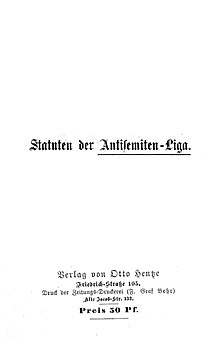 The origin of "antisemitic" terminologies is found in the responses of Moritz Steinschneider to the views of Ernest Renan. As Alex Bein writes: "The compound anti-Semitism appears to have been used first by Steinschneider, who challenged Renan on account of his 'anti-Semitic prejudices' [i.e., his derogation of the "Semites" as a race]."[14] Avner Falk similarly writes: 'The German word antisemitisch was first used in 1860 by the Austrian Jewish scholar Moritz Steinschneider (1816-1907) in the phrase antisemitische Vorurteile (antisemitic prejudices). Steinschneider used this phrase to characterise the French philosopher Ernest Renan's false ideas about how "Semitic races" were inferior to "Aryan races"'.[15]1879 statute of the Antisemitic League
 In 1879 German journalist Wilhelm Marr published a pamphlet, Der Sieg des Judenthums über das Germanenthum. Vom nicht confessionellen Standpunkt aus betrachtet (The Victory of the Jewish Spirit over the Germanic Spirit. Observed from a non-religious perspective) in which he used the word Semitismus interchangeably with the word Judentum to denote both "Jewry" (the Jews as a collective) and "jewishness" (the quality of being Jewish, or the Jewish spirit).[20][21][22]Cover page of Marr's The Way to Victory of Germanicism over Judaism, 1880 edition
 Bernard Lewis defines antisemitism as a special case of prejudice, hatred, or persecution directed against people who are in some way different from the rest. According to Lewis, antisemitism is marked by two distinct features: Jews are judged according to a standard different from that applied to others, and they are accused of "cosmic evil." Thus, "it is perfectly possible to hate and even to persecute Jews without necessarily being anti-Semitic" unless this hatred or persecution displays one of the two features specific to antisemitism.[39]Antisemitic caricature by C.Léandre (France, 1898) showing Rothschild with the world in his hands
 1889 Paris, France elections poster for self-described "candidat antisémite" Adolphe Willette: "The Jews are a different race, hostile to our own... Judaism, there is the enemy!" (see file for complete translation)
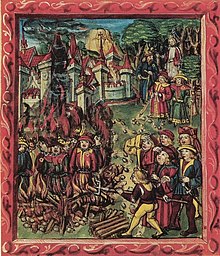 Antisemitism manifests itself in a variety of ways. René König mentions social antisemitism, economic antisemitism, religious antisemitism, and political antisemitism as examples. König points out that these different forms demonstrate that the "origins of anti-Semitic prejudices are rooted in different historical periods." König asserts that differences in the chronology of different antisemitic prejudices and the irregular distribution of such prejudices over different segments of the population create "serious difficulties in the definition of the different kinds of anti-Semitism."[52] These difficulties may contribute to the existence of different taxonomies that have been developed to categorize the forms of antisemitism. The forms identified are substantially the same; it is primarily the number of forms and their definitions that differ. Bernard Lazare identifies three forms of antisemitism: Christian antisemitism, economic antisemitism, and ethnologic antisemitism.[53] William Brustein names four categories: religious, racial, economic and political.[54] The Roman Catholic historian Edward Flannery distinguished four varieties of antisemitism:[55]Jews (identified by the mandatory Jewish badge and Jewish hat) being burned during the Black Death in 1348.
 Religious antisemitism, also known as anti-Judaism, is antipathy towards Jews because of their perceived religious beliefs. In theory, antisemitism and attacks against individual Jews would stop if Jews stopped practicing Judaism or changed their public faith, especially by conversion to the official or right religion. However, in some cases discrimination continues after conversion, as in the case of Christianized Marranos or Iberian Jews in the late 15th century and 16th century who were suspected of secretly practising Judaism or Jewish customs.[55]Execution of Mariana de Carabajal (converted Jew), accused of a relapse into Judaism, Mexico City, 1601
 Racial antisemitism is prejudice against Jews as a racial/ethnic group, rather than Judaism as a religion.[82]Jewish Soviet soldier taken prisoner by the German Army, August 1941. At least 50,000 Jewish soldiers were shot after selection.[clarification needed]
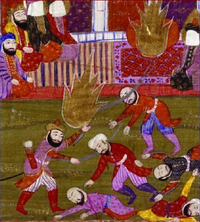 Many authors see the roots of modern antisemitism in both pagan antiquity and early Christianity. Jerome Chanes identifies six stages in the historical development of antisemitism:[103]The massacre of the Banu Qurayza, a Jewish tribe of Medina, 627
 Between 1900 and 1924, approximately 1.75 million Jews migrated to America, the bulk from Eastern Europe. Before 1900 American Jews had always amounted to less than 1% of America's total population, but by 1930 Jews formed about 3.5%. This increase, combined with the upward social mobility of some Jews, contributed to a resurgence of antisemitism. In the first half of the 20th century, in the USA, Jews were discriminated against in employment, access to residential and resort areas, membership in clubs and organizations, and in tightened quotas on Jewish enrolment and teaching positions in colleges and universities. The lynching of Leo Frank by a mob of prominent citizens in Marietta, Georgia in 1915 turned the spotlight on antisemitism in the United States.[162] The case was also used to build support for the renewal of the Ku Klux Klan which had been inactive since 1870.[163]The victims of a 1905 pogrom in Yekaterinoslav
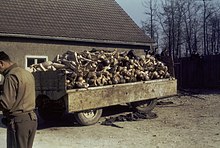 In Germany, Nazism led Adolf Hitler and the Nazi Party, who came to power on 30 January 1933 and instituted repressive legislation which denied the Jews basic civil rights. In 1935, the Nuremberg Laws prohibited sexual relations and marriages between "Aryans" and Jews as Rassenschande ("race disgrace") and stripped all German Jews, even quarter- and half-Jews, of their citizenship, (their official title became "subjects of the state"). It instituted a pogrom on the night of 9–10 November 1938, dubbed Kristallnacht, in which Jews were killed, their property destroyed and their synagogues torched.[166] Antisemitic laws, agitation and propaganda were extended to German-occupied Europe in the wake of conquest, often building on local antisemitic traditions. In the east the Third Reich forced Jews into ghettos in Warsaw, Kraków, Lvov, Lublin and Radom.[167] After the invasion of the Soviet Union in 1941 a campaign of mass murder, conducted by the Einsatzgruppen, culminated from 1942 to 1945 in systematic genocide: the Holocaust.[168] Eleven million Jews were targeted for extermination by the Nazis, and some six million were eventually killed.[168][169][170]A wagon piled high with corpses outside the crematorium at the recently liberated Buchenwald concentration camp
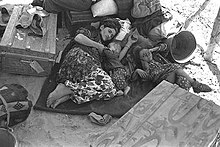 Robert Bernstein, founder of Human Rights Watch, says that antisemitism is "deeply ingrained and institutionalized" in "Arab nations in modern times."[175]Displaced Iraqi Jews arrive in Israel in 1951 during the Jewish exodus from Arab and Muslim countries
 In March 2011, the Israeli government issued a paper claiming that "Anti-Israel and anti-Semitic messages are heard regularly in the government and private media and in the mosques and are taught in school books," to the extent that they are "an integral part of the fabric of life inside the PA."[202] In August 2012, Israeli Strategic Affairs Ministry director-general Yossi Kuperwasser stated that Palestinian incitement to antisemitism is "going on all the time" and that it is "worrying and disturbing." At an institutional level, he said the PA has been promoting three key messages to the Palestinian people that constitute incitement: "that the Palestinians would eventually be the sole sovereign on all the land from the Jordan River to the Mediterranean Sea; that Jews, especially those who live in Israel, were not really human beings but rather 'the scum of mankind'; and that all tools were legitimate in the struggle against Israel and the Jews."[203] In August 2014, the Hamas' spokesman in Doha said on live television that Jews use blood to make matzos.[204]Haj Amin al-Husseini is a central figure of Palestinian nationalism in Mandatory Palestine. He took refuge and collaborated with Nazi Germany during World War II. He met Adolf Hitler in December 1941. Scholarly opinion is divided on the Mufti's antisemitsm, with many scholars viewing him as a staunch antisemite[200] while some deny the appropriateness of the term, or argue that he became antisemitic.[201]

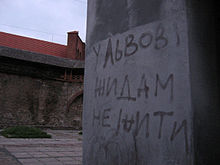
 Antisemitic graffiti in Venezuela, alongside a hammer and sickleFurther information: Antisemitism in Venezuela and History of the Jews in VenezuelaIn a 2009 news story, Michael Rowan and Douglas E. Schoen wrote, "In an infamous Christmas Eve speech several years ago, Chávez said the Jews killed Christ and have been gobbling up wealth and causing poverty and injustice worldwide ever since."[293] Hugo Chávez stated that "[t]he world is for all of us, then, but it so happens that a minority, the descendants of the same ones that crucified Christ, the descendants of the same ones that kicked Bolívar out of here and also crucified him in their own way over there in Santa Marta, in Colombia. A minority has taken possession of all of the wealth of the world."[294]


![[icon]](https://en.wikipedia.org/wiki/File:Wiki_letter_w_cropped.svg)


No comments:
Post a Comment