The Panama–Pacific International Exposition (PPIE) was a world's fair held in San Francisco, in the...
Panama–Pacific International Exposition
From Wikipedia, the free encyclopedia
Modern picture of the
Palace of Fine Arts, the only building surviving today (reconstructed) still on the exposition grounds
The
Panama–Pacific International Exposition (
PPIE) was a
world's fair held in
San Francisco,
in the United States, between February 20 and December 4 in 1915. Its
ostensible purpose was to celebrate the completion of the
Panama Canal, but it was widely seen in the city as an opportunity to showcase its recovery from the
1906 earthquake. The fair was constructed on a
635 acre (2.6 km2) site in San Francisco, along the northern shore, between the
Presidio and
Fort Mason, now known as the
Marina District.
Exhibits
Among the exhibits at the Exposition was the
C. P. Huntington, the first
steam locomotive purchased by
Southern Pacific Railroad; the locomotive is now on static display at the
California State Railroad Museum in
Sacramento. A
telephone line was also established to
New York City so people across the continent could hear the
Pacific Ocean. The
Liberty Bell traveled by train on a nationwide tour from
Philadelphia, Pennsylvania
to attend the exposition. After that trip, the Liberty Bell returned to
Philadelphia, and has not made any further journeys since.
[1]
The
1915 American Grand Prize and
Vanderbilt Cup auto races were held February 27 and March 6 on a 3.84-mile (6.18 km) circuit set up around the Exposition grounds.
[2] The
Smithsonian Institution also had an exhibition at the Exposition.
[3]
Architecture
The centerpiece was the
Tower of Jewels, which rose to 435 feet and was covered with over 100,000 cut glass Novagems. The
3⁄4
to 2 inch colored "gems" sparkled in sunlight throughout the day and
were illuminated by over 50 powerful electrical searchlights at night.
In front of the Tower, the Fountain of Energy flowed at the center of
the South Gardens, flanked by the Palace of Horticulture on the west
and the Festival Hall to the east. The arch of the Tower served as the
gateway to the Court of the Universe, leading to the Court of the Four
Seasons to the west and the Court of Abundance to the east. These courts
formed the primary exhibit area for the fair, which included the Food
Products Palace, the Education and Social Economy Palace, the
Agriculture Palace, the Liberal Arts Palace, the Transportation Palace,
the Manufacturers Palace, the Mines and Metallurgy Palace, and the
Varied Industries Palace. The Machinery Palace, the largest hall,
dominated the east end of the central court.
At the west end of central court group was the
Palace of Fine Arts.
Further west toward the bay down The Avenue of the Nations were
national and states' buildings, displaying customs and products unique
to the area represented. At the opposite end of the Fair, near
Fort Mason was "The Zone", an avenue of popular amusements and concessions stands.
Construction
Constructed from temporary materials (primarily
staff,
a combination of plaster and burlap fiber), almost all the fair's
various buildings and attractions were pulled down in late 1915.
Intended to fall into pieces at the close of the fair (reportedly
because the architect believed every great city needed ruins), the only
surviving building on the Exposition grounds,
Bernard Maybeck's Palace of Fine Arts, remained in place, slowly falling into disrepair
[4] (although the hall used to display painting and sculpture during the Fair was repurposed as a garage for jeeps during
World War II).
The Palace, including the colonnade with its signature weeping women
and rotunda dome, was completely reconstructed in the 1960s and a
seismic retrofit was completed in early 2009. The
Exploratorium,
an interactive science museum, occupied the northern 2/3 of the Palace
from 1969 to 2013; the city-owned Palace of Fine Arts Theater, has
occupied the southern 1/3 since 1970.
A panorama of the Palace of Fine Arts c.1919. The current building was
rebuilt in the 1930s, again in the 1960s, and then seismically
retrofitted after damage from 1989's Loma Prieta Earthquake, and again
in 2009.
Other surviving buildings
Souvenir booklet, "The Jewel City" 1915
Buildings from the Exposition that still stand today (other than the Palace of Fine Arts) include what is now called the
Bill Graham Civic Auditorium at Civic Center Plaza and the Japanese Tea house, which was barged down the Bay to
Belmont, California and currently operates as a restaurant.
Also surviving are the one-third scale steam locomotives of the
Overfair Railroad that operated at the Exposition. They are maintained
in working order at the Swanton Pacific Railroad Society located on Cal
Poly San Luis Obispo's Swanton Ranch just north of Santa Cruz.
[5][6]
The
Legion of Honor Museum, in Lincoln Park, was the gift of
Alma de Bretteville Spreckels, wife of the sugar magnate and
thoroughbred racehorse owner/breeder
Adolph B. Spreckels.
[7]
The building is a full-scale replica of the French Pavilion from the
1915 Panama Pacific International Exposition, which in turn was a
three-quarter-scale version of the
Palais de la Légion d'Honneur also known as the Hôtel de Salm in
Paris
by George Applegarth and H. Guillaume. At the close of the exposition,
the French government granted Spreckels permission to construct a
permanent replica of the French Pavilion, but World War I delayed the
groundbreaking until 1921.
[8]
Commemorations
Postcard showing new buildings in San Francisco, with earthquake ruins
and bear in foreground, and two small images of buildings of the
Exposition at bottom
The
US Post Office issued a set of four
postage stamps to commemorate the exposition, with designs depicting a profile of
Vasco Núñez de Balboa (1¢), the
Pedro Miguel Locks of the
Panama Canal (2¢), the
Golden Gate (5¢), and the discovery of
San Francisco Bay
(10¢). The stamps were first put on sale in 1913, to promote the coming
event, and perforated 12, and then reissued in 1914 and 1915,
perforated 10. Their prices today range widely; the 2¢ of 1913 is
available for under a dollar in used condition, while an unused 10¢ of
the scarcer orange-yellow variety in 1915 can be worth up to a thousand
United States dollars.
[9]
The
United States Congress authorized the
San Francisco Mint
(also known as "The Granite Lady") to issue a series of five
commemorative coins. Said coins were the 1915-S silver Panama-Pacific
half dollar and four gold coins. The denominations of the gold coins
were $1, $
2 1⁄2
(quarter eagle) and $50 (in two types: a round coin, and an unusual
octagonal coin). The Panama-Pacific coins have the distinction of being
the first commemorative coins to bear the motto "In God We Trust", and
were also the first commemoratives to be struck at a branch mint.
[10]
The gold coins are scarce while the two $50 ones are extremely rare.
The half dollar had a mintage of 27,134 and in modestly worn condition
is available for several hundred dollars.
[citation needed]
Numismatist Farran Zerbe supervised the creation of a series of commemorative medals, an award medal, a souvenir medal, and diplomas.
[citation needed]
In 2015, the
California Historical Society,
the Maybeck Foundation, and Innovation Hangar will partner with the
City and County of San Francisco to commemorate the centennial of the
transformative 1915 Panama Pacific International Exposition.
[11]
On June 20, 2015 a commemorative orchestra, chorus and band concert
was held at the Palace of Fine Arts to celebrate the 100th anniversary
of the fair.
A feature film,
When the World Came to San Francisco, which tells the story of the fair, was made by writer and director
R. Christian Anderson. It was a "core partner" of the official centennial celebration sanctioned by the California Historical Society.
[12]
Pictures
-
-
-
-
The model of the Panama Canal
-
-
The State of Wisconsin Pavilion
-
The "India Block" at the Exposition.
-
Aerial view of the Panama–Pacific International Exposition. The
exposition buildings have been colored to distinguish them from the rest
of the Marina District area.
See also
 Floodlit pavilion at the Panama-Pacific International Exposition. The Tower of Jewels on the left, and the Italian Tower on the right.
 The Panama–Pacific International Exposition (PPIE) was a world's fair held in San Francisco, in the United States, between February 20 and December 4 in 1915. Its ostensible purpose was to celebrate the completion of the Panama Canal, but it was widely seen in the city as an opportunity to showcase its recovery from the 1906 earthquake. The fair was constructed on a 635 acre (2.6 km2) site in San Francisco, along the northern shore, between the Presidio and Fort Mason, now known as the Marina District.Modern picture of the Palace of Fine Arts, the only building surviving today (reconstructed) still on the exposition grounds
 A panorama of the Palace of Fine Arts c.1919. The current building was rebuilt in the 1930s, again in the 1960s, and then seismically retrofitted after damage from 1989's Loma Prieta Earthquake, and again in 2009.
 Buildings from the Exposition that still stand today (other than the Palace of Fine Arts) include what is now called the Bill Graham Civic Auditorium at Civic Center Plaza and the Japanese Tea house, which was barged down the Bay to Belmont, California and currently operates as a restaurant.Souvenir booklet, "The Jewel City" 1915
 The US Post Office issued a set of four postage stamps to commemorate the exposition, with designs depicting a profile of Vasco Núñez de Balboa (1¢), the Pedro Miguel Locks of the Panama Canal (2¢), the Golden Gate (5¢), and the discovery of San Francisco Bay (10¢). The stamps were first put on sale in 1913, to promote the coming event, and perforated 12, and then reissued in 1914 and 1915, perforated 10. Their prices today range widely; the 2¢ of 1913 is available for under a dollar in used condition, while an unused 10¢ of the scarcer orange-yellow variety in 1915 can be worth up to a thousand United States dollars.[9]Postcard showing new buildings in San Francisco, with earthquake ruins and bear in foreground, and two small images of buildings of the Exposition at bottom
 Festival Hall
 Palace of Horticulture
 California Building
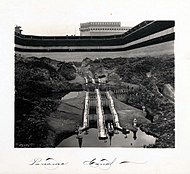 The model of the Panama Canal
 Palace of Fine Arts, by Exposition exhibitor Colin Campbell Cooper
 The State of Wisconsin Pavilion
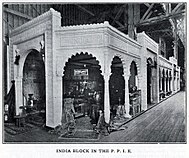 The "India Block" at the Exposition.
 Aerial view of the Panama–Pacific International Exposition. The exposition buildings have been colored to distinguish them from the rest of the Marina District area.


No comments:
Post a Comment