-
931551, these dolmens are also located on the slopes of hills and follow the Jiseokgang river. The Hyosan-ri group contains 158 dolmens and the Dasin-ri5 KB (632 words) - 02:13, 17 February 2016
-
The largest concentration of dolmens in the world is found on the Korean peninsula. With an estimated 35,000 dolmens, Korea alone accounts for nearly 40%22 KB (2,662 words) - 12:44, 7 February 2016
- Gojoseon (category Former countries in Korean history)walled-town states in this period. Dolmens and bronze daggers found in the area are uniquely Korean and cannot be found in China. In the Mumun pottery22 KB (2,795 words) - 03:20, 22 February 2016
-
with an estimated 35,000-100,000 dolmen, Korea counts for nearly 70% of the world's total. Similar dolmens can be found in Manchuria, the Shandong Peninsula28 KB (2,727 words) - 14:21, 19 February 2016
- Mumun pottery period (category Archaeology of Korea)is an archaeological era in Korean prehistory that dates to approximately 1500-300 BC This period is named after the Korean name for undecorated or plain16 KB (1,968 words) - 00:49, 22 May 2015
-
"Dolmens Telling of Ancient Korea's Capital". KCNA. December 3, 2009. Retrieved September 8, 2015. "관산리고인돌". Visit Korea (South Korean travel1 KB (98 words) - 02:36, 19 December 2015
- Choi Mong-lyong (category South Korean expatriates in the United States)Distribution of Korean Dolmens. Hanguk Sanggosa Hakbo [Journal of the Korean Ancient Historical Society] 39, 1999. Trade in Wiman State Formation. In Pacific3 KB (315 words) - 07:53, 19 November 2015
Gochang, Hwasun and Ganghwa Dolmen Sites
From Wikipedia, the free encyclopediaUNESCO World Heritage Site Gochang, Hwasun, and Ganghwa Dolmen Sites Name as inscribed on the World Heritage List 
One of the tallest Domens at Gochang DomensType Cultural Criteria iii Reference 977 UNESCO region Asia-Pacific Inscription history Inscription 2000 (24th Session)
The Gochang, Hwasun and Ganghwa Dolmen Sites are the location of hundreds of stone dolmen which were used as grave markers and for ritual purposes during the first millennium BCE when the Megalithic Culture was prominent on the Korean Peninsula. The sites were designated as a World Heritage Site by UNESCO in 2000. Korea is said to contain more than 40% of the world's dolmen, which are mostly concentrated in these three sites.[1]Gochang, Hwasun and Ganghwa Dolmen Sites Hangul 고창 / 화순 / 강화지석묘군 Hanja 高敞 / 和順 / 江華支石墓群 Revised Romanization Gochang / Hwasun / Ganghwa Jiseongmyogun McCune–Reischauer Koch'ang / Hwasun / Kanghwa Chisŏngmyogun
The megalithic stones are invaluable because they mark the graves of the ruling elite. Pottery, comma-shaped jewels, bronzes, and other funerary artifacts have been excavated from these dolmen. The culture of the people during this time can be gleaned from the evidence left by the dolmen. Additionally, it can be induced from the stones how the stone was quarried, transported, and used to build the dolmen.
Dolmen in Korea have been dated to the seventh century BCE in locations such as Gochang and the practice ended around the third century BCE. The dolmen culture is linked with the Neolithic and bronze cultures of Korea.
Excavation at the sites did not begin until 1965. Since, then multiple digs have been sponsored and an extensive program of inventory and preservation has been initiated by the Korean government.
Contents
Description
Dolmen are generally classified in two types in East Asia. The table/northern-type and the go-board/southern-type. In the former, four stones were positioned to make the walls of a box and were capped by a stone which lay on top of the supports. The latter is characterized by underground burial with stones that supported the capstone.
Gochang Dolmen Site
This group of dolmen are the largest and most varied. They are known as the Jungnim-ri dolmens and are centered in Maesan village, Gochang County, North Jeolla province.
The dolmens were built from east to west at the foot of a series of hills at an altitude of 15 to 50 meters/49 feet to 164 feet. Generally, the capstones of the dolmens are around 1 to 5.8 meters/3.2 to 19 feet in length and may weigh up to 225 tons. 442 dolmen have been documented and classified based on the size of the capstone.
This group is believed to have been constructed around the seventh century BCE.
The Gochang Dolmen Site is listed as Historic Site #391.

Wikimedia Commons has media related to Gochang Dolmens. Hwasun Dolmen Sites
Found in Hwasun County, South Jeolla, 34.9775414°N 126.931551°E, these dolmens are also located on the slopes of hills and follow the Jiseokgang river. The Hyosan-ri group contains 158 dolmens and the Dasin-ri group, 129. These dolmens are less well preserved than the Jungnim-ri group. The quarry where some of the stones of this group were carved out has been located. This group is dated to around the sixth or fifth century BCE.
Ganghwa Dolmen Sites
 These dolmen are located on Ganghwa Island, Ganghwa County, Incheon. They are located on the slopes of mountains and are thus higher in elevation than their counterparts. These dolmen are believed to be earliest ones made because the dolmen groups in Bugeun-ri (부근리, in Hajeom-myeon) and Gocheon-ri (고천리, in Naega-myeon) resemble the early dolmen. However, this has not been conclusively proved.An example of a go-board/southern-type dolmen on Ganghwa
A notable dolmen at Ganghwa is a northern/table-type dolmen where it was believed ancestral rites were performed. It is the biggest stone in South Korea and measures at 2.6 × 7.1 × 5.5 meters. This probably weighs between 150 and 225 tons. [2].
References
See also
Wikimedia Commons has media related to Dolmens in South Korea. External links
Coordinates: 34°58′0.01″N 126°55′45.01″E[hide] World Heritage Sites - Baekje Historic Areas
- Changdeokgung Palace Complex
- Gochang, Hwasun and Ganghwa Dolmen Sites
- Gyeongju Historic Areas
- Haeinsa Temple Janggyeong Panjeon, the Depositories for the Tripitaka Koreana Woodblocks
- Historic Villages of Korea: Hahoe and Yangdong
- Hwaseong Fortress
- Jeju Volcanic Island and Lava Tubes
- Jongmyo Shrine
- Namhansanseong
- Royal Tombs of the Joseon Dynasty
- Seokguram Grotto and Bulguksa Temple
Tentative Lists - Ancient Mountain Fortresses in Central Korea
- Daegokcheon Stream Petroglyphs
- Gaya Tumuli of Gimhae - Haman
- Kangjingun Kiln Sites
- Mt. Soraksan Nature Reserve
- Naganeupseong, Town Fortress and Village
- Oeam Village
- Salterns
- Seoul City Wall
- Seowon, Confucian Academies of Korea
- Sites of fossilized dinosaurs across the southern South Korean coast
- Southwestern Coast Tidal Flats
- The Goryeong Jisandong Daegaya Tumuli
- Traditional Buddhist Mountain Temples of Korea
- Upo Wetland
-
The largest concentration of dolmens in the world is found on the Korean peninsula. With an estimated 35,000 dolmens, Korea alone accounts for nearly 40%22 KB (2,662 words) - 12:44, 7 February 2016
Dolmen sites
 T-shaped Hunebed D27 in Borger-Odoorn, Netherlands
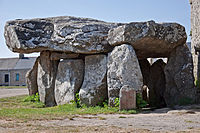 Crucuno dolmen in Plouharnel, Brittany, France
Asia
Korea
The largest concentration of dolmens in the world is found on the Korean peninsula. With an estimated 35,000 dolmens, Korea alone accounts for nearly 40% of the world’s total.
The largest distribution of these is on the west coast area of South Korea, an area that would eventually become host to the Mahan confederacy and be united under the rule of the ancient kingdom of Baekje at one time.
Three specific UNESCO World Heritage sites at Gochang, Hwasun and Ganghwa ( Hwasun – 34.9775414°N 126.931551°E) by themselves account for over 1,000 dolmens.[5]
The Korean word for dolmen is goindol (Hangul: 고인돌 ) "supported stone". Serious studies of the Korean megalithic monuments were not undertaken until relatively recently, well after much research had already been conducted on dolmens in other regions of the world. After 1945, new research is being conducted by Korean scholars.
Korean dolmens exhibit a morphology distinct from the Atlantic European dolmen.[6]
In 1981 a curator of Seoul's National Museum of Korea, Gon'gil Ji, classified Korean dolmens into two general types: northern and southern. The boundary between them falls at the Bukhan River although examples of both types are found on either side. Northern style dolmens stand above ground with a four sided chamber and a megalithic roof (also referred to as "table type"), while southern style dolmens are normally built into the ground and contain a stone chest or pit covered by a rock slab.[6]
Korean dolmens can also be divided into three main types: the table type, the go-table type and the unsupported capstone type. The dolmen in Ganghwa is a northern-type, table-shaped dolmen and is the biggest stone of this kind in South Korea, measuring 2.6 by 7.1 by 5.5 metres. There are many sub-types and different styles.[7] Southern type dolmens are associated with burials but the reason for building northern style dolmens is uncertain.[8]
Due to the vast numbers and great variation in styles, no absolute chronology of Korean dolmens has yet been established. It is generally accepted that the Korean megalithic culture emerged from the late Neolithic age, during which agriculture developed on the peninsula, and flourished throughout the Bronze Age. Thus, it is estimated that the Korean dolmens were built in the first millennium BC.
How and why Korea has produced so many dolmens are still poorly understood. There is no current conclusive theory on the origin of Korea's megalithic culture, and so it is difficult to determine the true cultural character of Korean dolmens. A few northern style dolmens are found in Manchuria and the Shandong Peninsula. Off the peninsula, similar specimens can be found in smaller numbers, but they are often considerably larger than the Korean dolmens.[9] It is a mystery why this culture flourished so extensively only on the Korean peninsula and its vicinity in Northeast Asia.
India
 Dolmen circles, Sulimalthe, Somwarpet
 Megalithic Dolmen at Dannanapeta in Andhra Pradesh, India
There are also dolmens in Andhra Pradesh, Karnataka, Kerala and Tamil Nadu in South India.
This article needs additional citations for verification. (January 2015)
Karnataka
In Karnataka more than 50 dolmens are identified on top of Pandavara Betta about 7 km away from Somwarpet towards Shaniwar Sante in Madikeri (Coorg) District.
Tamil Nadu
In Tamil Nadu more than 100 dolmens are identified in the Moral Pari near Mallachandram [10] located 19 km from Krishnagiri district, Tamil Nadu.
Monday, February 22, 2016
35,000 dolmens in Korea?


Subscribe to:
Post Comments (Atom)
No comments:
Post a Comment