If there were any doubts about Vladimir Putin’s objectives in Syria, the
recent Russian military escalation around this city must surely have
set them aside
‘The aftershocks of the Aleppo bombardment will be felt far and wide. If
there is one thing Europeans have learned in 2015, it is that they
cannot be shielded from the effects of conflict in the Middle East.’
Photograph: Thaer Mohammed/AFP/Getty Images
If Aleppo
falls, Syria’s vicious war will take a whole new turn, one with
far-reaching consequences not just for the region but for Europe too.
The latest government assault on the besieged northern Syrian city,
which has caused tens of thousands more people to flee in recent days,
is also a defining moment for relations between the west and Russia,
whose airforce is playing a key role. The defeat of anti-Assad rebels
who have partially controlled the city since 2012 would leave nothing on
the ground in Syria but Assad’s regime and Islamic State. And all hope
of a negotiated settlement involving the Syrian opposition will vanish.
This has been a longstanding Russian objective – it was at the heart of
Moscow’s decision to intervene militarily four months ago.
It is hardly a coincidence that the bombardment of Aleppo, a symbol
of the 2011 anti-Assad revolution, started just as peace talks were
being attempted in Geneva. Predictably, the talks soon faltered. Russian
military escalation in support of the Syrian army was meant to sabotage
any possibility that a genuine Syrian opposition might have its say on
the future of the country. It was meant to thwart any plans the west and
the UN had officially laid out. And it entirely contradicted Moscow’s
stated commitment to a political process to end the war.
The aftershocks will be felt far and wide. If there is one thing
Europeans have learned in 2015, it is that they cannot be shielded from
the effects of conflict in the Middle East. And if there is one thing
they learned from the Ukraine conflict in 2014, it is that Russia can
hardly be considered Europe’s friend. It is a revisionist power capable
of military aggression.
In fact, as the fate of Aleppo hangs in the balance, these events
have – as no other perhaps since the beginning of the war – highlighted
the connections between the Syrian tragedy and the strategic weakening
of Europe
and the west in general. This spillover effect is something Moscow has
not only paid close attention to, but also in effect fuelled. The spread
of instability fits perfectly with Russia’s goal of seeking dominance
by exploiting the hesitations and contradictions of those it identifies
as adversaries.
Aleppo will define much of what happens next. A defeat for Syrian
opposition forces would further empower Isis in the myth that it is
the sole defender of Sunni Muslims – as it terrorises the population
under its control. There are many tragic ironies here, not least that
western strategy against Isis has officially depended on building up
local Syrian opposition ground forces so that they might one day push
the jihadi insurgency out of its stronghold in Raqqa. If the very people
that were meant to be counted on to do that job as foot soldiers now
end up surrounded and crushed in Aleppo, who will the west turn to? Russia
has all along claimed it was fighting Isis – but in Aleppo it is
helping to destroy those Syrian groups that have in the past proved to
be efficient against Isis.
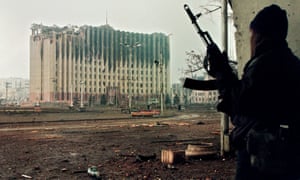
January 10, 1995: a Chechen fighter taking cover from sniper fire after
the presidential palace was destroyed by Russian artillery bombardments.
Photograph: Michael Evstafiev/AFP/Getty
If there were ever any doubts about Russia’s objectives in Syria, events around Aleppo will surely have cleared them.
Advertisement
Vladimir Putin
has duplicated in Syria the strategy he applied to Chechnya: full
military onslaught on populated areas so rebels are destroyed or forced
out. There is a long history of links – going back to the Soviet era –
between the Syrian power structure and Russian intelligence. Just as
Putin’s regime physically eliminated those in Chechnya who might have
been interlocutors for a negotiated peace settlement, Assad has
conflated all political opposition with “terrorism”. And as there was
never any settlement in Chechnya (only full-on war and destruction until
the Kremlin put its own Chechen leader in place), in Putin’s view there
can be no settlement in Syria with the opposition.
Russia’s strategic objectives go much further, however. Putin wants
to reassert Russian power in the Middle East, but it is Europe that he
really has in mind. The defining moment came in 2013, when Barack Obama gave up on airstrikes
against Assad’s military bases after chemical weapons were used. This
encouraged Putin to test western resolve further away, on the European
continent. Putin was certainly caught off guard by the Ukrainian Maidan popular uprising,
but he swiftly moved to restore dominance through use of force,
including the annexation of territory. He calculated – rightly – that
his hybrid war in Ukraine could not be prevented by the west. Russian
policies in Ukraine have as a result shaken the pillars of Europe’s
post-cold-war security order – which Putin would like to see rewritten
to Russia’s advantage.
Likewise, Russian military involvement in Syria has put Nato in a
bind, with one of its key members right on the frontline. Turkey’s
relations with Russia have been on the brink for months. Now Moscow has
openly warned Turkey against sending forces into Syria to defend Aleppo.
How the Turkish leader will choose to react is another western
headache.
All this is happening at a time when European governments are
desperate to win Ankara’s cooperation on the refugee problem. If Turkey
now turns into a troublemaker for Nato on its Middle Eastern flank, that
serves Russian interests. Similarly, if Europe sees a new exodus of
refugees, Russia will stand to benefit.The refugee crisis has sowed deep
divisions on the continent and it has helped populist rightwing parties
flourish – many of which are Moscow’s political allies against the EU
as a project. The refugee crisis has put key EU institutions under
strain; it has heightened the danger of Brexit (which Moscow would
welcome); and it has severely weakened Angela Merkel, the architect of
European sanctions against Russia.
Of course, it would be an exaggeration to say that Putin had all this
worked out from the start. He has been led by events as much as he has
wanted to control them. Russia is not responsible for the outbreak of
the civil war in Syria, nor does it have its hand in everything that
happens in Ukraine. But the way Russia has cynically played its pawns
should send more alarm bells ringing in the west and in the UN than is
the case now.
Putin likes to cast himself as a man of order, but his policies have
brought more chaos, and Europe is set to pay an increasing price.
Getting the Russian regime to act otherwise will require more than
wishful thinking. Aleppo is an unfolding human tragedy. But it is
necessary to connect the dots between the plight of this city, Europe’s
future, and how Russia hovers over both.
end quote from:




No comments:
Post a Comment