HEMET, California—Many cities
across America are doing better today than they were before the
recession. This is not one of them. A decade after the start of the
Great Recession, it struggles with pervasive crime and poverty. “We’re
still recovering—we were really hit hard on all levels,” Linda Krupa,
the mayor of Hemet, told me. A fifth of the population lives below the
poverty line, up from 13 percent in 2005.
Hemet is not alone in its troubles. A report
released this year by the Economic Innovation Group, a research group
started by Silicon Valley entrepreneurs, found that one in six Americans
lives in what the group calls “economically distressed communities”
that are “increasingly alienated from the benefits of the modern
economy.” Such communities have high shares of poverty, many housing
vacancies, a large proportion of adults without a high-school diploma,
high joblessness, and a lower median income than the rest of the state
in which they are located. They also lost jobs and businesses between
2011 and 2015.Many
of these distressed communities are located in Rust Belt states like
Ohio, New York, and Michigan. They include Youngstown, Buffalo, and
Flint. In the months after the 2016 election, there was a lot of
conversation about how people living in these areas felt left behind by
the changing economy and the prosperity in the rest of the country.
But
there’s another type of left-behind community that’s gotten far less
attention. These towns are located in the suburbs of the American west,
in regions hit hard by the housing crisis—Southern California, Las
Vegas, and Arizona. Hemet, a suburb of Riverside, California, with a
population of 84,000, ranked eighth on EIG’s most distressed
small-and-mid-sized-cities list. In Hemet, according to the group’s report,
employment fell 15.5 percent between 2011 and 2015, while it grew 9.4
percent nationwide. The number of businesses in Hemet dropped 4.8
percent over that time period. The median home price, at $237,000, is
still 30 percent lower than it was in 2006.
Why hasn’t Hemet found
surer footing? For one thing, the region where Hemet is located was
decimated by the housing crisis, with among the highest foreclosure and
unemployment rates in the nation; many families are still recovering.
But Hemet’s problems are also the result of structural changes in the
economy—changes that have been underway for decades but were masked by
the heady days of the housing boom. Middle-class jobs have been
disappearing while high-wage and low-wage jobs have grown—but in
different geographic locations. High-wage jobs are often located in big
cities, while low-wage jobs are in relatively cheap locations like
suburbs and small cities. This dynamic changes the housing markets of
these cities, too, with big cities getting more expensive as more
high-wage workers migrate there, and low-wage workers leaving cities to
seek more affordable housing in the far-away suburbs they can afford.
Now that the dust of the recession has cleared, it is evident that the
geography of poverty has changed in America. Hemet is emblematic of just
how fast—and just how dramatically—this has happened.I first visited Hemet in 2010, when, as a reporter for the Los Angeles Times, I stumbled across
a one-time luxury development that real-estate agents were, at the
time, calling a “gated ghetto.” Dozens of families in the community,
called Willowalk, had lost their homes to foreclosure and investors had
swooped in, bought up the properties, and rented them out, often not
checking references and not maintaining the properties. Homeowners were
shocked when renters with Section 8 vouchers moved in next door.
When
I returned to Hemet this November, I assumed that the development would
have bounced back in the seven years since. The houses are huge and
Willowalk features a community pool, a lake, and walking trails, all
features that, in California’s booming real-estate market, would make
the development seem like a steal. But not much has changed in the seven
years since I first visited. If anything, the situation has gotten
worse for people who remained.
“The crime level just keeps getting
higher,” Toni Willden, who bought her home in 2005, told me recently,
about Willowalk. The gates that keep out nonresidents get broken once or
twice a week, she said. Just about everybody in town knows the code to
the gates anyway—I got it by asking the clerk at the hotel where I was
staying. Another woman, Amy Aschenberg, whose family in 2014 bought a
five-bedroom home overlooking a pond, told me that she and her husband
realized they’d made a mistake soon after buying their home. The gated
community was filled with renters, who didn’t keep up their homes and
who hosted parties late into the night, especially in the summer. Home
burglaries—in the middle of the day—happened with alarming regularity.
“I would never have moved here if I had known what this place was,”
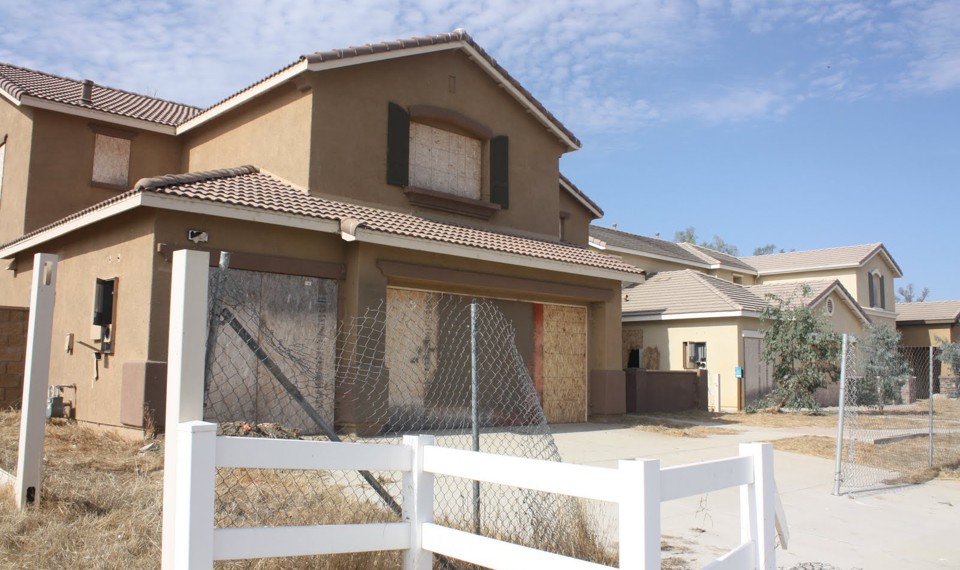
Aschenberg, 36, told me recently. Single-family homes in Hemet, California (Jae C. Hong / AP)This
gated community is an example of how some neighborhoods that were once
middle-class are becoming poorer. “The lack of construction in coastal
cities has forced people who are marginally educated and low-income to
move inland,” said John Husing, the chief economist of the Inland Empire
Economic Partnership. Median rents in Hemet rose just five percent
between 2009 and 2016; in Los Angeles, they rose 20 percent, according
to Census data.Krupa,
the mayor, has said that the recession caused Hemet to transition from a
retirement community to a low-income community because of the influx of
new, poor residents. In the suburbs of the Riverside-San Bernardino
metro area, including Hemet, the number of people living below the
poverty line grew 63 percent, to 596,310, between 2007 and 2016,
according to Elizabeth Kneebone, the research director at the University
of California-Berkeley’s Terner Center for Housing Innovation. In the
suburbs around Las Vegas, the change was even more dramatic: There, the
poor population grew 126 percent between 2006 and 2016, according to
Kneebone. “It’s the new normal that suburbs are going to be struggling
with poverty,” she said.
Hemet problems are in some ways
particular to the areas that suffered the most during the housing bust.
Suburbs far away from Los Angeles, Las Vegas, and Phoenix, where people
bought homes during the “drive til you qualify” housing boom, were
plagued by a high number of foreclosures in the bust. After the homes
went through foreclosure, they were purchased by investors and rented
out, creating new, low-cost rentals. Before the recession, 63 percent of
homes in Hemet were owner-occupied, today just 54 percent are,
according to Census data.
Renters aren’t necessarily bad for a
neighborhood, but the transition of a neighborhood from one of
homeowners to one of renters can be disruptive. When a home is lost to
foreclosure and then changes hands a number of times, it can upset the
community ties in a neighborhood, according to Husing. When homeowners
live in their own homes, they are invested in the community, and their
own fortunes are bound to those around them. When they live far away and
are renting them out, they’re often less able to put time into
maintenance and upkeep. “Detached single-family rental housing tends to
really upset the social structure of communities,” Husing said. “Many
times they never get back.”Research
by Deirdre Pfeiffer, a professor at Arizona State University, found
that after investors bought up single-family homes and rented them out
in the Phoenix suburb of Chandler, Arizona, the neighborhoods had more
service calls to police about violent crime. Husing did a similar study
in San Bernardino, the next county over from Riverside, and found that
in one city, Ontario, it was 47 percent more likely that police would be
called to single-family rentals than to owner-occupied homes, 25
percent more likely that the fire department would be called to
single-family rentals, and 36 more likely that the city would have to
take out code enforcement actions on single-family rentals than
owner-occupied homes.
The problem is not the influx of renters,
necessarily, but instead the absentee landlords who don’t keep up homes.
I talked to a woman named Domenica Azzolini, who moved into a big house
in Willowalk after losing her home to foreclosure. She moved in without
seeing the rental because she was desperate for a place, only to find
that the floors were unfinished concrete, and that there was black mold
growing in the bathroom. Her landlord refused to fix either, so Azzolini
paid for the repairs out of her own pocket. The deteriorating upkeep of
some neighborhoods like Willowalk has led to an exodus of those who can
leave. The Lopezes, the family of first-time homeowners in Willowalk I
had profiled in 2010, walked away from their home and moved to another
town. “It got so bad that we had to move,” Maria Lopez told me.Lower-income
neighborhoods typically have higher crime rate than higher-income
neighborhoods, and an influx of low-income renters has tracked with an
uptick in crime in Hemet. According to FBI crime data, in 2016 in Hemet
there were more motor-vehicle thefts (623), robberies (170), and
aggravated assaults (398) than in any other year in the 21st century.
“I’ve seen the community really go downhill since the recession,” Jim
Ollerton, a lifelong Hemet resident and member of the Hemet Planning
Commission told me. “The community is still suffering with a lot of
quality-of-life criminal activity.” He recently voted against a new
planned condominium in Hemet because he thinks the city has too many
rentals. A for-rent sign in the gated Willowalk community in Hemet (Alana Semuels / The Atlantic)Of
course, the challenges in places like Hemet aren’t just caused by an
uptick in low-income new arrivals. People who have lived in these areas
for years are also struggling. It’s not that there aren’t jobs: In the
last five years, the Inland Empire, as the area encompassing Riverside
and San Bernardino counties is called, had the second-fastest
rate of job growth in California, after San Francisco. But these jobs
aren’t the kind that give families a comfortable middle-class life;
rather, they are low-paying and unstable. The fastest-growing industry
in the Inland Empire between 2011 and 2016 was warehousing and storage,
which more than doubled employment. Other fields that saw big growth
were food service and health care. The pay isn’t great in any of these
fields—in the Inland Empire, the 40,000 or so food-preparation workers
make an average of $24,000 a year; the 55,000 material movers make
$29,000, and the 30,000 people working in health-care support make
$34,000. “It is the whole nature of this economy not delivering rising
real incomes to people in those types of jobs,” Husing said.It’s
not random chance that has concentrated these jobs in places like the
Inland Empire. Well-paying jobs for people with college educations are
increasingly located in cities. Meanwhile, jobs in retail,
manufacturing, and warehousing have suburbanized as companies move to
places with cheaper land and labor.“The types of jobs that are more
suburbanized tend to be lower-paying,” Kneebone said. And the Inland
Empire is essentially one big suburb. The Riverside–San Bernardino area
has the worst annual average private-sector wage of the top 50 metropolitan statistical areas in the country, at $40,000 in 2015.
The
inflated wages in the construction and finance industries during the
housing boom gave suburbs like those in the Inland Empire a few good
years in which people could live a middle-class life. Now that lifestyle
is out of reach for many, a fact Tricia and Rich Powe know all too
well. Before the recession, they did well for themselves—he worked in
manufacturing, she was a mortgage counselor.
But they both lost
their jobs during the recession, and then lost the home they’d bought in
Corona, a suburb of Riverside, in 2008. After a long spell of
unemployment, Rich found a new job in manufacturing three years ago, but
he began as a temporary worker, and even though he was recently brought
on as a full-time employee, he makes $6.25 an hour less than he did
before the recession. They haven’t been able to accumulate any savings,
and are still paying off loans; Rich for his daughter’s college
education, Tricia for school. “We’re living paycheck to paycheck,”
Tricia told me. “If we lost our jobs, we’d be in trouble.”
In the
end, Hemet is stuck. The city itself can’t convince companies to pay
better wages, and it has no control over the rents in big cities that
are pushing people out to the suburbs. It has tried to force absentee
landlords to keep up their homes, but has limited resources to do so,
and struggles to smooth over its transition from a community of
homeowners to one of renters. Like many other suburbs and small cities
across the country, the economic tide has turned against its residents,
leaving them seemingly no path back to vitality. As Hemet and many
suburbs like it are finding, growing poverty can lead to even bigger
problems—lower tax revenues, fewer businesses able to stay put, worse
services like schools and police. This, of course, makes them even less
attractive for people who have other choices about where to live. Over
time, the situation only gets worse. As nearby cities prosper, and the
recession appears as just a bump in the road in the rearview mirror,
distressed areas are still there, unable to move ahead.


No comments:
Post a Comment