Ancient Greek manuscripts reveal life lessons from the Roman empire
Newly translated textbooks from the second and sixth centuries aimed
at language learners also provide pointers on shopping, bathing, dining
and how to deal with drunk relatives
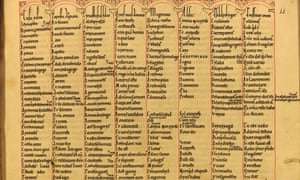
How to live, the Latin way. A 12th-century manuscript with material
copied from the earlier texts – an important source for Professor Dickey
in her research.
Photograph: Zisterzienserstift Zwettl
Ever been unsure about how to deal with a drunken family member
returning from an orgy? A collection of newly translated textbooks aimed
at Greek speakers learning Latin in the ancient world might hold the
solution.
Professor Eleanor Dickey travelled around Europe to view the scraps
of material that remain from ancient Latin school textbooks, or
colloquia, which would have been used by young Greek speakers in the
Roman empire learning Latin between the second and sixth centuries AD.
The manuscripts, which Dickey has brought together and translated into
English for the first time in her forthcoming book Learning Latin the
Ancient Way: Latin Textbooks in the Ancient World, lay out everyday
scenarios to help their readers get to grips with life in Latin.
Subjects range from visiting the public baths to arriving at school late
– and dealing with a sozzled close relative.
“Quis sic facit, domine, quomodo tu, ut tantum bibis? Quid dicent,
qui te viderunt talem?” runs the scene from the latter, which Dickey
translates as: “Who acts like this, sir, as you do, that you drink so
much? What would they say, the people who saw you in such a condition?
“Is this a fitting way for a master of a household who gives advice
to others to conduct himself? It is not possible (for things) more
shamefully nor more ignominiously to happen than you acted yesterday,”
the scolder continues, adding: “infamiam maximam tibi cumulasti”, or
“Great infamy have you accumulated for yourself … But now you don’t want
to vomit, do you?”
The recipient of the attack is suitably chastened in the scenario: “I
certainly am very much ashamed,” he replies. “I don’t know what to say,
for so upset have I been that no explanation to anyone can I give.”
“Roman dinner parties were not always decorous affairs; participants
might drink more than was sensible and while under the influence might
do things that they would later regret,” writes Dickey in her book,
which is published tomorrow by Cambridge University Press. “The
colloquia do not describe any of these scenes, but they do include a
scene in which a character is rebuked for his (unspecified) behaviour
while drunk. It is unclear what the relationship between the scolder and
the miscreant is, though some type of family connection seems likely.”
The colloquia show the language learners how to deal with
getting to school late – a boy told that “yesterday you slacked off and
at midday you were not at home”. He successfully escapes from censure by
putting the blame on his very important father, whom he had accompanied
“to the praetorium” where he was “greeted by the magistrates, and he
received letters from my masters the emperors”.
The Latin learners are provided with examples of how to deal with
visits to sick friends and preparations for dinner parties. They are
also briefed on trips to the market to wrangle over prices (“How much is
the cape?” “Two hundred denarii.” “You’re asking a lot; accept a
hundred denarii”) and an excursion to the bank.
“We don’t know if they would have roleplayed the scenes with other
students,” said Dickey, a professor of classics at the University of
Reading. “But my hunch is that they did.”
Dickey said the texts were very commonly used. “We know this because
they survive in lots of different medieval manuscript versions. At least
six different versions were floating around Europe by 600 AD,” she
said. “This is actually more common than many better-known ancient
texts: there was only one copy of Catullus, and fewer than six of
Caesar. Also, we have several papyrus fragments – since only a tiny
fraction survive, when you have more than one papyrus fragment, for sure
a text was popular in antiquity.”
The oldest versions of the texts exist as fragments on papyri in
Egypt, where the climate meant they survived. Due to the size of these
fragments, Dickey had to refer to medieval manuscripts from across
Europe. “They have been copied and copied over many centuries, with
everyone introducing more mistakes, so they’re not that readable. As an
editor, I had to find all the different manuscripts and try to work out
what the mistakes were, so I could get to the original text.”
Dickey shows how the students had glossaries to help them get to
grips with the new language, collecting together lists of words on
useful subjects such as sacrifices (“exta” means entrails, “victimator”
is a calf-slaughterer and “hariolus” is a soothsayer) and entertainment.
“They’re definitely not the same sorts of words as we’d need,” said
Dickey.
Advertisement
There’s
a phrasebook section on excuses (“You did what I told you?” “Not yet
“Why?” “I (shall) do it soon, for I’m in a hurry to go out”), and a
varied one on insults. “Maledicis me, malum caput? crucifigaris!” or “Do
you revile me, villain? May you be crucified!” is one particularly
vicious one, along with: “And does he revile (me), that animal-fighter?
Let me go, and I shall shake out his teeth.”
“When we think of the Romans, it’s mainly of the rich and famous
generals, emperors and statesmen,” Dickey told the Guardian. “But those
people are clearly atypical: they’re famous precisely because they were
remarkable. Historians try to correct this bias by telling us about the
masses of ordinary Romans, but rarely do we have works written by or
about these people. These colloquia give us real, contemporary stories
about their lives and I hope my work gives a fairer and truer vision of
ancient society.”
Insights into the intended readers’ times are provided by a scene
played out during a visit to the public baths. Here, wrestling is
followed by anointing with oil, before time in the sweatrooms and the
hot pools. “Let’s use the dry heat room and go down that way to the hot
pool,” one character suggests. “Go down, pour hot water over me. Now get
out. Throw yourself into the pool in the open air. Swim!” “I have
swum.”
“We learn all kinds of things we didn’t know here. When they come
from the baths, they take a shower and scrape themselves off with a
‘strigil’,” said Dickey. A strigil was a metal scraper used to remove
dirt after an activity such as wrestling, and the characters have washed
and swum since they wrestled. Dickey believes the only plausible reason
for then showering and scraping is that their bath has made the
characters dirtier than they were previously. “We knew the baths were
dirty, but not that they were this dirty.”
end quote from:


No comments:
Post a Comment