Intuition, a phenomenon of the mind, describes the ability to acquire knowledge without inference or the use of reason. The word "intuition" comes from Latin ...
Intuition
From Wikipedia, the free encyclopedia
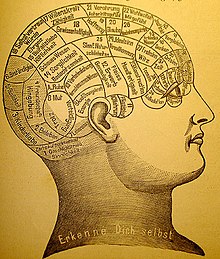
A phrenological
mapping[1] of the
brain –
phrenology was among the first attempts to correlate mental functions with specific parts of the brain
Intuition, a phenomenon of the
mind, describes the ability to acquire knowledge without
inference or the use of
reason.
[2] The word "intuition" comes from Latin verb
intueri translated as
consider or from
late middle English word
intuit, "to contemplate".
[3] Intuition is often interpreted with varied meaning from intuition being glimpses of greater knowledge
[4] to only a function of
mind; however, processes by which and why they happen typically remain mostly unknown to the thinker, as opposed to the view of
rational thinking.
Intuition has been subject of discussion from ancient philosophy to modern
psychology, also a topic of interest in various
religions and
esoteric domains, as well as a common subject of writings
[5] and is often misunderstood and misinterpreted as
instinct, truth,
belief,
meaning and other subjects. The
right brain is popularly associated with intuitive processes such as aesthetic or generally creative abilities.
[6][7][8] Some scientists have contended that intuition is associated with innovation in scientific discovery.
[9]
Intuition can also be the result of reading
social cues.
Intuition Peak on
Livingston Island in the
South Shetland Islands,
Antarctica is named in appreciation of the role of scientific intuition for the advancement of human knowledge.
[10]
Philosophy
Both
Eastern and
Western philosophers have studied the concept in great detail.
Philosophy of mind deals with the concept of intuition. The concept is often confused with other concepts such as
truth,
belief, and
meaning.
[11]
Eastern philosophy
In the East intuition is mostly intertwined with
religion and
spirituality, and various meanings exist from different religious texts.
[12]
Hinduism
In Hinduism various attempts have been made to interpret the
Vedic and other esoteric texts.
Sri Aurobindo
believed humans are evolutionary beings who currently are not fully
developed and are only in a transitional period. To him, intuition in
human beings are just glimpses of wider and higher self-knowing
knowledge beyond human intelligence, a knowledge where there is no
division between the knowledge and the person obtaining the knowledge
and where understanding of
reality is in its entirety, currently he finds the
mind
often twists and always diminishes the quality of knowledge from
intuition. He thought that with time intuition will be the main function
of human thought and thinking would become a secondary activity of the
mind. He also claimed that one can perform actions to try to achieve
this state.
[4]
Osho believed consciousness of human beings to be in increasing order from basic animal
instincts
to intelligence and intuition, and humans being constantly living in
that conscious state often moving between these states depending on
their affinity and he also suggests living in the state of intuition is
one of the ultimate aims of humanity.
[13]
Advaita vedanta (a school of thought) takes intuition to be an experience through which one can come in contact with and experience
Brahman.
[14]
Buddhism
Buddhism
finds intuition being a faculty in the mind of immediate knowledge and
puts the term intuition beyond mental process of conscious
thinking,
as the conscious intellect cannot necessarily access subconscious
information, or render such information into a communicable form.
[15] In
Zen Buddhism
various techniques have been developed to help develop ones intuitive
capability, such as kó-an - the resolving of which leads to states of
minor enlightenment (
satori).
In parts of Zen Buddhism intuition is deemed a mental state between the
Universal mind and one's individual, discriminating mind.
[16][17]
Islam
In Islam
there are various scholars with varied interpretation of intuition
(often termed as hads, hitting correctly on a mark), sometimes relating
the ability of having intuitive knowledge to
prophet
hood. Siháb al Din-al Suhrawadi in his book philosophy of illumination
(ishráq) finds intuition is a knowledge got through illumination and is
mystical in nature and also suggests mystical contemplation(mushãhada)
on this to bring about correct judgements.
[18]
while Ibn Sīnā finds the ability of having intuition as a "prophetic
capacity" terms it as a knowledge obtained without intentionally
acquiring it. He finds regular knowledge is based on imitation while
intuitive knowledge as based on intellectual certitude.
[19]
Western philosophy
In the West, intuition does not appear as a separate field of study, and early mention and definition can be traced back to
Plato. In his book
Republic he tries to define intuition as a fundamental capacity of human
reason to comprehend the true nature of
reality.
[20] In his discussion with
Meno &
Phaedo,
he describes intuition as a pre-existing knowledge residing in the
"soul of eternity," and a phenomenon by which one becomes conscious of
pre-existing knowledge. He provides an example of mathematical truths,
and posits that they are not arrived at by reason. He argues that these
truths are accessed using a knowledge already present in a dormant form
and accessible to our intuitive capacity. This concept by Plato is also
sometimes referred to as
anamnesis. The study was later continued by his
followers.
[21]
In his book Meditations on first philosophy,
Descartes
refers to an intuition as a pre-existing knowledge gained through
rational reasoning or discovering truth through contemplation. This
definition is commonly referred to as rational intuition.
[22] Later philosophers, such as
Hume,
have more ambiguous interpretations of intuition. Hume claims intuition
is a recognition of relationships (relation of time, place, and
causation) while he states that "the resemblance" (recognition of
relations) "will strike the eye" (which would not require further
examination) but goes on to state, "or rather in mind" - attributing
intuition to power of mind, contradicting the theory of
empiricism.
[23][24]
Immanuel Kant finds intuition is thought of as basic sensory information provided by the
cognitive faculty of sensibility (equivalent to what might loosely be called
perception). Kant held that our
mind casts all of our external intuitions in the form of
space, and all of our internal intuitions (
memory, thought) in the form of time.
[25] Intuitionism is a position advanced by
Luitzen Egbertus Jan Brouwer in
philosophy of mathematics derived from Kant's claim that all
mathematical knowledge is knowledge of the pure forms of the intuition - that is, intuition that is not empirical.
Intuitionistic logic was devised by
Arend Heyting to accommodate this position (and has been adopted by other forms of
constructivism in general). It is characterized by rejecting the
law of excluded middle: as a consequence it does not in general accept rules such as
double negation elimination and the use of
reductio ad absurdum to prove the existence of something.
[citation needed]
Intuitions are customarily appealed to independently of any
particular theory of how intuitions provide evidence for claims, and
there are divergent accounts of what sort of mental state intuitions
are, ranging from mere spontaneous judgment to a special presentation of
a necessary truth.
[26] However, in recent years a number of philosophers, especially George Bealer have tried to defend appeals to intuition against
Quinean doubts about
conceptual analysis.
[27] A different challenge to appeals to intuition has recently come from
experimental philosophers, who argue that appeals to intuition must be informed by the methods of social science.
[citation needed]
The
metaphilosophical assumption that philosophy depends on intuitions has recently been challenged by some philosophers.
Timothy Williamson
has argued that intuition plays no special role in philosophy practice,
and that skepticism about intuition cannot be meaningfully separated
from a general
skepticism
about judgment. On this view, there are no qualitative differences
between the methods of philosophy and common sense, the sciences or
mathematics.
[28]
Psychology
Freud and Jung
Sigmund
Freud
said knowledge could only be attained through the intellectual
manipulation of carefully made observations and rejected any other means
of acquiring knowledge such as intuition, and his findings could have
been analytic turn of his mind towards the subject.
[29] In
Carl Jung's theory of the
ego, described in 1921 in
Psychological Types,
intuition was an "abstract function", opposed most directly by
sensation, and could be found in combination with either of the "judging
functions" of thinking and feeling, as in intuitive thinking types and
intuitive feeling types.
[30]
Jung defined intuition as "perception via the unconscious": using
sense-perception only as a starting point, to bring forth ideas, images,
possibilities, patterns, ways out of a blocked situation, by a process
that is mostly unconscious.
Jung said that a person in whom intuition was dominant, an "intuitive
type", did not use their concrete sensory experience but an abstract
intuitive one. An extroverted intuitive type, "the natural champion of
all minorities with a future", orients themselves to new and promising
but unproven possibilities, often leaving to chase after the new
possibility before old ventures have borne fruit, oblivious to his or
her own welfare in the constant pursuit of change. An introverted
intuitive type orients himself with images from the unconscious, ever
exploring the psychic world of the
archetypes,
seeking to perceive the meaning of events, but often having no interest
in playing a role in those events and not seeing any connection between
the contents of the psychic world and him or herself. Jung thought that
extroverted intuitive types were likely entrepreneurs, speculators,
cultural revolutionaries, often undone by a desire to escape every
situation before it becomes settled and constraining, repeatedly leaving
lovers for the sake of new romantic possibilities. His introverted
intuitive types were likely mystics, prophets, or cranks, struggling
with a tension between protecting their visions from influence by others
and making their ideas comprehensible and reasonably persuasive to
others—a necessity for those visions to bear real fruit.
[31]
Modern psychology
In more-recent psychology, intuition can encompass the ability to know valid solutions to problems and
decision making. For example, the
recognition primed decision (RPD) model explains how people can make relatively fast decisions without having to compare options.
Gary Klein
found that under time pressure, high stakes, and changing parameters,
experts used their base of experience to identify similar situations and
intuitively choose feasible solutions. Thus, the RPD model is a blend
of intuition and analysis. The intuition is the pattern-matching process
that quickly suggests feasible courses of action. The
analysis is the mental simulation, a conscious and deliberate review of the courses of action.
[32]
A lot of time
instinct
is misinterpreted as intuition and its reliability considered to be
dependent on past knowledge and occurrences in a specific area. For
example, someone who has had more experiences with children will tend to
have a better instinct about what they should do in certain situations
with them. This is not to say that one with a great amount of experience
is always going to have an accurate intuition.
[33]
Intuitive abilities were quantitatively tested at Yale University in the 1970s. While studying
nonverbal communication, researchers noted that some subjects were able to read nonverbal facial cues before reinforcement occurred.
[34]
In employing a similar design, they noted that highly intuitive
subjects made decisions quickly but could not identify their rationale.
Their level of accuracy, however, did not differ from that of non
intuitive subjects.
[35]
Colloquial usage
Intuition,
as a gut feeling based on experience, has been found to be useful for
business leaders for making judgement about people, culture and
strategy.
[36]
Law enforcement officers often claim to observe suspects and
immediately "know" that they possess a weapon or illicit narcotic
substances, which could also be action of
instincts, however, this can sometimes be considered to be subconscious racism.
[37]
Often unable to articulate why they reacted or what prompted them at
the time of the event, they sometimes retrospectively can plot their
actions based upon what had been clear and present danger signals. Such
examples liken intuition to "
gut feelings" and when viable illustrate
preconscious activity.
[38]
See also
References
Notes


No comments:
Post a Comment