Inside the MIT lab developing soft, wearable robots
As
researchers continue to develop new and improved robots, many are
concerned about the future capabilities of these machines. Even tech
innovators like Elon Musk and Bill Gates fear that if we don't control
artificial intelligence, we might create machines that can cause harm.
But
at MIT, researchers are working to create robots that will improve our
lives – but they don't look like the hard metal machines that often come
to mind. They've come up with a "soft," wearable robot that could turn
us all into cyborgs, reports CBS News' Tony Dokoupil.
Inside a
garage-like lab at MIT, robotics researcher Shuguang Li toils for up to
20 hours a day. He's perfecting the material for a new breed of robot –
one that's light and flexible but also two to three times stronger than a
human being.
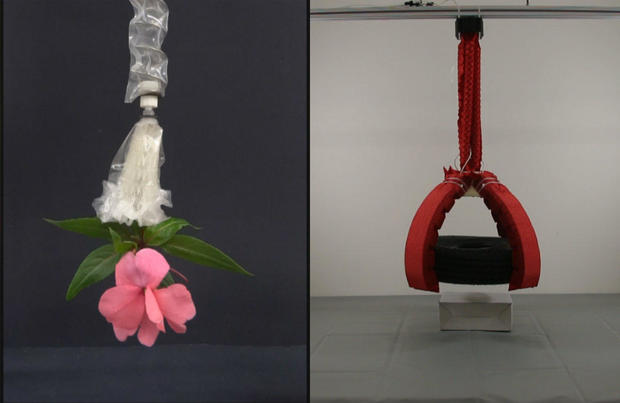
Made of nylon and plastic and powered by compressed
air, the "artificial muscles" have folds inside them. They can grip,
lift and twist everything from a flower to a tire.
Made
of nylon and plastic and powered by compressed air, the "artificial
muscles" have folds inside them and can grip, lift and twist.
CBS News
Li and his colleagues, including Harvard's Daniel Vogt, hope we'll be able to wear the robot like Tony Stark in "Iron Man."
The
researchers there say warnings of a robot revolution are overblown.
After all, you can fool a robot, or at least fool an artificial
intelligence program designed to see and recognize the world around it.
"A.I.'s
are actually really good at recognizing objects these days," said MIT
doctoral student Anish Athalye. "The current state of algorithms are
above 95 percent accurate."
Athalye says that kind of accuracy
is fueling the future of A.I., including enhanced security screenings
and self-driving vehicles.
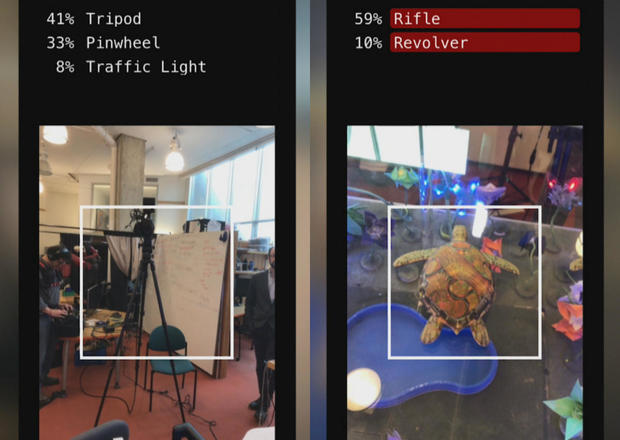
"And if we point it at one of the
cameras, it says, oh, like this is a tripod," he demonstrated. "So these
things work pretty well."
Researchers have also discovered a way to trick the A.I.
CBS News
But
along with these advancements, Athalye and others are also discovering
potentially dangerous drawbacks. They found a way to trick the computer
by making a toy loggerhead turtle look like something very different and
alarming from a security standpoint.
"It's currently 66 percent confident that it's looking at a rifle," Athalye said.
With
pixel changes too small for the human eye, Athalye says he can also
turn a baseball into an espresso and a cat picture into guacamole. But
his concern is what others might do with ill intent.
"Can a terrorist build a bomb that the computer thinks is a bouquet of flowers?" Dokoupil asked.
"Yeah
so, I think we have a fun example for you, we took a missile and then
modified the texture so it looks like a balloon," Athalye said. "I
feel like it's good that this is happening now, before these systems are
very widely deployed."
Google created the program tricked by
researchers at MIT. But in a statement, the company said it welcomes
efforts to identify security risks, adding "we believe A.I. will be
overwhelmingly beneficial."



No comments:
Post a Comment