The butterfly effect is a tenet of Chaos Theory that describes how very small actions can have extremely complex effects, such as...
Butterfly effect
From Wikipedia, the free encyclopedia
A plot of Lorenz's
strange attractor for values ρ=28, σ = 10, β = 8/3. The butterfly effect or sensitive dependence on initial conditions is the property of a
dynamical system that, starting from any of various arbitrarily close alternative
initial conditions on the attractor, the
iterated points will become arbitrarily spread out from each other.
The
Butterfly Effect is a concept that small causes can have
large effects. Initially, it was used with weather prediction but later
the term became a metaphor used in and out of science.
[1]
In
chaos theory, the
butterfly effect is the sensitive dependence on
initial conditions in which a small change in one state of a deterministic
nonlinear system can result in large differences in a later state. The name, coined by
Edward Lorenz
for the effect which had been known long before, is derived from the
metaphorical example of the details of a hurricane (exact time of
formation, exact path taken) being influenced by minor perturbations
such as the flapping of the wings of a distant
butterfly several weeks earlier. Lorenz discovered the effect when he observed that runs of his
weather model
with initial condition data that was rounded in a seemingly
inconsequential manner would fail to reproduce the results of runs with
the unrounded initial condition data. A very small change in initial
conditions had created a significantly different outcome.
The idea, that small causes may have large effects in general and in weather specifically, was used from
Henri Poincaré to
Norbert Wiener.
Edward Lorenz's
work developed the concept of instability of the atmosphere to a
quantitative foundation and linked the concept to the properties of
large classes of systems undergoing
nonlineardynamics and
deterministic chaos theory.
[1]
The butterfly effect is exhibited by very simple systems. For example, the
randomness of the outcomes of throwing
dice
depends on this characteristic to amplify small differences in initial
conditions—the precise direction, thrust, and orientation of the
throw—into significantly different dice paths and outcomes, which makes
it virtually impossible to throw dice exactly the same way twice.
History
Chaos theory and the sensitive dependence on initial conditions were described in the literature in a particular case of the
three-body problem by
Henri Poincaré in 1890.
[2] He later proposed that such phenomena could be common, for example, in meteorology.
[3]
In 1898,
[2] Jacques Hadamard noted general divergence of trajectories in spaces of negative curvature.
Pierre Duhem discussed the possible general significance of this in 1908.
[2] The idea that one
butterfly could eventually have a far-reaching
ripple effect on subsequent historic events made its earliest known appearance in "
A Sound of Thunder", a 1952 short story by
Ray Bradbury about time travel (
see Literature and print here).
In 1961, Lorenz was running a numerical computer model to redo a
weather prediction from the middle of the previous run as a shortcut. He
entered the initial condition 0.506 from the printout instead of
entering the full precision 0.506127 value. The result was a completely
different weather scenario.
[4] In 1963 Lorenz published a theoretical study of this effect in a highly cited, seminal paper called
Deterministic Nonperiodic Flow[5][6] (the calculations were performed on a
Royal McBee LGP-30 computer).
[7][8] Elsewhere he stated:
One meteorologist remarked that if the theory were correct, one flap of a sea gull's
wings would be enough to alter the course of the weather forever. The
controversy has not yet been settled, but the most recent evidence seems
to favor the sea gulls.[8]
Following suggestions from colleagues, in later speeches and papers Lorenz used the more poetic
butterfly. According to Lorenz, when he failed to provide a title for a talk he was to present at the 139th meeting of the
American Association for the Advancement of Science in 1972, Philip Merilees concocted
Does the flap of a butterfly’s wings in Brazil set off a tornado in Texas? as a title.
[9]
Although a butterfly flapping its wings has remained constant in the
expression of this concept, the location of the butterfly, the
consequences, and the location of the consequences have varied widely.
[10]
The phrase refers to the idea that a butterfly's wings might create tiny changes in the
atmosphere that may ultimately alter the path of a
tornado
or delay, accelerate or even prevent the occurrence of a tornado in
another location. The butterfly does not power or directly create the
tornado, but the term is intended to imply that the flap of the
butterfly's wings can
cause the tornado: in the sense that the
flap of the wings is a part of the initial conditions; one set of
conditions leads to a tornado while the other set of conditions doesn't.
The flapping wing represents a small change in the initial condition of
the system, which cascades to large-scale alterations of events
(compare:
domino effect).
Had the butterfly not flapped its wings, the trajectory of the system
might have been vastly different—but it's also equally possible that the
set of conditions without the butterfly flapping its wings is the set
that leads to a tornado.
The butterfly effect presents an obvious challenge to prediction,
since initial conditions for a system such as the weather can never be
known to complete accuracy. This problem motivated the development of
ensemble forecasting, in which a number of forecasts are made from perturbed initial conditions.
[11]
Some scientists have since argued that the weather system is not as sensitive to initial condition as previously believed.
[12] David Orrell
argues that the major contributor to weather forecast error is model
error, with sensitivity to initial conditions playing a relatively small
role.
[13][14] Stephen Wolfram
also notes that the Lorenz equations are highly simplified and do not
contain terms that represent viscous effects; he believes that these
terms would tend to damp out small perturbations.
[15]
Illustration
-
| The butterfly effect in the Lorenz attractor |
| time 0 ≤ t ≤ 30 (larger) |
z coordinate (larger) |
 |
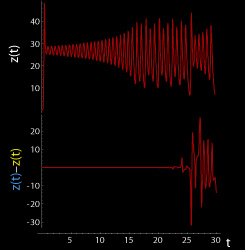 |
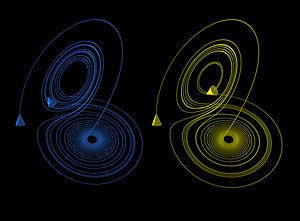
| These figures show two segments of the three-dimensional
evolution of two trajectories (one in blue, the other in yellow) for
the same period of time in the Lorenz attractor starting at two initial points that differ by only 10−5 in the x-coordinate. Initially, the two trajectories seem coincident, as indicated by the small difference between the z coordinate of the blue and yellow trajectories, but for t > 23
the difference is as large as the value of the trajectory. The final
position of the cones indicates that the two trajectories are no longer
coincident at t = 30. |
| An animation of the Lorenz attractor shows the continuous evolution. |
Theory and mathematical definition
Recurrence,
the approximate return of a system towards its initial conditions,
together with sensitive dependence on initial conditions, are the two
main ingredients for chaotic motion. They have the practical consequence
of making
complex systems, such as the
weather,
difficult to predict past a certain time range (approximately a week in
the case of weather) since it is impossible to measure the starting
atmospheric conditions completely accurately.
A
dynamical system
displays sensitive dependence on initial conditions if points
arbitrarily close together separate over time at an exponential rate.
The definition is not topological, but essentially metrical.
If
M is the
state space for the map

, then
displays sensitive dependence to initial conditions if for any x in
M and any δ > 0, there are y in
M, with distance
d(. , .) such that

and such that

for some positive parameter
a. The definition does not require that all points from a neighborhood separate from the base point
x, but it requires one positive
Lyapunov exponent.
The simplest mathematical framework exhibiting sensitive dependence
on initial conditions is provided by a particular parametrization of the
logistic map:

which, unlike most chaotic maps, has a
closed-form solution:

where the
initial condition parameter

is given by

. For rational
, after a finite number of
iterations 
maps into a
periodic sequence. But almost all
are irrational, and, for irrational
,
never repeats itself – it is non-periodic. This solution equation
clearly demonstrates the two key features of chaos – stretching and
folding: the factor 2
n shows the exponential growth of
stretching, which results in sensitive dependence on initial conditions
(the butterfly effect), while the squared sine function keeps
folded within the range [0, 1].
Examples
The butterfly effect is most familiar in terms of
weather; it can easily be demonstrated in standard weather prediction models, for example.
[16]
The potential for sensitive dependence on initial conditions (the butterfly effect) has been studied in a number of cases in
semiclassical and
quantum physics including atoms in strong fields and the anisotropic
Kepler problem.
[17][18]
Some authors have argued that extreme (exponential) dependence on
initial conditions is not expected in pure quantum treatments;
[19][20]
however, the sensitive dependence on initial conditions demonstrated in
classical motion is included in the semiclassical treatments developed
by
Martin Gutzwiller[21] and Delos and co-workers.
[22]
Other authors suggest that the butterfly effect can be observed in
quantum systems. Karkuszewski et al. consider the time evolution of
quantum systems which have slightly different
Hamiltonians. They investigate the level of sensitivity of quantum systems to small changes in their given Hamiltonians.
[23]
Poulin et al. presented a quantum algorithm to measure fidelity decay,
which "measures the rate at which identical initial states diverge when
subjected to slightly different dynamics". They consider fidelity decay
to be "the closest quantum analog to the (purely classical) butterfly
effect".
[24]
Whereas the classical butterfly effect considers the effect of a small
change in the position and/or velocity of an object in a given
Hamiltonian system,
the quantum butterfly effect considers the effect of a small change in
the Hamiltonian system with a given initial position and velocity.
[25][26] This quantum butterfly effect has been demonstrated experimentally.
[27] Quantum and semiclassical treatments of system sensitivity to initial conditions are known as
quantum chaos.
[19][25]
The butterfly effect has also played a large role in many modern
video games. There have been many instances of it being used, where a
single/multiple choice(s) throughout gameplay may alter the entire
ending of the game. A few examples are
Heavy Rain,
Beyond Two Souls,
Until Dawn, and
Life is Strange.
See also
References
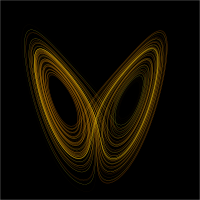 The Butterfly Effect is a concept that small causes can have large effects. Initially, it was used with weather prediction but later the term became a metaphor used in and out of science.[1]A plot of Lorenz's strange attractor for values ρ=28, σ = 10, β = 8/3. The butterfly effect or sensitive dependence on initial conditions is the property of a dynamical system that, starting from any of various arbitrarily close alternative initial conditions on the attractor, the iterated points will become arbitrarily spread out from each other.


No comments:
Post a Comment