- A war elephant was an elephant trained and guided by humans for combat.
- Battle of the Dumbos: Elephant Warfare From Ancient Greece to the Vietnam War Elephants have fought in wars for 2,300 years
- The War Elephant was an ancient battlefield weapon popularized most notably by India. The pondering beasts were trained and domesticated to the fullest extent and ...
- War elephants were not raised from infancy. Most were captured in the wild with techniques which still survive today. In India, a large ditched enclosure was ...

War elephant
From Wikipedia, the free encyclopediaThis article is about elephants trained for combat. For the album by Deer Tick, see War Elephant (album).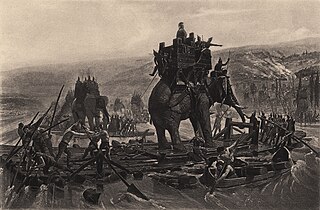 A war elephant was an elephant trained and guided by humans for combat.
Contents
Description
The war elephant's main use was to charge the enemy, breaking their ranks and instilling terror. Elephantry are military units with elephant-mounted troops.[1] They were first employed in India, the practice spreading out across south-east Asia and westwards into the Mediterranean. Their most famous use in the West was by the Greek King Pyrrhus of Epirus and in significant numbers by the armies of Carthage, including briefly by Hannibal.
In the Mediterranean, improved tactics reduced the value of the elephant in battle, while their availability in the wild also decreased. In the east, where supplies of animals were greater and the terrain ideal, it was the advent of the cannon that finally concluded the use of the combat elephant at the end of the 19th century, thereafter restricting their use to engineering and labour roles.
Taming
 A 17th century depiction of the mythological war of Lanka in the ancient Indian epic Ramayana, showing war elephants.See also: Captive elephantsThe first elephant species to be tamed was the Asian Elephant, for use in agriculture. Elephant taming - not full domestication, as they are still captured in the wild, rather than being bred in captivity - may have begun in any of three different places. The oldest evidence comes from the Indus Valley Civilization, around roughly 4500 BC.[2] Archaeological evidence for the presence of wild elephants in the Yellow River valley during the Shang Dynasty (1600–1100 BC) of China may suggest that they also used elephants in warfare.[3] The wild elephant populations of Mesopotamia and China declined quickly because of deforestation and human overpopulation: by c. 850 BC the Mesopotamian elephants were extinct, and by c. 500 BC the Chinese elephants were seriously reduced in numbers and limited to areas well south of the Yellow River.
Capturing elephants from the wild remained a difficult task, but a necessary one given the difficulties of breeding in captivity and the long time required for an elephant to reach sufficient maturity to engage in battle. It is commonly thought that all war elephants were male because of males' greater aggression, but it is rather because a female elephant in battle will run from a male; therefore only males could be used in war, whereas female elephants were more commonly used for logistics.[4]
Antiquity
India, Persia, and Alexander the Great
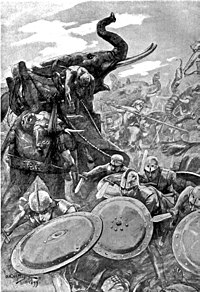 There is uncertainty as to when elephant warfare first began. The earliest Indian Vedic hymns, the Rigveda, dating from the late 2nd and early 1st millennia BC, make reference to the use of elephants for transport - especially Indra and his divine white elephant, Airavata - but make no reference to the use of elephants in war, focusing instead on Indra's role in leading horse cavalry.[5] The later stories of the Mahabharata and the Ramayana, dating from around the 4th century BC,[6] do however mention elephant warfare, suggesting its introduction during the intervening period.[7] The ancient Indian kings certainly valued the elephant in war, some stating that an army without elephants is as despicable as a forest without a lion, a kingdom without a king or as valour unaided by weapons.'[8]A Victorian depiction of war elephants attacking at the Battle of the Hydaspes River.
From India, military thinking on the use of war elephants spread westwards to the Persian Empire, where they were used in several campaigns and in turn came to influence the campaigns of Alexander the Great. The first confrontation between Europeans and the Persian war elephants occurred at the Alexander's Battle of Gaugamela (331 BC), where the Persians deployed fifteen elephants.[9] These elephants were placed at the centre of the Persian line and made such an impression on the Macedonian troops that Alexander felt the need to sacrifice to the God of Fear the night before the battle - but according to some sources the elephants ultimately failed to deploy in the final battle owing to their long march the day before.[10] Alexander won resoundingly at Gaugamela, but was deeply impressed by the enemy elephants and took these first fifteen into his own army, adding to their number during his capture of the rest of Persia.
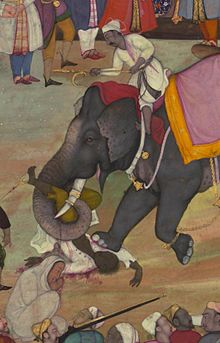 By the time Alexander reached the borders of India five years later, he had a substantial number of elephants under his own command. When it came to defeating Porus, who ruled in the Punjab region of modern-day Pakistan, Alexander found himself facing a considerable force of between 85 and 100 war elephants[11][12] at the Battle of the Hydaspes River. Preferring stealth and mobility to sheer force, Alexander manoeuvered and engaged with just his infantry and cavalry, ultimately defeating Porus' forces, including his elephant corps, albeit at some cost. Porus for his part placed his elephants individually, at long intervals from each other, a short distance in front of his main infantry line, in order to scare off Macedonian cavalry attacks and aid his own infantry in their struggle against the phalanx.War elephants of the Mughal Empire carry out an execution.
Arrian described the subsequent fight:
...whenever the beasts could wheel around, they rushed forth against the ranks of infantry and demolished the phalanx of the Macedonians, dense as it was.
The Macedonians adopted the standard ancient tactic of fighting elephants, loosening their ranks to allow the elephants to pass through and assailing them with javelins as they tried to wheel around. Eventually most of mahouts were killed by javelins, and the panicked and wounded elephants turned on the Indians themselves.[13]
Looking further east again, however, Alexander could see that the kings of the Nanda Empire and Gangaridai could deploy between 3,000 and 6,000 war elephants. Such a force was many times larger than the number employed by the Persians and Greeks, which discouraged Alexander's small band of men and effectively halted their advance into India.[14] On his return, Alexander established a force of elephants to guard his palace at Babylon, and created the post of elephantarch to lead his elephant units.[10]
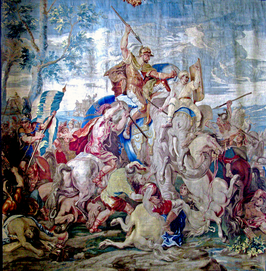 The successful military use of elephants spread further. The successors to Alexander's empire, the Diadochi, used hundreds of Indian elephants in their wars, with the Seleucid empire being particularly notable for their use of the animals, still being largely brought from India. Indeed, the Seleucid–Mauryan war of 305-303 BC ended with the Seleucids ceding vast eastern territories in exchange for 500 war elephants[15] - a small part of the Maurya forces, which included up to 9,000 elephants by some accounts.[16] The Seleucids put their new elephants to good use at the battle of Ipsus four years later, where they blocked the return of the victorious Antigonid cavalry, allowing the latter's phalanx to be isolated and defeated. Later in its history, the Seleucid Empire used elephants in its efforts to crush the Maccabean Revolt in Judea. The elephants were terrifying to the lighter-armed Jewish warriors, and the youngest of the Hasmonean brothers, Eleazar Maccabeus, famously defeated one of the creatures in the Battle of Beth Zechariah, sticking a spear under the belly of an elephant he mistakenly believed to be carrying Seleucid king Antiochus V, killing the elephant at the cost of Eleazar's own life.[17]War elephants during Battle of Gaugamela.
The first use of war elephants in Europe was made in 318 BC by Polyperchon, one of Alexander's generals, when he besieged Megalopolis (Peloponnesus) during the wars of the Diadochi. He used 60 elephants brought from Asia with their mahouts. A veteran of Alexander's army, named Damis, helped the besieged Megalopolitians to defend themselves against the elephants and eventually Polyperchon was defeated. Those elephants were subsequently taken by Cassander and transported, partly by sea, to other battle-fields in Greece. It is assumed that Cassander constructed the first elephant-transport sea-vessels. Some of the elephants died of starvation in 316 BC in the besieged city of Pydna (Macedonia). Others of Polyparchon's elephants were used in various parts of Greece by Cassander.[18]
The Mediterranean
The Ptolemies and the Carthaginians began acquiring African elephants for the same purpose, as did the Numidians and the Kushites. The animal used was the North African forest elephant[19] which would become extinct from over-exploitation.[citation needed] These animals were smaller than the Asian elephants used by the Seleucids on the east of the Mediterranean region, particularly those from Syria,[20] which stood 2.5-3.5 meters (8–10 ft) at the shoulder. It is likely that at least some Syrian elephants were traded abroad. The favorite, and perhaps last surviving elephant of Hannibal's 218 B.C. crossing of the Alps was an impressive animal named Surus ("the Syrian"), and may have been of Syrian stock,[21] though the evidence remains ambiguous.[22]
Since the late 1940s a strand of scholarship has argued that the African forest elephants used by Numidian, Ptolemaic and Punic armies did not carry howdahs or turrets in combat, perhaps owing to the physical weakness of the species.[23] Some allusions to turrets in ancient literature are certainly anachronistic or poetic invention, but other references are less easily discounted. There is explicit contemporary testimony that the army of Juba I of Numidia included turreted elephants in 46 BC.[24] This is confirmed by the image of a turreted African elephant used on the coinage of Juba II.[25] This also appears to be the case with Ptolemaic armies: Polybius reports that at the battle of Raphia in 217 BC the elephants of Ptolemy IV carried turrets; these beasts were significantly smaller than the Asian elephants fielded by the Seleucids and so presumably African forest elephants.[26] There is also evidence that Carthaginian war elephants were furnished with turrets and howdahs in certain military contexts.[27]
Farther south, tribes would have had access to the African savanna elephant.[28] Although much larger than either the African forest elephant or the Asian elephant, these proved difficult to tame for war purposes and were not used extensively.[29] Some Asian elephants were traded westwards to the Mediterranean markets; Pliny the Elder stated that the Sri Lankan elephants, for example, were larger, fiercer and better for war than local elephants. This superiority, as well as the proximity of the supply to seaports, made Sri Lanka's elephants a lucrative trading commodity.[30]
Although the use of war elephants in the Mediterranean is most famously associated with the wars between Carthage and Rome, the introduction of war elephants was primarily the result of the Greek kingdom of Epirus. King Pyrrhus of Epirus brought twenty elephants to attack the Romans at the battle of Heraclea in 280 BC, leaving some fifty additional animals, on loan from Pharaoh Ptolemy II, on the mainland. The Romans were unprepared for fighting elephants, and the Epirot forces routed the Romans. The next year, the Epirots again deployed a similar force of elephants, attacking the Romans at the battle of Asculum. This time the Romans came prepared with flammable weapons and anti-elephant devices: these were ox-drawn wagons, equipped with long spikes to wound the elephants, pots of fire to scare them, and accompanying screening troops who would hurl javelins at the elephants to drive them away. A final charge of Epirot elephants won the day again, but this time Pyrrhus had suffered very heavy casualties - a Pyrrhic victory.
 Perhaps inspired by these victories, Carthage developed its own use of war elephants and deployed them extensively during the First and Second Punic Wars. The performance of the Carthaginian elephant corps was rather mixed, illustrating the need of proper tactics to take advantage of the elephant's strength and cover its weaknesses. At Adyss in 255 BC, the Carthaginian elephants were ineffective due to the terrain, while at the battle of Panormus in 251 BC the Romans' velites were able to terrify the Carthaginian elephants being used unsupported, which fled from the field. At the battle of Tunis however the charge of the Carthaginian elephants helped to disorder the legions, allowing the Carthaginian phalanx to stand fast and defeat the Romans. During the Second Punic War, Hannibal famously led an army of war elephants across the Alps—although unfortunately many of them perished in the harsh conditions. The surviving elephants were successfully used in the battle of Trebia, where they panicked the Roman cavalry and Gallic allies. The Romans eventually developed effective anti-elephant tactics, leading to Hannibal's defeat at his final battle of Zama in 202 BC; his elephant charge, unlike the one at the battle of Tunis, was ineffective because the disciplined Roman maniples simply made way for them to pass.Battle of Zama by Henri-Paul Motte, 1890
Rome brought back many elephants at the end of the Punic Wars, and used them in its campaigns for many years afterwards. The conquest of Greece saw many battles in which the Romans deployed war elephants, including the invasion of Macedonia in 199 BC, the battle of Cynoscephalae 197 BC,[31] the battle of Thermopylae,[32] and the battle of Magnesia in 190 BC, during which Antiochus III's fifty-four elephants took on the Roman force of sixteen. In later years the Romans deployed twenty-two elephants at Pydna in 168 BC.[33] The role of the elephant force at Cynoscephalae was particularly decisive, as their quick charge shattered the unformed Macedonian left wing, allowing the Romans to encircle and destroy the victorious Macedonian right. A similar event also transpired at Pydna. The Romans' successful use of war elephants against the Macedonians might be considered ironic, given that it was Pyrrhus who first taught them the military potential of these beasts.
They also featured throughout the Roman campaign against the Celtiberians in Hispania and against the Gauls. Famously, the Romans used a war elephant in the invasion of Britain, one ancient writer recording that "Caesar had one large elephant, which was equipped with armor and carried archers and slingers in its tower. When this unknown creature entered the river, the Britons and their horses fled and the Roman army crossed over,"[34] - although he may have confused this incident with the use of a similar war elephant in Claudius' final conquest of Britain. At least one elephant skeleton with flint weapons that has been found in England was initially misidentified as these elephants, but later dating proved it to be a mammoth skeleton from the stone age.[35]
 By the time of Claudius however, such animals were being used by the Romans in single numbers only - the last significant use of war elephants in the Mediterranean was against the Romans at the battle of Thapsus, 46 BC, where Julius Caesar armed his fifth legion (Alaudae) with axes and commanded his legionaries to strike at the elephant's legs. The legion withstood the charge, and the elephant became its symbol. Thapsus was the last significant use of elephants in the West.[36] The remainder of the elephants seemed to have been thrown into panic by Caesar's archers and slingers.A medieval Armenian miniature representing the Sassanid Persians War elephants in the Battle of Vartanantz.
The Parthian dynasty of Persia occasionally used war elephants in their battles against the Roman Empire[citation needed] but elephants were of substantial importance in the army of the subsequent Sassanid dynasty.[37] The Sassanids employed the animals in many of their campaigns against their western enemies. One of the most memorable engagements was the Battle of Vartanantz in 451 AD, at which the Sassanid elephants terrified the Armenians. Another example is the Battle of al-Qādisiyyah of 636 AD, in which a unit of thirty-three elephants was used, albeit less successfully, against the invading Arab forces. The Sassanid elephant corps held primacy amongst the Sassanid cavalry forces and was recruited from India. The elephant corps was under a special chief, known as the Zend−hapet, or "Commander of the Indians," either because the animals came from that country, or because they were managed by natives of Hindustan.[38] The Sassanid elephant corps was never on the same scale as others further east, however, and after the fall of the Sassanid empire the use of war elephants died out in the region.
The Far East
 In China, the use of war elephants was relatively rare compared to other locations.[39][40] Their earliest recorded use took place as late as 554 AD when the Western Wei deployed two armored war elephants from Lingnan in battle, guided by Malay slaves, and equipped with wooden towers, and swords fastened onto their trunks.[39] The elephants were turned away by archers' arrows.[39]War elephants in battle during the Carnatic Wars.
The Han Dynasty of the 2nd century BC fought against Nanyue and Yue[disambiguation needed] kingdoms of South East Asia (ancient proto Sino-Vietnamese) that did employ war elephants. Common tactics used to repel these elephants included massed crossbow or artillery fire, and digging pits or trenches filled with spikes.
By comparison, neighbouring states significantly embraced the use of war elephants. Sri Lankan history records indicate elephants were used as mounts for kings leading their men in the battlefield,[41] with individual mounts being recorded in history. The elephant Kandula was King Dutugamunu's mount and Maha Pambata, 'Big Rock', the mount of King Elara during their historic encounter on the battlefield in 200 BC, for example.[42] In what is now modern day Vietnam, in 602 AD the Champan army employed war elephants against the invading Sui Chinese army.[43] The Sui troops led the elephants into a trap of falling into deep pits dug by them, also making extensive use of crossbows.[43]
Middle Ages
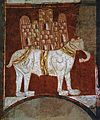 In Islamic history there is a significant event known as The Year of the Elephant, approximately equating to 570 AD. At that time Abraha, the Christian ruler of Yemen marched upon the Kaaba, intending to demolish it. He had a large army, which included one or more elephants, (as many as eight, in some accounts). However, the (single or lead) elephant, whose name was Mahmud, is said to have stopped at the boundary around Mecca, and refused to enter - which was taken by both the Meccans and their Yemenite foes as a serious omen. According to Islamic tradition, it was in this year that Muhammad was born.[44]A Romanesque painting of a war elephant. Spain, 11th century.
In the Middle Ages, elephants were seldom used in Europe. Charlemagne took his one elephant, Abul-Abbas, when he went to fight the Danes in 804, and the Crusades gave Holy Roman Emperor Frederick II the opportunity to capture an elephant in the Holy Land, the same animal later being used in the capture of Cremona in 1214, but the use of these individual animals was more symbolic than practical, especially when contrasting food and water consumption of elephants in foreign lands and the harsh conditions of the crusades.
Farther east, elephants continued to be used in warfare. In India the Chola dynasty and the Western Chalukya Empire maintained a large number of war elephants in the 11th and 12th century.[45] The war elephants of the Chola dynasty carried on their backs fighting towers which were filled with soldiers who shoot arrows at long range.[46] The Mongols faced war-elephants in Khorazm, Burma, Vietnam and India throughout the 13th century.[47] Despite their unsuccessful campaigns in Vietnam and India, the Mongols defeated the war elephants outside Samarkand by using catapults and mangonels, and in Burma by showering arrows from their famous composite bow.[48] Genghis and Kublai both retained captured elephants as part of their entourage.[49] Another central Asian invader, Timur faced similar challenges a century later. In 1398 Timur's army faced more than one hundred Indian elephants in battle and almost lost because of the fear they caused amongst his troops. Historical accounts say that the Timurids ultimately won by employing an ingenious strategy: Timur tied flaming straw to the back of his camels before the charge. The smoke made the camels run forward, scaring the elephants, who crushed their own troops in their efforts to retreat. Another account of the campaign reports that Timur used oversized caltrops to halt the elephants' charge.[50] Later, the Timurid leader used the captured animals against the Ottoman Empire.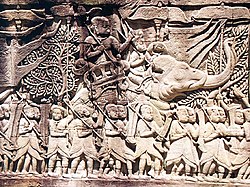
King Rajasinghe I laid siege to the Portuguese fort at Colombo, Sri Lanka, in 1558 with an army containing 2200 elephants, used for logistics and siege work.[51] The Sri Lankans had continued their proud traditions in capturing and training elephants from ancient times. The officer in charge of the royal stables, including the capture of elephants, was called the Gajanayake Nilame,[51] while the post of Kuruve Lekham controlled the Kuruwe or elephant men[51] - the training of war elephants was the duty of the Kuruwe clan who came under their own Muhandiram, a Sri Lankan administrative post.
 In the Southeast Asia, the powerful Khmer Empire had come to regional dominance by the 9th century AD, drawing heavily on the use of war elephants. Uniquely, the Khmer military deployed double cross-bows on the top of their elephants. With the collapse of Khmer power in the 15th century, the successor region powers of Burma (now Myanmar) and Siam (now Thailand) also adopted the widespread use of war elephants. In many battles of the period it was the practice for leaders to fight each other personally on elephants. One famous battle occurred when the Burmese army attacked Siam's Kingdom of Ayutthaya. The war was concluded when the Burmese crown prince Mingyi Swa was killed by Siamese King Naresuan in personal combat on elephant in 1593.[52]"The Great Battle of Yuthahatthi" - Siamese King Naresuan fights the Burmese crown prince near Suphanburi in Jan. 1593.
In Thailand, the king or general rode on the elephant's neck and carried a long pole with a sabre at the end, plus a metal hook for controlling the elephant. Sitting behind him on a howdah, was a signaller, who signalled by waving of a pair of peacock feathers. Above the signaller was the chatras, consisting of progressively stacked circular canopies, the number signifying the rank of the rider. Finally, behind the signaller on the elephant's back, was the steerer, who steered via a long pole. The steerer may have also carried a short musket and a sword.[53]:40–41
Farther north, the Chinese continued to reject the use of war elephants throughout the period, with the notable exception of the Southern Han during the 10th century AD - the "only nation on Chinese soil ever to maintain a line of elephants as a regular part of its army".[39] This anomaly in Chinese warfare is explained by the geographical proximity and close cultural links of the southern Han to Southeast Asia.[39] The military officer who commanded these elephants was given the title "Legate Digitant and Agitant of the Gigantic Elephants."[54] Each elephant supported a wooden tower that could allegedly hold ten or more men.[55] For a brief time, war elephants played a vital role in Southern Han victories such as the invasion of Chu in 948 AD,[55] but the Southern Han elephant corps were ultimately soundly defeated at Shao in 971 AD, decimated by crossbow fire from troops of the Song Dynasty.[55] As one academic has put it, "thereafter this exotic introduction into Chinese culture passed out of history, and the tactical habits of the North prevailed."[55] However, as late as the Ming dynasty in as far north as Beijing, there were still records of elephants being used in Chinese warfare, namely in 1449 where a Vietnamese contingent of war elephants helped the Ming Dynasty defend the city from the Mongols.[56]
Modern era
 With the advent of gunpowder warfare in the late 15th century, the balance of advantage for war elephants on the battlefield began to change. While muskets had limited impact on elephants, which could withstand numerous volleys,[57] cannon fire was a different matter entirely—an animal could easily be knocked down by a single shot. With elephants still being used to carry commanders on the battlefield, they became even more tempting targets for enemy artillery.The Elephant Battery in Peshawar.
Nonetheless, in south-east Asia the use of elephants on the battlefield continued up until the end of the 19th century. One of the major difficulties in the region was terrain, and elephants could cross difficult terrain in many cases more easily than horse cavalry. Burmese forces used war elephants to oppose British forces until the First Anglo-Burmese War March–April 1825 battle of Danubyu, where they were stopped by Congreve rocket fire. The Siamese Army continued utilising war elephants armed with jingals up until the Franco-Siamese War of 1893, while the Vietnamese used them in battle as late as 1885, during the Sino-French War.
 Into the 20th century, non-battle-trained elephants were used for other military purposes as late as World War II,[58] particularly because the animals could perform tasks in regions that were problematic for modern vehicles. Sir William Slim, commander of the XIVth Army wrote about elephants in his introduction to Elephant Bill: "They built hundreds of bridges for us, they helped to build and launch more ships for us than Helen ever did for Greece. Without them our retreat from Burma would have been even more arduous and our advance to its liberation slower and more difficult."[59]During World War I, elephants pulled heavy equipment. This one worked in a munitions yard in Sheffield.
Elephants are now more valuable to many armies in failing states for their ivory than as transport, and many thousands of elephants have died during civil conflicts due to poaching. They are classed as a pack animal in a U.S. Special Forces field manual issued as recently as 2004, but their use by US personnel is discouraged because elephants are an endangered species.[60] The last recorded use of elephants in war occurred in 1987 when Iraq was alleged to have used them to transport heavy weaponry for use in Kirkuk.[citation needed]
Tactical use
There were many military purposes for which elephants could be used. In battle, war elephants were usually deployed in the centre of the line, where they could be useful to prevent a charge or to conduct one of their own. Their sheer size and their terrifying appearance made them valued heavy cavalry.[61] Off the battlefield, they could carry heavy material and provided a useful means of transport before mechanized vehicles rendered them mostly obsolete.
 An elephant charge could reach about 30 km/h (20 mph), and unlike horse cavalry, could not be easily stopped by an infantry line setting spears. Such a charge was based on pure force: elephants crashing into an enemy line, trampling and swinging their tusks. Those men who were not crushed were at least knocked aside or forced back. Moreover, elephants could inspire terror in an enemy unused to fighting them - even the very disciplined Romans - and could cause the enemy to break and flee. Horses unaccustomed to the smell of elephants also panicked easily. The elephants' thick hide gave them considerable protection,[dubious ] while their height and mass protected their riders. Some elephants were even equipped with their own armor to further protect them. Many generals preferred to base themselves atop elephants so as to get a better view of the battlefield.Engraving of the Battle of Zama by Cornelis Cort, 1567.
 In addition to charging, the elephants could provide a safe and stable platform for archers to shoot arrows in the middle of the battlefield, from which more targets could be seen and engaged. The archery evolved into more advanced weapons, and several Khmer and Indian kings used giant crossbow platforms (similar to the ballista) to shoot long armor-piercing shafts to kill other enemy war elephants and cavalry. The late 16th century AD also saw the use of culverin and jingals on elephants, an adaptation to the gunpowder age that ultimately drove elephants from the battlefield.The elephant Citranand attacking another, called Udiya, during the Mughal campaign against the rebel forces of Khan Zaman and Bahadur Khan in 1567.
Elephants were further enhanced with their own weaponry and armour. In India and Sri Lanka, heavy iron chains with steel balls at the end were tied to the trunks of war elephants, which the animals were trained to swirl menacingly and with great skill. Numerous cultures designed elephant armour, aiming to protect the body and legs of the animal while leaving his trunk free to attack the enemy. Tusk swords were sometimes employed. Larger animals could also carry a protective tower on their backs, called a howdah.
Further east, large numbers of men were carried, with the senior commander either utilising the howdah or leading from his seat on the elephant's neck. The driver, called a mahout, was responsible for controlling the animal. In many armies, the mahout also carried a chisel-blade and a hammer to cut through the spinal cord and kill the animal if the elephant went berserk.[62]
 War elephants had tactical weaknesses, however, that enemy forces often learnt to exploit. Elephants had a tendency to panic themselves: after sustaining painful wounds or when their driver was killed they would run amok,[61] indiscriminately causing casualties as they sought escape. Their panicked retreat could inflict heavy losses on either side. Experienced Roman infantry often tried to sever their trunks, causing an instant panic, and hopefully causing the elephant to flee back into its own lines. Fast skirmishers armed with javelins were also used to drive them away, as javelins and similar weapons could madden an elephant. Elephants were often unarmoured and vulnerable to blows to their flanks, so Roman infantry armed with some sort of flaming object or with a stout line of pikes, such as Triarii, would often attempt to make the elephant turn to expose its flank to the infantry, making the elephant susceptible to a pike thrust or a Skirmisher's javelin. The cavalry sport of tent pegging grew out of training regimes for horsemen to incapacitate or turn back war elephants.[64] One famous historical method for disrupting elephant units was the war pig. Ancient writers believed that "elephants are scared by the smallest squeal of a pig",[65] and the vulnerability was exploited. At the Megara siege during the Diadochi wars, for example, the Megarians reportedly poured oil on a herd of pigs, set them alight, and drove them towards the enemy's massed war elephants. The elephants bolted in terror from the flaming squealing pigs.[66]Gajashaala or elephant's stable in Vijayanagara, India, built during the reign of Vijayanagar Empire.[63]
The value of war elephants in battle remains a contested issue. In the 19th century, it was fashionable to contrast the western, Roman focus on infantry and discipline with the eastern, exotic use of war elephants that relied merely on fear to defeat their enemy.[67] One writer commented that war elephants "have been found to be skittish and easily alarmed by unfamiliar sounds and for this reason they were found prone to break ranks and flee."[68] Nonetheless, the continued use of war elephants for several thousand years attests to their enduring value to the historical battlefield commander.
Cultural legacy
 Entry to the Gwalior Fort from the Hathi Pol or "Elephant door", high arches of the door, allowed elephants to pass into the fort.The use of war elephants over the centuries has left a deep cultural legacy in many countries. Many traditional war games incorporate war elephants. Chaturanga, the ancient Indian board game from which Modern chess has gradually developed - calls its rook Gaja, meaning elephant in Sanskrit, it is still the case in Chinese Chess. Also in Arabic - and derived from it, in Spanish - the bishop piece is called al-fil, Arabic for "elephant"; in Russian, too, the bishop piece is an elephant (Слон). In Bengali, the bishop is called 'hati', Bengali for "elephant". In the Japanese game shogi, there used to be a piece known as the "Drunken Elephant"; it was, however, dropped by order of the Emperor Go-Nara and no longer appears in the version played in contemporary Japan.
Elephant armour, originally designed for use in war, is today usually only seen in museums. One particularly fine set of Indian elephant armour is preserved at the Leeds Royal Armouries Museum, while Indian museums across the sub-continent display other fine pieces. The architecture of India also shows the deep impact of elephant warfare over the years. War elephants adorn many military gateways, such as those at Lohagarh Fort for example, while some spiked, anti-elephant gates still remain, for example at Kumbhalgarh fort. Across India, older gateways are invariably much higher than their European equivalents, in order to allow elephants with howdahs to pass through underneath.
War elephants also remain a popular artistic trope, either in the Orientalist painting tradition of the 19th century, or in literature following Tolkien, who popularised a fantastic rendition of war elephants in the form of oliphaunts.
See also

Wikimedia Commons has media related to War elephant. - Cavalry tactics
- Cultural depictions of elephants
- Execution by elephant
- History of elephants in Europe
- List of battles involving war elephants
- List of historical elephants
- Military animals
- Persian war elephants
- Sassanid army
- Tent pegging
- Thai elephant
Notes
- Whitney, William Dwight; Smith, Benjamin Eli (1911). "elephantry". The Century Dictionary and Cyclopedia: The Century dictionary. Century Company. p. 2257. Also: elephantry (Wiktionary)


- Jayawardhene, (1994).
References
- Chakrvarti, P. The Art of War in Ancient India, (2003).
- Charles, Michael B. "The Rise of the Sassanian Elephant Corps: Elephants and the Later Roman Empire", Iranica Antiqua 42 (2007) 301-346.
- Chinnock, E. J. The Anabasis of Alexander: The Battle of Gaugamela by Arrian (trans).
- Davis, Paul K. 100 Decisive Battles from Ancient Times to the Present: The World’s Major Battles and How They Shaped History. (1999)
- Ebrey, Patricia Buckley, Anne Walthall, James Palais (2006). East Asia: A Cultural, Social, and Political History. Boston: Houghton Mifflin Company. ISBN 0-618-13384-4.
- Fox, Robin L. Alexander the Great, Penguin (2004) ISBN 0-14-102076-8.
- Goldworthy, Adrian The Fall of Carthage: The Punic Wars 265-146 BC, Orion (2003) ISBN 0-304-36642-0.
- Gowers, William "The African Elephant in Warfare," African Affairs, Vol. 46 No. 182.
- Jayawardhene, Jayantha Elephant in Sri Lanka (1994).
- Joregensen, Christer, Eric Niderost and Rob S. Rice Fighting Techniques of the Oriental World, Amber Books (2008).
- Keegan, John A History of Warfare, Pimlico (1993) ISBN 0-679-73082-6.
- Kistler, John M. War Elephants, Westport, CT: Praeger, (2006).
- Nossov, Konstantin War Elephants (2008) ISBN 978-1-84603-268-4.
- Rance, Philip, "Elephants in Warfare in Late Antiquity", Acta Antiqua Academiae Scientiarum Hungaricae 43 (2003) 355-384.
- Rance, Philip, "Hannibal, Elephants and Turrets in Suda Θ 438 [Polybius Fr. 162B] – An Unidentified Fragment of Diodorus", Classical Quarterly 59.1 (2009) 91-111.
- Rawlinson, George The Seven Great Monarchies of the Ancient Eastern World: The Seventh Monarchy: History of the Sassanian or New Persian Empire (1885; reprint 2007) ISBN 978-1-4286-4792-3.
- Said, Edward Orientalism (1978) ISBN 0-394-74067-X.
- Sankalia, H.D., Ramayana: Myth or Reality, New Delhi (1963).
- Schafer, Edward H. "War Elephants in Ancient and Medieval China," Oriens (Volume 10, Number 2, 1957): 289–291.
- Scullard, H., "Hannibal’s elephants", Numismatic Chronicle (ser. 6) 8 (1948) 158-68
- Scullard, H. H. The Elephant in the Greek and Roman World, London (1974) ISBN 0-500-40025-3.
- Sun, Laichen. "Chinese Military Technology and Dai Viet: c. 1390-1497", Asia Research Institute Working Paper Series No. 11, Asia Research Institute, Singapore (2003).
- White, Horace (ed) Appian, The Foreign Wars (1899).
External links
|
Wikimedia Commons has media related to: |
Listen to this article (info/dl)


This audio file was created from a revision of the "War elephant" article dated 2005-04-21, and does not reflect subsequent edits to the article. (Audio help)
- end quote from:


No comments:
Post a Comment