Wednesday, October 31, 2018

It's supposed to rain most days in Portland through next Tuesday

I drove up through Mt. Shasta and arrived here Sunday and my wife flew in Tuesday from San Francisco to spend Halloween with my grandson who is four from my son.  My other daughter living here and my oldest daughter is in Europe now with her boyfriend but will return before I leave for California next week sometime so I'll get to see her too. So, adapting to so much drizzling rain and clouds is a lot to deal with but sort of fun like when it cloudburst one day with hail too. It's nice to see my wife as I haven't seen her in over 1 week since I drove up through mt. Shasta too. It's great to see my kids and Grandson too!

Recessions come in cycles like the turning of a wheel on a vehicle

Because of this you know every 7 to 10 years there will be a recession. In the 1970s they seemed to hit every 3 to 5 years for example, especially during the Arab Oil Crisis where Gasoline rose sometimes by 3 to 4 times that you had to pay at the pump. I remember 17cent a gallon in 1969 but by the late 1970s it was 85 cents to a dollar a gallon. This is really where the affluence in the U.S. disappeared from Arab oil. The affluence of the average person here in the U.S. was gone after that and by the mid 1980s most social programs which came from the affluent times of Kennedy and Johnson ended too except for the Civil rights bill. That stayed.

But, the last big recession was from about 2006 to 2008 and was the Great Recession which lasted until 2010 or 2012 so this created a really long upswing because the Great Recession completely destroyed the Middle Class of America which also created the cynical people who vote for Trump who are enraged at what happened to them during this time when they lost everything meaningful in their lives of financial value.

So, now the recession is very very late (compared to others because of how deep this last recession actually was) with fundamentals much much worse than the Great Depression, many of the fundamentals were never corrected by the way which means another Great Depression worldwide could be the next recession we see between I figure Winter or Spring  of 2019 to 2020 or before caused this time mostly by Trump's Tax Cut and Trade War with China.

Guggenheim says next recession at latest early 2020


begin quote from:
Yield Curve Isn't Lying About Next Recession, Guggenheim 
Business

Yield Curve Isn't Lying About Next Recession, Guggenheim Says

Cormac Mullen

Yield Curve Isn't Lying About Next Recession, Guggenheim Says
(Bloomberg) -- Investors continue to ignore the flattening yield curve at their peril, according to Guggenheim Partners.
Despite robust economic growth in the third quarter, the $265 billion investment firm’s view that the next U.S. recession will begin in early 2020 remains intact, strategists including global chief investment officer Scott Minerd wrote in a note to clients. The yield curve -- an inversion of which has preceded past economic downturns -- is a powerful signal, they said.
“While there is little risk of downturn in the near term, more restrictive monetary policy will overtake an overheating economy,” they wrote. “Despite prevailing sentiment to the contrary, the flattening yield curve remains a powerful indicator of coming recession.”
The prominent argument that quantitative easing has caused the curve to be unduly flat has several flaws, according to Guggenheim. It fails to recognize that net Treasury issuance, post-crisis regulatory changes and foreign exchange reserve intervention have acted in the opposite direction -- steepening the curve, they argued.
The benchmark 10-year Treasury yield has climbed about 70 basis points to 3.10 percent this year, while that on the 2-year equivalent is up 95 basis points to 2.83 percent. The gap between the two shrunk to an 11-year low of 19 basis points on Aug. 24 before rebounding to about 27 basis points Tuesday.
Survey Signal
Wall Street rates strategists are mixed on what’s next, given the past week’s sell-off in the equity market, and supply dynamics ahead of the U.S. Treasury announcement on issuance this week. While Morgan Stanley and JPMorgan Chase & Co. see the curve flattening in the coming months, banks including Bank of America Merrill Lynch and Wells Fargo & Co. expect some steepening.
For Guggenheim, data about market beliefs regarding future economic activity corroborate the flattening yield curve’s signal. For example, the difference between consumer confidence today and expectations for the future show respondents think current conditions may be as good as they get, the strategists said.
“This implied curve flattening from survey data is additional evidence that the yield curve’s signal regarding our position in the cycle is not distorted,” they wrote.
--With assistance from Sydney Maki.
To contact the reporter on this story: Cormac Mullen in Tokyo at cmullen9@bloomberg.net
To contact the editors responsible for this story: Christopher Anstey at canstey@bloomberg.net, Ravil Shirodkar
For more articles like this, please visit us at bloomberg.com

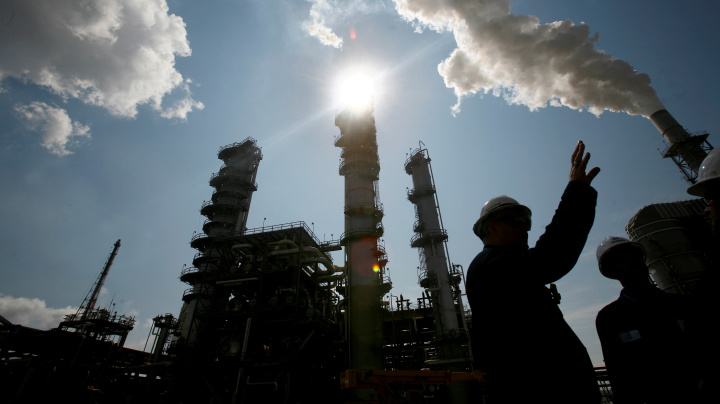
Crude oil just had its worst month in two years

Legally, Only the voters themselves can change citizenship laws: That's all!


No, birthright citizenship isn't required by the Constitution

No, birthright citizenship isn't required by the Constitution
US President Donald Trump with Attorney General Jeff Sessions on December 15, 2017. (NICHOLAS KAMM / AFP/Getty Images)
As a matter of constitutional first principle, no branch of our government can amend the Constitution. Not the Congress, not the President, not even the Supreme Court. Only “we the people” can do that, by one of the two procedures specified in Article V of the Constitution.
Had President Trump’s recent comments proposing to end birthright citizenship by executive order suggested that he thought he could unilaterally amend the Constitution, they would and should be met with a resounding response that he has no such authority.
That is not what he proposed, of course, though the notion that birth on U.S. soil is alone sufficient to be granted automatic citizenship has become so conventional that many have wrongly concluded otherwise. The Fourteenth Amendment’s citizenship clause, adopted in 1868, actually has two components, not one: birth on U.S. soil, and being subject to the jurisdiction of the United States.
Here’s the actual text: “All persons born or naturalized in the United States, and subject to the jurisdiction thereof, are citizens of the United States and of the State wherein they reside.” (Emphasis added.)
PAID POSTWhat Is This?
How to pay off your house ASAP (It's so simple)
Americans could save thousands by taking advantage of this government program
SEE MORE
Some read the phrase, “subject to the jurisdiction,” to be synonymous with “subject to the laws,” and therefore conclude that everyone born in the U.S. (with the small exception of children born to foreign diplomats) is automatically a citizen.
But that is not how those who drafted and ratified the Fourteenth Amendment understood it. For them, being subject to the laws was synonymous with being subject to the “partial” or “territorial” jurisdiction of the United States. Anyone on U.S. soil is of course subject to our laws.
Sen. Lyman Trumbull, a key figure in the drafting and adoption of the Fourteenth Amendment, noted at the time that “subject to the jurisdiction” of the United States meant subject to its “complete” juris­diction, “[n]ot owing allegiance to anybody else.” The clause therefore mirrored and constitutionalized language that was already in the 1866 Civil Rights Act: “All persons born in the United States, and not subject to any foreign power, excluding Indians not taxed, are hereby declared to be citizens of the United States.”
Thomas Cooley, one of the preeminent constitutional law writers of the 19th century, agreed. As he noted in The General Principles of Constitutional Law in America, “subject to the jurisdiction” of the United States “meant full and complete jurisdiction to which citizens are generally subject, and not any qualified and partial jurisdiction, such as may consist with allegiance to some other government.”
And as the Supreme Court noted in the 1872 Slaughter-House Cases, “The phrase, ‘subject to its jurisdiction’ was intended to exclude from its operation children of ministers, consuls, and citizens or subjects of foreign States born within the United States.”
In the 1898 decision known as Wong Kim Ark, the Supreme Court held that the children of parents who were lawful and permanent residents in the United States were citizens, but it has never decided that the children of temporary visitors, much less the children of those unlawfully present in the United States, are citizens.
Children born to parents who are subject to the complete jurisdiction of the United States are automatically citizens because their parents have already consented to be part of the American political community, and the American political community has consented to their membership. That is not true of those who are extended the privilege of temporarily visiting this country, and certainly not true of those who have never been granted permission even to enter. To argue otherwise is to attack the foundational principles of American political community embodied in our Declaration of Independence.
To allow individuals in the country illegally to demand citizenship for their children is to change such bilateral consent into a unilateral one, which destroys the notion of consent, undermines the rule of law, deprives Congress of its power to set naturalization policy, commits an injustice against the current citizens, and threatens the very idea of sovereignty. We should applaud President Trump for proposing to take this first step to set us back on the correct, constitutional course.
Williams is president of the Claremont Institute.
end quote from:
http://www.nydailynews.com/opinion/ny-oped-no-birthright-citizenship-isnt-required-by-the-constitution-20181030-story.html

Too Big to Fail Banks?


On September 15, 2008, Lehman Brothers, a well-known and respected investment bank, filed for bankruptcy protection after the Bush Administration's Treasury Secretary, Hank Paulson, refused to grant them a bailout. While there had been market volatility during the preceding months, the fall of Lehman Brothers marks what many consider the beginning of a global financial crisis.
After the Dow Jones Industrial Average closed down 504 points – roughly four and a half percent – and the Nasdaq lost three and a half percent in response to the Lehman bankruptcy, policymakers reversed their stance on bailouts and initiated a $700 billion program to stabilize financial markets. Companies deemed "too big to fail" received cash infusions in exchange for stock, commercial bank status, and access to discounted loans from the Federal Reserve.
So, what were the financial companies that received help from the government, and ten years later, where are they?

Bear Stearns: The Harbinger of Too Big to Fail That Actually Failed

The first "too big to fail" moment actually occurred months before the Lehman Brothers failure.
The Bear Stearns deal was meant to shore up financial markets and promote stability in a system increasingly recognized as unstable since the middle of 2007. 
In March 2008, the Federal Reserve agreed to lend up to $30 billion to JPMorgan Chase so they could buy Bear Stearns. JPMorgan did so — paying only $10 a share for the ailing investment bank. Rather than stopping the panic, the deal did little to allay fears, and ultimately more bailouts followed.
Seven years later, in 2015, JPMorgan Chase CEO Jamie Dimon said he regretted the decision to buy Bear Stearns, even at the discounted price. "No, we would not do something like Bear Stearns again," he wrote in a shareholder letter, citing billions in losses and legal bills stemming from crisis-era acquisitions Bear Stearns and Washington Mutual.
JPMorgan isn't suffering too much, though. Its second-quarter profit for 2018 rose to $5.4 billion, a year-over-year increase of 13 percent.

AIG: The Biggest Bailout in History

Just after letting Lehman Brothers fail, the government stepped in when it became clear that American International Group would fail due to its heavy investments in credit default swaps – and potentially bring down the entire financial system. With AIG, the infusions came in multiple stages, including a low-cost loan, preferred share purchases, and mortgage-backed securities. In the end, the government poured more than $180 billion into AIG.
However, because the government took on a stake of nearly 80% of the company, the money spent was recovered by 2012, with a net profit to U.S. taxpayers. 
Today, after a few years of profits, AIG is once again struggling. In August of 2018, AIG reported that its general insurance business had dropped 46% year-over-year and the underwriting income, which logged profits of $149 million a year ago, is now showing an $89 million loss. Claims paid out due to catastrophic losses are on the rise, and net income continues to fall. AIG is trying to turn things around by hiring new executives, and the CEO, Brian Duperreault, insists that underwriting will be profitable by the end of the year.

Morgan Stanley and Goldman Sachs: Becoming Commercial Banks

The bailouts of 2008 weren't just about the government buying shares, but also about changing the face of banking. Investment banks Morgan Stanley and Goldman Sachs couldn't get involved with commercial consumer banking until the financial crisis. At that point, the Federal Reserve allowed them to become commercial banks so they could access funds by borrowing heavily, using the discount window the Fed offers commercial banks, as well as access to other government guarantee programs extended to these types of banks.
Both Morgan Stanley and Goldman Sachs borrowed billions at these low rates to help stabilize their operations. On top of that, becoming commercial banks has allowed them to tap into the consumer market in a way that they were unable to do before.
Today, Morgan Stanley offers a variety of banking services in addition to investment banking. In July 2018, Morgan Stanley reported a year-over-year profit growth of 39%, with its banking assets topping $200 billion for the first time in the second quarter of 2018. The bank reported quarterly profits of more than $10 billion for two consecutive quarters in 2018 – something that hasn't happened since 2007.
For Goldman Sachs, though, the picture isn't quite as rosy. Even though profit surged 40% year-over-year in the second quarter of 2018, Goldman shares have been struggling. After reaching a peak in January of 2018, they have declined 13 percent year-to-date. While Goldman Sachs has retail banking and is pushing into consumer banking with products like its high-yield savings offering Marcus, the institution is still primarily known for its trading and investment banking operations. However, the bank's Q2 profits amounted to $2.57 billion.

Bank of America: Bailed Out to Buy Failing Financial Institutions

Bank of America also received bailout money from the government, including more than $100 billion in guarantees, so that it could buy failing financial companies Countrywide Financial and Merrill Lynch. Bank of America had to take on losses related to those companies, including shouldering legal fees associated with Countrywide's questionable mortgage lending practices. 
Even with these costs, though, Bank of America is booming today. It's America's second-largest lender, and its total profits for the second quarter of 2018 came in at $6.8 billion. Revenue sits at $22.6 billion for the second quarter, and Bank of America has been touting its cost-cutting measures. Hugh Son noted on CNBC that the bank's quarterly income tax charge fell from $3 billion to $1.7 billion. At least some of the credit for their positive quarter is due to the Trump tax cuts. The bank expects to continue to see growth resulting from an expected $500 million investment in technology.

Is "Too Big to Fail" Alive and Well?

Ten years after the financial crisis, there's a good chance that, facing a similar situation, the government would pledge money to bail out financial institutions. Even though Congress passed a $700 billion bailout package during the global financial crisis, some estimates indicate that the U.S. actually spent, lent, or guaranteed up to $12.8 trillion to rescue the economy. While that much money might not have been spent directly, the  government essentially offered itself as a backstop to dozens of banks considered essential to the U.S. financial system and economy.
Following the financial crisis, "too big to fail" put additional regulatory requirements on 44 banks with more than $50 billion in assets. Earlier in 2018, Congress changed the definition of "too big to fail" to banks with at least $250 billion in assets, reducing the list to 13 banks. However, if faced with another meltdown, it's doubtful that the government would stop at propping up so few financial institutions.


Read more: Too Big to Fail Banks: Where Are They Now? | Investopedia https://www.investopedia.com/insights/too-big-fail-banks-where-are-they-now/#ixzz5VX9oTS3V
Follow us: Investopedia on Facebook