This very interesting man coined the word Shamanism based upon Russian Shamans in Siberia. However, all tribes around the world had shamans before they had farms. So, farms created state religions and kings. And shamanism changed as people went from hunter gatherers or herders to farmers. When people were farmers they needed shamans less or maybe kings killed shamans more because they might interfere with Kings psychologically or physically dominating their people. So, as shamans were murdered by kings along with Tribal leaders religions changed and people who didn't worship the Kings then were killed or tortured or imprisoned. This is the history of every major religion in regard to Kings and Emperors pretty much.
Mircea Eliade
From Wikipedia, the free encyclopedia
"Eliade" redirects here. For other persons of the same name, see
Eliade (surname).
| Mircea Eliade |
 |
| Born |
March 9, 1907
Bucharest, Romania |
| Died |
April 22, 1986 (aged 79)
Chicago, Illinois, United States |
| Occupation |
Historian, philosopher, short story writer, journalist, essayist, novelist |
| Nationality |
Romanian |
| Period |
1921–1986 |
| Genre |
fantasy, autobiography, travel literature |
| Subject |
history of religion, philosophy of religion, cultural history, political history |
| Literary movement |
Modernism
Criterion
Trăirism |
Mircea Eliade (
Romanian: [ˈmirt͡ʃe̯a eliˈade]; March 9 [
O.S. February 24] 1907 – April 22, 1986) was a Romanian historian of religion, fiction writer, philosopher, and professor at the
University of Chicago. He was a leading interpreter of religious experience, who established
paradigms in religious studies that persist to this day. His theory that
hierophanies form the basis of religion, splitting the human experience of reality into
sacred and profane space and time, has proved influential.
[1] One of his most influential contributions to religious studies was his theory of
Eternal Return,
which holds that myths and rituals do not simply commemorate
hierophanies, but, at least to the minds of the religious, actually
participate in them.
[1]
His literary works belong to the
fantastic and
autobiographical genres. The best known are the novels
Maitreyi ("La Nuit
Bengali" or "Bengal Nights"),
Noaptea de Sânziene ("The Forbidden Forest"),
Isabel și apele diavolului ("Isabel and the Devil's Waters") and
Romanul Adolescentului Miop ("Novel of the Nearsighted Adolescent"), the
novellas Domnișoara Christina ("Miss Christina") and
Tinerețe fără tinerețe ("Youth Without Youth"), and the short stories
Secretul doctorului Honigberger ("The Secret of Dr. Honigberger") and
La Țigănci ("With the Gypsy Girls").
Early in his life, Eliade was a journalist and essayist, a disciple of Romanian
far-right philosopher and journalist
Nae Ionescu, and a member of the literary society
Criterion. In the 1940s, he served as cultural attaché to the United Kingdom and Portugal.
Noted for his vast erudition, Eliade had fluent command of five languages (
Romanian, French, German, Italian, and English) and a reading knowledge of three others (
Hebrew,
Persian, and
Sanskrit). He was elected a posthumous member of the
Romanian Academy.
Biography
Childhood
Born in
Bucharest, he was the son of
Romanian Land Forces officer Gheorghe Eliade (whose original surname was Ieremia)
[2][3] and Jeana
née Vasilescu.
[4] An
Orthodox believer, Gheorghe Eliade registered his son's birth four days before the actual date, to coincide with the
liturgical calendar feast of the
Forty Martyrs of Sebaste.
[3] Mircea Eliade had a sister, Corina, the mother of
semiologist Sorin Alexandrescu.
[5][6] His family moved between
Tecuci and Bucharest, ultimately settling in the capital in 1914,
[2] and purchasing a house on Melodiei Street, near
Piața Rosetti, where Mircea Eliade resided until late in his teens.
[6]
Eliade kept a particularly fond memory of his childhood and, later in
life, wrote about the impact various unusual episodes and encounters
had on his mind. In one instance during the
World War I Romanian Campaign, when Eliade was about ten years of age, he witnessed the bombing of Bucharest by
German zeppelins and the
patriotic fervor in the occupied capital at news that Romania was able to stop the
Central Powers' advance into
Moldavia.
[7]
He described this stage in his life as marked by an unrepeatable
epiphany.
[8][9] Recalling his entrance into a drawing room that an "eerie iridescent light" had turned into "a fairy-tale palace", he wrote,
I practiced for many years [the] exercise of recapturing that
epiphanic moment, and I would always find again the same plenitude. I
would slip into it as into a fragment of time devoid of duration—without
beginning, middle, or end. During my last years of lycée, when I
struggled with profound attacks of melancholy,
I still succeeded at times in returning to the golden green light of
that afternoon. [...] But even though the beatitude was the same, it was
now impossible to bear because it aggravated my sadness too much. By
this time I knew the world to which the drawing room belonged [...] was a
world forever lost.[10]
Robert Ellwood, a professor of religion who did his graduate studies under Mircea Eliade,
[11] saw this type of
nostalgia as one of the most characteristic themes in Eliade's life and academic writings.
[9]
Adolescence and literary debut
After completing his primary education at the school on Mântuleasa Street,
[2] Eliade attended the
Spiru Haret National College in the same class as
Arșavir Acterian,
Haig Acterian, and
Petre Viforeanu (and several years the senior of
Nicolae Steinhardt, who eventually became a close friend of Eliade's).
[12] Among his other colleagues was future philosopher
Constantin Noica[3] and Noica's friend, future art historian
Barbu Brezianu.
[13]
As a child, Eliade was fascinated with the natural world, which formed the setting of his very first literary attempts,
[3] as well as with
Romanian folklore and the
Christian faith as expressed by peasants.
[6] Growing up, he aimed to find and record what he believed was the common source of all religious traditions.
[6] The young Eliade's interest in physical exercise and adventure led him to pursue
mountaineering and
sailing,
[6] and he also joined the
Romanian Boy Scouts.
[14]
With a group of friends, he designed and sailed a boat on the
Danube, from
Tulcea to the
Black Sea.
[15]
In parallel, Eliade grew estranged from the educational environment,
becoming disenchanted with the discipline required and obsessed with the
idea that he was uglier and less virile than his colleagues.
[3] In order to cultivate his willpower, he would force himself to swallow insects
[3] and only slept four to five hours a night.
[7] At one point, Eliade was failing four subjects, among which was the study of the
Romanian language.
[3]
Instead, he became interested in
natural science and
chemistry, as well as the
occult,
[3] and wrote short pieces on
entomological subjects.
[7] Despite his father's concern that he was in danger of losing his already weak eyesight, Eliade read passionately.
[3] One of his favorite authors was
Honoré de Balzac, whose work he studied carefully.
[3][7] Eliade also became acquainted with the
modernist short stories of
Giovanni Papini and
social anthropology studies by
James George Frazer.
[7]
His interest in the two writers led him to learn Italian and English in private, and he also began studying
Persian and
Hebrew.
[2][7] At the time, Eliade became acquainted with
Saadi's poems and the ancient
Mesopotamian Epic of Gilgamesh.
[7] He was also interested in philosophy—studying, among others,
Socrates,
Vasile Conta, and the
Stoics Marcus Aurelius and
Epictetus, and read works of history—the two Romanian historians who influenced him from early on were
Bogdan Petriceicu Hasdeu and
Nicolae Iorga.
[7] His first published work was the 1921
Inamicul viermelui de mătase ("The Silkworm's Enemy"),
[2] followed by
Cum am găsit piatra filosofală ("How I Found the
Philosophers' Stone").
[7] Four years later, Eliade completed work on his debut volume, the autobiographical
"Diary of a Short-Sighted Adolescent" translated into English and published by
Istros Books in 2016.
University studies and Indian sojourn
Between 1925 and 1928, he attended the
University of Bucharest's Faculty of Philosophy and Letters in 1928, earning his diploma with a study on Early Modern Italian philosopher
Tommaso Campanella.
[2] In 1927, Eliade traveled to Italy, where he met Papini
[2] and collaborated with the scholar
Giuseppe Tucci.
It was during his student years that Eliade met
Nae Ionescu, who lectured in
Logic, becoming one of his disciples and friends.
[3][6][16] He was especially attracted to Ionescu's radical ideas and his interest in religion, which signified a break with the
rationalist tradition represented by senior academics such as
Constantin Rădulescu-Motru,
Dimitrie Gusti, and
Tudor Vianu (all of whom owed inspiration to the defunct literary society
Junimea, albeit in varying degrees).
[3]
Eliade's scholarly works began after a long period of study in
British India, at the
University of Calcutta. Finding that the
Maharaja of
Kassimbazar
sponsored European scholars to study in India, Eliade applied and was
granted an allowance for four years, which was later doubled by a
Romanian
scholarship.
[17] In autumn 1928, he sailed for
Calcutta to study
Sanskrit and philosophy under
Surendranath Dasgupta, a
Bengali Cambridge alumnus and professor at Calcutta University, the author of a five volume
History of Indian Philosophy. Before reaching the
Indian subcontinent, Eliade also made a brief visit to Egypt.
[2] Once there, he visited large areas of the region, and spent a short period at a
Himalayan ashram.
[18]
He studied the basics of
Indian philosophy, and, in parallel, learned Sanskrit,
Pali and
Bengali under Dasgupta's direction.
[17] At the time, he also became interested in the actions of
Mahatma Gandhi, whom he met personally,
[19] and the
Satyagraha as a phenomenon; later, Eliade adapted Gandhian ideas in his discourse on spirituality and Romania.
[19]
In 1930, while living with Dasgupta, Eliade fell in love with his host's daughter,
Maitreyi Devi, later writing a barely disguised autobiographical novel
Maitreyi (also known as "La Nuit Bengali" or "Bengal Nights"), in which he claimed that he carried on a physical relationship with her.
[20]
Eliade received his
PhD in 1933, with a thesis on
Yoga practices.
[3][6][21][22] The book, which was translated into French three years later,
[17] had significant impact in academia, both in Romania and abroad.
[6]
He later recalled that the book was an early step for understanding
not just Indian religious practices, but also Romanian spirituality.
[23] During the same period, Eliade began a correspondence with the
Ceylonese-born philosopher
Ananda Coomaraswamy.
[24] In 1936–1937, he functioned as honorary assistant for Ionescu's course, lecturing in
Metaphysics.
[25]
In 1933, Mircea Eliade had a physical relationship with the actress
Sorana Țopa, while falling in love with Nina Mareș, whom he ultimately
married.
[5][6][26] The latter, introduced to him by his new friend
Mihail Sebastian, already had a daughter, Giza, from a man who had divorced her.
[6] Eliade subsequently adopted Giza,
[27] and the three of them moved to an apartment at 141
Dacia Boulevard.
[6] He left his residence in 1936, during a trip he made to the United Kingdom and Germany, when he first visited
London,
Oxford and
Berlin.
[2]
Criterion and Cuvântul
After contributing various and generally polemical pieces in university magazines, Eliade came to the attention of journalist
Pamfil Șeicaru, who invited him to collaborate on the
nationalist paper
Cuvântul, which was noted for its harsh tones.
[3] By then,
Cuvântul was also hosting articles by Ionescu.
[3]
As one of the figures in the
Criterion literary society (1933–1934), Eliade's initial encounter with the traditional
far right was polemical: the group's conferences were stormed by members of
A. C. Cuza's
National-Christian Defense League, who objected to what they viewed as
pacifism and addressed
antisemitic insults to several speakers, including Sebastian;
[28] in 1933, he was among the signers of a manifesto opposing
Nazi Germany's state-enforced
racism.
[29]
In 1934, at a time when Sebastian was publicly insulted by Nae Ionescu, who prefaced his book (
De două mii de ani...)
with thoughts on the "eternal damnation" of Jews, Mircea Eliade spoke
out against this perspective, and commented that Ionescu's references to
the verdict "
Outside the Church there is no salvation" contradicted the notion of God's
omnipotence.
[30][31] However, he contended that Ionescu's text was not evidence of antisemitism.
[32]
In 1936, reflecting on the early history of the
Romanian Kingdom and its
Jewish community, he deplored the expulsion of Jewish savants from Romanian soil, making specific references to
Moses Gaster,
Heimann Hariton Tiktin and
Lazăr Șăineanu.
[33] Eliade's views at the time focused on innovation—in the summer of 1933, he replied to an anti-
modernist critique written by
George Călinescu:
All I wish for is a deep change, a complete transformation. But, for God's sake, in any direction other than spirituality.[34]
He and friends
Emil Cioran and
Constantin Noica were by then under the influence of
Trăirism, a school of thought that was formed around the ideals expressed by Ionescu. A form of
existentialism,
Trăirism was also the synthesis of traditional and newer
right-wing beliefs.
[35] Early on, a public polemic was sparked between Eliade and
Camil Petrescu: the two eventually reconciled and later became good friends.
[27]
Like Mihail Sebastian, who was himself becoming influenced by
Ionescu, he maintained contacts with intellectuals from all sides of the
political spectrum: their entourage included the right-wing
Dan Botta and
Mircea Vulcănescu, the non-political Petrescu and
Ionel Jianu, and
Belu Zilber, who was a member of the illegal
Romanian Communist Party.
[36]
The group also included
Haig Acterian,
Mihail Polihroniade,
Petru Comarnescu,
Marietta Sadova and
Floria Capsali.
[30]
He was also close to
Marcel Avramescu, a former
Surrealist writer whom he introduced to the works of
René Guénon.
[37] A doctor in the
Kabbalah and future
Romanian Orthodox cleric, Avramescu joined Eliade in editing the short-lived
esoteric magazine
Memra (the only one of its kind in Romania).
[38]
Among the intellectuals who attended his lectures were
Mihail Şora (whom he deemed his favorite student),
Eugen Schileru and
Miron Constantinescu—known later as, respectively, a philosopher, an art critic, and a sociologist and political figure of the
communist regime.
[27] Mariana Klein, who became Șora's wife, was one of Eliade's female students, and later authored works on his scholarship.
[27]
Eliade later recounted that he had himself enlisted Zilber as a
Cuvântul contributor, in order for him to provide a
Marxist perspective on the issues discussed by the journal.
[36] Their relation soured in 1935, when the latter publicly accused Eliade of serving as an agent for the secret police,
Siguranța Statului
(Sebastian answered to the statement by alleging that Zilber was
himself a secret agent, and the latter eventually retracted his claim).
[36]
1930s political transition
Eliade's articles before and after his adherence to the principles of the
Iron Guard (or, as it was usually known at the time, the
Legionary Movement), beginning with his
Itinerar spiritual ("Spiritual Itinerary", serialized in
Cuvântul in 1927), center on several political ideals advocated by the far right.
They displayed his rejection of
liberalism and the
modernizing goals of the
1848 Wallachian revolution (perceived as "an abstract apology of Mankind"
[39] and "ape-like imitation of [Western] Europe"),
[40] as well as for
democracy itself (accusing it of "managing to crush all attempts at national renaissance",
[41] and later praising
Benito Mussolini's
Fascist Italy
on the grounds that, according to Eliade, "[in Italy,] he who thinks
for himself is promoted to the highest office in the shortest of
times").
[41] He approved of an
ethnic nationalist state centered on the Orthodox Church (in 1927, despite his still-vivid interest in
Theosophy, he recommended young
intellectuals "the return to the Church"),
[42] which he opposed to, among others, the
secular nationalism of
Constantin Rădulescu-Motru;
[43] referring to this particular ideal as "Romanianism", Eliade was, in 1934, still viewing it as "neither fascism, nor
chauvinism".
[44]
Eliade was especially dissatisfied with the incidence of unemployment
among intellectuals, whose careers in state-financed institutions had
been rendered uncertain by the
Great Depression.
[45]
In 1936, Eliade was the focus of a campaign in the far right press, being targeted for having authored "
pornography" in his
Domnișoara Christina and
Isabel și apele diavolului; similar accusations were aimed at other cultural figures, including
Tudor Arghezi and
Geo Bogza.
[46] Assessments of Eliade's work were in sharp contrast to one another: also in 1936, Eliade accepted an award from the
Romanian Writers' Society, of which he had been a member since 1934.
[47]
In summer 1937, through an official decision which came as a result of
the accusations, and despite student protests, he was stripped of his
position at the University.
[48]
Eliade decided to sue the
Ministry of Education, asking for a symbolic compensation of 1
leu.
[49] He won the trial, and regained his position as Nae Ionescu's assistant.
[49]
Nevertheless, by 1937, he gave his intellectual support to the Iron Guard, in which he saw "a
Christian revolution aimed at creating a new Romania",
[50] and a group able "to reconcile Romania with God".
[50] His articles of the time, published in Iron Guard papers such as
Sfarmă Piatră and
Buna Vestire, contain ample praises of the movement's leaders (
Corneliu Zelea Codreanu,
Ion Moţa,
Vasile Marin, and
Gheorghe Cantacuzino-Grănicerul).
[51][52]
The transition he went through was similar to that of his fellow
generation members and close collaborators—among the notable exceptions
to this rule were
Petru Comarnescu, sociologist
Henri H. Stahl and future dramatist
Eugène Ionesco, as well as Sebastian.
[53]
He eventually enrolled in the
Totul pentru Țară ("Everything for the Fatherland" Party), the political expression of the Iron Guard,
[3][54] and contributed to its
1937 electoral campaign in
Prahova County—as indicated by his inclusion on a list of party members with
county-level responsibilities (published in
Buna Vestire).
[54]
Internment and diplomatic service
The stance taken by Eliade resulted in his arrest on July 14, 1938 after a crackdown on the Iron Guard authorized by
King Carol II. At the time of his arrest, he had just interrupted a column on
Provincia și legionarismul ("The Province and Legionary Ideology") in
Vremea, having been singled out by
Prime Minister Armand Călinescu as an author of Iron Guard
propaganda.
[55]
Eliade was kept for three weeks in a cell at the
Siguranţa Statului Headquarters, in an attempt to have him sign a "declaration of dissociation" with the Iron Guard, but he refused to do so.
[56] In the first week of August he was transferred to a makeshift camp at
Miercurea-Ciuc. When Eliade began coughing blood in October 1938, he was taken to a clinic in
Moroeni.
[56] Eliade was simply released on November 12, and subsequently spent his time writing his play
Iphigenia (also known as
Ifigenia).
[30] In April 1940, with the help of
Alexandru Rosetti, became the Cultural Attaché to the United Kingdom, a posting cut short when Romanian-British foreign relations were broken.
[56]
After leaving London he was assigned the office of Counsel and
Press Officer (later Cultural Attaché) to the Romanian Embassy in Portugal,
[26][57][58][59] where he was kept on as diplomat by the
National Legionary State (the Iron Guard government) and, ultimately, by
Ion Antonescu's regime. His office involved disseminating propaganda in favor of the Romanian state.
[26] In February 1941, weeks after the bloody
Legionary Rebellion was crushed by Antonescu,
Iphigenia was staged by the
National Theater Bucharest—the
play soon raised doubts that it owed inspiration to the Iron Guard's
ideology, and even that its inclusion in the program was a Legionary
attempt at subversion.
[30]
In 1942, Eliade authored a volume in praise of the
Estado Novo, established in Portugal by
António de Oliveira Salazar,
[59][60][61] claiming that "The Salazarian state, a Christian and
totalitarian one, is first and foremost based on love".
[60]
On July 7 of the same year, he was received by Salazar himself, who
assigned Eliade the task of warning Antonescu to withdraw the
Romanian Army from the
Eastern Front ("[In his place], I would not be grinding it in Russia").
[62] Eliade also claimed that such contacts with the leader of a neutral country had made him the target for
Gestapo surveillance, but that he had managed to communicate Salazar's advice to
Mihai Antonescu, Romania's
Foreign Minister.
[19][62]
In autumn 1943, he traveled to
occupied France, where he rejoined
Emil Cioran, also meeting with scholar
Georges Dumézil and the
collaborationist writer
Paul Morand.
[26] At the same time, he applied for a position of lecturer at the
University of Bucharest, but withdrew from the race, leaving
Constantin Noica and
Ion Zamfirescu to dispute the position, in front of a panel of academics comprising
Lucian Blaga and
Dimitrie Gusti (Zamfirescu's eventual selection, going against Blaga's recommendation, was to be the topic of a controversy).
[63]
In his private notes, Eliade wrote that he took no further interest in
the office, because his visits abroad had convinced him that he had
"something great to say", and that he could not function within the
confines of "a minor culture".
[26] Also during the war, Eliade traveled to
Berlin, where he met and conversed with controversial political theorist
Carl Schmitt,
[6][26] and frequently visited
Francoist Spain, where he notably attended the 1944 Lusitano-Spanish scientific congress in
Córdoba.
[26][64][65] It was during his trips to Spain that Eliade met philosophers
José Ortega y Gasset and
Eugeni d'Ors. He maintained a friendship with d'Ors, and met him again on several occasions after the war.
[64]
Nina Eliade fell ill with
uterine cancer and died during their stay in
Lisbon, in late 1944. As the widower later wrote, the disease was probably caused by an
abortion procedure she had undergone at an early stage of their relationship.
[26] He came to suffer from
clinical depression, which increased as Romania and her
Axis allies suffered major defeats on the Eastern Front.
[26][65] Contemplating a return to Romania as a soldier or a
monk,
[26] he was on a continuous search for effective
antidepressants, medicating himself with
passion flower extract, and, eventually, with
methamphetamine.
[65]
This was probably not his first experience with drugs: vague mentions
in his notebooks have been read as indication that Mircea Eliade was
taking
opium during his travels to
Calcutta.
[65] Later, discussing the works of
Aldous Huxley, Eliade wrote that the British author's use of
mescaline
as a source of inspiration had something in common with his own
experience, indicating 1945 as a date of reference and adding that it
was "needless to explain why that is".
[65]
Early exile
At signs that the
Romanian communist regime
was about to take hold, Eliade opted not to return to the country. On
September 16, 1945, he moved to France with his adopted daughter Giza.
[2][26] Once there, he resumed contacts with Dumézil, who helped him recover his position in academia.
[6] On Dumézil's recommendation, he taught at the
École Pratique des Hautes Études in
Paris.
[27] It was estimated that, at the time, it was not uncommon for him to work 15 hours a day.
[22] Eliade married a second time, to the Romanian exile Christinel Cotescu.
[6][66] His second wife, the descendant of
boyars, was the sister-in-law of the conductor
Ionel Perlea.
[66]
Together with
Emil Cioran and other Romanian expatriates, Eliade rallied with the former diplomat
Alexandru Busuioceanu, helping him publicize
anti-communist opinion to the
Western European public.
[67] He was also briefly involved in publishing a Romanian-language magazine, titled
Luceafărul ("The Morning Star"),
[67] and was again in contact with
Mihail Șora, who had been granted a
scholarship to study in France, and with Șora's wife
Mariana.
[27] In 1947, he was facing material constraints, and
Ananda Coomaraswamy found him a job as a
French-language teacher in the United States, at a school in
Arizona; the arrangement ended upon Coomaraswamy's death in September.
[24]
Beginning in 1948, he wrote for the journal
Critique, edited by French philosopher
Georges Bataille.
[2] The following year, he went on a visit to Italy, where he wrote the first 300 pages of his novel
Noaptea de Sânziene (he visited the country a third time in 1952).
[2] He collaborated with
Carl Jung and the
Eranos circle after
Henry Corbin recommended him in 1949,
[24] and wrote for the
Antaios magazine (edited by
Ernst Jünger).
[22] In 1950, Eliade began attending
Eranos conferences, meeting Jung,
Olga Fröbe-Kapteyn,
Gershom Scholem and
Paul Radin.
[68] He described
Eranos as "one of the most creative cultural experiences of the modern Western world."
[69]
In October 1956, he moved to the United States, settling in
Chicago the following year.
[2][6] He had been invited by
Joachim Wach to give a series of lectures at Wach's home institution, the
University of Chicago.
[69]
Eliade and Wach are generally admitted to be the founders of the
"Chicago school" that basically defined the study of religions for the
second half of the 20th century.
[70] Upon Wach's death before the lectures were delivered, Eliade was appointed as his replacement, becoming, in 1964, the
Sewell Avery Distinguished Service Professor of the History of Religions.
[2] Beginning in 1954, with the first edition of his volume on
Eternal Return,
Eliade also enjoyed commercial success: the book went through several
editions under different titles, which sold over 100,000 copies.
[71]
In 1966, Mircea Eliade became a member of the
American Academy of Arts and Sciences.
[2] He also worked as editor-in-chief of
Macmillan Publishers'
Encyclopedia of Religion, and, in 1968, lectured in religious history at the
University of California, Santa Barbara.
[72] It was also during that period that Mircea Eliade completed his voluminous and influential
History of Religious Ideas, which grouped together the overviews of his main original interpretations of religious history.
[6] He occasionally traveled out of the United States, such as attending the Congress for the History of Religions in
Marburg (1960) and visits to Sweden and Norway in 1970.
[2]
Final years and death
Initially, Eliade was attacked with virulence by the
Romanian Communist Party press, chiefly by
România Liberă—which described him as "the Iron Guard's ideologue,
enemy of the working class, apologist of Salazar's dictatorship".
[73] However, the regime also made secretive attempts to enlist his and Cioran's support:
Haig Acterian's widow, theater director
Marietta Sadova, was sent to Paris in order to re-establish contacts with the two.
[74]
Although the move was planned by Romanian officials, her encounters
were to be used as evidence incriminating her at a February 1960 trial
for treason (where
Constantin Noica and
Dinu Pillat were the main defendants).
[74] Romania's secret police, the
Securitate, also portrayed Eliade as a spy for the British
Secret Intelligence Service and a former agent of the Gestapo.
[75]
He was slowly
rehabilitated at home beginning in the early 1960s, under the rule of
Gheorghe Gheorghiu-Dej.
[76] In the 1970s, Eliade was approached by the
Nicolae Ceaușescu regime in several ways, in order to have him return.
[6] The move was prompted by the officially sanctioned nationalism and Romania's claim to independence from the
Eastern Bloc,
as both phenomena came to see Eliade's prestige as an asset. An
unprecedented event occurred with the interview that was granted by
Mircea Eliade to poet
Adrian Păunescu,
during the latter's 1970 visit to Chicago; Eliade complimented both
Păunescu's activism and his support for official tenets, expressing a
belief that
the youth of Eastern Europe is clearly superior to that of Western
Europe. [...] I am convinced that, within ten years, the young
revolutionary generation shan't be behaving as does today the noisy
minority of Western contesters.
[...] Eastern youth have seen the abolition of traditional
institutions, have accepted it [...] and are not yet content with the
structures enforced, but rather seek to improve them.[77]
Păunescu's visit to Chicago was followed by those of the nationalist official writer
Eugen Barbu and by Eliade's friend Constantin Noica (who had since been released from jail).
[52]
At the time, Eliade contemplated returning to Romania, but was
eventually persuaded by fellow Romanian intellectuals in exile
(including
Radio Free Europe's
Virgil Ierunca and
Monica Lovinescu) to reject Communist proposals.
[52]
In 1977, he joined other exiled Romanian intellectuals in signing a
telegram protesting the repressive measures newly enforced by the
Ceauşescu regime.
[3] Writing in 2007, Romanian anthropologist
Andrei Oișteanu recounted how, around 1984, the Securitate unsuccessfully pressured to become an
agent of influence in Eliade's Chicago circle.
[78]
During his later years, Eliade's fascist past was progressively
exposed publicly, the stress of which probably contributed to the
decline of his health.
[3] By then, his writing career was hampered by severe
arthritis.
[27] The last academic honors bestowed upon him were the
French Academy's
Bordin Prize (1977) and the title of
Doctor Honoris Causa, granted by the
University of Washington (1985).
[2]
Mircea Eliade died at the
Bernard Mitchell Hospital in April 1986. Eight days previously, he suffered a
stroke while reading
Emil Cioran's
Exercises of Admiration, and had subsequently lost his speech function.
[8] Four months before, a fire had destroyed part of his office at the
Meadville Lombard Theological School (an event which he had interpreted as an
omen).
[3][8] Eliade's Romanian disciple
Ioan Petru Culianu, who recalled the scientific community's reaction to the news, described Eliade's death as "a
mahaparanirvana", thus comparing it to the passing of
Gautama Buddha.
[8] His body was
cremated in Chicago, and the funeral ceremony was held on University grounds, at the
Rockefeller Chapel.
[2][8] It was attended by 1,200 people, and included a public reading of Eliade's text in which he recalled the
epiphany of his childhood—the lecture was given by novelist
Saul Bellow, Eliade's colleague at the University.
[8] His grave is located in
Oak Woods Cemetery.
[79]
Work
The general nature of religion
In his work on the history of religion, Eliade is most highly regarded for his writings on
Alchemy,
[80] Shamanism,
Yoga and what he called the
eternal return—the implicit belief, supposedly present in religious thought in general, that
religious behavior
is not only an imitation of, but also a participation in, sacred
events, and thus restores the mythical time of origins. Eliade's
thinking was in part influenced by
Rudolf Otto,
Gerardus van der Leeuw,
Nae Ionescu and the writings of the
Traditionalist School (
René Guénon and
Julius Evola).
[37] For instance, Eliade's
The Sacred and the Profane partially builds on Otto's
The Idea of the Holy to show how religion emerges from the experience of the sacred, and myths of time and nature.
Eliade is known for his attempt to find broad, cross-cultural parallels and unities in religion, particularly in myths.
Wendy Doniger,
Eliade's colleague from 1978 until his death, has observed that "Eliade
argued boldly for universals where he might more safely have argued for
widely prevalent patterns".
[81] His
Treatise on the History of Religions was praised by French philologist
Georges Dumézil for its coherence and ability to synthesize diverse and distinct mythologies.
[82]
Robert Ellwood describes Eliade's approach to religion as follows.
Eliade approaches religion by imagining an ideally "religious" person,
whom he calls
homo religiosus in his writings. Eliade's theories basically describe how this
homo religiosus would view the world.
[83] This does not mean that all religious practitioners actually think and act like
homo religiosus. Instead, it means that religious behavior "says through its own language" that the world is as
homo religiosus would see it, whether or not the real-life participants in religious behavior are aware of it.
[84]
However, Ellwood writes that Eliade "tends to slide over that last
qualification", implying that traditional societies actually thought
like
homo religiosus.
[84]
Sacred and profane
Eliade argues that religious thought in general rests on a sharp distinction between the Sacred and the profane;
[85]
whether it takes the form of God, gods, or mythical Ancestors, the
Sacred contains all "reality", or value, and other things acquire
"reality" only to the extent that they participate in the sacred.
[86]
Eliade's understanding of religion centers on his concept of
hierophany (manifestation of the Sacred)—a concept that includes, but is not limited to, the older and more restrictive concept of
theophany (manifestation of a god).
[87]
From the perspective of religious thought, Eliade argues, hierophanies
give structure and orientation to the world, establishing a sacred
order. The "profane" space of nonreligious experience can only be
divided up geometrically: it has no "qualitative differentiation and,
hence, no orientation [is] given by virtue of its inherent structure".
[88]
Thus, profane space gives man no pattern for his behavior. In contrast
to profane space, the site of a hierophany has a sacred structure to
which religious man conforms himself. A hierophany amounts to a
"revelation of an absolute reality, opposed to the non-reality of the
vast surrounding expanse".
[89] As an example of "
sacred space" demanding a certain response from man, Eliade gives the story of
Moses halting before
Yahweh's manifestation as a
burning bush (
Exodus 3:5) and taking off his shoes.
[90]
Origin myths and sacred time
Eliade notes that, in traditional societies, myth represents the absolute truth about primordial time.
[91]
According to the myths, this was the time when the Sacred first
appeared, establishing the world's structure—myths claim to describe the
primordial events that made society and the natural world be that which
they are. Eliade argues that all myths are, in that sense, origin
myths: "myth, then, is always an account of a
creation".
[92]
Many traditional societies believe that the power of a thing lies in its origin.
[93] If origin is equivalent to power, then "it is the first manifestation of a thing that is significant and valid"
[94] (a thing's reality and value therefore lies only in its first appearance).
According to Eliade's theory, only the Sacred has value, only a
thing's first appearance has value and, therefore, only the Sacred's
first appearance has value. Myth describes the Sacred's first
appearance; therefore, the mythical age is sacred time,
[91] the only time of value: "primitive man was interested only in the
beginnings [...] to him it mattered little what had happened to himself, or to others like him, in more or less distant times".
[95] Eliade postulated this as the reason for the "
nostalgia for origins" that appears in many religions, the desire to return to a primordial
Paradise.
[95]
Eternal return and "Terror of history"
Eliade argues that traditional man attributes no value to the linear
march of historical events: only the events of the mythical age have
value. To give his own life value, traditional man performs myths and
rituals. Because the Sacred's essence lies only in the mythical age,
only in the Sacred's first appearance, any later appearance is actually
the first appearance; by recounting or re-enacting mythical events,
myths and rituals "re-actualize" those events.
[96] Eliade often uses the term "
archetypes"
to refer to the mythical models established by the Sacred, although
Eliade's use of the term should be distinguished from the use of the
term in
Jungian psychology.
[97]
Thus, argues Eliade, religious behavior does not only commemorate, but also participates in, sacred events:
In imitating the exemplary acts of a god or of a mythical
hero, or simply by recounting their adventures, the man of an archaic
society detaches himself from profane time and magically re-enters the
Great Time, the sacred time.[91]
Eliade called this concept the "
eternal return" (distinguished from the
philosophical concept of "eternal return"). Wendy Doniger noted that Eliade's theory of the eternal return "has become a truism in the study of religions".
[1]
Eliade attributes the well-known "cyclic" vision of time in ancient thought to belief in the eternal return. For instance, the
New Year ceremonies among the
Mesopotamians, the
Egyptians, and other
Near Eastern peoples re-enacted their
cosmogonic myths. Therefore, by the logic of the eternal return, each New Year ceremony
was
the beginning of the world for these peoples. According to Eliade,
these peoples felt a need to return to the Beginning at regular
intervals, turning time into a circle.
[98]
Eliade argues that yearning to remain in the mythical age causes a
"terror of history": traditional man desires to escape the linear
succession of events (which, Eliade indicated, he viewed as empty of any
inherent value or sacrality). Eliade suggests that the abandonment of
mythical thought and the full acceptance of linear, historical time,
with its "terror", is one of the reasons for modern man's anxieties.
[99] Traditional societies escape this anxiety to an extent, as they refuse to completely acknowledge historical time.
Coincidentia oppositorum
Eliade claims that many myths, rituals, and mystical experiences involve a "coincidence of opposites", or
coincidentia oppositorum. In fact, he calls the
coincidentia oppositorum "the mythical pattern".
[100] Many myths, Eliade notes, "present us with a twofold revelation":
they express on the one hand the diametrical opposition of two divine
figures sprung from one and the same principle and destined, in many
versions, to be reconciled at some illud tempus of eschatology, and on the other, the coincidentia oppositorum
in the very nature of the divinity, which shows itself, by turns or
even simultaneously, benevolent and terrible, creative and destructive,
solar and serpentine, and so on (in other words, actual and potential).[101]
Eliade argues that "Yahweh is both kind and wrathful; the God of the
Christian mystics and theologians is terrible and gentle at once".
[102]
He also thought that the Indian and Chinese mystic tried to attain "a
state of perfect indifference and neutrality" that resulted in a
coincidence of opposites in which "pleasure and pain, desire and
repulsion, cold and heat [...] are expunged from his awareness".
[102]
According to Eliade, the
coincidentia oppositorum’s appeal lies in "man's deep dissatisfaction with his actual situation, with what is called the human condition".
[103] In many mythologies, the end of the mythical age involves a "fall", a fundamental "
ontological change in the structure of the World".
[104] Because the
coincidentia oppositorum is a contradiction, it represents a denial of the world's current logical structure, a reversal of the "fall".
Also, traditional man's dissatisfaction with the post-mythical age expresses itself as a feeling of being "torn and separate".
[103]
In many mythologies, the lost mythical age was a Paradise, "a
paradoxical state in which the contraries exist side by side without
conflict, and the multiplications form aspects of a mysterious Unity".
[104] The
coincidentia oppositorum
expresses a wish to recover the lost unity of the mythical Paradise,
for it presents a reconciliation of opposites and the unification of
diversity:
On the level of pre-systematic thought, the mystery of totality
embodies man's endeavor to reach a perspective in which the contraries
are abolished, the Spirit of Evil reveals itself as a stimulant of Good,
and Demons appear as the night aspect of the Gods.[104]
Exceptions to the general nature
Eliade acknowledges that not all religious behavior has all the
attributes described in his theory of sacred time and the eternal
return. The
Zoroastrian,
Jewish,
Christian, and
Muslim traditions embrace linear, historical time as sacred or capable of sanctification, while some
Eastern traditions largely reject the notion of sacred time, seeking escape from the
cycles of time.
Because they contain rituals, Judaism and Christianity necessarily—Eliade argues—retain a sense of cyclic time:
by the very fact that it is a religion, Christianity had to keep at least one mythical aspect—liturgical Time, that is, the periodic rediscovery of the illud tempus of the beginnings [and] an imitation of the Christ as exemplary pattern.[105]
However, Judaism and Christianity do not see time as a circle
endlessly turning on itself; nor do they see such a cycle as desirable,
as a way to participate in the Sacred. Instead, these religions embrace
the concept of linear history progressing toward the
Messianic Age or the
Last Judgment, thus initiating the idea of "progress" (humans are to work for a Paradise in the future).
[106] However, Eliade's understanding of Judaeo-Christian
eschatology
can also be understood as cyclical in that the "end of time" is a
return to God: "The final catastrophe will put an end to history, hence
will restore man to eternity and beatitude".
[107]
The pre-
Islamic Persian religion of Zoroastrianism, which made a notable "contribution to the religious formation of the West",
[108]
also has a linear sense of time. According to Eliade, the Hebrews had a
linear sense of time before being influenced by Zoroastrianism.
[108]
In fact, Eliade identifies the Hebrews, not the Zoroastrians, as the
first culture to truly "valorize" historical time, the first to see all
major historical events as episodes in a continuous divine revelation.
[109]
However, Eliade argues, Judaism elaborated its mythology of linear time
by adding elements borrowed from Zoroastrianism—including
ethical dualism, a savior figure, the future resurrection of the body, and the idea of cosmic progress toward "the final triumph of Good".
[108]
The
Indian religions of the East generally retain a cyclic view of time—for instance, the
Hindu doctrine of
kalpas.
According to Eliade, most religions that accept the cyclic view of time
also embrace it: they see it as a way to return to the sacred time.
However, in
Buddhism,
Jainism, and some forms of Hinduism, the Sacred lies outside the flux of the material world (called
maya, or "illusion"), and one can only reach it by escaping from the cycles of time.
[110] Because the Sacred lies outside cyclic time, which conditions humans, people can only reach the Sacred by escaping the
human condition. According to Eliade,
Yoga techniques aim at escaping the limitations of the body, allowing the soul (
atman) to rise above
maya and reach the Sacred (
nirvana,
moksha).
Imagery of "freedom", and of death to one's old body and rebirth with a
new body, occur frequently in Yogic texts, representing escape from the
bondage of the temporal human condition.
[111] Eliade discusses these themes in detail in
Yoga: Immortality and Freedom.
Symbolism of the Center
A recurrent theme in Eliade's myth analysis is the
axis mundi,
the Center of the World. According to Eliade, the Cosmic Center is a
necessary corollary to the division of reality into the Sacred and the
profane. The Sacred contains all value, and the world gains purpose and
meaning only through hierophanies:
In the homogeneous and infinite expanse, in which no point of
reference is possible and hence no orientation is established, the hierophany reveals an absolute fixed point, a center.[89]
Because profane space gives man no orientation for his life, the
Sacred must manifest itself in a hierophany, thereby establishing a
sacred site around which man can orient himself. The site of a
hierophany establishes a "fixed point, a center".
[112] This Center abolishes the "homogeneity and relativity of profane space",
[88] for it becomes "the central axis for all future orientation".
[89]
A manifestation of the Sacred in profane space is, by definition, an
example of something breaking through from one plane of existence to
another. Therefore, the initial hierophany that establishes the Center
must be a point at which there is contact between different planes—this,
Eliade argues, explains the frequent mythical imagery of a
Cosmic Tree or Pillar joining Heaven, Earth, and the
underworld.
[113]
Eliade noted that, when traditional societies found a new territory,
they often perform consecrating rituals that reenact the hierophany that
established the Center and founded the world.
[114] In addition, the designs of traditional buildings, especially temples, usually imitate the mythical image of the
axis mundi joining the different cosmic levels. For instance, the
Babylonian ziggurats were built to resemble cosmic mountains passing through the heavenly spheres, and the rock of the
Temple in Jerusalem was supposed to reach deep into the
tehom, or primordial waters.
[115]
According to the logic of the
eternal return, the site of each such symbolic Center will actually be the Center of the World:
It may be said, in general, that the majority of the sacred and
ritual trees that we meet with in the history of religions are only
replicas, imperfect copies of this exemplary archetype, the Cosmic Tree.
Thus, all these sacred trees are thought of as situated at the Centre
of the World, and all the ritual trees or posts [...] are, as it were,
magically projected into the Centre of the World.[116]
According to Eliade's interpretation, religious man apparently feels the need to live not only near, but
at, the mythical Center as much as possible, given that the Center is the point of communication with the Sacred.
[117]
Thus, Eliade argues, many traditional societies share common outlines in their mythical
geographies. In the middle of the known world is the sacred Center, "a place that is sacred above all";
[118] this Center anchors the established order.
[88]
Around the sacred Center lies the known world, the realm of established
order; and beyond the known world is a chaotic and dangerous realm,
"peopled by ghosts, demons, [and] 'foreigners' (who are [identified
with] demons and the souls of the dead)".
[119]
According to Eliade, traditional societies place their known world at
the Center because (from their perspective) their known world is the
realm that obeys a recognizable order, and it therefore must be the
realm in which the Sacred manifests itself; the regions beyond the known
world, which seem strange and foreign, must lie far from the Center,
outside the order established by the Sacred.
[120]
The High God
According to some "evolutionistic" theories of religion, especially that of
Edward Burnett Tylor, cultures naturally progress from
animism and
polytheism to
monotheism.
[121]
According to this view, more advanced cultures should be more
monotheistic, and more primitive cultures should be more polytheistic.
However, many of the most "primitive", pre-agricultural societies
believe in a supreme
sky-god.
[122] Thus, according to Eliade, post-19th-century scholars have rejected Tylor's theory of evolution from
animism.
[123]
Based on the discovery of supreme sky-gods among "primitives", Eliade
suspects that the earliest humans worshiped a heavenly Supreme Being.
[124] In
Patterns in Comparative Religion,
he writes, "The most popular prayer in the world is addressed to 'Our
Father who art in heaven.' It is possible that man's earliest prayers
were addressed to the same heavenly father."
[125]
However, Eliade disagrees with
Wilhelm Schmidt, who thought the earliest form of religion was a strict monotheism. Eliade dismisses this theory of "primordial monotheism" (
Urmonotheismus) as "rigid" and unworkable.
[126] "At most," he writes, "this schema [Schmidt's theory] renders an account of human [religious] evolution since the
Paleolithic era".
[127] If an
Urmonotheismus
did exist, Eliade adds, it probably differed in many ways from the
conceptions of God in many modern monotheistic faiths: for instance, the
primordial High God could manifest himself as an animal without losing
his status as a celestial Supreme Being.
[128]
According to Eliade, heavenly Supreme Beings are actually less common in more advanced cultures.
[129] Eliade speculates that the discovery of agriculture brought a host of
fertility gods and goddesses into the forefront, causing the celestial Supreme Being to fade away and eventually vanish from many ancient religions.
[130] Even in primitive hunter-gatherer societies, the High God is a vague, distant figure, dwelling high above the world.
[131] Often he has no
cult and receives
prayer only as a last resort, when all else has failed.
[132] Eliade calls the distant High God a
deus otiosus ("idle god").
[133]
In belief systems that involve a
deus otiosus, the distant
High God is believed to have been closer to humans during the mythical
age. After finishing his works of creation, the High God "forsook the
earth and withdrew into the highest heaven".
[134]
This is an example of the Sacred's distance from "profane" life, life
lived after the mythical age: by escaping from the profane condition
through religious behavior, figures such as the
shaman return to the conditions of the mythical age, which include nearness to the High God ("by his
flight or ascension, the shaman [...] meets the God of Heaven face to face and speaks directly to him, as man sometimes did
in illo tempore").
[135] The shamanistic behaviors surrounding the High God are a particularly clear example of the eternal return.
Shamanism
Overview
Eliade's scholarly work includes a study of shamanism,
Shamanism: Archaic Techniques of Ecstasy, a survey of shamanistic practices in different areas. His
Myths, Dreams and Mysteries also addresses shamanism in some detail.
In
Shamanism, Eliade argues for a restrictive use of the word
shaman: it should not apply to just any
magician or
medicine man,
as that would make the term redundant; at the same time, he argues
against restricting the term to the practitioners of the sacred of
Siberia and
Central Asia (it is from one of the titles for this function, namely,
šamán, considered by Eliade to be of
Tungusic origin, that the term itself was introduced into Western languages).
[136] Eliade defines a shaman as follows:
he is believed to cure, like all doctors, and to perform miracles of the fakir type, like all magicians [...] But beyond this, he is a psychopomp, and he may also be a priest, mystic, and poet.[137]
If we define shamanism this way, Eliade claims, we find that the term
covers a collection of phenomena that share a common and unique
"structure" and "history".
[137] (When thus defined, shamanism tends to occur in its purest forms in
hunting and
pastoral societies like those of Siberia and Central Asia, which revere a celestial High God "on the way to becoming a
deus otiosus".
[138] Eliade takes the shamanism of those regions as his most representative example.)
In his examinations of shamanism, Eliade emphasizes the shaman's
attribute of regaining man's condition before the "Fall" out of sacred
time: "The most representative mystical experience of the archaic
societies, that of shamanism, betrays the
Nostalgia for Paradise, the desire to recover the state of freedom and beatitude before 'the Fall'."
[135]
This concern—which, by itself, is the concern of almost all religious
behavior, according to Eliade—manifests itself in specific ways in
shamanism.
Death, resurrection and secondary functions
According to Eliade, one of the most common shamanistic themes is the shaman's supposed death and
resurrection. This occurs in particular during his
initiation.
[139]
Often, the procedure is supposed to be performed by spirits who
dismember the shaman and strip the flesh from his bones, then put him
back together and revive him. In more than one way, this death and
resurrection represents the shaman's elevation above human nature.
First, the shaman dies so that he can rise above human nature on a
quite literal level. After he has been dismembered by the initiatory
spirits, they often replace his old organs with new, magical ones (the
shaman dies to his profane self so that he can rise again as a new,
sanctified, being).
[140]
Second, by being reduced to his bones, the shaman experiences rebirth
on a more symbolic level: in many hunting and herding societies, the
bone represents the source of life, so reduction to a skeleton "is
equivalent to re-entering the womb of this primordial life, that is, to a
complete renewal, a mystical rebirth".
[141] Eliade considers this return to the source of life essentially equivalent to the eternal return.
[142]
Third, the shamanistic phenomenon of repeated death and resurrection
also represents a transfiguration in other ways. The shaman dies not
once but many times: having died during initiation and risen again with
new powers, the shaman can send his spirit out of his body on errands;
thus, his whole career consists of repeated deaths and resurrections.
The shaman's new ability to die and return to life shows that he is no
longer bound by the laws of profane time, particularly the law of death:
"the ability to 'die' and come to life again [...] denotes that [the
shaman] has surpassed the human condition".
[143]
Having risen above the human condition, the shaman is not bound by
the flow of history. Therefore, he enjoys the conditions of the mythical
age. In many myths, humans can speak with animals; and, after their
initiations, many shamans claim to be able to communicate with animals.
According to Eliade, this is one manifestation of the shaman's return to
"the
illud tempus described to us by the paradisiac myths".
[144]
The shaman can descend to the underworld or ascend to heaven, often by climbing the
World Tree, the cosmic pillar, the sacred ladder, or some other form of the
axis mundi.
[145]
Often, the shaman will ascend to heaven to speak with the High God.
Because the gods (particularly the High God, according to Eliade's
deus otiosus
concept) were closer to humans during the mythical age, the shaman's
easy communication with the High God represents an abolition of history
and a return to the mythical age.
[135]
Because of his ability to communicate with the gods and descend to the land of the dead, the shaman frequently functions as a
psychopomp and a
medicine man.
[137]
Eliade's philosophy
Early contributions
In
addition to his political essays, the young Mircea Eliade authored
others, philosophical in content. Connected with the ideology of
Trăirism, they were often prophetic in tone, and saw Eliade being hailed as a herald by various representatives of his generation.
[7] When Eliade was 21 years old and publishing his
Itinerar spiritual, literary critic
Şerban Cioculescu described him as "the column leader of the spiritually mystical and
Orthodox youth."
[7]
Cioculescu discussed his "impressive erudition", but argued that it was
"occasionally plethoric, poetically inebriating itself through abuse".
[7] Cioculescu's colleague
Perpessicius
saw the young author and his generation as marked by "the specter of
war", a notion he connected to various essays of the 1920s and 30s in
which Eliade threatened the world with the verdict that a new conflict
was looming (while asking that young people be allowed to manifest their
will and fully experience freedom before perishing).
[7]
One of Eliade's noted contributions in this respect was the 1932
Soliloquii ("Soliloquies"), which explored
existential philosophy.
George Călinescu who saw in it "an echo of
Nae Ionescu's lectures",
[146] traced a parallel with the essays of another of Ionescu's disciples,
Emil Cioran, while noting that Cioran's were "of a more exulted tone and written in the
aphoristic form of
Kierkegaard".
[147] Călinescu recorded Eliade's rejection of
objectivity,
citing the author's stated indifference towards any "naïveté" or
"contradictions" that the reader could possibly reproach him, as well as
his dismissive thoughts of "theoretical data" and mainstream philosophy
in general (Eliade saw the latter as "inert, infertile and
pathogenic").
[146] Eliade thus argued, "a sincere brain is unassailable, for it denies itself to any relationship with outside truths."
[148]
The young writer was however careful to clarify that the existence he
took into consideration was not the life of "instincts and personal
idiosyncrasies", which he believed determined the lives of many humans, but that of a distinct set comprising "personalities".
[148] He described "personalities" as characterized by both "purpose" and "a much more complicated and dangerous alchemy".
[148]
This differentiation, George Călinescu believed, echoed Ionescu's
metaphor of man, seen as "the only animal who can fail at living", and
the duck, who "shall remain a duck no matter what it does".
[149]
According to Eliade, the purpose of personalities is infinity:
"consciously and gloriously bringing [existence] to waste, into as many
skies as possible, continuously fulfilling and polishing oneself,
seeking ascent and not circumference."
[148]
In Eliade's view, two roads await man in this process. One is glory,
determined by either work or procreation, and the other the
asceticism of religion or magic—both, Călinescu believed, where aimed at reaching the
absolute, even in those cases where Eliade described the latter as an "abyssal experience" into which man may take the plunge.
[146]
The critic pointed out that the addition of "a magical solution" to the
options taken into consideration seemed to be Eliade's own original
contributions to his mentor's philosophy, and proposed that it may have
owed inspiration to
Julius Evola and his disciples.
[146]
He also recorded that Eliade applied this concept to human creation,
and specifically to artistic creation, citing him describing the latter
as "a magical joy, the victorious break of the iron circle" (a
reflection of
imitatio dei, having salvation for its ultimate goal).
[146]
Philosopher of religion
Anti-reductionism and the "transconscious"
By
profession, Eliade was a historian of religion. However, his scholarly
works draw heavily on philosophical and psychological terminology. In
addition, they contain a number of philosophical arguments about
religion. In particular, Eliade often implies the existence of a
universal psychological or spiritual "essence" behind all religious
phenomena.
[150] Because of these arguments, some have accused Eliade of over-generalization and "
essentialism",
or even of promoting a theological agenda under the guise of historical
scholarship. However, others argue that Eliade is better understood as a
scholar who is willing to openly discuss sacred experience and its
consequences.
[151]
In studying religion, Eliade rejects certain "
reductionist" approaches.
[152]
Eliade thinks a religious phenomenon cannot be reduced to a product of
culture and history. He insists that, although religion involves "the
social man, the economic man, and so forth", nonetheless "all these
conditioning factors together do not, of themselves, add up to the life
of the spirit".
[153]
Using this anti-reductionist position, Eliade argues against those who accuse him of overgeneralizing, of looking for
universals at the expense of
particulars. Eliade admits that every religious phenomenon is shaped by the particular culture and history that produced it:
When the Son of God incarnated and became the Christ, he had to speak Aramaic;
he could only conduct himself as a Hebrew of his times [...] His
religious message, however universal it might be, was conditioned by the
past and present history of the Hebrew people. If the Son of God had
been born in India, his spoken language would have had to conform itself
to the structure of the Indian languages.[153]
However, Eliade argues against those he calls "
historicist or
existentialist philosophers" who do not recognize "man in general" behind particular men produced by particular situations
[153] (Eliade cites
Immanuel Kant as the likely forerunner of this kind of "historicism").
[154] He adds that human consciousness transcends (is not reducible to) its historical and cultural conditioning,
[155] and even suggests the possibility of a "transconscious".
[156]
By this, Eliade does not necessarily mean anything supernatural or
mystical: within the "transconscious", he places religious motifs,
symbols, images, and nostalgias that are supposedly universal and whose
causes therefore cannot be reduced to historical and cultural
conditioning.
[157]
Platonism and "primitive ontology"
According
to Eliade, traditional man feels that things "acquire their reality,
their identity, only to the extent of their participation in a
transcendent reality".
[86]
To traditional man, the profane world is "meaningless", and a thing
rises out of the profane world only by conforming to an ideal, mythical
model.
[158]
Eliade describes this view of reality as a fundamental part of "primitive
ontology" (the study of "existence" or "reality").
[158] Here he sees a similarity with the philosophy of
Plato, who believed that physical phenomena are pale and transient imitations of eternal models or "Forms" (
see Theory of forms). He argued:
Plato could be regarded as the outstanding philosopher of 'primitive
mentality,' that is, as the thinker who succeeded in giving philosophic
currency and validity to the modes of life and behavior of archaic
humanity.[158]
Eliade thinks the
Platonic Theory of forms is "primitive ontology" persisting in
Greek philosophy. He claims that Platonism is the "most fully elaborated" version of this primitive ontology.
[159]
In
The Structure of Religious Knowing: Encountering the Sacred in Eliade and Lonergan,
John Daniel Dadosky
argues that, by making this statement, Eliade was acknowledging
"indebtedness to Greek philosophy in general, and to Plato's theory of
forms specifically, for his own theory of archetypes and repetition".
[160] However, Dadosky also states that "one should be cautious when trying to assess Eliade's indebtedness to Plato".
[161] Dadosky quotes
Robert Segal,
a professor of religion, who draws a distinction between Platonism and
Eliade's "primitive ontology": for Eliade, the ideal models are patterns
that a person or object may or may not imitate; for Plato, there is a
Form for everything, and everything imitates a Form by the very fact
that it exists.
[162]
Existentialism and secularism
Behind
the diverse cultural forms of different religions, Eliade proposes a
universal: traditional man, he claims, "always believes that there is an
absolute reality,
the sacred, which transcends this world but manifests itself in this world, thereby sanctifying it and making it real".
[163]
Furthermore, traditional man's behavior gains purpose and meaning
through the Sacred: "By imitating divine behavior, man puts and keeps
himself close to the gods—that is, in the real and the significant."
[164]
According to Eliade, "modern nonreligious man assumes a new existential situation".
[163]
For traditional man, historical events gain significance by imitating
sacred, transcendent events. In contrast, nonreligious man lacks sacred
models for how history or human behavior should be, so he must decide on
his own how history should proceed—he "regards himself solely as the
subject and agent of history, and refuses all appeal to transcendence".
[165]
From the standpoint of religious thought, the world has an objective
purpose established by mythical events, to which man should conform
himself: "Myth teaches [religious man] the primordial 'stories' that
have constituted him existentially."
[166] From the standpoint of
secular
thought, any purpose must be invented and imposed on the world by man.
Because of this new "existential situation", Eliade argues, the Sacred
becomes the primary obstacle to nonreligious man's "freedom". In viewing
himself as the proper maker of history, nonreligious man resists all
notions of an externally (for instance, divinely) imposed order or model
he must obey: modern man "
makes himself, and he only makes
himself completely in proportion as he desacralizes himself and the
world. [...] He will not truly be free until he has killed the last
god".
[165]
Religious survivals in the secular world
Eliade
says that secular man cannot escape his bondage to religious thought.
By its very nature, secularism depends on religion for its sense of
identity: by resisting sacred models, by insisting that man make history
on his own, secular man identifies himself only through opposition to
religious thought: "He [secular man] recognizes himself in proportion as
he 'frees' and 'purifies' himself from the '
superstitions' of his ancestors."
[167] Furthermore, modern man "still retains a large stock of camouflaged myths and degenerated rituals".
[168]
For example, modern social events still have similarities to
traditional initiation rituals, and modern novels feature mythical
motifs and themes.
[169]
Finally, secular man still participates in something like the eternal
return: by reading modern literature, "modern man succeeds in obtaining
an 'escape from time' comparable to the 'emergence from time' effected
by myths".
[170]
Eliade sees traces of religious thought even in secular academia. He
thinks modern scientists are motivated by the religious desire to return
to the sacred time of origins:
One could say that the anxious search for the origins of Life and
Mind; the fascination in the 'mysteries of Nature'; the urge to
penetrate and decipher the inner structure of Matter—all these longings
and drives denote a sort of nostalgia for the primordial, for the
original universal matrix. Matter, Substance, represents the absolute origin, the beginning of all things.[171]
Eliade believes the rise of materialism in the 19th century forced
the religious nostalgia for "origins" to express itself in science. He
mentions his own field of History of Religions as one of the fields that
was obsessed with origins during the 19th century:
The new discipline of History of Religions developed rapidly in this
cultural context. And, of course, it followed a like pattern: the positivistic approach to the facts and the search for origins, for the very beginning of religion.
All Western historiography was during that time obsessed with the quest of origins.
[...] This search for the origins of human institutions and cultural
creations prolongs and completes the naturalist's quest for the origin
of species, the biologist's dream of grasping the origin of life, the
geologist's and the astronomer's endeavor to understand the origin of
the Earth and the Universe. From a psychological point of view, one can
decipher here the same nostalgia for the 'primordial' and the
'original'.[172]
In some of his writings, Eliade describes modern political ideologies as secularized mythology. According to Eliade,
Marxism "takes up and carries on one of the great
eschatological
myths of the Middle Eastern and Mediterranean world, namely: the
redemptive part to be played by the Just (the 'elect', the 'anointed',
the 'innocent', the 'missioners', in our own days the
proletariat), whose sufferings are invoked to change the ontological status of the world."
[173] Eliade sees the widespread myth of the
Golden Age, "which, according to a number of traditions, lies at the beginning and the end of History", as the "precedent" for
Karl Marx's vision of a
classless society.
[174] Finally, he sees Marx's belief in the final triumph of the good (the proletariat) over the evil (the
bourgeoisie) as "a truly messianic Judaeo-Christian ideology".
[174]
Despite Marx's hostility toward religion, Eliade implies, his ideology
works within a conceptual framework inherited from religious mythology.
Likewise, Eliade notes that Nazism involved a
pseudo-pagan mysticism based on
ancient Germanic religion.
He suggests that the differences between the Nazis' pseudo-Germanic
mythology and Marx's pseudo-Judaeo-Christian mythology explain their
differing success:
In comparison with the vigorous optimism of the communist myth, the
mythology propagated by the national socialists seems particularly
inept; and this is not only because of the limitations of the racial
myth (how could one imagine that the rest of Europe would voluntarily
accept submission to the master-race?), but above all because of the
fundamental pessimism of the Germanic mythology. [...] For the eschaton
prophesied and expected by the ancient Germans was the ragnarok--that is, a catastrophic end of the world.[174]
Modern man and the "Terror of history"
According
to Eliade, modern man displays "traces" of "mythological behavior"
because he intensely needs sacred time and the eternal return.
[175]
Despite modern man's claims to be nonreligious, he ultimately cannot
find value in the linear progression of historical events; even modern
man feels the "Terror of history": "Here too [...] there is always the
struggle against Time, the hope to be freed from the weight of 'dead
Time,' of the Time that crushes and kills."
[176]
According to Eliade, this "terror of history" becomes especially
acute when violent and threatening historical events confront modern
man—the mere fact that a terrible event has happened, that it is part of
history, is of little comfort to those who suffer from it. Eliade asks
rhetorically how modern man can "tolerate the catastrophes and horrors
of history—from collective deportations and massacres to
atomic bombings—if beyond them he can glimpse no sign, no transhistorical meaning".
[177]
Eliade indicates that, if repetitions of mythical events provided
sacred value and meaning for history in the eyes of ancient man, modern
man has denied the Sacred and must therefore invent value and purpose on
his own. Without the Sacred to confer an absolute, objective value upon
historical events, modern man is left with "a
relativistic or
nihilistic view of history" and a resulting "spiritual aridity".
[178] In chapter 4 ("The Terror of History") of
The Myth of the Eternal Return and chapter 9 ("Religious Symbolism and the Modern Man's Anxiety") of
Myths, Dreams, and Mysteries, Eliade argues at length that the rejection of religious thought is a primary cause of modern man's anxieties.
Inter-cultural dialogue and a "new humanism"
Eliade
argues that modern man may escape the "Terror of history" by learning
from traditional cultures. For example, Eliade thinks
Hinduism
has advice for modern Westerners. According to many branches of
Hinduism, the world of historical time is illusory, and the only
absolute reality is the immortal soul or
atman
within man. According to Eliade, Hindus thus escape the terror of
history by refusing to see historical time as the true reality.
[179]
Eliade notes that a
Western or
Continental philosopher might feel suspicious toward this Hindu view of history:
One can easily guess what a European historical and existentialist philosopher might reply [...] You ask me, he would say, to 'die to History'; but man is not, and he cannot be
anything else but History, for his very essence is temporality. You are
asking me, then, to give up my authentic existence and to take refuge
in an abstraction, in pure Being, in the atman: I am to sacrifice
my dignity as a creator of History in order to live an a-historic,
inauthentic existence, empty of all human content. Well, I prefer to put
up with my anxiety: at least, it cannot deprive me of a certain heroic
grandeur, that of becoming conscious of, and accepting, the human
condition.[180]
However, Eliade argues that the Hindu approach to history does not
necessarily lead to a rejection of history. On the contrary, in Hinduism
historical human existence is not the "absurdity" that many Continental
philosophers see it as.
[180]
According to Hinduism, history is a divine creation, and one may live
contentedly within it as long as one maintains a certain degree of
detachment from it: "One is devoured by Time, by History, not because
one lives in them, but because one thinks them
real and, in consequence, one forgets or undervalues eternity."
[181]
Furthermore, Eliade argues that Westerners can learn from non-Western
cultures to see something besides absurdity in suffering and death.
Traditional cultures see suffering and death as a
rite of passage. In fact, their
initiation
rituals often involve a symbolic death and resurrection, or symbolic
ordeals followed by relief. Thus, Eliade argues, modern man can learn to
see his historical ordeals, even death, as necessary initiations into
the next stage of one's existence.
[182]
Eliade even suggests that traditional thought offers relief from the vague
anxiety caused by "our obscure presentiment of the end of the world, or more exactly of the end of
our world, our
own civilization".
[182]
Many traditional cultures have myths about the end of their world or
civilization; however, these myths do not succeed "in paralysing either
Life or Culture".
[182]
These traditional cultures emphasize cyclic time and, therefore, the
inevitable rise of a new world or civilization on the ruins of the old.
Thus, they feel comforted even in contemplating the end times.
[183]
Eliade argues that a Western spiritual rebirth can happen within the framework of Western spiritual traditions.
[184] However, he says, to start this rebirth, Westerners may need to be stimulated by ideas from non-Western cultures. In his
Myths, Dreams, and Mysteries, Eliade claims that a "genuine encounter" between cultures "might well constitute the point of departure for a new
humanism, upon a world scale".
[185]
Christianity and the "salvation" of History
Mircea Eliade sees the
Abrahamic religions
as a turning point between the ancient, cyclic view of time and the
modern, linear view of time, noting that, in their case, sacred events
are not limited to a far-off primordial age, but continue throughout
history: "time is no longer [only] the circular Time of the
Eternal Return; it has become linear and irreversible Time".
[186]
He thus sees in Christianity the ultimate example of a religion
embracing linear, historical time. When God is born as a man, into the
stream of history, "all history becomes a
theophany".
[187] According to Eliade, "Christianity strives to
save history".
[188]
In Christianity, the Sacred enters a human being (Christ) to save
humans, but it also enters history to "save" history and turn otherwise
ordinary, historical events into something "capable of transmitting a
trans-historical message".
[188]
From Eliade's perspective, Christianity's "trans-historical message"
may be the most important help that modern man could have in confronting
the terror of history. In his book
Mito ("Myth"), Italian researcher
Furio Jesi
argues that Eliade denies man the position of a true protagonist in
history: for Eliade, true human experience lies not in intellectually
"making history", but in man's experiences of joy and grief. Thus, from
Eliade's perspective, the Christ story becomes the perfect myth for
modern man.
[189]
In Christianity, God willingly entered historical time by being born as
Christ, and accepted the suffering that followed. By identifying with
Christ, modern man can learn to confront painful historical events.
[189] Ultimately, according to Jesi, Eliade sees Christianity as the only religion that can save man from the "Terror of history".
[190]
In Eliade's view, traditional man sees time as an endless repetition
of mythical archetypes. In contrast, modern man has abandoned mythical
archetypes and entered linear, historical time—in this context, unlike
many other religions, Christianity attributes value to historical time.
Thus, Eliade concludes, "Christianity incontestably proves to be the
religion of 'fallen man'", of modern man who has lost "the paradise of
archetypes and repetition".
[191]
"Modern gnosticism", Romanticism and Eliade's nostalgia
In analyzing the similarities between the "mythologists" Eliade,
Joseph Campbell
and Carl Jung, Robert Ellwood concluded that the three modern
mythologists, all of whom believed that myths reveal "timeless truth",
[192] fulfilled the role "
gnostics" had in
antiquity.
The diverse religious movements covered by the term "gnosticism" share
the basic doctrines that the surrounding world is fundamentally evil or
inhospitable, that we are trapped in the world through no fault of our
own, and that we can be saved from the world only through secret
knowledge (
gnosis).
[193] Ellwood claimed that the three mythologists were "modern gnostics through and through",
[194] remarking,
Whether in Augustan Rome or modern Europe, democracy all too easily gave way to totalitarianism,
technology was as readily used for battle as for comfort, and immense
wealth lay alongside abysmal poverty. [...] Gnostics past and present
sought answers not in the course of outward human events, but in
knowledge of the world's beginning, of what lies above and beyond the
world, and of the secret places of the human soul. To all this the
mythologists spoke, and they acquired large and loyal followings.[195]
According to Ellwood, the mythologists believed in gnosticism's basic
doctrines (even if in a secularized form). Ellwood also believes that
Romanticism, which stimulated the modern study of mythology,
[196]
strongly influenced the mythologists. Because Romantics stress that
emotion and imagination have the same dignity as reason, Ellwood argues,
they tend to think political truth "is known less by rational
considerations than by its capacity to fire the passions" and,
therefore, that political truth is "very apt to be found [...] in the
distant past".
[196]
As modern gnostics, Ellwood argues, the three mythologists felt
alienated from the surrounding modern world. As scholars, they knew of
primordial societies that had operated differently from modern ones. And
as people influenced by Romanticism, they saw myths as a saving
gnosis that offered "avenues of eternal return to simpler primordial ages when the values that rule the world were forged".
[197]
In addition, Ellwood identifies Eliade's personal sense of nostalgia
as a source for his interest in, or even his theories about, traditional
societies.
[198]
He cites Eliade himself claiming to desire an "eternal return" like
that by which traditional man returns to the mythical paradise: "My
essential preoccupation is precisely the means of escaping History, of
saving myself through symbol, myth, rite, archetypes".
[199]
In Ellwood's view, Eliade's nostalgia was only enhanced by his exile
from Romania: "In later years Eliade felt about his own Romanian past as
did primal folk about mythic time. He was drawn back to it, yet he knew
he could not live there, and that all was not well with it."
[200] He suggests that this nostalgia, along with Eliade's sense that "exile is among the profoundest metaphors for all human life",
[201]
influenced Eliade's theories. Ellwood sees evidence of this in Eliade's
concept of the "Terror of history" from which modern man is no longer
shielded.
[202]
In this concept, Ellwood sees an "element of nostalgia" for earlier
times "when the sacred was strong and the terror of history had barely
raised its head".
[203]
Criticism of Eliade's scholarship
Overgeneralization
Eliade
cites a wide variety of myths and rituals to support his theories.
However, he has been accused of making over-generalizations: many
scholars think he lacks sufficient evidence to put forth his ideas as
universal, or even general, principles of religious thought. According
to one scholar, "Eliade may have been the most popular and influential
contemporary historian of religion", but "many, if not most, specialists
in anthropology, sociology, and even history of religions have either
ignored or quickly dismissed" Eliade's works.
[204]
The classicist
G. S. Kirk criticizes Eliade's insistence that
Australian Aborigines and ancient
Mesopotamians
had concepts of "being", "non-being", "real", and "becoming", although
they lacked words for them. Kirk also believes that Eliade overextends
his theories: for example, Eliade claims that the modern myth of the "
noble savage" results from the religious tendency to idealize the primordial, mythical age.
According to Kirk, "such extravagances, together with a marked
repetitiousness, have made Eliade unpopular with many anthropologists
and sociologists". In Kirk's view, Eliade derived his theory of
eternal return from the functions of
Australian Aboriginal mythology
and then proceeded to apply the theory to other mythologies to which it
did not apply. For example, Kirk argues that the eternal return does
not accurately describe the functions of
Native American or
Greek mythology.
[206]
Kirk concludes, "Eliade's idea is a valuable perception about certain
myths, not a guide to the proper understanding of all of them".
[207]
Even
Wendy Doniger, Eliade's successor at the University of Chicago, claims (in an introduction to Eliade's own
Shamanism) that the eternal return does not apply to all myths and rituals, although it may apply to many of them.
[1]
However, although Doniger agrees that Eliade made over-generalizations,
she notes that his willingness to "argue boldly for universals" allowed
him to see patterns "that spanned the entire globe and the whole of
human history".
[208]
Whether they were true or not, she argues, Eliade's theories are still
useful "as starting points for the comparative study of religion". She
also argues that Eliade's theories have been able to accommodate "new
data to which Eliade did not have access".
[209]
Lack of empirical support
Several researchers have criticized Eliade's work as having no
empirical
support. Thus, he is said to have "failed to provide an adequate
methodology for the history of religions and to establish this
discipline as an empirical science",
[210] though the same critics admit that "the history of religions should not aim at being an empirical science anyway".
[210]
Specifically, his claim that the sacred is a structure of human
consciousness is distrusted as not being empirically provable: "no one
has yet turned up the basic category
sacred".
[211] Also, there has been mention of his tendency to ignore the social aspects of religion.
[52]
Anthropologist Alice Kehoe is highly critical of Eliade's work on
Shamanism, namely because he was not an anthropologist but a historian.
She contends that Eliade never did any field work or contacted any
indigenous groups that practiced Shamanism, and that his work was
synthesized from various sources without being supported by direct field
research.
[212]
In contrast, Professor Kees W. Bolle of the
University of California, Los Angeles argues that "Professor Eliade's approach, in all his works, is empirical":
[213]
Bolle sets Eliade apart for what he sees as Eliade's particularly close
"attention to the various particular motifs" of different myths.
[213]
French researcher Daniel Dubuisson places doubt on Eliade's scholarship
and its scientific character, citing the Romanian academic's alleged
refusal to accept the treatment of religions in their historical and
cultural context, and proposing that Eliade's notion of
hierophany refers to the actual existence of a supernatural level.
[59]
Ronald Inden, a historian of India and University of Chicago professor, criticized Mircea Eliade, alongside other intellectual figures (
Carl Jung and
Joseph Campbell among them), for encouraging a "romantic view" of
Hinduism.
[214] He argued that their approach to the subject relied mainly on an
Orientalist
approach, and made Hinduism seem like "a private realm of the
imagination and the religious which modern, Western man lacks but
needs."
[214]
Far right and nationalist influences
Although
his scholarly work was never subordinated to his early political
beliefs, the school of thought he was associated with in
interwar Romania, namely
Trăirism, as well as the works of
Julius Evola he continued to draw inspiration from, have thematic links to fascism.
[37][59][215]
Writer and academic Marcel Tolcea has argued that, through Evola's
particular interpretation of Guénon's works, Eliade kept a traceable
connection with
far right ideologies in his academic contributions.
[37] Daniel Dubuisson singled out Eliade's concept of
homo religiosus as a reflection of fascist
elitism, and argued that the Romanian scholar's views of
Judaism and the
Old Testament, which depicted Hebrews as the enemies of an ancient cosmic religion, were ultimately the preservation of an
antisemitic discourse.
[59]
A piece authored in 1930 saw Eliade defining Julius Evola as a great
thinker and offering praise to the controversial intellectuals
Oswald Spengler,
Arthur de Gobineau,
Houston Stewart Chamberlain and the
Nazi ideologue
Alfred Rosenberg.
[59]
Evola, who continued to defend the core principles of mystical fascism,
once protested to Eliade about the latter's failure to cite him and
Guénon. Eliade replied that his works were written for a contemporary
public, and not to initiates of esoteric circles.
[216] After the 1960s, he, together with Evola,
Louis Rougier, and other intellectuals, offered support to
Alain de Benoist's controversial
Groupement de recherche et d'études pour la civilisation européenne, part of the
Nouvelle Droite intellectual trend.
[217]
Notably, Eliade was also preoccupied with the cult of
Zalmoxis and its supposed
monotheism.
[218][219] This, like his conclusion that
Romanization had been superficial inside
Roman Dacia, was a view celebrated by contemporary partisans of
Protochronist nationalism.
[52][218] According to historian
Sorin Antohi, Eliade may have actually encouraged Protochronists such as
Edgar Papu to carry out research which resulted in the claim that medieval Romanians had anticipated the
Renaissance.
[220]
In his study of Eliade, Jung, and Campbell, Ellwood also discusses
the connection between academic theories and controversial political
involvements, noting that all three mythologists have been accused of
reactionary political positions. Ellwood notes the obvious parallel between the
conservatism of myth, which speaks of a primordial golden age, and the conservatism of far right politics.
[221]
However, Ellwood argues that the explanation is more complex than that.
Wherever their political sympathies may have sometimes been, he claims,
the three mythologists were often "apolitical if not antipolitical,
scorning any this-worldly salvation".
[222]
Moreover, the connection between mythology and politics differs for
each of the mythologists in question: in Eliade's case, Ellwood
believes, a strong sense of nostalgia ("for childhood, for historical
times past, for cosmic religion, for paradise"),
[83] influenced not only the scholar's academic interests, but also his political views.
Because Eliade stayed out of politics during his later life, Ellwood
tries to extract an implicit political philosophy from Eliade's
scholarly works. Ellwood argues that the later Eliade's nostalgia for
ancient traditions did not make him a political reactionary, even a
quiet one. He concludes that the later Eliade was, in fact, a "radical
modernist".
[223] According to Ellwood,
Those who see Eliade's fascination with the primordial as merely
reactionary in the ordinary political or religious sense of the word do
not understand the mature Eliade in a sufficiently radical way. [...]
Tradition was not for him exactly Burkean
'prescription' or sacred trust to be kept alive generation after
generation, for Eliade was fully aware that tradition, like men and
nations, lives only by changing and even occultation. The tack is not to
try fruitlessly to keep it unchanging, but to discover where it is
hiding.[223]
According to Eliade, religious elements survive in secular culture, but in new, "camouflaged" forms.
[224]
Thus, Ellwood believes that the later Eliade probably thought modern
man should preserve elements of the past, but should not try to restore
their original form through reactionary politics.
[225]
He suspects that Eliade would have favored "a minimal rather than a
maximalist state" that would allow personal spiritual transformation
without enforcing it.
[226]
Many scholars have accused Eliade of "
essentialism",
a type of over-generalization in which one incorrectly attributes a
common "essence" to a whole group—in this case, all "religious" or
"traditional" societies. Furthermore, some see a connection between
Eliade's essentialism with regard to religion and fascist essentialism
with regard to races and nations.
[227] To Ellwood, this connection "seems rather tortured, in the end amounting to little more than an
ad hominem argument which attempts to tar Eliade's entire [scholarly] work with the ill-repute all decent people feel for
storm troopers and the Iron Guard".
[227]
However, Ellwood admits that common tendencies in "mythological
thinking" may have caused Eliade, as well as Jung and Campbell, to view
certain groups in an "essentialist" way, and that this may explain their
purported antisemitism: "A tendency to think in generic terms of
peoples, races, religions, or parties, which as we shall see is
undoubtedly the profoundest flaw in mythological thinking, including
that of such modern mythologists as our three, can connect with nascent
anti-Semitism, or the connection can be the other way."
[228]
Literary works
Generic traits
Many of Mircea Eliade's literary works, in particular his earliest ones, are noted for their
eroticism and their focus on subjective experience. Modernist in style, they have drawn comparisons to the contemporary writings of
Mihail Sebastian,
[229] I. Valerian,
[230] and
Ion Biberi.
[231] Alongside
Honoré de Balzac and
Giovanni Papini, his literary passions included
Aldous Huxley and
Miguel de Unamuno,
[27] as well as
André Gide.
[7] Eliade also read with interest the prose of
Romain Rolland,
Henrik Ibsen, and the
Enlightenment thinkers
Voltaire and
Denis Diderot.
[7] As a youth, he read the works of Romanian authors such as
Liviu Rebreanu and
Panait Istrati; initially, he was also interested in
Ionel Teodoreanu's prose works, but later rejected them and criticized their author.
[7]
Investigating the works' main characteristics,
George Călinescu stressed that Eliade owed much of his style to the direct influence of French author André Gide, concluding that, alongside
Camil Petrescu and a few others, Eliade was among Gide's leading disciples in
Romanian literature.
[4]
He commented that, like Gide, Eliade believed that the artist "does not
take a stand, but experiences good and evil while setting himself free
from both, maintaining an intact curiosity."
[4]
A specific aspect of this focus on experience is sexual
experimentation—Călinescu notes that Eliade's fiction works tend to
depict a male figure "possessing all practicable women in [a given]
family".
[232] He also considered that, as a rule, Eliade depicts woman as "a basic means for a sexual experience and repudiated with harsh
egotism."
[232]
For Călinescu, such a perspective on life culminated in "banality",
leaving authors gripped by the "cult of the self" and "a contempt for
literature".
[4] Polemically, Călinescu proposed that Mircea Eliade's supposed focus on "aggressive youth" served to instill his
interwar Romanian writers with the idea that they had a common destiny as a generation apart.
[4]
He also commented that, when set in Romania, Mircea Eliade's stories
lacked the "perception of immediate reality", and, analyzing the
non-traditional names the writer tended to ascribe to his Romanian
characters, that they did not depict "specificity".
[233] Additionally, in Călinescu's view, Eliade's stories were often "
sensationalist compositions of the illustrated magazine kind."
[234] Mircea Eliade's assessment of his own pre-1940 literary contributions oscillated between expressions of pride
[26] and the bitter verdict that they were written for "an audience of little ladies and high school students".
[58]
A secondary but unifying feature present in most of Eliade's stories is their setting, a magical and part-fictional
Bucharest.
[6]
In part, they also serve to illustrate or allude to Eliade's own
research in the field of religion, as well as to the concepts he
introduced.
[6] Thus, commentators such as
Matei Călinescu and
Carmen Mușat have also argued that a main characteristic of Eliade's
fantasy prose is a substitution between the
supernatural
and the mundane: in this interpretation, Eliade turns the daily world
into an incomprehensible place, while the intrusive supernatural aspect
promises to offer the sense of life.
[235] The notion was in turn linked to Eliade's own thoughts on
transcendence, and in particular his idea that, once "camouflaged" in life or history,
miracles become "unrecognizable".
[235]
Oriental themed novels
One of Eliade's earliest fiction writings, the controversial
first-person narrative Isabel şi apele diavolului, focused on the figure of a young and brilliant academic, whose self-declared fear is that of "being common".
[236]
The hero's experience is recorded in "notebooks", which are compiled to
form the actual narrative, and which serve to record his unusual,
mostly sexual, experiences in
British India—the narrator describes himself as dominated by "a devilish indifference" towards "all things having to do with art or
metaphysics", focusing instead on eroticism.
[236] The guest of a
pastor,
the scholar ponders sexual adventures with his host's wife, servant
girl, and finally with his daughter Isabel. Persuading the pastor's
adolescent son to run away from home, becoming the sexual initiator of a
twelve-year-old girl and the lover of a much older woman, the character
also attempts to seduce Isabel. Although she falls in love, the young
woman does not give in to his pressures, but eventually allows herself
to be abused and impregnated by another character, letting the object of
her affection know that she had thought of him all along.
[237]
One of Eliade's best-known works, the novel
Maitreyi, dwells on Eliade's own experience, comprising camouflaged details of his relationships with
Surendranath Dasgupta and Dasgupta's daughter
Maitreyi Devi. The main character, Allan, is an
Englishman
who visits the Indian engineer Narendra Sen and courts his daughter,
herself known as Maitreyi. The narrative is again built on "notebooks"
to which Allan adds his comments. This technique Călinescu describes as
"boring", and its result "cynical".
[237]
Allan himself stands alongside Eliade's male characters, whose focus
is on action, sensation and experience—his chaste contacts with Maitreyi
are encouraged by Sen, who hopes for a marriage which is nonetheless
abhorred by his would-be European son-in-law.
[237] Instead, Allan is fascinated to discover Maitreyi's Oriental version of
Platonic love, marked by spiritual attachment more than by physical contact.
[238]
However, their affair soon after turns physical, and she decides to
attach herself to Allan as one would to a husband, in what is an
informal and intimate wedding ceremony (which sees her vowing her love
and invoking an
earth goddess as the seal of union).
[233]
Upon discovering this, Narendra Sen becomes enraged, rejecting their
guest and keeping Maitreyi in confinement. As a result, his daughter
decides to have intercourse with a lowly stranger, becoming pregnant in
the hope that her parents would consequently allow her to marry her
lover. However, the story also casts doubt on her earlier actions,
reflecting rumors that Maitreyi was not a virgin at the time she and
Allan first met, which also seems to expose her father as a hypocrite.
[233]
George Călinescu objected to the narrative, arguing that both the
physical affair and the father's rage seemed artificial, while
commenting that Eliade placing doubt on his Indian characters' honesty
had turned the plot into a piece of "
ethnological humor".
[233] Noting that the work developed on a classical theme of
miscegenation, which recalled the prose of
François-René de Chateaubriand and
Pierre Loti,
[237] the critic proposed that its main merit was in introducing the
exotic novel to local literature.
[233]
Mircea Eliade's other early works include
Șantier ("Building
Site"), a part-novel, part-diary account of his Indian sojourn. George
Călinescu objected to its "monotony", and, noting that it featured a set
of "intelligent observations", criticized the "banality of its
ideological conversations."
[233] Șantier was also noted for its portrayal of
drug addiction and intoxication with
opium, both of which could have referred to Eliade's actual travel experience.
[65]
Portraits of a generation
In his earliest novel, titled
Novel of the Nearsighted Adolescent and written in the first person, Eliade depicts his experience through high school.
[7] It is proof of the influence exercised on him by the literature of
Giovanni Papini, and in particular by Papini's story
Un uomo finito.
[7] Each of its chapters reads like an independent
novella, and, in all, the work experiments with the limits traced between novel and diary.
[7] Literary critic
Eugen Simion
called it "the most valuable" among Eliade's earliest literary
attempts, but noted that, being "ambitious", the book had failed to
achieve "an aesthetically satisfactory format".
[7] According to Simion, the innovative intent of the
Novel... was provided by its technique, by its goal of providing authenticity in depicting experiences, and by its insight into
adolescent psychology.
[7] The novel notably shows its narrator practicing self-
flagellation.
[7]
Eliade's 1934 novel
Întoarcerea din rai ("Return from
Paradise") centers on Pavel Anicet, a young man who seeks knowledge
through what Călinescu defined as "sexual excess".
[233]
His search leaves him with a reduced sensitivity: right after being
confronted with his father's death, Anicet breaks out in tears only
after sitting through an entire dinner.
[233]
The other characters, standing for Eliade's generation, all seek
knowledge through violence or retreat from the world—nonetheless, unlike
Anicet, they ultimately fail at imposing rigors upon themselves.
[233]
Pavel himself eventually abandons his belief in sex as a means for
enlightenment, and commits suicide in hopes of reaching the level of
primordial unity. The solution, George Călinescu noted, mirrored the
strange murder in Gide's
Lafcadio's Adventures.
[233]
Eliade himself indicated that the book dealt with the "loss of the
beatitude, illusions, and optimism that had dominated the first twenty
years of '
Greater Romania'."
[239]
Robert Ellwood connected the work to Eliade's recurring sense of loss
in respect to the "atmosphere of euphoria and faith" of his adolescence.
[200] Călinescu criticizes
Întoarcerea din rai,
describing its dialog sequences as "awkward", its narrative as "void",
and its artistic interest as "non-existent", proposing that the reader
could however find it relevant as the "document of a mentality".
[233]
The lengthy novel
Huliganii ("The Hooligans") is intended as
the fresco of a family, and, through it, that of an entire generation.
The book's main protagonist, Petru Anicet, is a composer who places
value in experiments; other characters include Dragu, who considers "a
hooligan's experience" as "the only fertile debut into life", and the
totalitarian
Alexandru Pleşa, who is on the search for "the heroic life" by
enlisting youth in "perfect regiments, equally intoxicated by a
collective myth."
[240][241] Călinescu thought that the young male characters all owed inspiration to
Fyodor Dostoevsky's
Rodion Romanovich Raskolnikov (
see Crime and Punishment).
[232]
Anicet, who partly shares Pleșa's vision for a collective experiment,
is also prone to sexual adventures, and seduces the women of the Lecca
family (who have hired him as a piano teacher).
[232] Romanian-born novelist
Norman Manea called Anicet's experiment: "the paraded defiance of
bourgeois conventions, in which venereal disease and lubricity dwell together."
[240]
In one episode of the book, Anicet convinces Anișoara Lecca to
gratuitously steal from her parents—an outrage which leads her mother to
moral decay and, eventually, to suicide.
[232]
George Călinescu criticized the book for inconsistencies and "excesses
in Dostoyevskianism", but noted that the Lecca family portrayal was
"suggestive", and that the dramatic scenes were written with "a
remarkable poetic calm."
[232]
The novel
Marriage in Heaven
depicts the correspondence between two male friends, an artist and a
common man, who complain to each other about their failures in love: the
former complains about a lover who wanted his children when he did not,
while the other recalls being abandoned by a woman who, despite his
intentions, did not want to become pregnant by him. Eliade lets the
reader understand that they are in fact talking about the same woman.
[234]
Fantastic and fantasy literature
Mircea Eliade's earliest works, most of which were published at later stages, belong to the
fantasy genre. One of the first such literary exercises to be printed, the 1921
Cum am găsit piatra filosofală, showed its adolescent author's interest in themes that he was to explore throughout his career, in particular
esotericism and
alchemy.
[7] Written in the first person, it depicts an experiment which, for a moment, seems to be the discovery of the
philosophers' stone.
[7] These early writings also include two sketches for novels:
Minunata călătorie a celor cinci cărăbuși in țara furnicilor roșii ("The Wonderful Journey of the Five Beetles into the Land of the Red Ants") and
Memoriile unui soldat de plumb ("The Memoirs of a Lead Soldier").
[7] In the former, a company of beetle spies is sent among the red ants—their travel offers a setting for
satirical commentary.
[7] Eliade himself explained that
Memoriile unui soldat de plumb was an ambitious project, designed as a fresco to include the birth of the Universe,
abiogenesis,
human evolution, and the entire world history.
[7]
Eliade's fantasy novel
Domnișoara Christina, was, on its own, the topic of a scandal.
[232]
The novel deals with the fate of an eccentric family, the Moscus, who
are haunted by the ghost of a murdered young woman, known as Christina.
The apparition shares characteristics with
vampires and with
strigoi: she is believed to be drinking the blood of cattle and that of a young family member.
[232] The young man Egor becomes the object of Christina's desire, and is shown to have intercourse with her.
[232] Noting that the plot and setting reminded one of
horror fiction works by the German author
Hanns Heinz Ewers, and defending
Domnişoara Christina
in front of harsher criticism, Călinescu nonetheless argued that the
"international environment" in which it took place was "upsetting".
[232] He also depicted the plot as focused on "major impurity", summarizing the story's references to
necrophilia,
menstrual fetish and
ephebophilia.
[232]
Eliade's short story
Șarpele ("The Snake") was described by George Călinescu as "
hermetic".
[232]
While on a trip to the forest, several persons witness a feat of magic
performed by the male character Andronic, who summons a snake from the
bottom of a river and places it on an island. At the end of the story,
Andronic and the female character Dorina are found on the island, naked
and locked in a sensual embrace.
[232] Călinescu saw the piece as an allusion to
Gnosticism, to the
Kabbalah, and to
Babylonian mythology, while linking the snake to the
Greek mythological figure and major
serpent symbol Ophion.
[232] He was however dissatisfied with this introduction of iconic images, describing it as "languishing".
[234]
The short story
Un om mare ("A Big Man"), which Eliade
authored during his stay in Portugal, shows a common person, the
engineer Cucoanes, who grows steadily and uncontrollably, reaching
immense proportions and ultimately disappearing into the wilderness of
the
Bucegi Mountains.
[242] Eliade himself referenced the story and
Aldous Huxley's experiments in the same section of his private notes, a matter which allowed
Matei Călinescu to propose that
Un om mare was a direct product of its author's experience with drugs.
[65] The same commentator, who deemed
Un om mare "perhaps Eliade's most memorable short story", connected it with the
uriași characters present in
Romanian folklore.
[242]
Other writings
Eliade reinterpreted the Greek mythological figure
Iphigeneia in his eponymous 1941 play. Here, the maiden falls in love with
Achilles, and accepts to be sacrificed on the
pyre as a means to ensure both her lover's happiness (as predicted by an
oracle) and her father
Agamemnon's victory in the
Trojan War.
[243] Discussing the association Iphigenia's character makes between love and death, Romanian theater critic
Radu Albala noted that it was a possible echo of
Meşterul Manole legend, in which a builder of the
Curtea de Argeș Monastery has to sacrifice his wife in exchange for permission to complete work.
[243] In contrast with early renditions of the myth by authors such as
Euripides and
Jean Racine, Eliade's version ends with the sacrifice being carried out in full.
[243]
In addition to his fiction, the exiled Eliade authored several
volumes of memoirs and diaries and travel writings. They were published
sporadically, and covered various stages of his life. One of the
earliest such pieces was
India, grouping accounts of the travels he made through the
Indian subcontinent.
[64] Writing for the Spanish journal
La Vanguardia, commentator
Sergio Vila-Sanjuán described the first volume of Eliade's
Autobiography
(covering the years 1907 to 1937) as "a great book", while noting that
the other main volume was "more conventional and insincere."
[6]
In Vila-Sanjuán's view, the texts reveal Mircea Eliade himself as "a
Dostoyevskyian character", as well as "an accomplished person, a
Goethian figure".
[6]
A work that drew particular interest was his
Jurnal portughez ("Portuguese Diary"), completed during his stay in
Lisbon and published only after its author's death. A portion of it dealing with his stay in Romania is believed to have been lost.
[5] The travels to Spain, partly recorded in
Jurnal portughez, also led to a separate volume,
Jurnal cordobez ("Cordoban Diary"), which Eliade compiled from various independent notebooks.
[64] Jurnal portughez shows Eliade coping with
clinical depression and political crisis, and has been described by
Andrei Oișteanu as "an overwhelming [read], through the immense suffering it exhales."
[65] Literary historian
Paul Cernat
argued that part of the volume is "a masterpiece of its time", while
concluding that some 700 pages were passable for the "among others"
section of
Eliade's bibliography.
[26]
Noting that the book featured parts where Eliade spoke of himself in
eulogistic terms, notably comparing himself favorably to Goethe and
Romania's national poet
Mihai Eminescu,
Cernat accused the writer of "egolatry", and deduced that Eliade was
"ready to step over dead bodies for the sake of his spiritual 'mission'
".
[26] The same passages led philosopher and journalist
Cătălin Avramescu to argue that Eliade's behavior was evidence of "
megalomania".
[58]
Eliade also wrote various essays of literary criticism. In his youth, alongside his study on
Julius Evola, he published essays which introduced the Romanian public to representatives of modern
Spanish literature and philosophy, among them
Adolfo Bonilla San Martín,
Miguel de Unamuno,
José Ortega y Gasset,
Eugeni d'Ors,
Vicente Blasco Ibáñez and
Marcelino Menéndez y Pelayo.
[64] He also wrote an essay on the works of
James Joyce, connecting it with his own theories on the
eternal return ("[Joyce's literature is] saturated with nostalgia for the myth of the eternal repetition"), and deeming Joyce himself an anti-
historicist "archaic" figure among the modernists.
[244] In the 1930s, Eliade edited the collected works of Romanian historian
Bogdan Petriceicu Hasdeu.
[7]
M. L. Ricketts discovered and translated into English a previously unpublished play written by Mircea Eliade in Paris 1946
Aventura Spirituală (
A Spiritual Adventure). It was published by for the first time in
Theory in Action -the journal of the
Transformative Studies Institute,
[245] vol. 5 (2012): 2–58.
Adaptations
Controversy: antisemitism and links with the Iron Guard
Early statements
The early years in Eliade's public career show him to have been highly tolerant of
Jews in general, and of the
Jewish minority in Romania in particular. His early condemnation of
Nazi antisemitic policies was accompanied by his caution and moderation in regard to
Nae Ionescu's various anti-Jewish attacks.
[30][246]
Late in the 1930s, Mihail Sebastian was marginalized by Romania's
antisemitic policies, and came to reflect on his Romanian friend's
association with the far right. The subsequent ideological break between
him and Eliade has been compared by writer
Gabriela Adameşteanu with that between
Jean-Paul Sartre and
Albert Camus.
[240] In his
Journal,
published long after his 1945 death, Sebastian claimed that Eliade's
actions during the 1930s show him to be an antisemite. According to
Sebastian, Eliade had been friendly to him until the start of his
political commitments, after which he severed all ties.
[30][247]
Before their friendship came apart, however, Sebastian claimed that he
took notes on their conversations (which he later published) during
which Eliade was supposed to have expressed antisemitic views. According
to Sebastian, Eliade said in 1939:
The Poles' resistance in Warsaw
is a Jewish resistance. Only yids are capable of the blackmail of
putting women and children in the front line, to take advantage of the Germans'
sense of scruple. The Germans have no interest in the destruction of
Romania. Only a pro-German government can save us... What is happening on the frontier with Bukovina
is a scandal, because new waves of Jews are flooding into the country.
Rather than a Romania again invaded by kikes, it would be better to have
a German protectorate.[248]
The friendship between Eliade and Sebastian drastically declined
during the war: the latter writer, fearing for his security during the
pro-Nazi
Ion Antonescu regime (
see Romania during World War II),
hoped that Eliade, by then a diplomat, could intervene in his favor;
however, upon his brief return to Romania, Eliade did not see or
approach Sebastian.
[6][30]
Later, Mircea Eliade expressed his regret at not having had the
chance to redeem his friendship with Sebastian before the latter was
killed in a car accident.
[26][62] Paul Cernat
notes that Eliade's statement includes an admission that he "counted on
[Sebastian's] support, in order to get back into Romanian life and
culture", and proposes that Eliade may have expected his friend to vouch
for him in front of hostile authorities.
[26]
Some of Sebastian's late recordings in his diary show that their author
was reflecting with nostalgia on his relationship with Eliade, and that
he deplored the outcome.
[6][30]
Eliade provided two distinct explanations for not having met with
Sebastian: one was related to his claim of being followed around by the
Gestapo,
and the other, expressed in his diaries, was that the shame of
representing a regime that humiliated Jews had made him avoid facing his
former friend.
[30] Another take on the matter was advanced in 1972 by the Israeli magazine
Toladot, who claimed that, as an official representative, Eliade was aware of Antonescu's agreement to implement the
Final Solution in Romania and of how this could affect Sebastian (
see Holocaust in Romania).
[30]
In addition, rumors were sparked that Sebastian and Nina Mareş had a
physical relationship, one which could have contributed to the clash
between the two literary figures.
[6]
Beyond his involvement with a movement known for its antisemitism,
Eliade did not usually comment on Jewish issues. However, an article
titled
Piloţii orbi ("The Blind Pilots"), contributed to the journal
Vremea in 1936, showed that he supported at least some Iron Guard accusations against the Jewish community:
Since the war [that is, World War I], Jews have occupied the villages of Maramureş and Bukovina, and gained the absolute majority in the towns and cities in Bessarabia.[249]
[...] It would be absurd to expect Jews to resign themselves in order
to become a minority with certain rights and very many duties—after they
have tasted the honey of power and conquered as many command positions
as they have. Jews are currently fighting with all forces to maintain
their positions, expecting a future offensive—and, as far as I am
concerned, I understand their fight and admire their vitality, tenacity,
genius.[250]
One year later, a text, accompanied by his picture, was featured as answer to an inquiry by the Iron Guard's
Buna Vestire about the reasons he had for supporting the movement. A short section of it summarizes an anti-Jewish attitude:
Can the Romanian nation end its life in the saddest decay witnessed by history, undermined by misery and syphilis, conquered by Jews and torn to pieces by foreigners, demoralized, betrayed, sold for a few million lei?[30][251]
According to the literary critic
Z. Ornea,
in the 1980s Eliade denied authorship of the text. He explained the use
of his signature, his picture, and the picture's caption, as having
been applied by the magazine's editor,
Mihail Polihroniade,
to a piece the latter had written after having failed to obtain
Eliade's contribution; he also claimed that, given his respect for
Polihroniade, he had not wished to publicize this matter previously.
[252]
Polemics and exile
Dumitru G. Danielopol, a fellow diplomat present in
London
during Eliade's stay in the city, later stated that the latter had
identified himself as "a guiding light of [the Iron Guard] movement" and
victim of
Carol II's repression.
[52] In October 1940, as the
National Legionary State came into existence, the
British Foreign Office blacklisted
Mircea Eliade, alongside five other Romanians, due to his Iron Guard
connections and suspicions that he was prepared to spy in favor of
Nazi Germany.
[75] According to various sources, while in Portugal, the diplomat was also preparing to disseminate
propaganda in favor of the Iron Guard.
[52] In
Jurnal portughez, Eliade defines himself as "a Legionary",
[6][26] and speaks of his own "Legionary climax" as a stage he had gone through during the early 1940s.
[26][30]
The depolitisation of Eliade after the start of his diplomatic career was also mistrusted by his former close friend
Eugène Ionesco, who indicated that, upon the close of
World War II, Eliade's personal beliefs as communicated to his friends amounted to "all is over now that Communism has won".
[253]
This forms part of Ionesco's severe and succinct review of the careers
of Legionary-inspired intellectuals, many of them his friends and former
friends, in a letter he sent to
Tudor Vianu.
[52][254] In 1946, Ionesco indicated to
Petru Comarnescu
that he did not want to see either Eliade or Cioran, and that he
considered the two of them "Legionaries for ever"—adding "we are
hyenas to one another".
[255]
Eliade's former friend, the communist
Belu Zilber, who was attending the
Paris Conference
in 1946, refused to see Eliade, arguing that, as an Iron Guard
affiliate, the latter had "denounced left-wingers", and contrasting him
with Cioran ("They are both Legionaries, but [Cioran] is honest").
[256]
Three years later, Eliade's political activities were brought into
discussion as he was getting ready to publish a translation of his
Techniques du Yoga with the left-leaning Italian company
Giulio Einaudi Editore—the denunciation was probably orchestrated by Romanian officials.
[257]
In August 1954, when
Horia Sima,
who led the Iron Guard during its exile, was rejected by a faction
inside the movement, Mircea Eliade's name was included on a list of
persons who supported the latter—although this may have happened without
his consent.
[257] According to exiled
dissident and novelist
Dumitru Ţepeneag, around that date, Eliade expressed his sympathy for Iron Guard members in general, whom he viewed as "courageous".
[258]
However, according to Robert Ellwood, the Eliade he met in the 1960s
was entirely apolitical, remained aloof from "the passionate politics of
that era in the United States", and "[r]eportedly [...] never read
newspapers"
[259] (an assessment shared by
Sorin Alexandrescu).
[5] Eliade's student
Ioan Petru Culianu noted that journalists had come to refer to the Romanian scholar as "the great recluse".
[8]
Despite Eliade's withdrawal from radical politics, Ellwood indicates,
he still remained concerned with Romania's welfare. He saw himself and
other exiled Romanian intellectuals as members of a circle who worked to
"maintain the culture of a free Romania and, above all, to publish
texts that had become unpublishable in Romania itself".
[260]
Beginning in 1969, Eliade's past became the subject of public debate in Israel. At the time, historian
Gershom Scholem asked Eliade to explain his attitudes, which the latter did using vague terms.
[30][52][261]
As a result of this exchange, Scholem declared his dissatisfaction, and
argued that Israel could not extend a welcome to the Romanian academic.
[52]
During the final years of Eliade's life, his disciple Culianu exposed
and publicly criticized his 1930s pro-Iron Guard activities; relations
between the two soured as a result.
[262] Eliade's other Romanian disciple,
Andrei Oişteanu,
noted that, in the years following Eliade's death, conversations with
various people who had known the scholar had made Culianu less certain
of his earlier stances, and had led him to declare: "Mr. Eliade was
never antisemitic, a member of the Iron Guard, or pro-Nazi. But, in any
case, I am led to believe that he was closer to the Iron Guard than I
would have liked to believe."
[263]
At an early stage of his polemic with Culianu, Eliade complained in
writing that "it is not possible to write an objective history" of the
Iron Guard and its leader
Corneliu Zelea Codreanu.
[264] Arguing that people "would only accept apologetics [...] or executions", he contended: "After
Buchenwald and
Auschwitz, even honest people cannot afford being objective".
[264]
Posterity
Alongside
the arguments introduced by Daniel Dubuisson, criticism of Mircea
Eliade's political involvement with antisemitism and fascism came from
Adriana Berger,
Leon Volovici,
Alexandra Lagniel-Lavastine, Florin Țurcanu and others, who have
attempted to trace Eliade's antisemitism throughout his work and through
his associations with contemporary antisemites, such as the Italian
fascist
occultist Julius Evola.
Volovici, for example, is critical of Eliade not only because of his
support for the Iron Guard, but also for spreading antisemitism and
anti-Masonry in 1930s Romania.
[265] In 1991, exiled novelist
Norman Manea published an essay firmly condemning Eliade's attachment to the Iron Guard.
[6]
Other scholars, like
Bryan S. Rennie,
have claimed that there is, to date, no evidence of Eliade's
membership, active services rendered, or of any real involvement with
any fascist or totalitarian movements or membership organizations, nor
that there is any evidence of his continued support for nationalist
ideals after their inherently violent nature was revealed. They further
assert that there is no imprint of overt political beliefs in Eliade's
scholarship, and also claim that Eliade's critics are following
political agendas.
[19][266]
Romanian scholar Mircea Handoca, editor of Eliade's writings, argues
that the controversy surrounding Eliade was encouraged by a group of
exiled writers, of whom Manea was a main representative, and believes
that Eliade's association with the Guard was a conjectural one,
determined by the young author's Christian values and
conservative stance, as well as by his belief that a Legionary Romania could mirror Portugal's
Estado Novo.
[6]
Handoca opined that Eliade changed his stance after discovering that
the Legionaries had turned violent, and argued that there was no
evidence of Eliade's actual affiliation with the Iron Guard as a
political movement.
[6]
Additionally, Joaquín Garrigós, who translated Eliade's works into
Spanish, claimed that none of Eliade's texts he ever encountered show
him to be an antisemite.
[6] Mircea Eliade's nephew and commentator
Sorin Alexandrescu himself proposed that Eliade's politics were essentially conservative and
patriotic, in part motivated by a fear of the
Soviet Union which he shared with many other young intellectuals.
[6] Based on Mircea Eliade's admiration for
Gandhi, various other authors assess that Eliade remained committed to
nonviolence.
[6]
Robert Ellwood also places Eliade's involvement with the Iron Guard
in relation to scholar's conservatism, and connects this aspect of
Eliade's life with both his nostalgia and his study of primal societies.
According to Ellwood, the part of Eliade that felt attracted to the
"freedom of new beginnings suggested by primal myths" is the same part
that felt attracted to the Guard, with its almost mythological notion of
a new beginning through a "national resurrection".
[267]
On a more basic level, Ellwood describes Eliade as an "instinctively
spiritual" person who saw the Iron Guard as a spiritual movement.
[268] In Ellwood's view, Eliade was aware that the "
golden age"
of antiquity was no longer accessible to secular man, that it could be
recalled but not re-established. Thus, a "more accessible" object for
nostalgia was a "secondary silver age within the last few hundred
years"—the
Kingdom of Romania's 19th century cultural renaissance.
[269]
To the young Eliade, the Iron Guard seemed like a path for returning to
the silver age of Romania's glory, being a movement "dedicated to the
cultural and national renewal of the Romanian people by appeal to their
spiritual roots".
[259]
Ellwood describes the young Eliade as someone "capable of being fired
up by mythological archetypes and with no awareness of the evil that was
to be unleashed".
[270]
Because of Eliade's withdrawal from politics, and also because the
later Eliade's religiosity was very personal and idiosyncratic,
[226] Ellwood believes the later Eliade probably would have rejected the "corporate sacred" of the Iron Guard.
[226]
According to Ellwood, the later Eliade had the same desire for a
Romanian "resurrection" that had motivated the early Eliade to support
the Iron Guard, but he now channeled it apolitically through his efforts
to "maintain the culture of a free Romania" abroad.
[271]
In one of his writings, Eliade says, "Against the terror of History
there are only two possibilities of defense: action or contemplation."
[272]
According to Ellwood, the young Eliade took the former option, trying
to reform the world through action, whereas the older Eliade tried to
resist the terror of history intellectually.
[200]
Eliade's own version of events, presenting his involvement in far
right politics as marginal, was judged to contain several inaccuracies
and unverifiable claims.
[52][273] For instance, Eliade depicted his arrest as having been solely caused by his friendship with
Nae Ionescu.
[274] On another occasion, answering Gershom Scholem's query, he is known to have explicitly denied ever having contributed to
Buna Vestire.
[52] According to
Sorin Antohi, "Eliade died without ever clearly expressing regret for his Iron Guard sympathies".
[275] Z. Ornea noted that, in a short section of his
Autobiography where he discusses the
Einaudi
incident, Eliade speaks of "my imprudent acts and errors committed in
youth", as "a series of malentendus that would follow me all my life."
[276]
Ornea commented that this was the only instance where the Romanian
academic spoke of his political involvement with a dose of
self-criticism, and contrasted the statement with Eliade's usual refusal
to discuss his stances "pertinently".
[257]
Reviewing the arguments brought in support of Eliade, Sergio
Vila-Sanjuán concluded: "Nevertheless, Eliade's pro-Legionary columns
endure in the newspaper libraries, he never showed his regret for this
connection [with the Iron Guard] and always, right up to his final
writings, he invoked the figure of his teacher Nae Ionescu."
[6]
In his
Felix Culpa, Manea directly accused Eliade of having embellished his memoirs in order to minimize an embarrassing past.
[6] A secondary debate surrounding Eliade's alleged unwillingness to dissociate with the Guard took place after
Jurnalul portughez saw print. Sorin Alexandrescu expressed a belief that notes in the diary show Eliade's "break with his far right past".
[5] Cătălin Avramescu
defined this conclusion as "whitewashing", and, answering to
Alexandrescu's claim that his uncle's support for the Guard was always
superficial, argued that
Jurnal portughez and other writings of
the time showed Eliade's disenchantment with the Legionaries' Christian
stance in tandem with his growing sympathy for
Nazism and its
pagan messages.
[58]
Paul Cernat, who stressed that it was the only one of Eliade's
autobiographical works not to have been reworked by its author,
concluded that the book documented Eliade's own efforts to "camouflage"
his political sympathies without rejecting them altogether.
[26]
Oișteanu argued that, in old age, Eliade moved away from his earlier stances and even came to sympathize with the non-
Marxist Left and the
hippie youth movement.
[72][78]
He noted that Eliade initially felt apprehensive about the consequences
of hippie activism, but that the interests they shared, as well as
their advocacy of
communalism and
free love had made him argue that hippies were "a quasi-religious movement" that was "rediscovering the sacrality of Life".
[277]
Andrei Oișteanu, who proposed that Eliade's critics were divided into a
"maximalist" and a "minimalist" camp (trying to, respectively, enhance
or shadow the impact Legionary ideas had on Eliade), argued in favor of
moderation, and indicated that Eliade's fascism needed to be correlated
to the political choices of his generation.
[261]
Political symbolism in Eliade's fiction
Various
critics have traced links between Eliade's fiction works and his
political views, or Romanian politics in general. Early on,
George Călinescu argued that the
totalitarian model outlined in
Huliganii
was: "An allusion to certain bygone political movements [...],
sublimated in the ever so abstruse philosophy of death as a path to
knowledge."
[232] By contrast,
Întoarcerea din rai partly focuses on a failed
communist rebellion, which enlists the participation of its main characters.
[233]
Iphigenia's story of self-sacrifice, turned voluntary in Eliade's version, was taken by various commentators, beginning with
Mihail Sebastian, as a favorable allusion to the Iron Guard's beliefs on commitment and death, as well as to the bloody outcome of the 1941
Legionary Rebellion.
[30]
Ten years after its premiere, the play was reprinted by Legionary
refugees in Argentina: on the occasion, the text was reviewed for
publishing by Eliade himself.
[30] Reading
Iphigenia was what partly sparked Culianu's investigation of his mentor's early political affiliations.
[30]
A special debate was sparked by
Un om mare. Culianu viewed it as a direct reference to
Corneliu Zelea Codreanu
and his rise in popularity, an interpretation partly based on the
similarity between, on one hand, two monikers ascribed to the Legionary
leader (by, respectively, his adversaries and his followers), and, on
the other, the main character's name (
Cucoanes).
[242] Matei Călinescu did not reject Culianu's version, but argued that, on its own, the piece was beyond political interpretations.
[242] Commenting on this dialog, literary historian and essayist
Mircea Iorgulescu
objected to the original verdict, indicating his belief that there was
no historical evidence to substantiate Culianu's point of view.
[242]
Alongside Eliade's main works, his attempted novel of youth,
Minunata călătorie a celor cinci cărăbuși in țara furnicilor roșii,
which depicts a population of red ants living in a totalitarian society
and forming bands to harass the beetles, was seen as a potential
allusion to the
Soviet Union and to communism.
[7] Despite Eliade's ultimate reception in
Communist Romania, this writing could not be published during the period, after
censors singled out fragments which they saw as especially problematic.
[7]
Cultural legacy
Tributes
An endowed chair in the History of Religions at the
University of Chicago
Divinity School was named after Eliade in recognition of his wide
contribution to the research on this subject; the current (and first
incumbent) holder of this chair is
Wendy Doniger.
To evaluate the legacy of Eliade and
Joachim Wach
within the discipline of the history of religions, the University of
Chicago chose 2006 (the intermediate year between the 50th anniversary
of Wach's death and the 100th anniversary of Eliade's birth), to hold a
two-day conference in order to reflect upon their academic contributions
and their political lives in their social and historical contexts, as
well as the relationship between their works and their lives.
[70]
In 1990, after the
Romanian Revolution, Eliade was elected posthumously to the
Romanian Academy. In Romania, Mircea Eliade's legacy in the field of the history of religions is mirrored by the journal
Archaeus (founded 1997, and affiliated with the
University of Bucharest
Faculty of History). The 6th European Association for the Study of
Religion and International Association for the History of Religions
Special Conference on
Religious History of Europe and Asia took place from September 20 to September 23, 2006, in
Bucharest.
An important section of the Congress was dedicated to the memory of
Mircea Eliade, whose legacy in the field of history of religions was
scrutinized by various scholars, some of whom were his direct students
at the University of Chicago.
[278]
As Antohi noted, Eliade,
Emil Cioran and
Constantin Noica "represent in
Romanian culture ultimate expressions of excellence, [Eliade and Cioran] being regarded as proof that Romania's
interwar
culture (and, by extension, Romanian culture as a whole) was able to
reach the ultimate levels of depth, sophistication and creativity."
[275] A
Romanian Television 1
poll carried out in 2006 nominated Mircea Eliade as the 7th Greatest
Romanian in history; his case was argued by the journalist
Dragoş Bucurenci (
see 100 greatest Romanians). His name was given to a boulevard in the northern Bucharest area of
Primăverii, to a street in
Cluj-Napoca, and to high schools in Bucharest,
Sighişoara, and
Reşiţa. The Eliades' house on Melodiei Street was torn down during the
communist regime, and an apartment block was raised in its place; his second residence, on
Dacia Boulevard, features a memorial plaque in his honor.
[6]
Eliade's image in contemporary culture also has political implications. Historian
Irina Livezeanu
proposed that the respect he enjoys in Romania is matched by that of
other "nationalist thinkers and politicians" who "have reentered the
contemporary scene largely as heroes of a pre- and anticommunist past",
including Nae Ionescu and Cioran, but also
Ion Antonescu and
Nichifor Crainic.
[279]
In parallel, according to Oişteanu (who relied his assessment on
Eliade's own personal notes), Eliade's interest in the American hippie
community was reciprocated by members of the latter, some of whom
reportedly viewed Eliade as "a
guru".
[72]
Eliade has also been hailed as an inspiration by German representatives of the
Neue Rechte, claiming legacy from the
Conservative Revolutionary movement (among them is the controversial magazine
Junge Freiheit and the essayist
Karlheinz Weißmann).
[280]
In 2007, Florin Ţurcanu's biographical volume on Eliade was issued in a
German translation by the Antaios publishing house, which is mouthpiece
for the
Neue Rechte.
[280] The edition was not reviewed by the mainstream German press.
[280] Other sections of the European
far right
also claim Eliade as an inspiration, and consider his contacts with the
Iron Guard to be a merit—among their representatives are the Italian
neofascist Claudio Mutti and Romanian groups who trace their origin to the Legionary Movement.
[261]
Portrayals, filmography and dramatizations
Early on, Mircea Eliade's novels were the subject of
satire: before the two of them became friends,
Nicolae Steinhardt, using the pen name
Antisthius, authored and published
parodies of them.
[12] Maitreyi Devi, who strongly objected to Eliade's account of their encounter and relationship, wrote her own novel as a reply to his
Maitreyi; written in
Bengali, it was titled
Na Hanyate (translated into English as "It Does Not Die").
[20] Several authors, including
Ioan Petru Culianu, have drawn a parallel between
Eugène Ionesco's
Absurdist play of 1959,
Rhinoceros,
which depicts the population of a small town falling victim to a mass
metamorphosis, and the impact fascism had on Ionesco's closest friends
(Eliade included).
[281]
In 2000,
Saul Bellow published his controversial
Ravelstein novel. Having for its setting the
University of Chicago,
it had among its characters Radu Grielescu, who was identified by
several critics as Eliade. The latter's portrayal, accomplished through
statements made by the eponymous character, is polemical: Grielescu, who
is identified as a disciple of
Nae Ionescu, took part in the
Bucharest Pogrom, and is in Chicago as a refugee scholar, searching for the friendship of a Jewish colleague as a means to rehabilitate himself.
[282]
In 2005, the Romanian literary critic and translator Antoaneta Ralian,
who was an acquaintance of Bellow's, argued that much of the negative
portrayal was owed to a personal choice Bellow made (after having
divorced from Alexandra Bagdasar, his Romanian wife and Eliade
disciple).
[283] She also mentioned that, during a 1979 interview, Bellow had expressed admiration for Eliade.
[283]
The 1988 film
The Bengali Night, directed by Nicolas Klotz and based upon the French translation of
Maitreyi, stars British actor
Hugh Grant as Allan, the European character based on Eliade, while
Supriya Pathak is Gayatri, a character based on Maitreyi Devi (who had refused to be mentioned by name).
[20] The film, considered "
pornographic" by
Hindu activists, was only shown once in India.
[20] In addition to
The Bengali Night, films based on, or referring to, his works, include:
Mircea Eliade et la redécouverte du Sacré (1987), part of the television series
Architecture et Géographie sacrées, by
Paul Barbă Neagră;
Domnişoara Christina (1992), by Viorel Sergovici;
Eu Adam (1996), by
Dan Pița;
Youth Without Youth (2007), by
Francis Ford Coppola.
Eliade's
Iphigenia was again included in theater programs during the late years of the
Nicolae Ceauşescu regime: in January 1982, a new version, directed by
Ion Cojar, premiered at the
National Theater Bucharest, starring
Mircea Albulescu,
Tania Filip and
Adrian Pintea in some of the main roles.
[243] Dramatizations based on his work include
La Țigănci, which has been the basis for two theater adaptations:
Cazul Gavrilescu ("The Gavrilescu Case"), directed by
Gelu Colceag and hosted by the
Nottara Theater,
[284] and an eponymous play by director Alexandru Hausvater, first staged by the
Odeon Theater in 2003 (starring, among others,
Adriana Trandafir,
Florin Zamfirescu, and
Carmen Tănase).
[285] In March 2007, on Eliade's 100th birthday, the
Romanian Radio Broadcasting Company hosted the
Mircea Eliade Week, during which
radio drama adaptations of several works were broadcast.
[286] In September of that year, director and dramatist Cezarina Udrescu staged a
multimedia performance based on a number of works Mircea Eliade wrote during his stay in Portugal; titled
Apocalipsa după Mircea Eliade ("The Apocalypse According to Mircea Eliade"), and shown as part of a Romanian Radio cultural campaign, it starred
Ion Caramitru,
Oana Pellea and
Răzvan Vasilescu.
[287] Domnișoara Christina has been the subject of two
operas: the first, carrying the same Romanian title, was authored by Romanian composer
Șerban Nichifor and premiered in 1981 at the Romanian Radio;
[288] the second, titled
La señorita Cristina, was written by Spanish composer
Luis de Pablo and premiered in 2000 at the
Teatro Real in
Madrid.
[64]
See also
Notes
 Between 1925 and 1928, he attended the University of Bucharest's Faculty of Philosophy and Letters in 1928, earning his diploma with a study on Early Modern Italian philosopher Tommaso Campanella.[2] In 1927, Eliade traveled to Italy, where he met Papini[2] and collaborated with the scholar Giuseppe Tucci.Eliade in 1933
 After contributing various and generally polemical pieces in university magazines, Eliade came to the attention of journalist Pamfil Șeicaru, who invited him to collaborate on the nationalist paper Cuvântul, which was noted for its harsh tones.[3] By then, Cuvântul was also hosting articles by Ionescu.[3]Eliade's home in Bucharest (1934–1940)
 Eliade argues that religious thought in general rests on a sharp distinction between the Sacred and the profane;[85] whether it takes the form of God, gods, or mythical Ancestors, the Sacred contains all "reality", or value, and other things acquire "reality" only to the extent that they participate in the sacred.[86]Moses taking off his shoes in front of the burning bush (illustration from a 16th-century edition of the Speculum Humanae Salvationis).
 Eliade acknowledges that not all religious behavior has all the attributes described in his theory of sacred time and the eternal return. The Zoroastrian, Jewish, Christian, and Muslim traditions embrace linear, historical time as sacred or capable of sanctification, while some Eastern traditions largely reject the notion of sacred time, seeking escape from the cycles of time.
 A recurrent theme in Eliade's myth analysis is the axis mundi, the Center of the World. According to Eliade, the Cosmic Center is a necessary corollary to the division of reality into the Sacred and the profane. The Sacred contains all value, and the world gains purpose and meaning only through hierophanies:
 Eliade's portrait on a Moldovan stamp
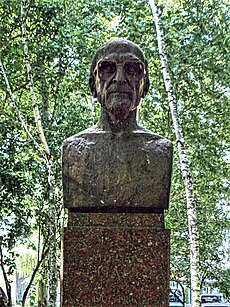 An endowed chair in the History of Religions at the University of Chicago Divinity School was named after Eliade in recognition of his wide contribution to the research on this subject; the current (and first incumbent) holder of this chair is Wendy Doniger.Portrait on the Alley of Classics, Chişinău
 Participate in an international science photo competition!


No comments:
Post a Comment