I was searching for a photo at National Geographic on Yamantaka and found this page through clicking on a Google Image of him
In the 1980s I first learned about Yamantaka who is a manifestation of the Buddha of Wrathful Wisdom. You might not have encountered this aspect of Tibetan Buddhism before. Most people concentrate on the Peaceful Buddha forms. However, in Tibetan Buddhism this is also a thing which reminds me a lot of the "Battle Hymn of the Republic" in American Culture which also reminds me of "Onward Christian Soldiers" and other songs like this. I was very surprised to find this article but somehow it seemed appropriate about now in World History.
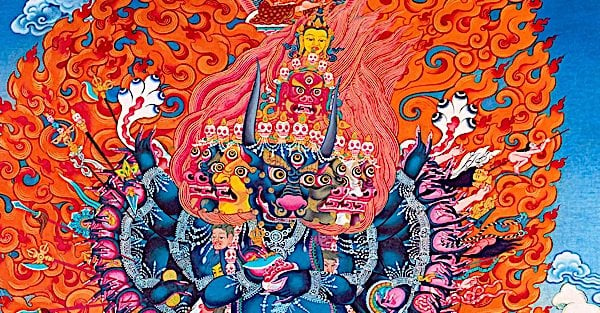
Along with the Photo of Yamantaka in the December 2025 National Geographic was this quote which I loved a lot:
"When Yamantaka steps into the monastery courtyard, the air itself seems to TREMBLE. In his gaze, evil dissolves. In his dance, the world is made NEW." quote by Jatenipat Ketpradit (photographer).
I experienced an all night long Puja at the Nyingma Tibetan Buddhist Lamasary in Rewalsar India to Dorje Drollo, a Crazy Wisdom form of Padmasambhava and that was pretty amazing too. I was in a penthouse view with open shutters looking out on this spectacle all night long. Amazing!
It is said that Padmasambhava created Rewalsar Lake when Mandharava's father a local king tried to burn him at the stake. So, he flew up into the hills or mountains there and melted his feet into the rocks there to show he was actually a Mahasiddha. I have actually seen these melted footprints in Rewalsar (Tsopema to the Tibetan Buddhists).
So, I know first hand just how amazing and powerful these experiences can be as they literally altar time and space itself into a much better form each moment.
Destroyer of Death Yamantaka:
Buffalo-headed Vajrabhairava, supremely wrathful Yidam manifestation of
Manjushri, the Buddha of Wisdom
Feature Contents
Death itself is conquered by this towering, wrathful deity,
Yamantaka. Conquering death, and the cycle of samsaric suffering, is at
the very heart of Buddhism. As the “death destroyer” Yamantaka
symbolizes this aspiration, and his meditational deity practice is
designed to achieve that goal.
No deity is more misunderstood than the buffalo-headed deity Vajrabhairava. Wrathful
barely begins to describe Yamantaka. Yet, he is none other than the
great Bodhisattva of wisdom, Manjushri, in his most terrible and
powerful form. How should we relate to such terrible aspects of
Enlightenment? Why is Yamantaka considered a Highest Yoga Practice? In
what way can he “destroy death?” We try to answer these questions, and
more, in this special feature.
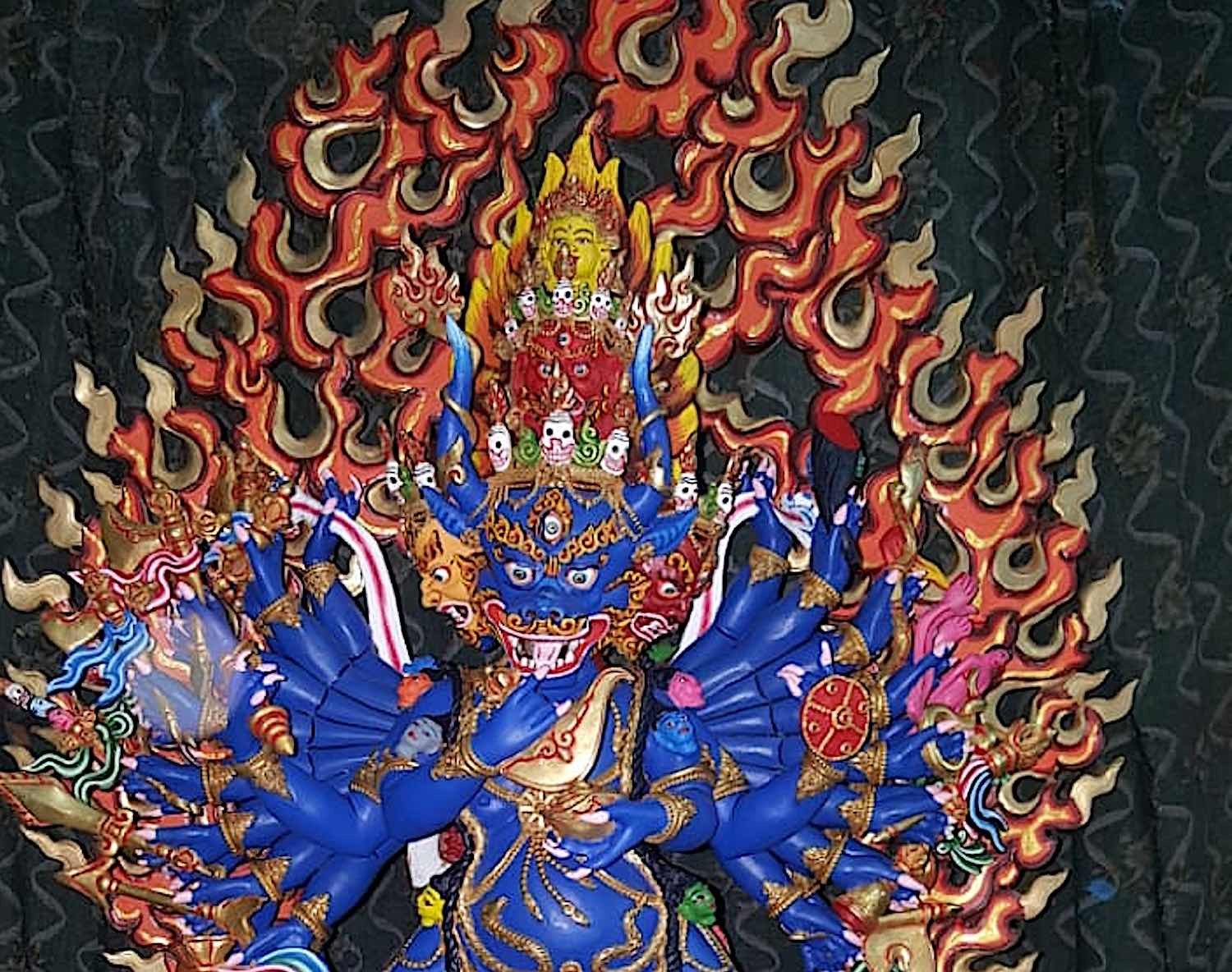
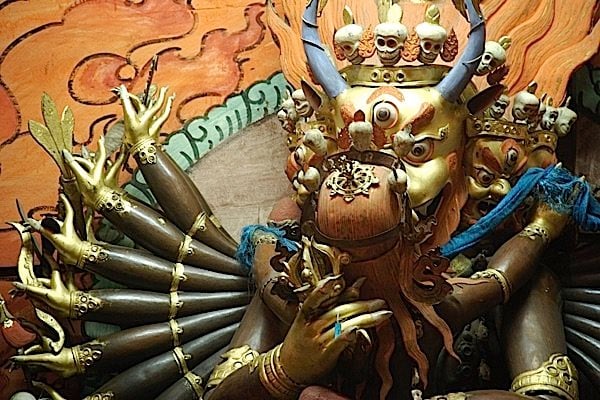
Stunning master-crafted and painted statue of Yamantaka by Nepal’s Best Statues. (Nepal’s Best Statues Facebook page>>)
“When the tantric wrathful deity is understood and
related to skillfully, it has the necessary qualities to be a catalyst
of transformation. One deity that embodies the power to transform the
destructive, aggressive aspect of the Shadow is Yamantaka.
Vajrabhairava, as he is also called is practiced to overcome emotional
and karmic obstacles, in particular the violence of anger and hatred.” —
The Psychology of Buddhist Tantra, Rob Preece
[See “Different forms of Yamantaka” section below.]
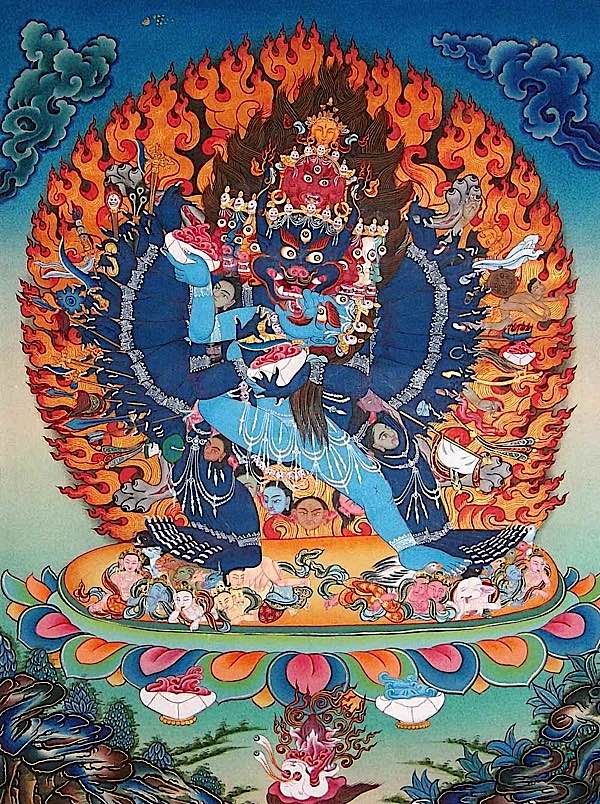
Arguably
the most ferocious of wrathful yidams in Manjushri’s form Solitary Hero
Yamantaka with 9 faces, 34 arms, 16 legs treading on gods, men and
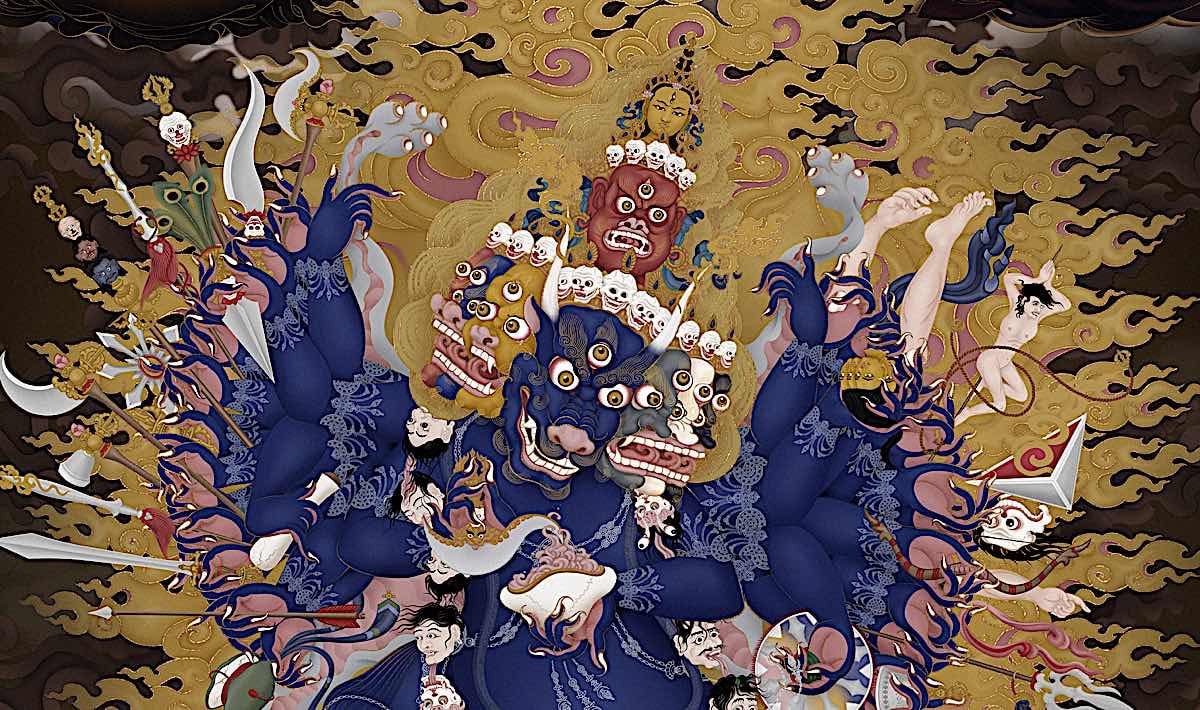
beasts alike. Detail from a magnificent Tangkha by Ben Christian (Jampay
Dorje). (The artist’s website here>>)
Shakyamuni as Vajrabhairava, Foe-Destroyer
There are Tantras describing the manifestation of Buddha as
Vajrahairava, the Foe-Destroyer. Foe Destroyer means the opponent of the
Maras (representing temptations, attachments, and fear of death.) In
some Tantra accounts, it is written that Shakyamuni himself — as he sat
under the Bodhi tree enduring the attack of demonic Mara the tempter and
Yama (death) — manifested as Vajrabhairava to “terrify and subdue” Mara
/ Yama. (Yama and Mara are often confounded.) Yamantaka means “death
opponent” or opponent of death.
In Sutra, Shakyamuni faced the hoards and temptations of Mara,
subduing them mentally, transforming them, and ultimately attaining
Enlightenment. In Tantra, this mental process transforms into visualized
or manifested forms. Shakyamuni manifested mentally as the Vajra
Terrifier (Vajrabhairava) — not only conquering the four Maras
(including the fourth: death), thus becoming the Conqueror — but also
demonstrating the ultimate Tantra practice. In Tantra, the mental
processes go beyond simple meditation and thought — incorporating
visualized imagery (deity generation) and sound (mantra) and
transformation (yoga.)
“Mara”, meaning the destroyer or tempter” was the demonic ‘evil one’
who attempted to obstruct Buddha’s enlightenment under the bodhi tree…
They are also depicted in the form of Brahma (Skandha Mara), Yaksha
(Klesha Mara), Yama… Iconographically, the four maras may be depicted as
being crushed under the feet of…. Vajrabhairava. In Vajrayana Buddhism,
the armies of Mara represent all of the mental and emotional delusions
that arise as “demonic enemies or fiends.” [1]
Yamantaka with Manjushri’s head at the crown.
The Four Maras to be overcome
The four Maras to be overcome (according to both Sutra and Tantra) are:
the mara of the aggregates (Skt. skandhamāra; Tib. ཕུང་པོའི་བདུད་, Wyl. phung po’i bdud), which symbolizes our clinging to forms, perceptions, and mental states as ‘real’;
the mara of the destructive emotions (Skt. kleśamāra; Tib. ཉོན་མོངས་ཀྱི་བདུད་, Wyl. nyon mongs kyi bdud), which symbolizes our addiction to habitual patterns of negative emotion;
the mara of the Lord of Death (Skt. mṛtyumāra; Tib. འཆི་བདག་གི་བདུད་, Wyl. ‘chi bdag gi bdud),
which symbolizes both death itself, which cuts short our precious human
birth, and also our fear of change, impermanence, and death; and
the mara of the sons of the gods (Skt. devaputramāra; Tib. ལྷའི་བུའི་བདུད་, Wyl. lha’i bu’i bdud), which symbolizes our craving for pleasure, convenience, and ‘peace’. [3]
Yamantaka’s “infamous” notoriety
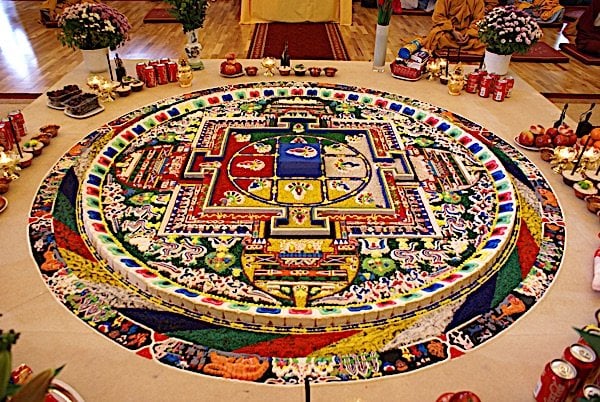
Yamantaka is, perhaps, most famous in the West because of the intricate and elaborate sand mandalas of Yamantaka:
Temporary
sand mandala of Yamantaka. After endless hours of intricate work, the
entire beautiful mandala is swept away to demonstrate impermanence.
It is said that when President Nixon was considering aid
for Tibet, he saw an image of Yamantaka, complete with horns, and judged
that the Tibetan people were primitive demon-worshipers. Of course,
modern understanding of the symbolism makes it clear that Yamantaka is a
wrathful but compassionate Yidam, whose terrible power is turned
against the obstacles to our practice, especially anger, hate, and
death.
Also, adding to Yamantaka’s “infamous” notoriety — or misunderstood
reputation — is the sometimes violent story of the Ra Lotsawa, the
“sorcerous” RaLo who vanquished rival teachers with Vajrabhairava
“magic.” [We’ll cover RaLo in an upcoming feature. Suffice it to
say, his stories have to be understood in context and are largely
metaphorical.]
Despite all of the infamy, Yamantaka is a most profound Highest Yoga
practice, as explained by Venerable Zasep Rinpoche: “Yamantaka practice
contains every practice you need.” Yamantaka practice in the Gelug
tradition incorporates “everything”: Generation and Completion practice,
Father and Mother Tantra, Vajrasattva purification practice, Guru Yoga,
Protection Wheel, Uncommon Protection Wheel, and even Body Mandala.
“Lama Tsongkhapa said, Yamantaka is the most powerful practice in
terms of transforming the mind and purification, ” explained H.E. Zasep
Rinpoche during teachings at Nelson B.C. on Yamantaka. “It is a very
powerful and important practice in this degeneration age.”
NOTE: Yamantaka practice is a Highest Yoga Tantric practice and REQUIRES initiation to practice as a Yidam.
According
to some accounts, one of the reasons then-President Richard Nixon
denied aid to Tibet was an image of Yamantaka in union with his Wisdom
Consort. The horns might have been too much for that era, but equally
the “sex” played a role.
Not only is Yamantaka the most ferocious of the Tibetan meditational
deities, everything about him is fierce and almost deliberately “over
the top” in scope and scale:
His name “Bhairava” means “terrifier.”
In his name, Yamantaka, contains the name “Yama”, the Lord of Death —
although when combined with “antaka” it actually means the “Destroyer
of Death”
He is visualized in an underworld, a charnel ground filled with
demons, spirits, cannibals — but all of whom he brings under his power
He is the “horned” god, and many Westerners see a resemblance to Satan’s horns.
He is brimming with invulnerable life-force, symbolized through his
potently erect penis. (The erect phallus represents “ever-expanding
great bliss” which is necessary to many Higher Yogic practices.)
His “shock and awe” imagery is meant to convey unshakable power that cannot be resisted.
He has many arms, legs and faces (depending on which form), his arms
holding many weapons, ripe with symbolism. The wrathful faces, to a
non-practitioner, can appear “demonic.”
He stamps on bodies — not as a killer, but as a force that brings all things under his control.
He is surrounded by flames — but not hell-flames; these are the
flames of wisdom — for he is none other than the Buddha of Wisdom,
Manjushri, in his wrathful form.
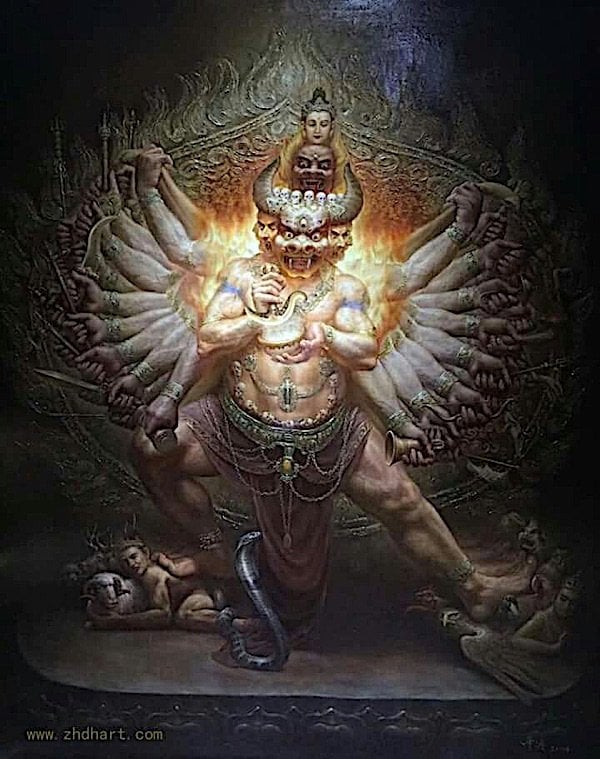
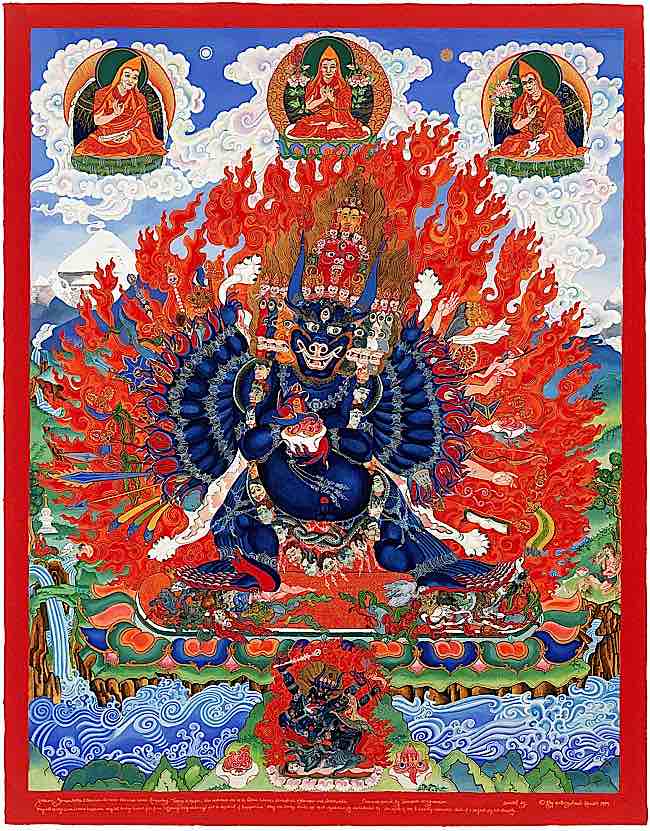
Yamantaka, among the most wrathful of the wrathful Enlightened deities.
Totality: the faces of compassion, wisdom, and activity
Wrathful barely begins to describe Yamantaka. In his Highest Yoga
Tantra form as Solitary Vajrabhairava, he has nine heads (the central
one being a “buffalo”), all with three eyes, fangs, and ferocious
expressions:
The nine faces represent the nine “scriptural categories” — which is explained in commentary to initiates.
The two horns represent “the two levels of truth” — relative and ultimate.
The thirty-four arms (together with body, speech and mind) represent the thirty-seven limbs of Enlightenment.
The sixteen legs represent the sixteen types of emptiness.
In this astonishing form, he has thirty-four hands, each with
symbolic weapons, and sixteen legs. He can also appear in union with his
consort Vajravetali. He can also appear with two or six-arms. He is
normally blue-black, symbolic of many things, among them wrathful
activity.
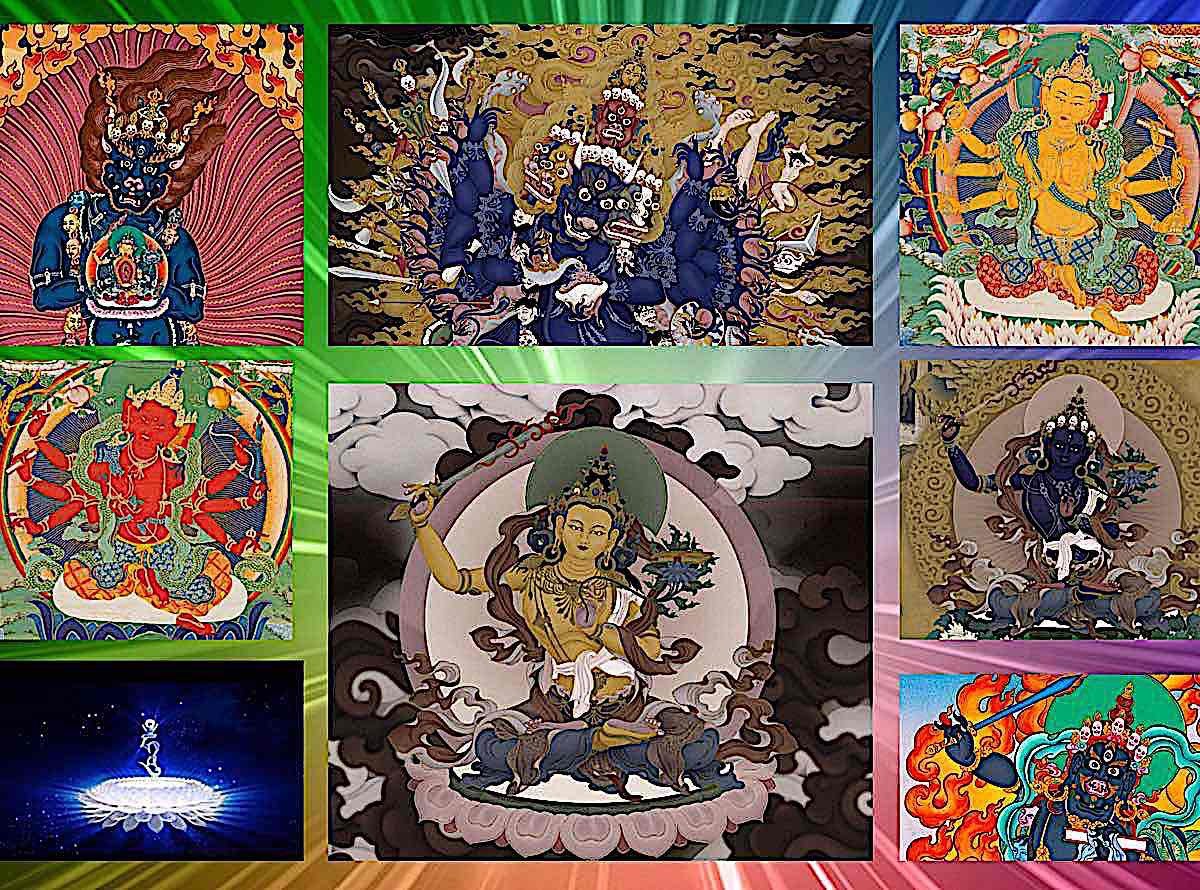
The
many faces of Wisdom and Compassion: Top right ferocious Yamantaka (two
arms), top center Yamantaka with nine heads — Manjushri’s head on top —
top right a rarer tantric form, center bottom Orange Manjushri with
Wisdom Sword, bottom right center Peaceful Black Manjushri, bottom Right
Wrathful Black Manjushri and bottom left, the syllable Hum on a Lotus.
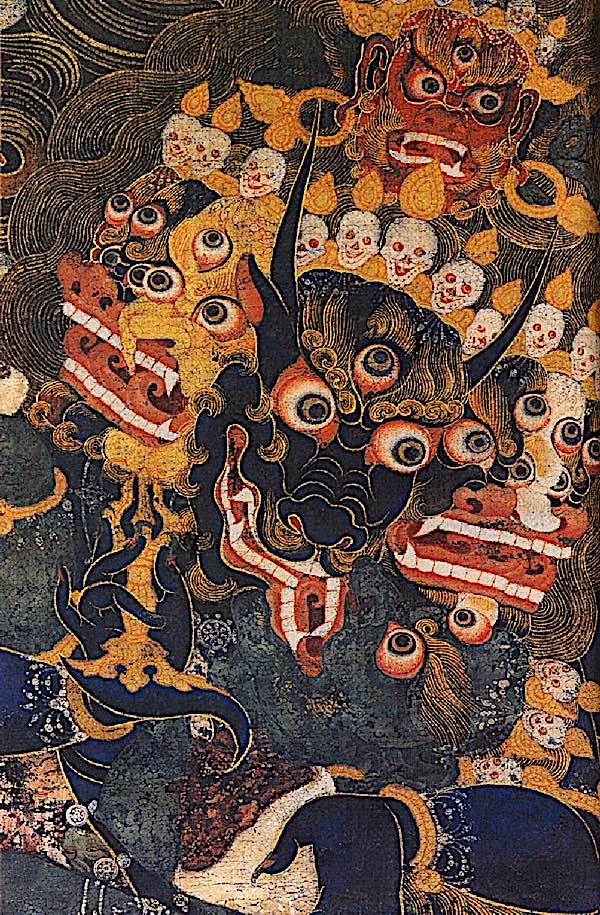
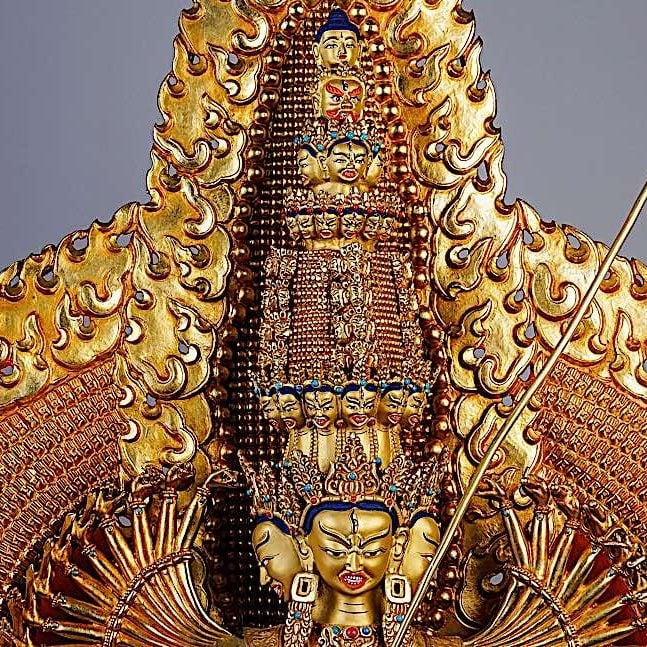
The top head is Manjushri, the Buddha of Wisdom. The middle face,
below Manjushri, and above the ferocious buffalo, is the face of red
Hayagriva — the ferocious form of Amitabha or Chenrezig Buddhas of
Compassion. These many faces describe the completeness of Yamantaka
practice: Manjushri for wisdom, Hayagriva for compassion, the wrathful
Buffalo head for Activity (Wisdom, Compassion and Activity together
represent a total practice). Surrounding these heads are six more faces:
red, yellow and green to the right and grey, white and black, to the
right — again associated with vast layers of symbolism.
To the uninitiated, seeing his ferocious image for the first time —
just imagine, for example, the early Christian missionaries arriving in
Tibet and seeing a near-demonic deity in the temples — he seems
frightening, the stuff of nightmares. This is, as it should be.
Yamantaka (Vajrabhairava in Sanskrit) is meant to be so fearsome that
even the demons — whether you view them as metaphorical inner demons or
external entities — tuck tail and run. Even Yama bows down (the ancient
equivalent of Satan or Hades).
Ultimately, death itself is conquered by this towering, wrathful
deity, Yamantaka. Conquering death, and the cycle of samsaric suffering,
is at the very heart of Buddhism. As the “death destroyer” Yamantaka
symbolizes this aspiration, and his meditational deity practice is
designed to achieve that goal.
Yamantaka, destroyer of death.
Yamantaka — overcoming anger and hatred
Yamantaka’s ultimate mission is “destroyer of death” (see below)— in
the same way, for example, Medicine Buddha’s main mission is “healing” —
but, as with all manifestations of the Enlightened, Yamantaka embodies
all of the qualities of a Buddha. He does, however, have other
well-known “specialties.” His practice is famous for overcoming
“emotional and karmic obstacles, in particular the violence of anger and
hatred.”
Dr. Alexander Berzin explains: “What is it that is going to prevent
us from attaining that state of a Buddha? Our own confusion, our own
laziness, our own bad temper and anger, our own attachments. This is the
real enemy – it’s all these disturbing emotions and negative attitudes
in our own minds. So we really need some very, very strong force not to
just give in and let ourselves be ruled by this confusion.”
He continues: “We need a combination of compassion – we want to help
others – and force and strength that “I’m not going to let all this junk
that’s going on in my mind prevent me from being able to help others,”
like laziness: “I don’t feel like doing it. I don’t feel like going and
helping somebody.” You have to cut through that.”
Yamantaka with Manjushri head.
Destroying death?
How does Vajrabhairava “destroy” death? By helping us to understand the true nature of reality.
Dr. Alexander Berzin explains why an assertive Yidam, such as
Yamantaka, can help us break through: “In order to overcome that
confusion and laziness, we need the full understanding of reality – in
Buddhist terms, voidness – that things don’t exist in the impossible
ways that our minds project. So with understanding, we want to cut
through these grosser levels with all the confusion – with a lot of
strength – and get down to the subtlest level.
As a Highest Yoga Tantra practice it includes generation and
completion stage practices, which are the ultimate meditational
practices for helping us see reality as it truly is. The assertive and
complex imagery of the “destroyer of death” requires us to really
concentrate on the task of “creating” (generating) the visualization.
Where softer, gentler meditational deities might allow us to relax and
coast, Yamantaka’s sheer ferocious complexity demands full attention.
Then, just as we master this awesome and frightening imagery — suddenly,
we are guided to deconstruct our hard work, to dissolve away the
intensely real visualization.
Yamantaka and consort.
In what way can this possibly “destroy death”? It has nothing to do
with immortality or staying young forever. Destroying death means to
understand that we are already Empty of inherent existence, that our
egos are a construct. When the ego is stripped away, we are no more than
part of the whole — but that, in itself, is an amazing truth and joy.
And, that whole that we are a part of, Shunyata, is eternal and
timeless. Understanding this concept is a deep and vast topic, not
explainable in a book or a simple feature article. This is why we have
great teachers to guide us. [For a story on Shunyata, or Emptiness, see>>]
We destroy death, in this case, by deconstructing the ego, the
bringer of our pain and suffering. It is the ego’s clinging to pleasure
and aversion to pain that causes our suffering. The moment our parents
put a label on us (as children) — we became that label. The ego
naturally followed. In its extreme form, the narcissistic personality,
the ego is everything. In its subtlest form, that of a humble monk who
has renounced most of the pleasures of so-called reality, the ego is
very unimportant. Compassion for others takes precedence, taking us yet
another step towards Enlightenment.
Yamantaka with 9 heads, 34 arms, 16 legs.
Highest Yoga Tantra — understanding Emptiness, overcoming death
Alexander Berzin explains the Highest Yoga Tantra, such as Yamantaka
practice, and how it helps us understand Emptiness (Voidness) and, with
practice, ultimately overcome death, for the benefit of all beings:
“Now, normally we get down to that subtlest level when we die. During
that period of death – what’s called the clear light of death – before
the Bardo (the in-between state) and rebirth, we are just experiencing
that clear-light level. (Pardon the dualistic way of saying that – that we are experiencing it, as if there’s a separate me. There’s no separate me
experiencing it.) In other words, our mental activity during that short
period of death is just this subtlest, subtlest level. I think that’s a
clearer way of saying it.
“But normally when we experience death, we’re totally unaware of
what’s going on – we don’t recognize the potentials and abilities of
that subtlest level of mind. We have all these habits of our confusion –
all these habits of compulsive behavior based on confusion and
disturbing emotions – and because of the momentum of so many lifetimes
of being under the influence of these habits, what happens? New rebirth –
samsaric rebirth – with another cluster or configuration of these
habits being activated and generating the next samsaric life filled with
the same types of compulsive behavior and confusion. That’s our
ordinary type of death.
“So what we want to do is to be able to overcome that kind of death
and instead be able, in our meditation, to get to that subtlest level of
mental activity. And we’ve used great force to get down there. But now
it’s with a totally calm understanding of reality that we can apply in
meditation at this time of clear light in order to be able to get:
That clear-light state to have the understanding of voidness or reality
The subtlest energy of it to transform and appear in the form of a Buddha.
“If we do this often enough and strongly enough, we’re
able to stay like that forever. So this is basically the tantra path of
the highest class of tantra.”
Of course, as a Highest Yoga Tantra practice, Yamantaka requires huge
dedication and commitment. It comes with practice commitments, Tantric
commitments and Guru commitments. It’s not for dabblers. It takes daily
practice for years to master — and it always requires a teacher, to
answer those tough questions that will inevitably arise.
Yamantaka (Vajrabhairava) is treasured in the Gelug tradition because
the great sage, Lama Tsongkhapa, himself an emanation of Manjushri,
recommended the practice as “most important.”
Yamantaka is treasured, in part, because it’s a “container practice.”
You can wrap other practices around Yamantaka practice. For instance,
if you invite protectors, you first visualize yourself as Yamantaka. It
incorporates Guhyasamaja and Chakrasamvara practices. Yamantaka practice
incorporates both Father and Mother tantra. Father tantra is the
practice of the “illusory body” and Mother tantra is the practice of
“clear light.”
Dr. Alexander Berzin explains: “You remember I said that
Vajrabhairava is the container within which you combine Guhyasamaja
practices and Chakrasamvara practices in the Gelugpa way of practicing?
He has thirty-four arms, right? The second of the five special features
is that in two of his hands he holds intestines and a triangular fire
stove. This represents two types of practices in Guhyasamaja: illusory
body and clear light. So that means that he incorporates the Guhyasamaja
type of practices.”
The main feature of Yamantaka practice is “overcoming the obstacles”
or “defeating the maras.” How does Yamantaka overcome the four Maras?
Dr. Berzin explains:
The mara of death: by understanding, with the
clear-light mind, emptiness, you come close to experiencing death,
without dying. As you understand the illusory nature of reality, and the
reason for our suffering, you come closer to escaping samsara.
The mara of disturbing emotions: anger to fight
anger, wrath to fight wrath, using the psychology of wrathful deities to
suppress the mara of disturbing emotions.
The mara of aggregates: Once we learn how to
transform the clear light of death into the Wisdom of Emptiness, the
aggregates of samsara can no longer affect us.
The mara of the sons of gods: With the Wisdom of Emptiness we overcome doubt and incorrect views.
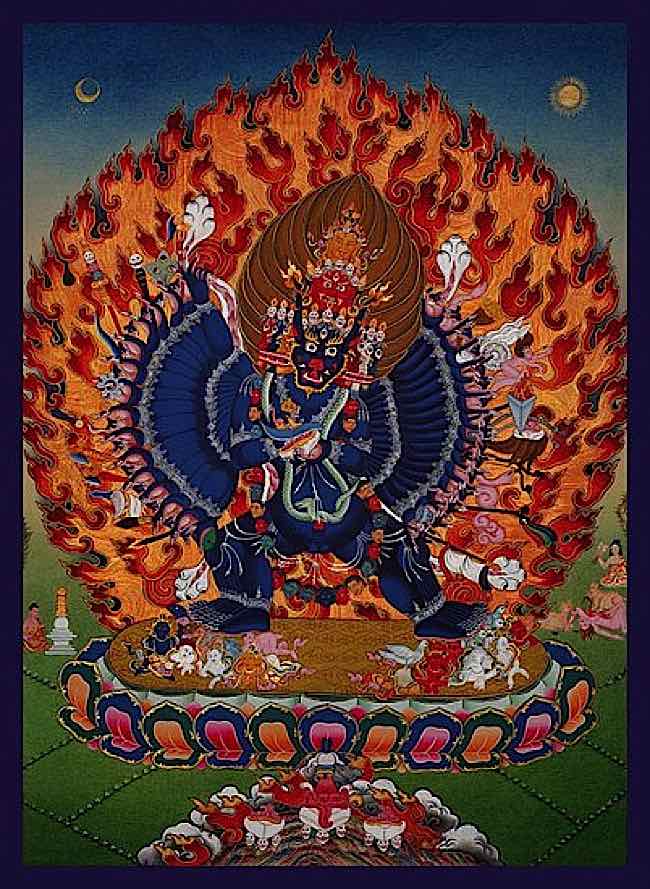
Yamantaka,
the Death Destroyer, arguably the fiercest of all the fierce deities in
Buddhism, is a highest yoga tantra practice. Yamantaka helps
practitioners with obstacles to practice, and particularly with anger.
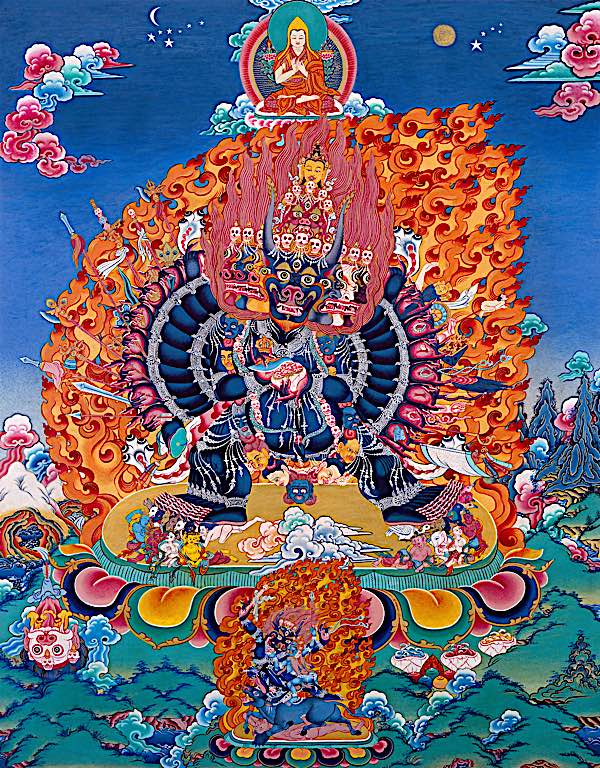
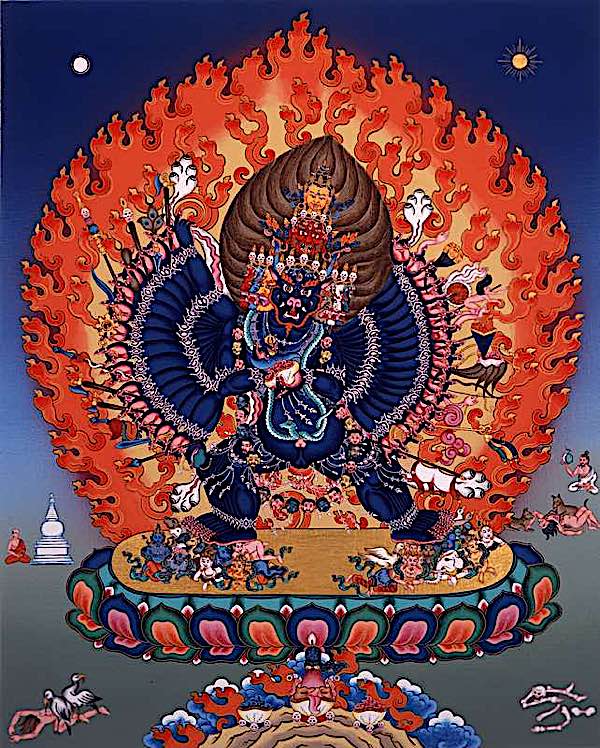
Yamantaka thangka by Kayla Komito Sacred Art. The Etsy site is here>>]
Father-Mother Combined?
Gelek Rimpoche explains: “Yamantaka basically falls into
the father tantra category, Heruka/Vajrayogini into the mother tantra.
Heruka is known as the ‘jewel tip’. If you have the mandala you put the
important jewel on the roof top and the queen of England does so with
the crown jewels. In that sense Heruka male and female is the
outstanding mother tantra, and likewise, in the Gelugpa tradition, the
Guhyasamaja tantra is considered the outstanding father tantra.”
Even though it is considered primarily “Father Tantra”, the symbolism
and attributes and practice do incorporate elements of Mother Tantra.
Since Yamantaka is the wrathful aspect of Manjushri, this shouldn’t be
too surprising. Usually, Highest Yoga practices are either Father
practice — emphasizing “illusory body”, compassion and “blissful
awareness” — or Mother Tantra — emphasizing “illusory mind” (rather than
body) clear light (or brilliance) and wisdom. Heruka Chakrasamvara and
Vajrayogini practices, for example, are Mother Tantra primarily;
Guhyasamāja is the classic example of Father Tantra. [See symbolism of implements below.]
Yamantaka has elements of both Father and Mother Tantra — although
his practice is generally considered Father Tantra — as indicated by the
symbolism of their visualized implements: the Khatvanga (Mother Tantra
and suggestive of Tummo practice, see below) and Yamantaka specifically
carries the triangular stove and intestines, standing for illusion body
and Father Tantra practice.
Mother Tantra Khatvanga carried by Vajrayogini has three heads and topped with a Vajra. Yamantaka also carries this Khatvanga.
Gelek Rimpoche: “The method of developing the illusion body. If you
look at Yamantaka’s hand implements, out of his thirty-four hands, one
is holding the intestines of a human being and another one is holding a
stove. He is not going to make a barbecue, but stove and intestines
symbolize something … Human intestines is a sign of the illusion body.
So showing that, is telling: ‘I also carry the quality of Guhyasamaja –
developing the illusion body’. So the second quality is that the
Yamantaka practice has the whole complete method of developing the
illusion body.”
Illusion body is associated with “Father Tantra” by definition.
However, Gelek Rimpoche explains the “Mother Tantra” aspects as well:
“Again, if you look at Yamantaka’s hand implements, you
see he carries a khatanga. What is a khatanga? There are different kinds
of these sticks they carry around. One is the trident [tib. katvang tse
sum], normally known in the west, then there is the one with the single
pole, and the mother tantra deities carry a khatanga which has a vajra
on the top and then [three] skulls. The khatanga normally is the
exclusive sign of the mother tantra, but Yamantaka carries a khatanga,
too. That gives you another message: just like the Heruka or Hevajra
tantras have a method of developing the psychic heat power [tib. tummo],
burning and melting the source of joy from the head, Yamantaka has that
too.”
Symbolism of Yamantaka
Yamantaka carries many implements, which are the most direct symbols
of his practice, benefits and completeness — and it is here we have
suggestions of the blend of Father and Mother Tantra. From Gelek
Rimpoche’s “Solitary Yamantaka Teachings” the symbolism is defined as:
Right side (his right):
“First right hand: skin of an elephant – victory
over narrow-mindedness
Yamantaka, a ferocious emanation of Manjushri, conquered Yama, Lord of Death.
“Remaining right hands:
I . curved knife (in front!) – cutting through ignorance
2. dart – piercing conception of subject and object
3. pestle – destroying degenerated mindfulness
4. fish knife – cutting off cyclic existence
5. harpoon – destroying the faults of body, speech, mind
6. ax – cutting imprints of obscurations of sentient beings
7 spear – piercing wrong views
8. arrow – transfixing pain of preconception
9. hook – keeps spirits and demons away
10. skull-headed club – destroying the obstacles of karma 11. Katanga – transforming into nature of great practice too – tummo)
12. rimless wheel – turning the wheel of Dharma
13. five-point vajra – being in the nature of the five wisdoms
14. vajra-hammer – destroying avarice
15. sword – bestowing the eight siddhis
16. hand-drum – invoking the buddhas
“Under the right feet: eight siddhis
1. human – pill
2. buffalo -eye lotion
3. bullock – underground movement
4. donkey – sword
5. camel – flying in space
6. dog – becoming invisible
7. sheep – immortality
8. fox – the destruction of sickness
NOW, the LEFT (his left):
First left hand: skin of an elephant – victory over narrow-mindedness
Remaining left hands
1. skull-cup filled with blood (in front!) restoring degenerated commitments
2. head of Brahma – working with great compassion
3. shield – victory over the 4 maras
4. leg – practitioner proceeding to enlightenment
5. lasso – enveloping the mental continuum with pure wisdom
6. bow – victory over the 3 worlds entrails -possibility of developing illusion body (YT holds method of father tantra)
7. intestine – represents the “illusion body” according to Gelek
Rimpoche: “shows that within this practice are included all the
teachings from Sangwa dupa which focuses on the illusion body” [1]8.
bell – sound of Prajnaparamita
9. hand – performing the four activities
10. cotton shroud – eliminating the veil of obstacles to wisdom
11. man impaled on a stick – directly realizing emptiness by penetrating
all things through voidness (YT practice not easy, but forcefully
you get through.) 12. brazier (stove) – possibility of developing clear light (YT practitioners — a quicker chance to develop wisdom)
13. scalp – mental continuum being filled with compassion
14 threatening mudra – threatening the demons: ‘You should give priority of bestowing Siddhihood on my practitioners’.
15. trident with flags – understanding the emptiness of the three doors as being one entity
16. fan – indicates that all things are like illusions
Under the left feet: eight powers
1. vulture – power of body
2. owl – power of speech
3. crow – power of mind
4. parrot – power of miracles
5. hawk – power of going anywhere
6. kite – power of abode
7. mynah bird – power of wish-fulfillment
8. swan – qualities (be of use for others)
The legend of Yamantaka — a story of anger and death
Yamantaka, a ferocious emanation of Manjushri, conquered Yama, Lord of Death.
Legend and myth are the languages of the subconscious, according to
various schools of psychology. The legend of Yamantaka is no different.
It’s essence, of course, is that Manjushri, the Buddha of Wisdom, took
on a form more terrible than Yama himself — Yama being the
personification of death — and prevented Yama from decimating Tibet. At
that level, the symbolism is clear.
Deeper into the legend you gain a lot more in terms of mysterious
symbolism and messaging. The story is told of a monk, a hermit really,
who was in his fiftieth year of isolated meditation in a cave in the
mountains. Just as he was about to achieve a profound insight, two
thieves burst into his cave, with a stolen Water Buffalo. Despite the
monk’s pleas to stop — just for a few minutes until he finished his
meditation — the thieves beheaded the poor buffalo. Then, out of spite,
the two thieves also beheaded the monk.
The monk, who had attained great siddhis, became suddenly very angry
and, using his great powers, arose bodily with the head of the bull in
place of his own. He killed the two thieves, then — even more furious,
now, that his bloodlust had risen — he went on a killing rampage all
over Tibet, as Yama, the personification of Death.
Alexander Berzin, from a lecture on Yamantaka, finishes the story:
“So the people of Tibet were afraid for their lives, and they prayed to
Manjushri to listen to them. And Manjushri transformed himself into
Yamantaka, looking very similar to Yama but ten times more powerful and
horrible, and Manjushri as Yamantaka then defeated Yama and made him
into a protector for Buddhism.
“So what do we learn from this story? It’s very interesting. Don’t
just look at these things as little fairy tales to tell children.
There’s this whole thing that you get in the study of mythology – to see
what are the lessons behind the mythology, and is there a deeper
psychological thing that is going on, and so on. You get that in Jungian
psychology, for example.
Of course, there’s anger and hate, to be tamed by our practice. Anger
and hate arise from ego and clinging. The monk was so attached to his
achievement, his anger could not be stopped — except by the wisdom of
Manjushri. The Buddha of Wisdom used fierce appearance to fight fierce
appearance, manifesting as Yama with a water buffalo bullhead, only many
times more ferocious. All to say, in Yamantaka practice, we can
overcome anger — and, ultimately, death — by understanding appearances
are deceptive, attachment is the root of samsara, and escape lies in
Emptiness.
Yamantaka YabYum with Wisdom consort. The YabYum represent Father (Yab) Mother (Yum) in union: compassion and wisdom together as one.
Different forms of Yamantaka
There are three very popular forms of Yamantaka, all of which have a
main “buffalo head” with Manjushri head on top (on the crown) except for
Black Yamari and Red Yamari, who have no buffalo head:
Vajrabhairava with 9 heads, 34 arms, 16 legs: this form can appear
in any of three mandalas: solitary (single-deity), 49-deity mandala and
13-deity mandala
Vajrabhairava with 6 heads, 6 arms, 6 legs (found in the Kalachakra text).
Vajrabhairava with 4 heads, 8 arms, 4 legs.
Yamantaka himself has many forms, some solitary, some in union with
consort, and all requiring empowerment from a lineage teacher:
please guide me where can i find authentic master and lineage
for Yamantaka yidam. i hav been seejing since long an authentic teacher
/ guide guru for Yamantaka
Dear Yashank, It is wonderful that you are seeking an
authentic teacher in this lineage. However, without knowing where you
are it’s difficult to recommend a teacher (unless you are willing to
travel). Yamantaka is a Highest Yoga Tantra practice. If you are ready
for this type of yoga, ask your teacher (only you and your teacher will
know). If you don’t have a teacher, seek one out in one of the schools
with Yamantaka lineage (Most schools, however Gelug lineage tends to
emphasize Yamantaka as a main Yidam practice). It is likely, however,
unless you already practice deity yoga, that you’ll be asked by teacher
to undertake foundation practices first. If you’ve already undertaken
these, likely the teacher who introduced you to those practices can
recommend a teacher if He or She doesn’t offer empowerment. I wish you
well on your search.
Hi. Kayla Komito here. Thank you for using my thangka
painting of Yamantaka as your link on Google image and cover piece. I
would appreciate it if you would acknowledge me as the painter as you
have in Jampay Dorje’s lovely Thangka of Manjushri. I enjoyed your
article on Yamantaka very much.
Blessings Kayla Komito
Thank you Kayla Komito. I think we’ve found all the places
your beautiful Thangka appears and added credit! Thank you for your kind
words. In kindness, Lee
Extremely useful article, thanks. Fortunate enough to be in
front of a Yamataka thankha on. Temporarily on display in HK Science
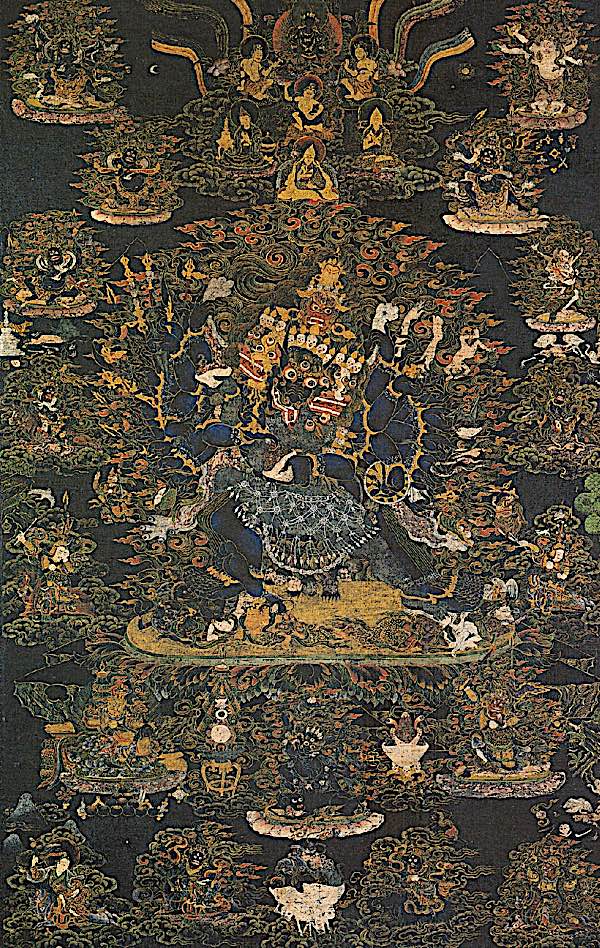
museum , originally it was in the Palace of the forbidden city.
Shock and awe is very apt. Dr Berzin and Gelek Rinpoche’s comments and guiance very helpful.
My hat’s of to you for this most in-depth article and all the
work that went into it. Read it more than once and will read it a few
more times. As a newbie Buddhist I had an initial adverse reaction and
now have great appreciation for him. I feel like for once a male’s
private parts being represented in this way – erect and adorned – is a
proper and spiritual way.
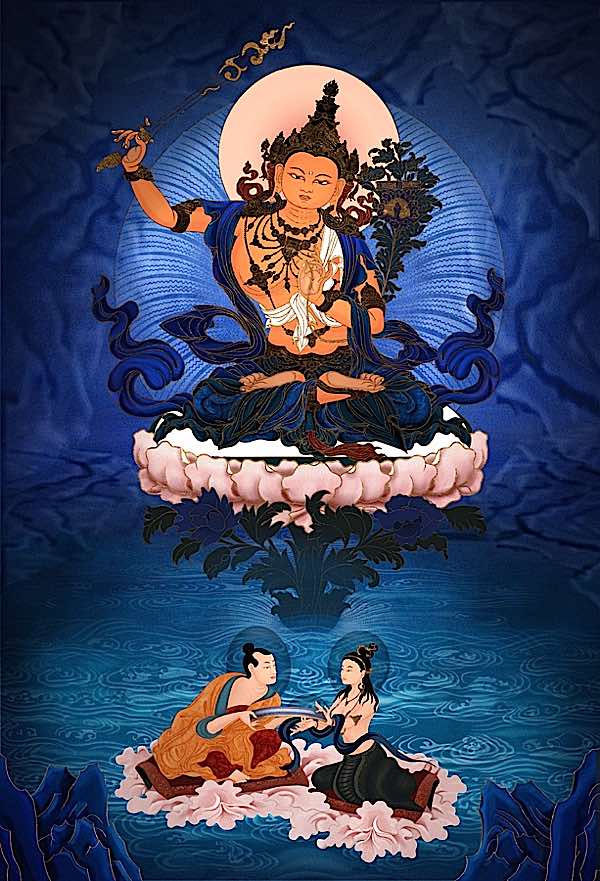
Five faces of wisdom: Mañjuśrī and the 5 prajñās transforming 5 demons and poisons
Daśacakra Kiṣitigarbha Dhāraṇī: Rescuing All Beings: The
Sanskrit Dharani that Saves Beings on Hearing or Seeing or Chanting
ON HEARING: Ushnisha Vijaya Dharani Overcomes Six Types of
Suffering, Conquering the Lord of Death: Supreme in Six Realms
Sitatapatra or Dukkar — the ultimate protective
Bodhisattva Goddess, form of Mother Tara — 1000 arms or 2 arms, she is
“Aparajita” the Undefeatable One
Sanskrit Wangdu: Lotus Song of Magnetizing in Sanskrit: Mipham Rinpoche “Accomplish all Wishes” – with Music Video!
Wangdu Great Cloud of Blessings: the 9 Magnetizing
Activity Yidams of the Padma Buddha family: Amitabha, Kurukulla,
Chenrezig, Hayagriva, Vajrayogini, Vajradharma, Padmaraja,
Chakrasamvara, Guhyajnana
The
power of Dharma to help sentient beings, in part, lies in ensuring
access to Buddha’s precious Dharma — the mission of Buddha Weekly. We
can’t do it without you!
A non-profit association since 2007, Buddha Weekly
published many feature articles, videos, and, podcasts. Please
consider supporting the mission to preserve and “Spread the Dharma."
Your support as either a patron or a supporting member helps defray the
high costs of producing quality Dharma content. Thank you! Learn more here, or become one of our super karma heroes on Patreon.
Lee Kane
Author | Buddha Weekly
Lee Kane is the
editor of Buddha Weekly, since 2007. His main focuses as a writer are
mindfulness techniques, meditation, Dharma and Sutra commentaries,
Buddhist practices, international perspectives and traditions,
Vajrayana, Mahayana, Zen. He also covers various events.
Lee also contributes as a writer to various other online magazines and blogs.
Buddha Weekly is a Non Profit Association of volunteers since 2007, committed to the Buddhist mission of "Spread the Dharma" — at NO cost to readers. About Buddha Weekly>>
Buddha Weekly and BuddhaWeekly.com are trademarks in use since 2007. Spread the Dharma is a trademark in use since 2021.
All Rights Reserved. Please feel free to excerpt stories with full credit and a link to Buddha Weekly. Please do not use more than an excerpt. Subject to terms of use and privacy statement. All
information on this site, including but not limited to, text, graphics,
images and other material contained on this website are for
informational and educational purposes only.
The purpose of this website is to promote understanding and knowledge. It is not intended to be a substitute for professional advice, including medical advice, diagnosis, or treatment.
Buddha
Weekly's mission "Spread the Dharma" is carried out through Buddhist
educational activities on this website, BuddhaWeekly.com, together with
the Buddha Weekly Youtube Channel, the SpreadtheDharma podcasts, and related websites, social media channels, and activities.
Buddha Weekly does
not recommend or endorse any information that may be mentioned on this
website. Reliance on any information appearing on this website is solely
at your own risk.
Amazonlinks are sometimes affiliate links with small commissions supporting the mission "Spread the Dharma" of Buddha Weekly.




 Lotus Song of Magnetizing in Sanskrit: Mipham Rinpoche “Accomplish all Wishes” – with Music Video!


I really enjoy your posts..learn a lot
Many thanks! Metta, Lee
please guide me where can i find authentic master and lineage for Yamantaka yidam. i hav been seejing since long an authentic teacher / guide guru for Yamantaka
Dear Yashank, It is wonderful that you are seeking an authentic teacher in this lineage. However, without knowing where you are it’s difficult to recommend a teacher (unless you are willing to travel). Yamantaka is a Highest Yoga Tantra practice. If you are ready for this type of yoga, ask your teacher (only you and your teacher will know). If you don’t have a teacher, seek one out in one of the schools with Yamantaka lineage (Most schools, however Gelug lineage tends to emphasize Yamantaka as a main Yidam practice). It is likely, however, unless you already practice deity yoga, that you’ll be asked by teacher to undertake foundation practices first. If you’ve already undertaken these, likely the teacher who introduced you to those practices can recommend a teacher if He or She doesn’t offer empowerment. I wish you well on your search.
where can I read more abt Vajra Vetali?
Hi. Kayla Komito here. Thank you for using my thangka painting of Yamantaka as your link on Google image and cover piece. I would appreciate it if you would acknowledge me as the painter as you have in Jampay Dorje’s lovely Thangka of Manjushri. I enjoyed your article on Yamantaka very much.
Blessings Kayla Komito
Thank you Kayla Komito. I think we’ve found all the places your beautiful Thangka appears and added credit! Thank you for your kind words. In kindness, Lee
Extremely useful article, thanks. Fortunate enough to be in front of a Yamataka thankha on. Temporarily on display in HK Science museum , originally it was in the Palace of the forbidden city.
Shock and awe is very apt. Dr Berzin and Gelek Rinpoche’s comments and guiance very helpful.
There’s a missing explanation on Left Hand Number 7 Intestine. Can please include it in? Thank you
Thanks Richard Pang for flagging the missing number 7!
My hat’s of to you for this most in-depth article and all the work that went into it. Read it more than once and will read it a few more times. As a newbie Buddhist I had an initial adverse reaction and now have great appreciation for him. I feel like for once a male’s private parts being represented in this way – erect and adorned – is a proper and spiritual way.
♥♥♥