Showing posts with label 000 people. Show all posts

Tuesday, December 9, 2025

article from 2021 marking 10 year anniversary of Japan tsunami and quake that killed 20,000 people

begin quote from CBS News: 

Marking ten years since the 2011 Japan earthquake

As Japan hastily navigates the logistics of hosting the 2021 Summer Olympic Games in Tokyo amidst a global pandemic, the people of the island nation will take a step back today to honor a tragic moment in recent Japanese history.

Ten years ago, on March 11, 2011, the fourth-largest recorded earthquake in history struck Japan's Pacific Coast, triggering a 128-foot tsunami wave that swallowed villages whole and triggered the biggest nuclear disaster since Chernobyl.

Nearly 20,000 people died, 500,000 were forced to evacuate, 138,000 buildings were destroyed, and the country suffered the most expensive disaster in human history, with $360 billion in economic losses, according to an estimate from the Brookings Institution.

On this day of remembrance, the Japanese government held a small memorial service at the National Theatre in Tokyo to mourn that which the country had lost. 

Today, 60 Minutes looks back at its coverage of the disaster, and the ways in which the people of Japan have coped and rebuilt the stricken region.

Immediately after the disaster struck, Scott Pelley and a team of producers travelled to Japan to report a story we called "Catastrophe," focusing on the devastating Fukushima nuclear crisis. The report includes an interview with Julia Nesheiwat, a U.S. State Department official, and David Chumreonlert, an American teacher living in Matsushima, focusing on the impact and danger of the melting nuclear reactors at the power plant in the area.

Nicole Young, a longtime producer working with Scott Pelley and a co-producer of "Catastrophe," vividly recalled the reporting assignment.

"When we finally arrived at the heart of the devastation, I couldn't believe my eyes," Young said. "It was like the earth was put in a bottle, shaken up and then dumped back out.  It was hard to comprehend the desolation, and even more distressing to be in constant fear of what might come next while we were on the ground… a potential nuclear disaster. We were all scared of something we could not physically see or comprehend."

The story left an indelible mark on 60 Minutes' Young. "This story forever changed my life.  I witnessed the stoicism and endurance of the Japanese people in the direct aftermath of an unfathomable natural and potential nuclear disaster. I learned more about humanity on this story than almost any other catastrophe I have reported on."

In the fall after the disaster, the late 60 Minutes correspondent Bob Simon and a team traveled to Otsuchi, a remote island in Japan that was hit hardest by the tsunami. Out of a small population of 15,000 people, 1,500 perished in a matter of minutes. Though the record-breaking earthquake and subsequent nuclear disaster grabbed headlines, the tsunami is what devasted many coastal cities and small islands the most, affecting thousands of people.

In "After the Wave," 60 Minutes reported on the small Japanese community, and how its people attempted to rebuild after the natural disaster wiped out ten percent of its population. 

In 2014, 60 Minutes reported on the aftermath of the March 11th earthquake, tsunami and nuclear disaster in Fukushima, which had by then created a radiation crisis in surrounding areas. In a story we titled "3 Years Later," correspondent Bob Simon and a team of producers spoke with Norio Kimura, who used to live in the devastated town of Okuma, and would go on to visit the radioactive city twice a year to pay his respects at his family's gravesite. The team also spoke with a nuclear engineer and the chairman of the Rebuild Japan Initiative Foundation to report on the Japanese government's strategy to evacuate towns and begin the slow-moving cleanup process from the nuclear crisis. 

More than seven years after the massive earthquake and resulting monster tsunami battered the northeast coast of Japan, 60 Minutes correspondent Lesley Stahl reported on how specialized robots were being used to clean up after the nuclear disaster at the Fukushima Daiichi power plant. Stahl and a producing team spoke with engineers, researchers and officials to explain how these four-legged robots climbed stairs, withstood high levels of radiation, and even swam in nuclear reactors filled with water. Equipped with sensors, maps, and 3D scanners, these robots were part of a decades-long, estimated $200 billion clean-up effort by the Japanese government.


Monday, May 4, 2020

Trump says he gets bad press as he tells world U.S. will lose at least 90,000 people

The thing is this likely isn't true. By this time next year I expect (unless a vaccine is created that works safely) that it isn't 90,000 but around 1 million Americans that will be dead from Coronavirus by May 1st of next year if this is anything like the Spanish Flu Pandemic of 1918.

The 90,000 dead will be likely by August from what I'm presently seeing now in the data.
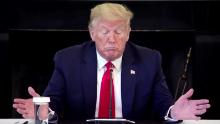
U.S. President Donald Trump gestures as he speaks during a Fox News town hall at the Lincoln Memorial in Washington, D.C., U.S., on Sunday, May 3, 2020. Trump holds a symbolic town hall meeting at the Lincoln Memorial Sunday as he accelerates efforts to reopen America after weeks of stay-at-home measures taken to stem coronavirus spread have ravaged the economy. Photographer: Oliver Contreras/Sipa/Bloomberg via Getty Images

begin quote from:Trump claims Lincoln got better press as he ups death estimate

Lincoln got better press treatment, Trump claims, as he ups pandemic death estimate

Ohio's slow reopening plan is frustrating local businesses

Watch Trump appear to dismiss intel statement

Pelosi pushed on Biden accusation after endorsement

Maryland Governor locked down test kits 'like Fort Knox'

CEO of Hilton emphasizes need for testing at event with Trump

Trump questions the need for blanket coronavirus testing

CNN reporter details incident between Trump and campaign manager

DC mayor juggles single parenting and running a city

Trump raises estimated US coronavirus death toll

Rep. Amash defends his 2020 presidential campaign

Tapper presses Kudlow: Why not take action now?

Trump moves to replace official who issued Covid-19 report

White House will allow Fauci to testify before Senate

Reporter to Trump's new press secretary: Will you ever lie to us?

Biden denies former staffer's sexual assault allegation

A third-party candidate could hurt Biden ... or Trump

Ohio's slow reopening plan is frustrating local businesses

Watch Trump appear to dismiss intel statement

Pelosi pushed on Biden accusation after endorsement

Maryland Governor locked down test kits 'like Fort Knox'

CEO of Hilton emphasizes need for testing at event with Trump

Trump questions the need for blanket coronavirus testing

CNN reporter details incident between Trump and campaign manager

DC mayor juggles single parenting and running a city

Trump raises estimated US coronavirus death toll

Rep. Amash defends his 2020 presidential campaign

Tapper presses Kudlow: Why not take action now?

Trump moves to replace official who issued Covid-19 report

White House will allow Fauci to testify before Senate

Reporter to Trump's new press secretary: Will you ever lie to us?

Biden denies former staffer's sexual assault allegation

A third-party candidate could hurt Biden ... or Trump

(CNN)After admitting US coronavirus deaths could hit 90,000, President Donald Trump is bemoaning his own plight -- complaining that he has been treated worse by the press than Abraham Lincoln.
Trump's comments, at the memorial in Washington to a president assassinated after emancipating the slaves during the Civil War, are likely to further polarize the raging politics of a current crisis that is stretching national unity.
"I am greeted with a hostile press the likes of which no president has ever seen," Trump said at the Fox News town hall Sunday night.
"The closest would be that gentleman right up there," Trump said, pointing to the 16th President's statue. "They always said nobody got treated worse than Lincoln. I believe I am treated worse."
    Trump was speaking at the time of a widening divide between states that are opening economies and others that are warning of premature declarations of victory amid soaring tensions fomented by weeks of coronavirus lockdowns.
    His statement was classic Trump, not just in his audacity of comparing himself to the man many historians rate as the greatest president, but in his tendency to make every issue -- even in the midst of a national tragedy in which tens of thousands of Americans have died -- about himself.
    It was also striking that the President who has consciously torn at the nation's political fault lines should make such a partisan argument under the marbled gaze of the man who warned "a house divided against itself cannot stand."
    The President admitted on Fox that his earlier estimates that between 50,000 and 60,000 Americans could die in the pandemic would be outpaced. But he argued that his leadership had been "successful" since the higher end of models used by the White House had previously suggested up to 240,000 people could perish, even with social distancing in place.
    "I used to say 65,000 and now I'm saying 80 or 90 and it goes up and it goes up rapidly," the President said at the memorial, a glorious and spectacular backdrop for the Fox News show that an image-making campaign manager could not have bettered.

    New stage in pandemic battle

    The President was making his best case at the start of a critical new period in the battle with Covid-19 that will play out in millions of lives in the six months until Election Day.
    The aggressive approach of some governors is already heaping pressure on those who run states still committed to stay-at-home guidelines -- even with the virus still rampant in their paths.
    With Trump agitating for a spark to the nation's economic engine, some governors are taking a gamble that in many cases contradicts the best advice of epidemiologists, but if it works, could alleviate some of the crippling unemployment triggered by the pandemic.
    The next three weeks or so could show whether a new wave of infections caused by an easing of tough restrictions on daily lives will swarm state hospital systems, significantly increase the death toll and require a return of lockdowns.
    In a worrying sign that points to the scale of the coming risks, few, if any, states that are opening have satisfied White House reopening guidelines of a 14-day dip in infections.
    But if states like South Carolina, Georgia, Florida and Texas that are opening can provide a blueprint for the "new normal" that will be American life until a vaccine is found, they could point the way to a broader recovery and speed economic rebounds.
    The reopening -- albeit with many restaurants and businesses at reduced capacity -- will also provide a new challenge for the White House, which insisted again Sunday, despite considerable contrary evidence, that it has built sufficient national testing to give states everything they need to safely ease restrictions.
    States like New York and Maryland -- which have plateaued at fairly high levels from Covid-19 -- are warning that easing restrictions too quickly could be disastrous.
    "I think everybody has a right to protest and express their feelings. A couple of dozen people did so yesterday. And they have every right to do that," Maryland Republican Gov. Larry Hogan told CNN's Jake Tapper on "State of the Union."
    "We sadly, we had far more people die yesterday in Maryland than we had protesters," he said, warning that some states appeared to be moving toward opening in an unsafe manner.
    New York Gov. Andrew Cuomo, a Democrat, also registered concern that gains made against the pandemic by grueling stay-at-home orders could be squandered as the lure of summer drains resolve.
    "My gut says the weather is going to warm, people are bored, people want this over. They see the numbers going down. They can take false comfort," Cuomo said on Sunday.
    "We never said it was over. We said the numbers are going down," he added. "Roughly a thousand new people a day walk into the hospitals."

    Three key states -- all run by Republicans

    Three states, Mississippi, Ohio and Florida -- all run by Republican governors -- are likely to reflect the intricate adjustments needed in the days ahead as the Covid-19 picture varies state by state and city by city.
    The Sunshine State's Gov. Ron DeSantis is a close Trump GOP ally who has rejected some of the scientific models used by epidemiologists as overstating the likely death toll from Covid-19.
    "Even though our hospitalization and infection and fatality rates are much lower than many of these other big states, particularly in the Northeast and Midwest, we did not necessarily -- quote -- 'shut everything down,'" DeSantis said on Fox News on Sunday.
    "So, we're starting, I think, a little ahead of where some other states are," he added.
    The quickening push to reopen came after disaster experts told CNN on Friday that states should not begin to open until coronavirus restrictions had been falling for 10 days to two weeks and there were sufficient tests available to assess how many people are really infected.
    "You're making a big mistake. It's going to cost lives," said Dr. Irwin Redlener, a pediatrician and disaster preparedness specialist at Columbia University Medical Center.
    In a sign of the balancing act governors face, Republican Tate Reeves of Mississippi had planned to announce an easing of restrictions on Friday but changed plans at the last minute due to a spike in infections.
    "We are trying to be very cautious and so we said, let's analyze the data over the weekend," Reeves said on "Fox News Sunday."
    "What we have found is that it was really a data dump."
    "So it was a one-day blip, but we wanted to make sure we investigate that data before we make a final decision, so we delayed it."
    The new stage of the fight is likely to defy the triumphant comeback narratives of the President. But it may be grayer than the predictions of scientific models and political leaders still stuck in the darkest days of the pandemic may suggest.
    Ohio's Republican Gov. Mike DeWine warned Sunday "we're going to watch numbers every single day."
    DeWine has extended his state's stay-at-home order until May 29 but expects to announce some easing of restrictions to allow some businesses to reopen in the coming days.
    "What I hope is as people see those numbers, if they do go up and if they go up dramatically, that the people of the state will react to that," DeWine said on ABC News' "This Week."

    Continued tension

    Some signs of hope?