Your heart is stronger
than your head today -- which could be quite an advantage! If nothing
else, you may find that you can see emotional issues for what they
really are. Stay calm!
Morning routines are important — but bedtime rituals can have a serious impact on your success.
That’s because the very last thing you do before bed affects your
mood and energy level the following day, since it often determines how
well and how much you sleep.
Knowing that, we decided to find out how the most successful spend their nights before surrendering to sleep.
Turns out some — like President Obama and writer Michael Lewis — are
night owls, preferring to work while the rest of the world sleeps; while
others —like Arianna Huffington and Sheryl Sandberg — know how
important sleep is, and force themselves to cool down. President Barack Obama is a "night owl" and likes to work late.
REUTERS/Kevin Lamarque
Unlike Obama's predecessor George W. Bush, who prefers to rise in the early hours, the current president stays up late, reports Carrie Budoff Brown at Politco. He is said to hold conference calls with senior staff as late as 11 p.m. and reads or writes before heading to bed.
In a 2011 interview with Newsweek, Obama calls himself a "night owl" and describes his typical evening:
"Have dinner with the family, hang out with the kids, and put them to
bed about 8:30 p.m. And then I'll probably read briefing papers or do
paperwork or write stuff until about 11:30 p.m., and then I usually have
about a half hour to read before I go to bed ... about midnight, 12:30
a.m. — sometimes a little later."
Obama has also said that if he's home late at night, he'll try to
catch "The Daily Show." "I think Jon Stewart's brilliant," Obama tells Rolling Stone. Inventor Benjamin Franklin asked himself the same self-improvement question every night.
AP Photo/Pablo Martinez Monsivais
In his autobiography, Franklin outlined a schedule that would lead him to "moral perfection." In this ideal schedule, Franklin asked himself the same self-improvement question every night: "What good have I done today?"
He described his other rituals before bed as "put things in their
places, supper, music or diversion or conversation, and examination of
the day."
Franklin tracked his progress on self-improvement daily. Facebook COO Sheryl Sandberg turns off her phone at night.
REUTERS/Rick Wilking
Sandberg might work for a tech company, but she knows when to unplug.
Sandberg tells Jefferson Graham at USAToday that it's "painful," but she turns her phone off at night so that she "won't get woken up."
"I check my e-mail the first thing in the morning, and the last thing at night," says Sandberg. Winston Churchill had an evening ritual that included a short nap, bath, and drinks well past midnight.
Getty Images
The British prime minister kept to a similar daily routine no matter what happened. In the book "Daily Rituals: How Artists Work," author Mason Currey recorded Churchill's schedule:
Around 5 p.m., the prime minister would drink a weak whisky and soda
before taking a nap for an hour and a half. Churchill said this siesta,
or short nap, allowed him to work for 1.5 days every 24 hours. When he
woke, he bathed and got ready for dinner.
At 8 p.m., Churchill would eat dinner, which was often followed by drinks and cigars well past midnight.
Due to his irregular sleep schedule, Churchill was said to hold War Cabinet meetings in his bath. Stephen King's nightly routine includes washing his hands and making sure all the pillows face a certain way.
AP Photo/CBS, Brownie Harris
"It’s not any different than a bedtime routine," says King as recorded in Lisa Rogak's book "Haunted Heart: The Life and Times of Stephen King."
"I brush my teeth, I wash my hands. Why would anybody wash their
hands before they go to bed? I don’t know. And the pillows are supposed
to be pointed a certain way. The open side of the pillowcase is supposed
to be pointed in toward the other side of the bed. I don’t know why." Arianna Huffington only reads "real books" before bed.

D Dipasupil/Getty Images
Sleep advocate Huffington recommends banning iPads, Kindles, laptops, and any other electronics from the bedroom to unwind.
Instead, she likes to read the old-fashioned way, "real books." Michael Lewis prefers to write between the hours of 7 p.m. and 4 a.m.
REUTERS/Lucas Jackson
Author Robert Boynton asked Lewis about his ideal writing routine, as recorded in the book "The New New Journalism":
"Left to my own devices, with no family, I'd start writing at 7 p.m.
and stop at 4 a.m.," says Lewis. "That is the way I used to write. I
liked to get ahead of everybody. I'd think to myself, 'I'm starting
tomorrow's workday, tonight!' Late nights are wonderfully tranquil. No
phone calls, no interruptions. I like the feeling of knowing that nobody
is trying to reach me." Former Googler Keval Desai works at night, so he can concentrate.
AdAge via YouTube
Desai, a former Google product director and current partner at
InterWest Partners, says that staying up is a habit of his. Desai tells Lydia Dishman at Fast Company that he likes to pick one project per night and doesn't go to bed until the project is done.
"During the day most of my time is spent in meetings with
entrepreneurs, and the only time I can find alone to do work that
requires some concentration is when the rest of the household is
asleep," he says. Kate White, former Cosmo editor-in-chief, likes to write while standing up in the kitchen.
Getty Images/Jemal Countess
As a magazine editor, White preferred to work on her fiction writing
in the early morning hours and switch to magazine editing and blogging
at night.
"My craziest trick is that I regularly do my work standing up at a
rolling butcher block counter in my kitchen. If I were to work sitting
down, I’d fall asleep," White told Dishman at Fast Company.
"I know it sounds awful, but I think of it as if I’m tending bar in the
evening — a bar of ideas. And I always keep the kitchen TV on so it
doesn’t seem too lonely. I drink several espressos at night, which
really helps." Bill Gates reads for an hour before bed, no matter what time he gets home.
REUTERS/Rick Wilking
The Microsoft billionaire told the Seattle Times: "I read an hour almost every night. It's part of falling asleep."
He enjoys "deeply informative and beautifully written" books (in June he released a list of six books he recommends) and his reading topics range from healthcare to climate change to business and politics.
Gates says he considers himself a very fast reader, despite never taking a speed-reading course. Vera Wang uses this "peaceful" time to look over materials her staffers send her.
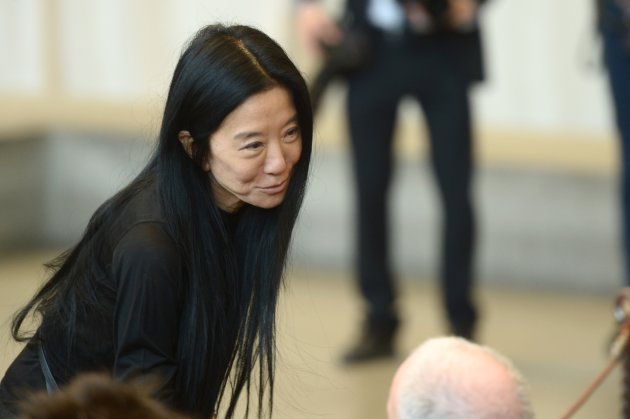
Michael Loccisano/Getty Images
"My bedroom is my sanctuary," the fashion designer told Fortune in 2006. "It's like a refuge, and it's where I do a fair amount of designing — at least conceptually if not literally."
She said staffers send her stuff at home, "and I always read it at
night — the only time when seven people aren't coming to me at once,"
Fortune reported. Buffer CEO Joel Gascoigne walks every evening right before bed.
Buffer
Gascoigne takes a 20-minute walk every evening to allow total disengagement from his work before turning off the lights.
"This is a wind down period, and allows me to evaluate the day’s
work, think about the greater challenges, gradually stop thinking about
work, and reach a state of tiredness," he writes in a blog post. Kenneth Chenault, CEO of American Express, writes down three things he wants to accomplish the next day.
Brian Ach /AP Images for American Express
Before retiring for the night, Chenault says he likes to write down
the top three things he wants to accomplish the next day. This helps him
prioritize first thing the next morning. More from Business Insider:
Like Obama I tend to be a Night Owl ever since I first found Johnny Carson and the tonight show before Tape VCRs were invented around 1960 when I was 12. Though I used to stay up during my late teens and early twenties sometimes to 4 am in the morning writing poetry or music lyrics or prose, now I often will go to bed at literally any time early or late but not usually after 1 am. Being retired can allow a person to move in their natural rhythms of both sleeping at waking more. So, all of a persons functions both bodily, spiritually, and physically might work better. I don't ever get into bed until I'm in such a sleepy biorhythm that I know I'll fall asleep. Otherwise, I will just lay there and never sleep. So, unless I'm really sleepy I find it is best just not to get into bed whatever time it is.
I consider myself to be successful in that I have stayed alive to age 66, have a great wife with 3 college degrees, have enough money now to live to 100 likely or more (as long as the world economy doesn't collapse and stay collapsed for 20 to 30 years or more. But then, we all would be in trouble then wouldn't we?), I have 3 great biological kids all of them either in college or already with College degrees and living their lives all over and traveling the world when they can. I also have two successful step kids now in their early 40s with one or more college degrees each. I also have one grandson that I hope to see for the first time in the next few months as he lives quite far away from me at present. However, I will work on changing that if I can so he lives nearer to me so I can influence his life in a good way growing up. So, likely that would mean them moving or me spending more time where they are.
Mostly, success for me personally isn't about money, it is about having my health at 66 which is quite remarkable for me in my way of thinking. I think almost dying at age 50 for about 8 months helped me have the capacity to live to 100 or more possibly. Here is how it works. If you think you are 18 to 25 and act like that into your 40s and 50s without modifying your behavior at all then sudden death is often a likely outcome because you aren't realizing how your body and mind and brain and heart and emotions are changing. So, unless you can address your physical mortality and address not only your diet, health and behavior then an early death likely will greet you. However, at 66 I still have a KLR 650 dual sport motorcycle that I still ride and I still ski downhill and cross country, hike at least a mile a day with my dogs in the forests and along the ocean, and like to write and compile and quote information here at my blog site to make both my life better and more enriched and yours as well, watch movies with my wife and outside of my kids living all over the place, I'm pretty happy with my life.
Also, now all of them are out of the nest so to speak, I can travel more with my wife and stay young from all the necessary adaptation. Because staying in one place in a rut is going to atrophy most people's minds. So, changing scenery (as long as you don't get too extreme like being in a different country every day the rest of your life, might be useful to your happiness and longevity for your sake, your spouse's sake and your kids sake as well as all the good things you can do for your friends and acquaintances along the way.
Traveling to see people and places you love is often a way to live a really long time if you want to. Exploration and adaptation is often good for the heart, the mind and the soul. As long as your are growing and learning your life can go on and on in amazing ways. By God's Grace!
37 mins ago - Thames Water, the company that keeps sewers flowing freely under London, has released a set of disgusting pictures of a "fatberg" that took a ...
This fatberg in London took a team of workers from Thames Water four days to clear. The mixture of congealed fat, wet wipes and other litter ...
Fatberg took four days to clear under London's streets
2 hours ago
This fatberg in London took a team of workers from Thames Water four days to clear.
The mixture of congealed fat, wet wipes and other litter was washed into drains or flushed down toilets.
Thames Water says the fatberg formed under an 80-metre stretch of Shepherd's Bush Road, as long as commercial plane.
Workers finished removing the dirt last Friday to stop local homes and businesses flooding.
They used high-powered water jets to break up the congealed mass so that wastewater could start to pass through the sewer again.
Dave
Dennis, Thames Water sewer operations manager, said: "We have 108,000
km (62,000 miles) of sewers, and that's a lot of pipe to keep clear.
"We
spend £12 million a year tackling blockages, most of them formed
because people have tipped cooking fats down the drain and wet wipes
down the loo.
"The sewers serve an important purpose - they are not an abyss for household rubbish.
"Fat goes down the drain easily enough, but when it hits the cold sewers, it hardens into fatbergs that block pipes.
He also said wet wipes were a particular problem in sewers.
"Wet
wipes cling to the fat," he said. "Fat clings to the wipes. And pretty
soon your fatberg is out of control and sewage is backing up into roads,
gardens and in the worst cases flooding up through toilets and into
homes.
"We've found all sorts in this sewer - from tennis balls to
planks of wood. It goes without saying they shouldn't be in those
pipes."
Harrow in London has had 13,417 blockages reported in the last five years. Shepherd's Bush has had 68.
Kingston had a 15-tonne fatberg removed from a sewer last year.
Follow @BBCNewsbeat on Twitter and Radio1Newsbeat on YouTube
Melting ice is fuelling sea-level rise around the coast of Antarctica, a new report in Nature Geoscience finds.
Near-shore waters went up by about 2mm per year more than the
general trend for the Southern Ocean as a whole in the period between
1992 and 2011.
Scientists say the melting of glaciers and the thinning of
ice shelves are dumping 350 billion tonnes of additional water into the
sea annually.
This influx is warming and freshening the ocean, pushing up its surface.
"Freshwater is less dense than salt water and so in regions
where an excess of freshwater has accumulated we expect a localised rise
in sea level," explained Dr Craig Rye from the University of
Southampton, UK, and lead author on the new journal paper.
Globally, sea levels are going up, in part because of the
contribution of the world's diminishing ice fields. This is well known.
But the Nature Geoscience report is the first to show the
direct consequences to sea surface height (SSH) around Antarctica
itself.
While the satellite data record indicates there has been a
general upward trend in SSH in the Southern Ocean south of 50 degrees of
up to 2.4mm per year, those satellites also indicate a more rapid rise
in waters sitting on the continental shelf. Mass losses
Modelling by Dr Rye's team suggests that this additional 2mm
per year can be attributed almost exclusively to freshwater runoff from
Antarctica, and not to some climatic oscillation that might make sea
levels "breathe" up and down on decadal timescales.
"We can estimate the amount of water that wind is pushing on
to the continental shelf, and show with some certainty that it is very
unlikely that this wind forcing is causing the sea level rise," Dr Rye
told BBC News.
"And because we can model the freshwater forcing, and the
fact that this is so much more like what we see in the real world, we
can come to the confident conclusion that the signal is driven by
freshwater forcing."
Recent satellite studies have underlined the increased mass losses occurring in Antarctica.
Much of this accelerated ice discharge is occurring in the
continent's western sectors, particularly in the Amundsen Sea Embayment
and along the Antarctic Peninsula.
In contrast to land ice, the sea ice around Antarctica stands at record levels and is becoming more extensive.
The growth is small and very regional in character, but nonetheless significant.
Quite how the freshening of surface waters might be influencing this phenomenon is now a target for study.
"That's a really interesting question which I'd like to look into with further research," Dr Rye said. Jonathan.Amos-INTERNET@bbc.co.uk and follow me on Twitter: @BBCAmos
I Started using this mantra when I first began to meet Tibetan Lamas in Oregon and California in 1980.
This morning as I was waking up I found myself doing this and a very warm feeling came over me as I experienced this statement for all beings in the universe in all time and space.
I realized how great this is to increase one's health and peace this statement. I also realized if someone was having trouble sleeping these days of turmoil on earth that this statement might bring peaceful sleep to you.
I sort of see the problems in the world as speed bumps on a road when driving a car, motorcycle or bicycle.
If you pretend those speed bumps aren't there and hit them at 70 mph in your car or motorcycle you are going to go off a cliff or be in a tree with your car and likely not live through them.
However, if you are aware of them you slow down your vehicle so you don't die from hitting them.
So, whether it is overpopulation, Global Climate change caused by overpopulation, people freaking out and becoming sociopaths from the stress of all this or becoming serial killers like ISIS members, you can begin to deal with all the craziness on earth now. You don't have to be a victim to it, but you can navigate through it and around it with your finances and your life and health. You don't have to die or get freaked out by it. But, you do have to slow down your car and realize it is what it is.
People who die from these things often don't see it coming and get caught in it through ignorance of the truth.
You don't have to get caught with your pants down. You can take control of your lives and slow down for the speed bumps before you are dead.
You may witness many people in the news hitting the speed bumps at 70 to 100 mph and think to yourself, "God Bless them" they didn't have a chance. But, you and I have a chance and can pray for them and try to make good decisions so our lives are not eventually destroyed by the mistakes others are making now.
"May all beings attain Bliss and the Cause of Bliss"
"May all being be free from suffering and the cause of suffering"
"May all beings never be without the Supreme Bliss that is free from all near and far
all Grasping and aversion"
if you also want the Tibetan Buddhist ending it is:
By this Merit may I become like the Buddha's and Bodhisattvas of the ten directions and the three times."
(the ten directions allow one to navigate all space, the three times allow one to navigate the past, present and future of the universe).
Pro-democracy
lawmakers display placards against Li Fei, deputy secretary general of
the National People's Congress' Standing Committee, during a briefing
session in Hong Kong Monday, Sept.
Protesters switched on their cellphones at a rally in Hong Kong on Sunday night after China curbed election reforms in the city.Credit
Bobby Yip/Reuters
The
decision by the National People’s Congress Standing Committee drew
battle lines in what pro-democracy groups warned would be a deepening
confrontation over the political future of the city and of China. The
committee demanded procedural barriers for candidates for the city’s
leader that would ensure Beijing remained the gatekeeper to that
position — and to political power over the city.
Li Fei, a deputy secretary general of the committee, told a news conference in Beijing that the nominating guidelines
— including a requirement that candidates “love the country, and love
Hong Kong” — would “protect the broad stability of Hong Kong now and in
the future.”
The
move closes one of the few avenues left for gradual political
liberalization in China after a sustained campaign against dissent on
the mainland this year under President Xi Jinping. In pressing its
offensive in Hong Kong, Beijing has chosen a showdown with a protest
movement unlike any it has ever faced on the mainland.
Photo
A protester in Hong Kong held a placard reading, “Communist Party, you lie!” at a rally attended by several thousand people.Credit
Bobby Yip/Reuters
Hong
Kong’s opposition forces enjoy civil liberties denied in the rest of
China and, capitalizing on those freedoms, have taken a more
confrontational approach than seen before in Hong Kong.
They
said the limits set by Beijing for selection of the city’s leader, the
chief executive, made a mockery of the “one person, one vote” principle
that had been promised to Hong Kong.
“After
having lied to Hong Kong people for so many years, it finally revealed
itself today,” said Alan Leong, a pro-democracy legislator. “Hong Kong
people are right to feel betrayed. It’s certain now that the central
government will be effectively appointing Hong Kong’s chief executive.”
Occupy Central,
the main Hong Kong group advocating open elections, said it was
planning civil disobedience protests in the city’s commercial heart.
Several thousand people turned out for a rally opposing Beijing’s plan
on Sunday night.
Photo
Benny Tai, right, co-founder
of the Occupy Central movement, rallied democracy activists next to the
Hong Kong government complex on Sunday.Credit
Alex Ogle/Agence France-Presse — Getty Images
“We
are no longer willing to be docile subjects,” Benny Tai, a co-founder
of Occupy Central and an associate professor of law at the University of
Hong Kong, told the crowd. “Our hope is that people gathered here will
be dauntless civil resisters. What is our hope? Our hope is that today
Hong Kong has entered a new era, an era of civil disobedience, an era of
resistance.”
Other
groups were also preparing to protest, and the Hong Kong Federation of
Students urged university students to boycott classes.
Beyond
their consequences for this former British colony of 7.2 million
people, the tight reins on Hong Kong politics reflect a fear among
leaders in Beijing that political concessions here would ignite demands
for liberalization on the mainland, a quarter-century after such hopes
were extinguished at Tiananmen Square in 1989.
“They
are afraid that caving in to Hong Kong would show weakness,” Minxin
Pei, a professor of government at Claremont McKenna College in
California, said in a telephone interview. “They believe that political
weakness will encourage Hong Kong to demand more and will give opponents
of the party’s rule in China great confidence to challenge the party.”
Photo
People gathered in Hong Kong on Sunday to protest election limits imposed by China.Credit
Alex Ogle/Agence France-Presse — Getty Images
Since
taking leadership of the Communist Party almost two years ago,
President Xi has orchestrated intense campaigns in China against
political dissent and demands for competitive democracy, civil society
and a legal system beyond party control. But Hong Kong presents special
challenges.
Advocates
and opponents of political liberalization alike have seen Hong Kong as a
potential incubator for change in China since it was returned to
Chinese rule in 1997. Since then, the territory has had considerable
autonomy and retained a wealth of Western-style freedoms under an
arrangement known as “one country, two systems.”
“China’s
two most important cities are Beijing and Hong Kong,” Hu Jia, a
prominent dissident in Beijing, said in a telephone interview on Sunday.
He said he had been placed under house arrest, like other dissidents,
before the National People’s Congress announcement.
Photo
Protesters in the Occupy Central movement outside the Hong Kong government complex on Sunday.Credit
Lam Yik Fei/Getty Images
“In
the territory controlled by the Chinese Communist Party, only Hong Kong
has some space for free speech, some judicial independence, so it is a
mirror for people on the mainland,” he said. “The outcome of this battle
for democracy will also determine future battles for democracy for all
of China.”
Chinese
officials have accused Hong Kong’s democracy groups of serving as tools
for subversion by Western forces seeking to chip away at party control.
Mr.
Li, the legislative official, on Sunday accused them of “sowing
confusion” and “misleading society” by arguing that elections for the
chief executive should follow international standards. “Each country’s
historical, cultural, economic, social and political conditions and
circumstances are different, and so the rules formulated for elections
naturally also differ,” he said.
Under
current law, the chief executive is chosen by an Election Committee,
whose approximately 1,200 members are selected by constituencies
generally loyal to Beijing and the city’s business elite.
Photo
A storm front moved over Hong
Kong on Sunday as protesters began gathering before China’s legislature
announced its decision on suffrage in the territory.Credit
Alex Ogle/Agence France-Presse — Getty Images
According
to the Chinese legislature’s proposal, the leader would be chosen by
popular vote starting in 2017, as promised, but candidates would first
have to win an endorsement from at least half the members of a
nominating committee. The composition of that committee would be based
on that of the current Election Committee, according to the decision,
announced at Beijing’s Great Hall of the People.
Mr.
Li said that the existing committee was already “broadly
representative” of the Hong Kong electorate, and so would furnish the
right basis for a nominating committee in future elections, an assertion
that Hong Kong democrats have roundly rejected. Democracy advocates
expect that the new committee, like the existing one, will exclude
candidates seen as unfavorable by Beijing.
Its
composition would ensure “that democrats have no chance of getting
nominated,” said Michael Davis, a law professor at the University of
Hong Kong. In fact, he said, it would raise the bar. Candidates have to
win only one-eighth of the support of the current committee but would
have to win 50 percent under the new guidelines. “As far as I can see,
the government has no capacity to offer a deal the democrats will take
in this,” he said.
The
Chinese government fears that direct nominations would allow candidates
hostile to Beijing, and it has said direct nominations would also
contravene the Basic Law, the document governing Hong Kong’s
relationship with the mainland. The People’s Daily, the main newspaper
of the Chinese Communist Party, said in an editorial on Monday that
“nobody who is antagonistic” to the central government should ever be
allowed to become chief executive.
Photo
From left, Edward Chin,
organizer of Financial Professionals for Occupy Central, Benny Tai,
co-founder of the Occupy Central movement, and the activist Bob Kraft
addressed members of the news media at a protest outside government
offices in Hong Kong on Friday.Credit
Alex Ogle/Agence France-Presse — Getty Images
But C. Y. Leung, Hong Kong’s current, pro-Beijing chief executive, said killing the bill would also kill universal suffrage.
“Five
million Hong Kong people would be deprived of the voting right that
they would be otherwise entitled to,” he said. “We cannot afford a
standstill in our constitutional development or else the prosperity, or
stability, of Hong Kong will be at stake.”
The clash in Hong Kong will be more about winning over public opinion than winning control of the crowded streets. Opinion polls
show that most Hong Kong citizens support the demand for “unfiltered”
electoral choice, but also that many have qualms about possible
disruption from protests.
On
the main campus of the University of Hong Kong on Monday, there were
mixed views about the wisdom of a student strike, but considerable
support for the idea.
“Going
on strike would be a sensible way to show our concern,” said Echo Lo,
an architecture student. “ If we don’t do anything, they’ll say that we
don’t care.”
But
others were warier. “The decision of the central government was a bit
tight, with no negotiation,” said Terrence Tang, a masters student in
economics. “But I also agree that any country must take care of its
security. It’s difficult because Hong Kong is so special.”
The Chinese government and the Hong Kong political establishment have accused Occupy Central and allied groups of recklessly imperiling the city’s reputation
for political stability and support for business. And many ordinary
Hong Kong residents have voiced worry about any political conflict that
could hurt their livelihoods.
Occupy
Central says it will engage in nonviolent civil disobedience to avoid
major disruption. Its organizers have said that they do not plan to
plunge into mass protests immediately.
“We’re
not making threats, we’re just sending warning signals,” said Mr. Tai,
the group’s co-founder. “The house is on fire, something has to be
done.”
Alan Wong contributed reporting from Hong Kong, and Patrick Zuo contributed research from Beijing.
A version of this article appears in print on September 1, 2014, on page A1 of the New York edition with the headline: China Restricts Voting Reforms for Hong Kong. Order Reprints|Today's Paper|Subscribe