From the Democrats point of view this isn't about Trump at all on one level. It is about the Lewinsky Affair. When Special Counsel Star couldn't get anything on Whitewater (because there wasn't anything) he settled on an affair with Monica Lewinsky in which there was not even penetration which seemed sort of ridiculous at the time because according to the way Clinton was taught you cannot be an adulterer unless there was penetration.
So now, with Trump there was consentual penetration of Stormy Daniels a adult film star (prostitute) that was according to her consentual and for which she was paid 130,000 dollars by his lawyer Cohen and all this happened either during the birth of Trump's latest son Barron or just after his birth which is what makes this an even more bitter pill for Trump (for any of you that are married for example would know about this).
But, from my point of view on one level it isn't about Trump at all it is about revenge for the Monica Lewinski affair and what Kenneth Star did to President Clinton while he was in office. However, I believe Clinton was re-elected after this to a 2nd term. So, people should watch out what they wish for because if Trump gets in it will be the NAZI states of America instead of the United States of America like it is now!
So, if Melania asks for a divorce with a Golden parachute after all this blows over don't be surprised. However, since she comes from a Country behind the Iron Curtain sometimes women in those countries are made of tougher stuff and she might take it out (in blood) upon Trump especially as he ages into senility. So, what I'm saying here is that Trump has NOTHING to look forward to at all regarding Melania, especially after this. This case will likely put Trump in a "LIVING HELL" at home the rest of his life no matter how this legally turns out.
And no one knows how Crazy or enraged Trump will get because of all this.
Because he could get much more crazy and violent and inciting violence much more than he has so far.
Almost anything could happen at that courthouse when I look into the future tomorrow and the rest of this week as an intuitive. The place on an astral level is like a black hole that could suck everyone into it who is there with no one coming out of this thing alive there. It's a really weird karmic place for anyone to be right now (sort of like Ukraine) if you know what I mean.
Another thing is that: "Who did Trump show those incredibly sensitive 100 documents too. Leaders of other countries? Corporate Heads? Trump Donors? And how much insider Trading etc. has been done from what he leaked to powerful people around the world? How many hundreds or thousands of people's deaths is Trump responsible for for what he did around those 100 different secret reports and documents.
And how many people whose relatives have died because of what he did want revenge on Trump right now?
These are all things to think about this week.
Because the most vindictive of all people (at least on a Physical or gun or bomb level are not the Democrats who are seldom armed to the teeth like extreme rightests almost always are.
So, for the real violence against Trump it isn't going to come from Democrats it is going to come from Far Right Republicans whose relatives are in jail or dead because of January 6th or some other Damn stupid thing Trump is responsible for overseas that got their relatives killed for no good reason.
This is something to be aware of this week.
Because this is what I worry the most about repeating itself is the Oklahoma City Government building Bombing by Timothy Mc Veigh where 168 people died and 680 were injured. This is what I worry the most about if the whole building goes up to a bomb somewhere. This is the scariest thing so far I'm picking up as an intuitive. All the rest is child's play compared to this sort of thing.
The bombing of the Alfred P. Murrah Federal Building in Oklahoma City on April 19, 1995 was the deadliest act of homegrown terrorism in U.S. history, resulting ...
The Oklahoma City bombing was a domestic terrorist truck bombing of the Alfred P. Murrah Federal Building in Oklahoma City, Oklahoma, United States, ...
Murrah Federal Building in downtown Oklahoma City, killing 168 people and injuring approximately 850. The governor's office reported that thirty children were ...
The Oklahoma City bombing
occurred when a truck packed with explosives was detonated on April 19,
1995, outside the Alfred P. Murrah Federal Building in ...
Mar 11, 2023 — Oklahoma City bombing, terrorist attack in Oklahoma City, Oklahoma, U.S., on April 19, 1995, in which a massive homemade bomb composed of ...
Oklahoma City Bombing:
California Sent its Best to Midwest Terror Response ... On April 19,
1995, a yellow moving truck parked in front of the Alfred P. Murrah ...
On April 19, 1995, an explosion destroyed the Alfred P. Murrah Federal Building in Oklahoma City, Oklahoma, resulting in the deaths of 168 people. A massive ...
by T Victims — of the Oklahoma City bombing in the investigative and prosecutorial phases of the criminal justice system. The opinions, findings, and con-.
The
Oklahoma City bombing was a domestic terrorist truck bombing of the
Alfred P. Murrah Federal Building in Oklahoma City, Oklahoma, United
States, on April 19, 1995. It was the deadliest act of terrorism in U.S.
history until the September 11 attacks in 2001 surpassed it.Wikipedia
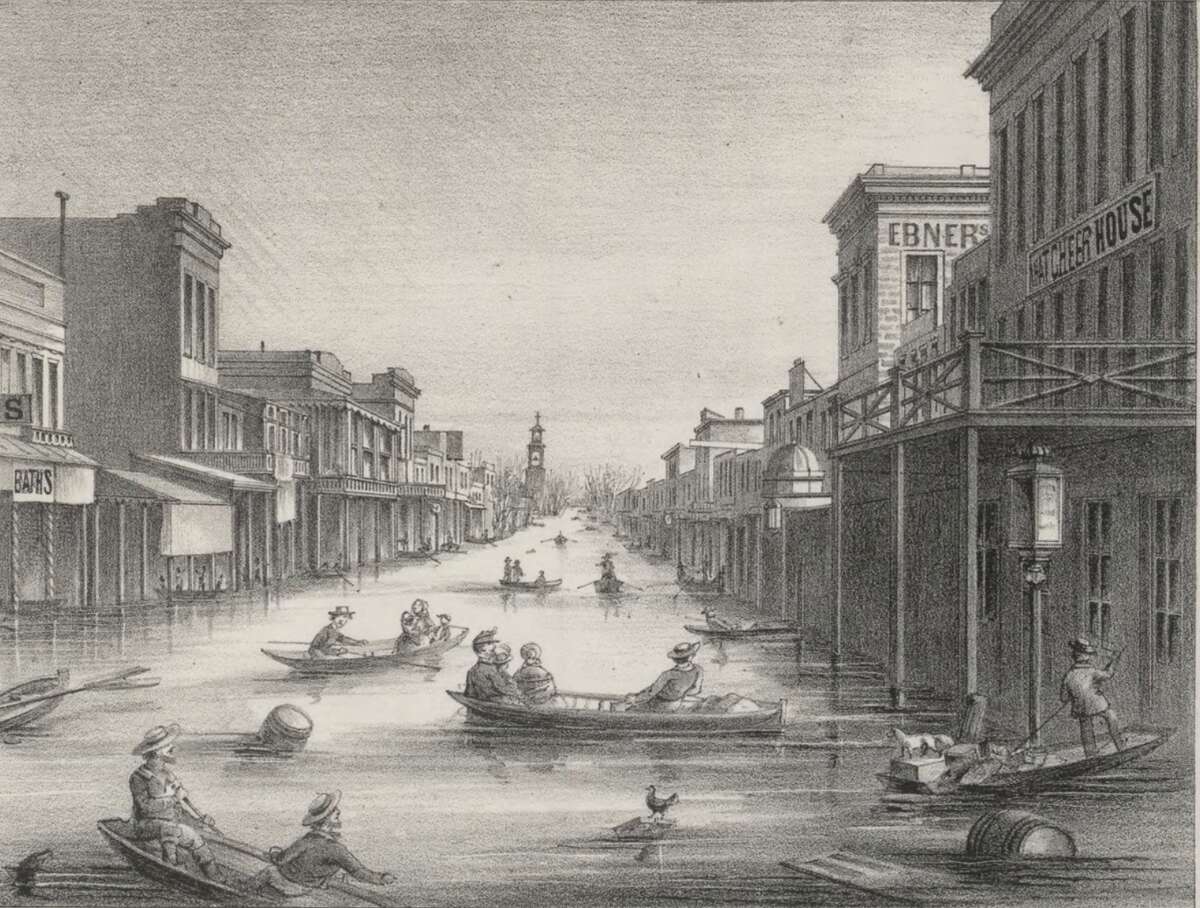
An illustrated view of Sacramento's K Street during catastrophic flooding in January 1862.
UC Berkeley Bancroft Library/Courtesy
Like every day that month, it was raining when Leland Stanford awoke on the morning of his inauguration.
The storm pounded the roof of his Sacramento mansion
as the soon-to-be California governor dressed in a neat black suit and
ate a leisurely breakfast. A scan of the morning’s newspaper brought
only troubles: Californians bitterly split between Union and
Confederacy, and reports of floods in every corner of the state.
Normally,
Stanford could walk the short distance to the brand-new state Capitol
building. But that day, Jan. 10, 1862, only the most intrepid or
desperate soul would try. So Stanford got into a rowboat and floated,
wave upon wave, to the Capitol.
Two weeks later, the waters still rising, the entire California Legislature packed up and fled to San Francisco.
“Nearly every house and farm over this immense region
is gone. America has never before seen such desolation by flood,” one
local wrote in a letter to family back east. “... Many houses have
partially toppled over; some have been carried from their foundations,
several streets (now avenues of water) are blocked up with houses that
have floated in them, dead animals lie about here and there — a dreadful
picture.
“I don’t think the city will ever rise from the shock, I don’t see how it can.”
---
Californians live with the specter of the Big One, but many don’t realize “The One” may not be an earthquake.
One hundred and sixty years ago, the biggest flood in
modern history wiped out California: 4,000 dead, one-third of all
property destroyed, a quarter of the state’s 800,000 cattle drowned or
starved. California went so utterly bankrupt that its governor,
Legislature and state employees didn’t draw a paycheck for 18 months.
The newly installed telegraph system fizzled, just the tops of its poles
visible under feet of water, and roads were impassable. Eggs cost $3 a
dozen (that’s $79 adjusted for inflation, if you thought today’s supply
chain issues were bad).
The catastrophe began with a snowstorm in the Sierra.
In early December 1861, upwards of 15 feet of snow fell in California’s
eastern mountains. What followed, modern National Oceanic and
Atmospheric Administration researchers believe, was a series of
atmospheric rivers. For 40 days, they kept coming, bringing warm rain
and high winds. All of the fresh Sierra snow melted, turning frozen
creeks into raging rivers as the water poured downstream.
The disaster struck the Sierra towns first. As rivers
overflowed their banks, the churning floodwaters devoured everything in
sight. Every last bridge in El Dorado County washed away, taking with
it ferry boats and mills. Several towns disappeared overnight. Chinese
immigrants, who were already banished to living in the worst parts of
town, were disproportionately affected. Entire communities drowned in
minutes, a fact met with characteristic callousness by white
publications.
"The Folsom Telegraph thinks that those journalists
who have centered many of their energies against Chinese immigration
ought to be shocked at the superiority of water over their spirit in
decreasing the 'Chinese nuisance,'" the paper joked, "for it is not to
be doubted that two or three thousand Chinamen have perished in
California since the commencement of the present rainy season."
After weeks of rain, the earth could absorb no more.
Water began pooling on every surface, destroying roads, seeping into
homes and smothering flora and fauna. Sacramento to the San Joaquin
Valley — a distance 300 miles long by 20 miles wide — was completely
underwater. In the Central Valley, flooding was up to 30 feet deep.
"From the Sierra Nevada to the Coast Range is apparently one sheet of
yellow rippling water,” the Marysville Appeal wrote.
Flooding is seen in Yuba County during the 1860s.
Yuba County Library/Courtesy
To the north, snowmelt and rain combined to sweep through
the burgeoning settlements near present-day Redding. "From the head
settlement [Weaverville] to the mouth of the Trinity River, for a
distance of one hundred and fifty miles, everything was swept to
destruction,” historian John Carr recalled in his 1891 book “Pioneer
Days in California.” “Not a bridge was left, or a mining-wheel or a
sluice-box. Parts of ranches and miners' cabins met the same fate. The
labor of hundreds of men, and their savings of years, invested in
bridges, mines and ranches, were all swept away.
“In forty-eight hours the valley of the Trinity was left desolate.”
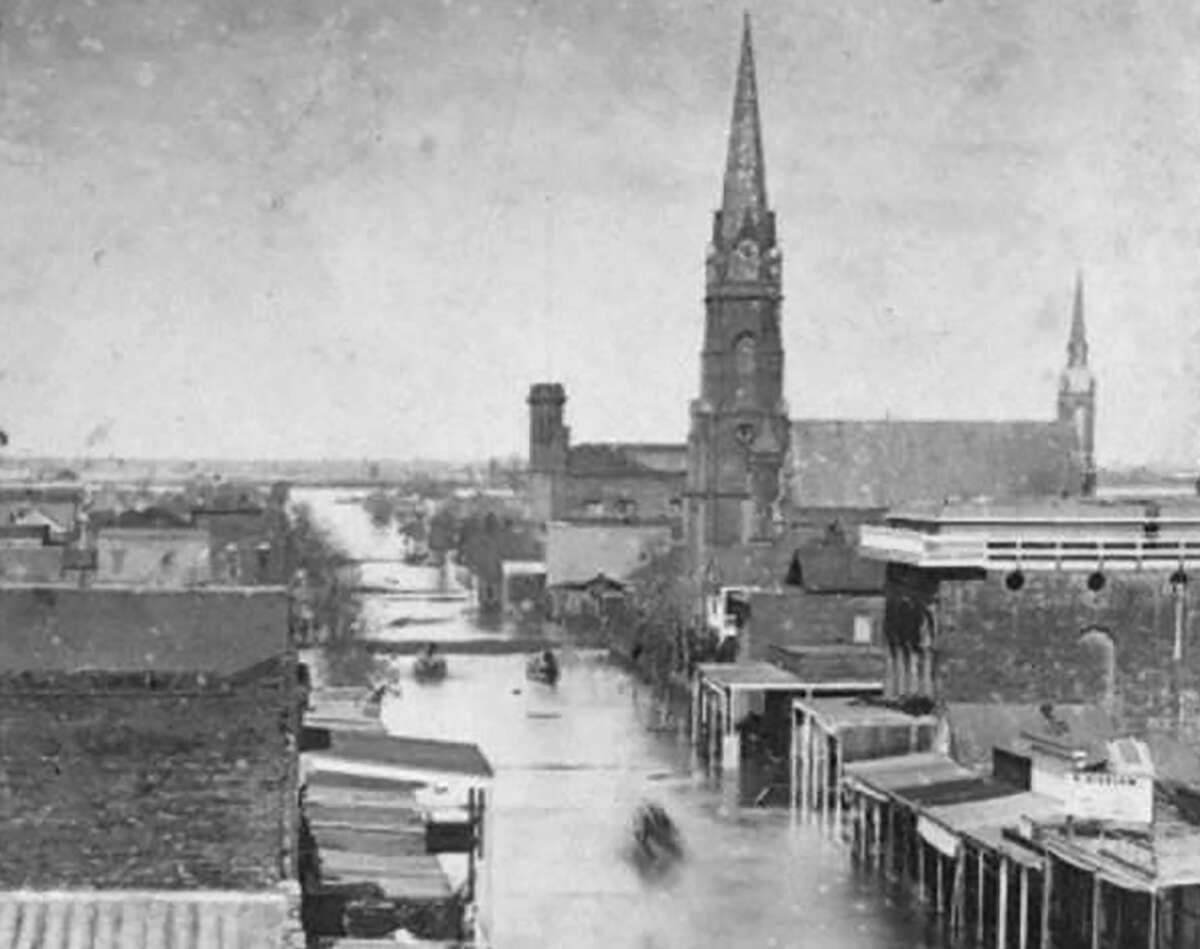
Conditions were equally bad in Sacramento. The town
was no stranger to floods; nestled in the confluence of the Sacramento
and American rivers, the area flooded almost every year. But this was
unlike anything residents had ever seen. A levee, built to keep water
out, proved to be too short for the catastrophic storm. Water first
poured in, then it stayed, turning Sacramento into a watery punch bowl.
The first floors of just about every home and building in town were
inundated. Sidewalks ceased to exist. The only viable method of
transportation for weeks was rowboat.
Those who survived next
faced starvation as livestock, farms and trade disappeared overnight.
Many stubborn farmers, with nothing left but the plot of land somewhere
beneath their feet, refused to leave. The Butte Democrat told the tale
of one such man, who was seen holding his beloved pet bulldog above his
head as the floodwaters raged around him. Finally, as the water began
lapping the man’s armpits, a rescue boat was able to reach him. He
gently nestled his dog in the boat before clambering in himself. After
thanking his rescuers, he mused aloud, “I wonder what has become of my
wife and children.”
There was some respite, relatively speaking, in the
Bay Area. Although the deluge overtook nearly every community there too,
the impact was not as prolonged. The state legislature briefly
relocated to San Francisco, which saw the upside to its many hills for
the first time. From this lofty perch, they witnessed life slow to a
halt. "Rails, portions of fences, gates, lumber, saw logs, everything
buoyant enough for the greedy water may be seen passing downstream,” the
Napa Daily Reporter wrote.
A man named L.H. Powell recalled his journey from San
Jose to San Francisco. It took 36 hours to navigate the sodden roads.
As he went, he saw bodies floating past him in the swollen creeks. He
stopped, he said, to retrieve the body of a boy and leave it where his
parents might find him.
---
When the waters receded — which in some parts of
California wasn’t until the summer — the state was forever changed. A
quarter of the economy had been destroyed in the course of a month, and
more than $3.1 billion in damage had been done (dwarfing the $235
million in damage from the 1906 earthquake over 40 years later).
“Confidence in the future is gone,” the Placer Herald
wrote. “... Build our Babylonian town as high as we may, the Heavens
are yet above and beyond us.”
But Californians were a hearty bunch, a self-selected
group who braved brutal ocean passages or deadly overland crossings to
begin new lives in the West. Accustomed to starting over, the survivors
rebuilt homes, roads and farms. Some settlements, like Empire City and
Mokelumne City, became ghost towns. The ranchos, once California’s
dominant economic system, finally unraveled, and the remaining massive
cattle farms were broken into smaller parcels.
If a flood of this proportion seems like a problem of the past, heed this warning: Scientists believe California is overdue for another one.
Sediment studies by the U.S. Geological Survey have shown California
tends to flood this badly every 100 to 200 years. The Indigenous peoples
of the West also had stories of catastrophic floods in their histories.
When the rain wouldn’t stop in 1862, newspapers noted Native Americans
weren’t surprised; their oral tradition told them such an event was not
uncommon in California history.
Though the past holds warnings, it also holds hope.
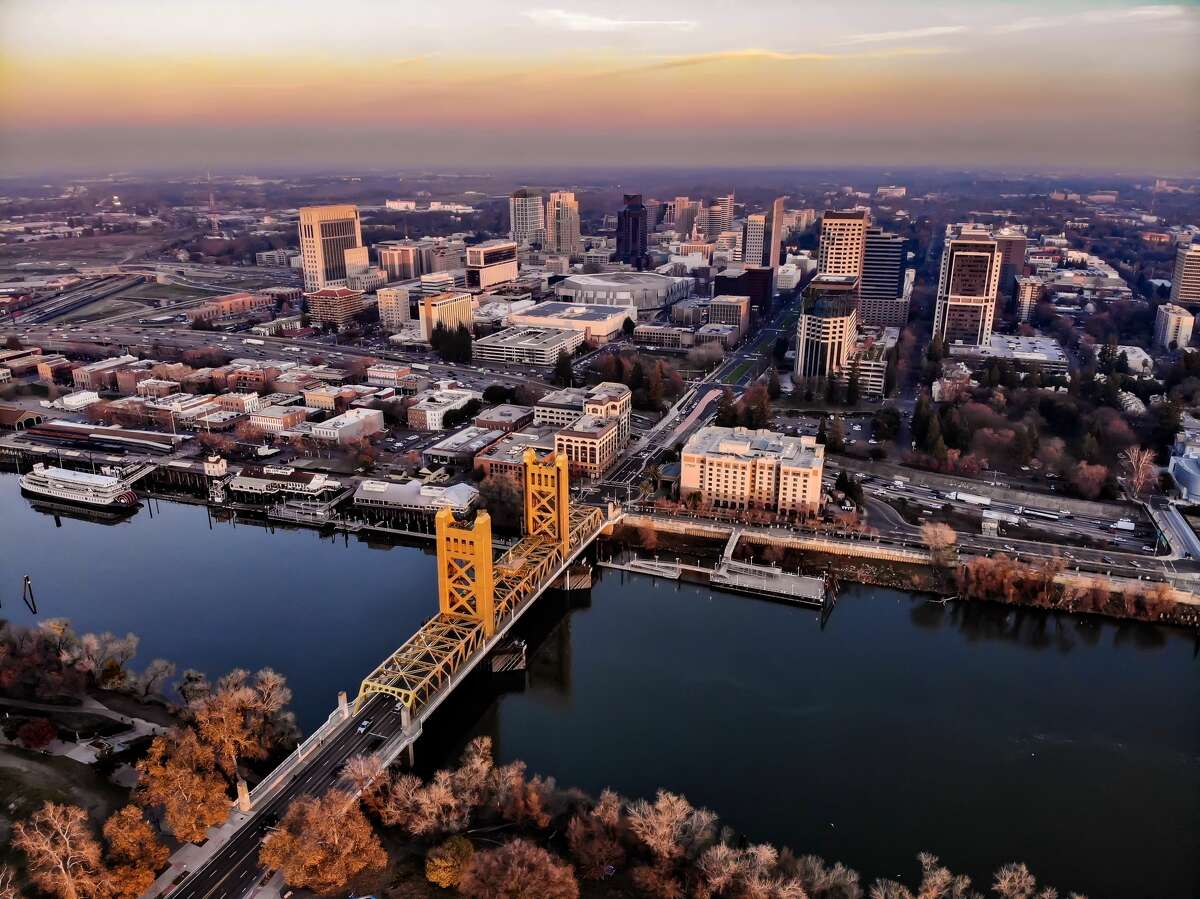
Sacramento, set between the Sacramento and American rivers, was beset by flooding constantly in the 1800s.
Brandon Williams/Getty Images/iStockphoto
In the aftermath of the great flood, Sacramento decided
to boost up the entire town. Over the course of the next decade, every
business and home in the flood zone rebuilt up to 10 feet higher. Some
did this by adding landfill, others jacked up existing buildings and
many just turned their first floor into a basement.
"The system of raising its buildings has its
advantages," Mark Twain quipped in 1869. "It makes the floor shady and
this is something that is great in such a warm climate. It also enables
the inquiring stranger to rest his elbows on the second-story windows
and look in and criticize the bedroom arrangements of all the citizens."
Today, Sacramentans walk over the skeleton of their city. If you want a glimpse at what remains, you can book a tour with the Sacramento History Museum,
which takes visitors down into the old alleys and buildings. But even
from street level, you can still see one vestige of the flood
renovations: colorful glass squares dotting the old town sidewalks. At
first glance, they seem decorative, but if you view them from below,
their purpose becomes clear. They’re pretty little skylights, bringing
sunshine down into the former living rooms of Sacramento.
This was the first really beautiful day of the year that I have been here visiting so far. Most other days have not been like this one. A really beautiful day! My daughter drove me down to the beach near the Santa Barbara Pier and to a Sushi restaurant with a view of the pier there. Then she drove me up into the hills with an incredibly beautiful view of the whole city too. Amazingly beautiful day in Santa Barbara!