Friday, November 30, 2018

If you have ever been in a really large Earthquake: PTSD can be a problem

I was listening to a reporter on TV tell her story of being about 10 years old in the Northridge quake in California and not being able to sleep for a year after this happened to her.

I am grateful this wasn't my experience. MY worst earthquake luckily happened when I was already 23 years old in 1971 in southern California.

This was the San Fernando Valley earthquake:
The 1971 San Fernando earthquake (also known as the Sylmar earthquake) occurred in the early morning of February 9 in the foothills of the San Gabriel Mountains in southern California.

People also ask

Web results

The 1971 San Fernando earthquake (also known as the Sylmar earthquake) occurred in the early morning of February 9 in the foothills of the San Gabriel Mountains in southern California.
Local date‎: ‎February 9, 1971
Duration‎: ‎12 seconds
Max. intensity‎: ‎XI (Extreme)
Landslides‎: ‎1,000+
Earthquake · ‎Surface faulting · ‎Damage · ‎Transportation

But, for some reason today I felt myself sort of going into shock along with the Alaska folks who are living with this initial shock of 7.0 combined with aftershocks many times above 6.0 which is still a pretty strong shaking and will throw pictures off the wall and glasses and glassware and silverware off the table.

A Man today said something useful about earthquakes. He said, "Just imagine the worst shaking you have ever felt on a plane and that's what an earthquake is like from about a 6.0 to an 8.0 or 9.0.

But, the difference is in the plane you usually have a seat belt on and in an Earthquake you don't so you are being hit with debris from the ceiling and off of walls and hopefully your ceiling doesn't collapse on you or a window doesn't blow out and cut you. 

So, today the rains have stopped (at least for today) and so I got up and swept all the pine needles and other debris from the rain off my deck to try to gather my wits after being triggered in a PTSD way by the Alaska Earthquake which (For whatever the reason) took me back to 1971 when I thought I was going to die in the 1971 earthquake. It was about the same size at this one with similar damage to southern California then.

The other quake that scared me but I didn't think I was going to die was a 5.0 in Orange County when I was visiting my cousin. My then 5 year old daughter was in a pool swimming on a float and a 5.0 earthquake suddenly hit. I ran out scared to death for my daughter in the pool during an earthquake and told her to swim to the center of the pool. She asked me why the water was going out of the pool and sloshing in all directions including a foot of water coming over my feet near the pool. I told her it was an earthquake and she needed to stay in the center of the pool so she wouldn't be thrown against the side of the pool and be knocked out against the hard edge of the pool. Luckily the pool was big enough so she was safe doing this.
My daughter is now 22 so this is a while ago now.

The point being that if you live anywhere from Southern California like I did in 1971 and still do to Alaska you need to prepare for this sort of thing because it isn't IF it is only When you will be in something like happened today in Alaska.

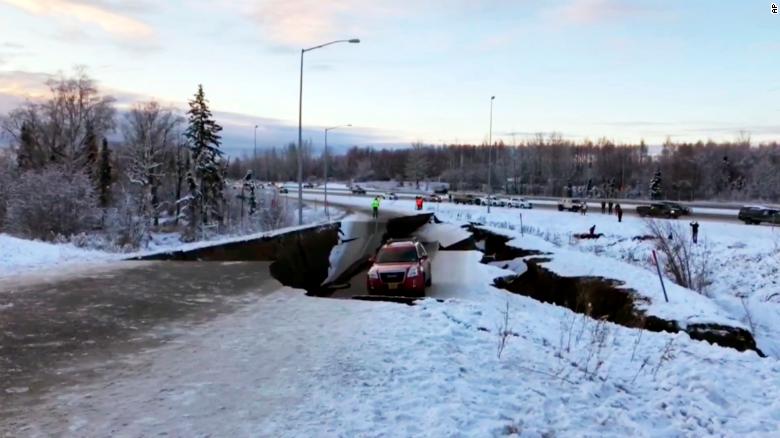
7.0 earthquake strikes Alaska: destroys many roads and infrastructure

  • begin quote from:
  • 3 min ago

    Earthquakes common in Alaska, says United States Geological Survey

    Earthquakes are common in this region, says the United States Geological Survey. Over the past century, 14 other earthquakes of 6.0 magnitude and above have occurred within 150 km (93.2 miles) of the earthquake that hit this morning near Anchorage.
    Two such earthquakes -- a 6.6 magnitude quake in July 1983 and a 6.4 magnitude quake in September 1983 -- seem similar to today's earthquake.
    They were at similarly shallow depths, and caused damage in the region of Valdez, east of Anchorage.
    The biggest earthquake that has hit Alaska was a 9.2 magnitude giant in March 1964, an interface thrust faulting earthquake that ruptured over several hundred kilometers between Anchorage and the Alaska-Aleutians trench, and to the southwest.
    17 min ago

    Alaska resident: Earthquake was "the most violent" in 37 years

    "I have been here 37 years and that was the most violent earthquake I have ever felt. It was absolutely terrifying," Kristin Dossett, a resident of Palmer, Alaska, told CNN.
    "It shook like I have never felt anything shake before. It just didn't stop. It kept going and got louder and louder, and things just fell everywhere — everything off my dressers, off my bookcases, my kitchen cupboard. Just broken glass everywhere."
    Dossett described aftershocks rattling the house and causing things to fall over. Her piano moved a foot and a half from the wall during a particularly strong aftershock.
    "You get a little scared because you don't know how big it's going to be," she said.
    Hear her describe the moment:
    27 min ago

    Attorneys scramble under desks in Anchorage courthouse, video shows

    Video from the Nesbett Courthouse in Anchorage showed attorneys jumping under their desks, paintings swinging on the walls and pieces of the ceiling dropping to the floor as the earthquake hit.
    17 min ago

    Seismologist to Alaskans: Expect aftershocks for months, maybe years

    Aftershocks are expected after this morning’s Alaska quake, according to Dr. Lucy Jones, a seismologist with the California Institute of Technology.
    She says the average sequence of aftershocks for a quake this size is a 5.8, but that it could be larger than that average figure. She advises to expect many more aftershocks from today’s event.
    ”We think the number dies off with time, but the relative distribution from large to small is constant,” and weeks to months later, aftershocks will follow, she explains.
    For example, the last 5-magnitude aftershock that followed the 1994 Northridge, California, quake was three years after the original event.
    There have been at least 15 aftershocks so far for this quake.
    Dr. Elizabeth Cochran of the United States Geological Survey says the Anchorage quake was a “normal faulting event” among plates under Alaska.
    48 min ago

    Map shows where Alaskans felt the earthquake — and how strong it was

    CNN meteorologist Allison Chinchar just walked viewers through a map that shows where Alaskans felt the shaking — yellow in the video below represents "strong" and orange "very strong" or "severe."
    A big concern for the area near the epicenter is what's called liquefaction, a process where the soil becomes saturated with water, which can cause it to erupt into torrents and topple buildings and destroy roads.
    Even in downtown Anchorage, a lot of the coastal regions are at significant risk for the potential for that liquefaction to take place, according to Chinchar.
    Watch below: Latest updates on Alaska damage
    22 min ago

    Home camera captures the moment the earthquake hit

    Eric Nelius's home camera caught the earthquake on film as it hit his home in Fairbanks, Alaska — almost 350 miles from the earthquake's epicenter in Anchorage.
    In the video, Nelius' wife rushes to grab her children and dogs as the walls begin shaking and a loud rumbling fills the air.
    The family is now safe, though their possessions sustained some damage.
    Watch it here: