Dallas Zoo’s missing tamarin monkeys were found in a closet, and
investigators still want to find photographed man, police say
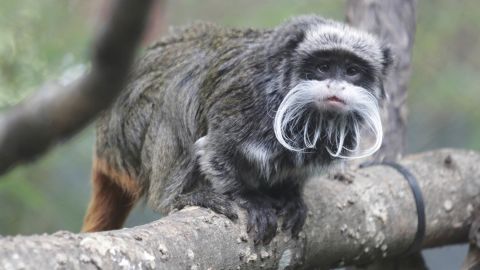
This photo provided by the Dallas Zoo shows an emperor tamarin monkey that lives at the zoo.
Dallas Zoo via AP
CNN
—
Two emperor tamarin monkeys missing from the Dallas Zoo were found
in the closet of an abandoned home in a suburb south of Dallas after
investigators received a tip, police said Tuesday.
“Dallas police received a tip the monkeys may be at an abandoned
home in Lancaster,” the department said Tuesday evening. “Dallas police,
with Lancaster police, went to the home and the home was empty and the
monkeys were found in a closet.”
The monkeys were thought to have been stolen Monday, the zoo said earlier.
Ad Feedback
“We are thrilled beyond belief to share that our two emperor
tamarin monkeys have been found,” the zoo said in a statement earlier.
Police “called our team to come secure and transport the tamarins back
to the Zoo,” the zoo said.
Police earlier tweeted a photo of
a man they said they wanted to speak to in connection with the animals’
disappearance. Investigators still want to speak with that man, Dallas
police spokesperson Kristin Lowman told CNN Tuesday night.
Police have not elaborated about why they want to speak to the man, and no arrests have been made.
Lancaster is a city roughly a 15-mile drive south of the zoo.
The monkeys will be evaluated by veterinarians Tuesday evening, according to the zoo.
Dallas police earlier said its preliminary investigation found the
emperor tamarin monkeys’ habitat had been intentionally cut open and
“it is believed the animals were intentionally taken from the
enclosure.”
On Tuesday – before they announced the monkeys were found – they released surveillance video and a photo of an unidentified man they wanted to speak to about the case.
In the surveillance video, the man can be seen walking slowly down
a nearly empty zoo sidewalk, looking back and forth as he moves. A
second person also can be seen in the background, but that person walks
in the opposite direction.
In the still image, the man is wearing a navy blue hooded
sweatshirt and a navy and red beanie cap and is eating a bag of Doritos.
Dallas police asked for the public's help in identifying this person.
Dallas Police Department
The investigation comes after a series of suspicious animal incidents this month at the Dallas Zoo.
The zoo said it believed two of its emperor tamarin monkeys were stolen
after they were discovered missing from their enclosure Monday.
“Emperor tamarin monkeys would likely stay close to home - the Zoo
searched near their habitat and across Zoo grounds and did not locate
them,” the zoo said in a statement Monday.
Earlier Monday, the zoo said it would be closed for the day due to inclement weather. The closure was later extended through Wednesday due to an ice storm impacting the area, the zoo said.
This was 4th time zoo discovered possible tampering this month, it says
This is the fourth time this month that the zoo has discovered its
animals or their enclosures may have been tampered with, including the “unusual” circumstances surrounding the death of a vulture last week, according to the zoo.
The string of events began January 13 when a clouded leopard named Nova disappeared,
prompting the zoo to close as they searched for the animal. Dallas
police opened a criminal investigation after it was discovered that the
fence around Nova’s enclosure had been “intentionally cut,” police said.
While the feline was found close to her habitat later that day, zoo personnel also found a similar cut had been made to the enclosure of some langur monkeys.
Despite the new escape route, none of the monkeys left their habitat,
the zoo said. Police said at the time that it was “unknown if the two
incidents are related.”
Following the incidents, the zoo installed additional security
cameras, more than doubled its overnight security personnel, increased
its overnight staffing, and began limiting some animals’ ability to go
outside overnight, President and CEO Gregg Hudson said.
But less than two weeks after the first discoveries, a vulture named Pin was found dead in his habitat.
Hudson called the bird’s death “suspicious” and said “an unusual wound
and injuries” indicated Pin did not die from natural causes.
The zoo is offering a $10,000 reward for information leading to
the arrest and indictment of a suspect in the vulture’s death.
Dallas police are investigating all four incidents. A spokesperson
said last week that the department is collaborating with US Fish and
Wildlife on the investigations.
CNN’s Ashley Killough, Ed Lavandera, Rebekah Riess, Tina Burnside,
Ashley Killough, Andy Rose and Zoe Sottile contributed to this report.
The fertile crescent is sometimes called the "Cradle of Civilization". However, I think you also have to look at ancient China and Ancient Tibet and Ancient India too to make full sense of what the Fertile Crescent actually is. Ancient Egypt I believe would also be considered a part of the Fertile Crescent.
The Fertile Crescent
(Arabic: الهلال الخصيب) is a crescent-shaped region in the Middle East,
spanning modern-day Iraq, Syria, Lebanon, Israel, Palestine and ...
What is the Fertile Crescent and why is it important?
The Fertile Crescent is the boomerang-shaped region of the Middle East that was home to some of the earliest human civilizations.
Also known as the “Cradle of Civilization,” this area was the
birthplace of a number of technological innovations, including writing,
the wheel, agriculture, and the use of irrigation.Dec 20, 2017
The Fertile Crescent is believed to be the very first region where settled farming emerged as people started the process of clearance and modification of natural vegetation to grow newly domesticated plants as crops. Early human civilizations such as Sumer in Mesopotamia flourished as a result.[3] Technological advances in the region include the development of agriculture and the use of irrigation, of writing, the wheel, and glass, most emerging first in Mesopotamia.
Terminology
1916 map of the Fertile Crescent by James H. Breasted, who popularised usage of the phrase.
It lies like an army facing south,
with one wing stretching along the eastern shore of the Mediterranean
and the other reaching out to the Persian Gulf, while the center has its
back against the northern mountains. The end of the western wing is
Palestine; Assyria makes up a large part of the center; while the end of
the eastern wing is Babylonia. [...] This great semicircle, for lack of
a name, may be called the Fertile Crescent.
There no single term for this region in antiquity. At the time that
Breasted was writing, it roughly corresponded with the territories of
the Ottoman Empire ceded to Britain and France in the Sykes–Picot Agreement.
Historian Thomas Scheffler has noted that Breasted was following a
trend in Western geography to "overwrite the classical geographical
distinctions between continents, countries and landscapes with large,
abstract spaces", drawing parallels with the work of Halford Mackinder, who conceptualised Eurasia as a 'pivot area' surrounded by an 'inner crescent', Alfred Thayer Mahan'sMiddle East, and Friedrich Naumann'sMitteleuropa.[10]
The area has borne the brunt of the tectonic divergence between the African and Arabian plates and the converging Arabian and Eurasian plates, which has made the region a very diverse zone of high snow-covered mountains.[citation needed]
The Fertile Crescent had many diverse climates, and major climatic changes encouraged the evolution of many "r" typeannual plants, which produce more edible seeds than "K" typeperennial plants.
The region's dramatic variety in elevation gave rise to many species of
edible plants for early experiments in cultivation. Most importantly,
the Fertile Crescent was home to the eight Neolithic founder crops important in early agriculture (i.e., wild progenitors to emmer wheat, einkorn, barley, flax, chick pea, pea, lentil, bitter vetch), and four of the five most important species of domesticated animals—cows, goats, sheep, and pigs; the fifth species, the horse, lived nearby.[11] The Fertile Crescent flora comprises a high percentage of plants that can self-pollinate, but may also be cross-pollinated.[11] These plants, called "selfers", were one of the geographical advantages of the area because they did not depend on other plants for reproduction.[11]
Area of the fertile crescent, circa 7500 BCE, with main sites of the Pre-Pottery Neolithic period. The area of Mesopotamia proper was not yet settled by humans. Includes Göbekli Tepe, a site in modern-day Turkey that is dated circa 9000 BCE.
It is in this region where the first libraries appeared about 4,500 years ago. The oldest known libraries are found in Nippur (in Sumer) and Ebla (in Syria), both from c. 2500 BCE.[12]
Both the Tigris and Euphrates start in the Taurus Mountains of what is modern-day Turkey.
Farmers in southern Mesopotamia had to protect their fields from
flooding each year. Northern Mesopotamia had sufficient rain to make
some farming possible. To protect against flooding they made levees.[13]
Since the Bronze Age, the region's natural fertility has been greatly extended by irrigation
works, upon which much of its agricultural production continues to
depend. The last two millennia have seen repeated cycles of decline and
recovery as past works have fallen into disrepair through the
replacement of states, to be replaced under their successors. Another
ongoing problem has been salination—gradual concentration of salt and other minerals in soils with a long history of irrigation.
Early domestications
Prehistoric seedless figs were discovered at Gilgal I in the Jordan Valley, suggesting that fig trees were being planted some 11,400 years ago.[14]Cereals were already grown in Syria as long as 9,000 years ago.[15] Small cats (Felis silvestris) also were domesticated in this region.[16] Also, legumes including peas, lentils and chickpea were domesticated in this region.
Modern analyses[17][18] comparing 24 craniofacial measurements reveal a relatively diverse population within the pre-Neolithic, Neolithic and Bronze Age Fertile Crescent,[17] supporting the view that several populations occupied this region during these time periods.[17][19][20][21][22][23][24] Similar arguments do not hold true for the Basques and Canary Islanders
of the same time period, as the studies demonstrate those ancient
peoples to be "clearly associated with modern Europeans". Additionally,
no evidence from the studies demonstrates Cro-Magnon influence, contrary to former suggestions.[17]
The studies further suggest a diffusion of this diverse population away from the Fertile Crescent, with the early migrants moving away from the Near East—westward into Europe and North Africa, northward to Crimea, and northeastward to Mongolia.[17] They took their agricultural practices with them and interbred with the hunter-gatherers whom they subsequently came in contact with while perpetuating their farming practices. This supports prior genetic[25][26][27][28][29] and archaeological[17][30][31][32][33][34] studies which have all arrived at the same conclusion.
Consequently, contemporary in situ
peoples absorbed the agricultural way of life of those early migrants
who ventured out of the Fertile Crescent. This is contrary to the
suggestion that the spread of agriculture disseminated out of the
Fertile Crescent by way of sharing of knowledge. Instead, the view now
supported by a preponderance of evidence is that it occurred by actual
migration out of the region, coupled with subsequent interbreeding with
indigenous local populations whom the migrants came in contact with.[17]
The studies show also that not all present day Europeans share strong genetic affinities to the Neolithic and Bronze Age
inhabitants of the Fertile Crescent; the closest ties to the Fertile
Crescent rest with Southern Europeans. The same study further
demonstrates all present-day Europeans to be closely related.[17]
Linguistically, the Fertile Crescent was a region of great diversity. Historically, Semitic languages generally prevailed in the modern regions of Iraq, Syria, Jordan, Lebanon, Israel, Palestine, Sinai and the fringes of southeast Turkey and northwest Iran, as well as the Sumerian (a language isolate) in Iraq, whilst in the mountainous areas to the east and north a number of generally unrelated language isolates were found, including; Elamite, Gutian and Kassite in Iran, and Hattic, Kaskian and Hurro-Urartian
in Turkey. The precise affiliation of these, and their date of arrival,
remain topics of scholarly discussion. However, given lack of textual
evidence for the earliest era of prehistory, this debate is unlikely to
be resolved in the near future.
The evidence that does exist suggests that, by the third
millennium BCE and into the second, several language groups already
existed in the region. These included:[35][36][37][38][39][40]
Proto-Euphratean language: a non-Semitic language previously hypothesized to be the substratum language of the people that introduced farming into Southern Iraq in the Early Ubaid period.
(5300–4700 BCE) The linguistic consensus today is that multiple unknown
substrata contributed to the formation of the artifacts in Sumerian
names that motivated the Proto-Euphratean substrate hypothesis,
including fossilized archaic elements from earlier stages of Sumerian
itself.[41] Another theory proposes that the pre-writing substrate was an early Indo-European language tentatively called Euphratic.[42]