begin quote from:
https://www.cnn.com/2021/08/16/us/lake-mead-colorado-river-water-shortage/index.html
First-ever water cuts declared for Colorado River in historic drought
By Rachel Ramirez, CNN
Updated 5:47 PM ET, Mon August 16, 2021
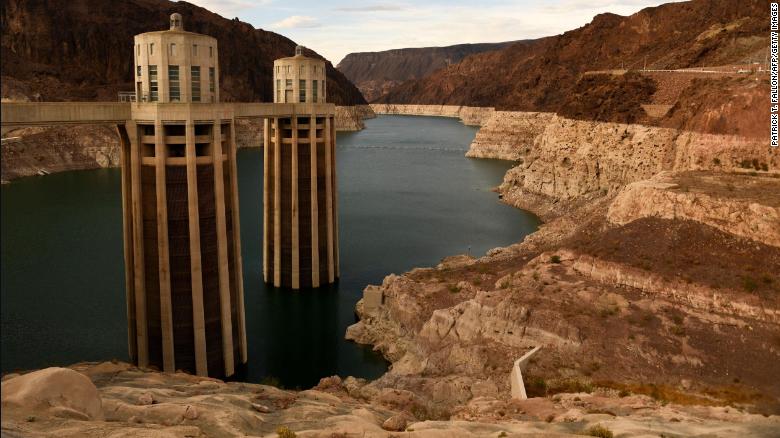
The water level at Lake Mead, the largest reservoir in the US by volume, is at its lowest since it was filled in the 1930s.
(CNN)The federal government on Monday declared a water shortage on the Colorado River for the first time, triggering mandatory water consumption cuts for states in the Southwest, as climate change-fueled drought pushes the level in Lake Mead to unprecedented lows.
Lake Mead, the largest reservoir in the US by volume, has drained at an alarming rate this year. At around 1,067 feet above sea level and 35% full, the Colorado River reservoir is at its lowest since the lake was filled after the Hoover Dam was completed in the 1930s.
Lake Powell, which is also fed by the Colorado River and is the country's second-largest reservoir, recently sank to a record low and is now 32% full.
"It's very significant," Brad Udall, senior water and climate scientist at Colorado State University, told CNN. "It's something that those of us in the climate community have been worried about for over a decade, based on declining flows due to climate change."
With the lake expected to remain at around 1,066 feet of elevation into 2022, according to the US Bureau of Reclamation's latest monthly projections, the agency announced that the Colorado River will go into the first tier of water cuts beginning January 1.
"Given ongoing historic drought and low runoff conditions in the Colorado River Basin, downstream releases from Glen Canyon Dam and Hoover Dam will be reduced in 2022 due to declining reservoir levels," the report said.
Enter your email to sign up for the Wonder Theory newsletter.
close dialog
Lake Mead provides water to roughly 25 million people in Arizona, Nevada, California and Mexico, according to the National Park Service. Under the complex priority system, Arizona and Nevada will be affected by the tier-1 shortage.
Arizona will see an 18% reduction in the state's total Colorado River supply, primarily impacting agriculture. Although Nevada will need to adhere to a 7% reduction in its Colorado River water supply in 2022, the state had already reduced its deliveries and no change is expected due to the shortage, according to John Entsminger, general manager of the Southern Nevada Water Authority.
Additional cuts -- each tier with worsening impact on agriculture and municipal water -- are expected if Lake Mead continues to fall. The second tier of cuts, triggered at 1,050 feet, could come as soon as 2023.


GOOGLE EARTH TIMELAPSE (GOOGLE, LANDSAT, COPERNICUS)
Snaking its way through the Rocky Mountains to the Gulf of California, the Colorado River's volume have been dwindling due to extreme heat and drought.
T.J. Atkin, a cattle rancher in Utah and Arizona, described the toll the drought was taking on his family's business and his animals.
"Everyone else I've talked to says in 85 years, it has not been this bad," Atkin told CNN in June. "We have 85 years' worth of our own drought data that says we've never done this ... not to this extent."
At a news conference announcing the cuts, US officials said climate change is behind the West's water shortage.
A UN report released last week emphasized the role human-caused climate change plays in drought frequency and intensity. Globally, droughts that may have occurred only once every 10 years or so now happen 70% more frequently, according to the report. The link is particularly strong in the Western US, scientists said, which is currently in the grips of a historic, multi-year drought.
More than 95% of the West was in drought as of last week, the largest area in the history of the US Drought Monitor.
"There's no doubt that climate change is real -- we're experiencing it every day in the Colorado River Basin and in other basins in the West," said Tanya Trujillo, assistant secretary for water and science at the US Department of the Interior. "I think the best strategy for planning is to think about a broad range of scenarios and a broad range of potential hydrology, and to work closely with our partners in the basin to try to think through all of those scenarios."

Photos: The West's historic drought
People in Portland, Oregon, cool off at the Oregon Convention Center on Sunday, June 27. Portland set an all-time high of 112 degrees that day. It surpassed it a day later with a high of 116.
Hide Caption
19 of 37

Photos: The West's historic drought
Carlos Torres drinks water on Saturday as he looks for paperwork in his destroyed mobile home in Kelseyville, California. A wind-whipped brush fire burned three mobile homes, two separate garages and vehicles, a single-family dwelling and outbuildings.
Hide Caption
20 of 37

Photos: The West's historic drought
Kayakers navigate the waters of Lake Powell in Page, Arizona, on June 24.
Hide Caption
21 of 37

Photos: The West's historic drought
John Elizondo, 11, dumps a bucket of water over himself while playing in the Snake River at the edge of Asotin, Washington, on June 24.
Hide Caption
22 of 37

Photos: The West's historic drought
Park visitors in Big Water, Utah, walk on an area of Lake Powell that used to be underwater at Lone Rock Beach.
Hide Caption
23 of 37

Photos: The West's historic drought
James Oehlerking spreads ice over a tub of bottled beer at Coors Field, the home of Major League Baseball's Colorado Rockies, on June 17. Temperatures were in the triple digits for a third straight day in Denver.
Hide Caption
24 of 37

Photos: The West's historic drought
A sign says "stop in and cool off" on a building at Lake Mead in Boulder City, Nevada, on June 16. The lake is at its lowest water level on record since the reservoir was filled in the 1930s.
Hide Caption
25 of 37

Photos: The West's historic drought
Gerry Huddleston cools off in the shallow water of the Russian River in Healdsburg, California, on June 16.
Hide Caption
26 of 37

Photos: The West's historic drought
A wildfire burns on a canyon wall south of St. Xavier, Montana, on June 15. Record-high temperatures and gusting winds stoked a rapid expansion of major fires across central and eastern Montana.
Hide Caption
27 of 37

Photos: The West's historic drought
Ranchers Jim Jensen, center, and Bill Jensen inspect a trench they are working on to try to get more water to their ranch in Tomales, California, on June 8. As the drought continues in California, many ranchers and farmers are beginning to see their wells and ponds dry up. They are having to make modifications to their existing water resources or have water trucked in for their livestock.
Hide Caption
28 of 37

Photos: The West's historic drought
Cattle walk up to a water trough in Tomales, California, on June 8.
Hide Caption
29 of 37

Photos: The West's historic drought
Low water levels can be seen in the Hoover Dam reservoir of Lake Mead on June 9. Water levels at Lake Powell and Lake Mead -- the two largest reservoirs on the Colorado River -- have dropped at an alarming rate.
Hide Caption
30 of 37

Photos: The West's historic drought
This aerial photo shows houseboats anchored at the Bidwell Canyon Marina in Oroville, California, on June 1. As water levels continued to fall at Lake Oroville, officials were flagging houseboats for removal so they could avoid being stuck or damaged.
Hide Caption
31 of 37

Photos: The West's historic drought
California's Tule Lake National Wildlife Refuge, near the Oregon border, is seen on May 28. The area has been severely affected by drought and the lack of irrigation waters from Upper Klamath Lake, which usually feeds into the refuge.
Hide Caption
32 of 37

Photos: The West's historic drought
This aerial photo shows rows of almond trees sitting on the ground during an orchard removal project in Snelling, California, on May 27. Because of a shortage of water in the Central Valley, some farmers are having to remove crops that require excessive watering.
Hide Caption
33 of 37

Photos: The West's historic drought
A firefighter inspects equipment on a Type 3 engine designed for wild land firefighting at a station in Oroville, California, on May 26.
Hide Caption
34 of 37

Photos: The West's historic drought
A launch ramp, extended to accommodate low water levels, stretches into California's Lake Oroville on May 22. At the time of this photo, the reservoir was at 39% of capacity and 46% of its historical average.
Hide Caption
35 of 37

Photos: The West's historic drought
Firefighters battle a brushfire in Santa Barbara, California, on May 21.
Hide Caption
36 of 37

Photos: The West's historic drought
Clinton Jackson prepares to fill water tanks with recycled water in Oakley, California, on May 20. The Ironhouse Sanitation District opened its residential recycled water fill station earlier than usual to make recycled water available for free to Oakley and Bethel Island residents.
Hide Caption
37 of 37

Photos: The West's historic drought
Water-level lines, unveiled by years of drought, are seen on the rocks of the Elephant Butte Reservoir in Truth or Consequences, New Mexico, on July 9.
Hide Caption
1 of 37

Photos: The West's historic drought
Cattle graze as the Tamarack Fire burns near the California-Nevada border on July 17.
Hide Caption
2 of 37

Photos: The West's historic drought
These peaks of the Sierra Nevada mountain range, near Lone Pine, California, often have snow packs that last throughout the summer months. But there were none on July 18.
Hide Caption
3 of 37

Photos: The West's historic drought
Cattle graze as the Tamarack Fire burns in Markleeville, California, on July 17.
Hide Caption
4 of 37

Photos: The West's historic drought
Dead carp fish rot in the remaining water of a drying Little Washoe Lake in Nevada.
Hide Caption
5 of 37

Photos: The West's historic drought
The Bootleg Fire illuminates smoke at night near Bly, Oregon.
Hide Caption
6 of 37

Photos: The West's historic drought
A plane drops fire retardant on Harlow Ridge above the Lick Creek Fire, southwest of Asotin, Washington, on July 12. The fire started the week before and has burned more than 50,000 acres of land between Asotin County and Garfield County.
Hide Caption
7 of 37

Photos: The West's historic drought
In this GeoColor image from July 12, smoke from numerous wildfires could be seen as gray-brown, in stark contrast to the white cloud cover over other parts of the continent.
Hide Caption
8 of 37

Photos: The West's historic drought
Annette Garcia, director of the Coachella Valley Horse Rescue, straps ice packs onto a horse's legs to help keep him cool amid a water shortage in Indio, California.
Hide Caption
9 of 37

Photos: The West's historic drought
Visitors take photos in front of a thermometer July 10 at Death Valley National Park in Death Valley, California. Death Valley is known to be a hot place, but on July 9 it hit 130 degrees Fahrenheit for only the fifth time in recorded history.
Hide Caption
10 of 37

Photos: The West's historic drought
Golden Davis cools off in a mister along the Las Vegas Strip on July 9. The city tied its all-time temperature record of 117 degrees Fahrenheit over the weekend.
Hide Caption
11 of 37

Photos: The West's historic drought
Smoke envelops trees as the Sugar Fire, part of the Beckwourth Complex Fire, burns in Doyle, California, on July 9.
Hide Caption
12 of 37

Photos: The West's historic drought
Volunteers hand out water and ice at a homeless-services facility in Sacramento, California, on July 8.
Hide Caption
13 of 37

Photos: The West's historic drought
A utility crew works on power lines in front of a hillside that was burned by the Salt Fire in California's Shasta County.
Hide Caption
14 of 37

Photos: The West's historic drought
As the Salt Fire burns nearby, a section of the drought-stricken Shasta Lake sits mostly dry in Lakehead, California, on July 2. Firefighters were battling nearly a dozen wildfires in the region.
Hide Caption
15 of 37

Photos: The West's historic drought
The exposed lake bed of the San Gabriel Reservoir is seen near Azusa, California, on June 29.
Hide Caption
16 of 37

Photos: The West's historic drought
A sign is posted about watering limits in Azusa, California, on June 29.
Hide Caption
17 of 37

Photos: The West's historic drought
This aerial photo shows the San Gabriel River and the exposed lake bed of the San Gabriel Reservoir near Azusa on June 29.
Hide Caption
18 of 37
Photos: The West's historic drought
People in Portland, Oregon, cool off at the Oregon Convention Center on Sunday, June 27. Portland set an all-time high of 112 degrees that day. It surpassed it a day later with a high of 116.
Hide Caption
19 of 37
Photos: The West's historic drought
Carlos Torres drinks water on Saturday as he looks for paperwork in his destroyed mobile home in Kelseyville, California. A wind-whipped brush fire burned three mobile homes, two separate garages and vehicles, a single-family dwelling and outbuildings.
Hide Caption
20 of 37
Photos: The West's historic drought
Kayakers navigate the waters of Lake Powell in Page, Arizona, on June 24.
Hide Caption
21 of 37
Photos: The West's historic drought
John Elizondo, 11, dumps a bucket of water over himself while playing in the Snake River at the edge of Asotin, Washington, on June 24.
Hide Caption
22 of 37
Photos: The West's historic drought
Park visitors in Big Water, Utah, walk on an area of Lake Powell that used to be underwater at Lone Rock Beach.
Hide Caption
23 of 37
Photos: The West's historic drought
James Oehlerking spreads ice over a tub of bottled beer at Coors Field, the home of Major League Baseball's Colorado Rockies, on June 17. Temperatures were in the triple digits for a third straight day in Denver.
Hide Caption
24 of 37
Photos: The West's historic drought
A sign says "stop in and cool off" on a building at Lake Mead in Boulder City, Nevada, on June 16. The lake is at its lowest water level on record since the reservoir was filled in the 1930s.
Hide Caption
25 of 37
Photos: The West's historic drought
Gerry Huddleston cools off in the shallow water of the Russian River in Healdsburg, California, on June 16.
Hide Caption
26 of 37
Photos: The West's historic drought
A wildfire burns on a canyon wall south of St. Xavier, Montana, on June 15. Record-high temperatures and gusting winds stoked a rapid expansion of major fires across central and eastern Montana.
Hide Caption
27 of 37
Photos: The West's historic drought
Ranchers Jim Jensen, center, and Bill Jensen inspect a trench they are working on to try to get more water to their ranch in Tomales, California, on June 8. As the drought continues in California, many ranchers and farmers are beginning to see their wells and ponds dry up. They are having to make modifications to their existing water resources or have water trucked in for their livestock.
Hide Caption
28 of 37
Photos: The West's historic drought
Cattle walk up to a water trough in Tomales, California, on June 8.
Hide Caption
29 of 37
Photos: The West's historic drought
Low water levels can be seen in the Hoover Dam reservoir of Lake Mead on June 9. Water levels at Lake Powell and Lake Mead -- the two largest reservoirs on the Colorado River -- have dropped at an alarming rate.
Hide Caption
30 of 37
Photos: The West's historic drought
This aerial photo shows houseboats anchored at the Bidwell Canyon Marina in Oroville, California, on June 1. As water levels continued to fall at Lake Oroville, officials were flagging houseboats for removal so they could avoid being stuck or damaged.
Hide Caption
31 of 37
Photos: The West's historic drought
California's Tule Lake National Wildlife Refuge, near the Oregon border, is seen on May 28. The area has been severely affected by drought and the lack of irrigation waters from Upper Klamath Lake, which usually feeds into the refuge.
Hide Caption
32 of 37
Photos: The West's historic drought
This aerial photo shows rows of almond trees sitting on the ground during an orchard removal project in Snelling, California, on May 27. Because of a shortage of water in the Central Valley, some farmers are having to remove crops that require excessive watering.
Hide Caption
33 of 37
Photos: The West's historic drought
A firefighter inspects equipment on a Type 3 engine designed for wild land firefighting at a station in Oroville, California, on May 26.
Hide Caption
34 of 37
Photos: The West's historic drought
A launch ramp, extended to accommodate low water levels, stretches into California's Lake Oroville on May 22. At the time of this photo, the reservoir was at 39% of capacity and 46% of its historical average.
Hide Caption
35 of 37
Photos: The West's historic drought
Firefighters battle a brushfire in Santa Barbara, California, on May 21.
Hide Caption
36 of 37
Photos: The West's historic drought
Clinton Jackson prepares to fill water tanks with recycled water in Oakley, California, on May 20. The Ironhouse Sanitation District opened its residential recycled water fill station earlier than usual to make recycled water available for free to Oakley and Bethel Island residents.
Hide Caption
37 of 37
Photos: The West's historic drought
Water-level lines, unveiled by years of drought, are seen on the rocks of the Elephant Butte Reservoir in Truth or Consequences, New Mexico, on July 9.
Hide Caption
1 of 37
Photos: The West's historic drought
Cattle graze as the Tamarack Fire burns near the California-Nevada border on July 17.
Hide Caption
2 of 37
Photos: The West's historic drought
These peaks of the Sierra Nevada mountain range, near Lone Pine, California, often have snow packs that last throughout the summer months. But there were none on July 18.
Hide Caption
3 of 37
Photos: The West's historic drought
Cattle graze as the Tamarack Fire burns in Markleeville, California, on July 17.
Hide Caption
4 of 37
Photos: The West's historic drought
Dead carp fish rot in the remaining water of a drying Little Washoe Lake in Nevada.
Hide Caption
5 of 37
Photos: The West's historic drought
The Bootleg Fire illuminates smoke at night near Bly, Oregon.
Hide Caption
6 of 37
Photos: The West's historic drought
A plane drops fire retardant on Harlow Ridge above the Lick Creek Fire, southwest of Asotin, Washington, on July 12. The fire started the week before and has burned more than 50,000 acres of land between Asotin County and Garfield County.
Hide Caption
7 of 37
Photos: The West's historic drought
In this GeoColor image from July 12, smoke from numerous wildfires could be seen as gray-brown, in stark contrast to the white cloud cover over other parts of the continent.
Hide Caption
8 of 37
Photos: The West's historic drought
Annette Garcia, director of the Coachella Valley Horse Rescue, straps ice packs onto a horse's legs to help keep him cool amid a water shortage in Indio, California.
Hide Caption
9 of 37
Photos: The West's historic drought
Visitors take photos in front of a thermometer July 10 at Death Valley National Park in Death Valley, California. Death Valley is known to be a hot place, but on July 9 it hit 130 degrees Fahrenheit for only the fifth time in recorded history.
Hide Caption
10 of 37
Photos: The West's historic drought
Golden Davis cools off in a mister along the Las Vegas Strip on July 9. The city tied its all-time temperature record of 117 degrees Fahrenheit over the weekend.
Hide Caption
11 of 37
Photos: The West's historic drought
Smoke envelops trees as the Sugar Fire, part of the Beckwourth Complex Fire, burns in Doyle, California, on July 9.
Hide Caption
12 of 37
Photos: The West's historic drought
Volunteers hand out water and ice at a homeless-services facility in Sacramento, California, on July 8.
Hide Caption
13 of 37
Photos: The West's historic drought
A utility crew works on power lines in front of a hillside that was burned by the Salt Fire in California's Shasta County.
Hide Caption
14 of 37
Photos: The West's historic drought
As the Salt Fire burns nearby, a section of the drought-stricken Shasta Lake sits mostly dry in Lakehead, California, on July 2. Firefighters were battling nearly a dozen wildfires in the region.
Hide Caption
15 of 37
Photos: The West's historic drought
The exposed lake bed of the San Gabriel Reservoir is seen near Azusa, California, on June 29.
Hide Caption
16 of 37
Photos: The West's historic drought
A sign is posted about watering limits in Azusa, California, on June 29.
Hide Caption
17 of 37
Photos: The West's historic drought
This aerial photo shows the San Gabriel River and the exposed lake bed of the San Gabriel Reservoir near Azusa on June 29.
Hide Caption
18 of 37
Photos: The West's historic drought
People in Portland, Oregon, cool off at the Oregon Convention Center on Sunday, June 27. Portland set an all-time high of 112 degrees that day. It surpassed it a day later with a high of 116.
Hide Caption
19 of 37


On average, the Colorado River's flow has declined by about 20% over the last century, according to a 2020 study by US Geological Survey scientists. Over half of that decline can be attributed to warming temperatures across the basin, researchers said.
Without any significant reductions to planet-heating emissions, particularly from the burning of fossil fuels, the study found the Colorado River's average discharge could shrink by 31%, compared to the historical average, by the middle of this century -- a theme consistent with the UN climate report.
The significance of the reservoirs' rapid decline cannot be overstated. The Colorado River supplies water to more than 40 million people living across seven US states and Mexico.
Lake Mead and Lake Powell provide a critical supply of drinking water, hydropower and irrigation for many communities across the region including rural farms and tribal nations.
As the climate rapidly changes, Udall said the West should prepare for more shortages.
"Climate change is water change, and many of the worst impacts we're going to see out of climate change are through changes in the water cycle," Udall said. "Not only do we have to plan for these undesirable water outcomes, but we also have to get our act together and reduce greenhouse gases as fast as we can."
CNN's Drew Kann contributed to this report.


No comments:
Post a Comment