This is very bad news for all the states opening early now in the U.S. Just remember people started dying in Wuhan in November and December of 2019.
This is now 6 months later and there are still problems in Wuhan, China. And likely so will there be 6 months from the first deaths in Los Angeles which were not directly connected to China on February 6th. So, since our first non-directly connected to China case (where the people hadn't been there anytime recently) was on February 6th 2020 and February 15th 2020 are autopsies recently found let's take it 6 months out which would be Late August of 2020. So, just like 6 months out from patient Zero on November 17th 2019 in Wuhan is around now.
So, August is going to be our 6 months out from I believe it was Santa Clara county where the autopsies were done on two deaths, one on February 6th and one on February 15th of 2020 that autopsies proved were due to coronavirus without those people ever going to China.
So, it was out and about in the Bay Area by February 6th 2020.
To the best of my ability I write about my experience of the Universe Past, Present and Future
Top 10 Posts This Month
- Dolly Parton on English version of Wikipedia
- Cancer rates 1900 to 2000 and beyond
- As of September 16th at around 6 am this is the most read article here at this blog
- Strait of Hormuz shut until Tehran's conditions met, Ghalibaf says
- Inside the bipartisan effort to stop the Big Bend border wall
- Hunter charged with manslaughter in shooting of woman he mistook for a deer: Police
- Russia’s New Favorite Jihadis: The Taliban
- From Google Images these are all variations of Tibetan Momos
- This article is about the French Language but written mostly in English (The French call their language (Francais)
- Protesters form human chain at Kennedy Center amid Trump's threats to demolish it
Thursday, April 30, 2020
Wuhan shows the end of lockdown is just the start of the Covid-19 crisis
begin quote from:
Wuhan shows the end of lockdown is just the start of the Covid-19 crisis
ANALYSIS
Many stores are still shut, restaurants are restricted to takeaway and even when citizens go outside they try to avoid each other
Wuhan shows the world that the end of lockdown is just the beginning of the Covid-19 crisis

Father opens up on why doctor who had coronavirus died by suicide
Coronavirus wreaks havoc on colleges' finances
Gupta lays out mental toll of virus for front line workers
Full body disinfection and other airport security plans
This stunning tribute to medical workers comes from the sky
Coronavirus survivor leaves heartfelt message for caregivers
Nurse shows how fast germs spread even with gloves
Nurse on front lines: This is bringing me to tears
Small businesses suffer despite lifting lockdown in Wuhan
Another 3.8 million Americans file for unemployment benefits
Paramedic: Number of home deaths is "astronomical"
What inmates think about comparing quarantine to jail
Dozens of bodies found in trucks outside funeral home
Hundreds of people lined up outside of Vegas casino for food
Couple married 73 years dies hours apart after Covid-19 fight
Fauci expresses optimism regarding trial of remdesivir
Father opens up on why doctor who had coronavirus died by suicide
Coronavirus wreaks havoc on colleges' finances
Gupta lays out mental toll of virus for front line workers
Full body disinfection and other airport security plans
This stunning tribute to medical workers comes from the sky
Coronavirus survivor leaves heartfelt message for caregivers
Nurse shows how fast germs spread even with gloves
Nurse on front lines: This is bringing me to tears
Small businesses suffer despite lifting lockdown in Wuhan
Another 3.8 million Americans file for unemployment benefits
Paramedic: Number of home deaths is "astronomical"
What inmates think about comparing quarantine to jail
Dozens of bodies found in trucks outside funeral home
Hundreds of people lined up outside of Vegas casino for food
Couple married 73 years dies hours apart after Covid-19 fight
Fauci expresses optimism regarding trial of remdesivir
Shanghai (CNN)All around the world, people are waiting for the announcement that the coronavirus pandemic is contained and they can return to normal life.
But the Chinese city at the center of the pandemic has shown that normal might still be a long way off.
When Wuhan officials eased outgoing travel restrictions on April 8, effectively ending the city's 76-day lockdown, residents and local businesses soon learned that city's actual reopening would be painfully slow.
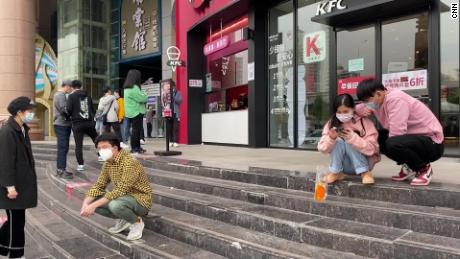
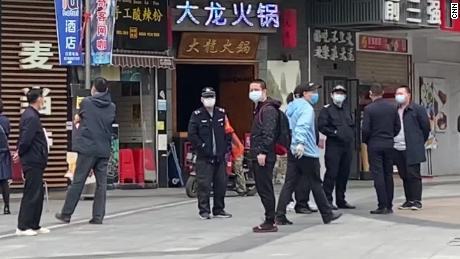
Despite the lifting of most strict lockdown laws, many stores are still shut, restaurants are restricted to takeaway and even when citizens go outside they still wear protective equipment and try to avoid each other.
The mood on the ground is very different to the official statements. At a press conference on April 8, Luo Ping, an epidemic control official in Wuhan said that some sectors of the city were already back to 100% resumption rate.
In a meeting of the Wuhan government on April 25, they promised a "double victory" of success of the epidemic and economic growth.
But even government-controlled media has suggested that plans to get the city back to 100% production by the end of April might be "too optimistic."
During a recent trip to the city, business owners told CNN that they were struggling with zero profits and huge rents and experts said that it might take the city's economy months to recover, if not longer.
"In the short term, of course, there's going to be a recovery," said Larry Hu, economist at Macquarie Capital Limited. "Production will recover first and then consumption, because a lot of people are still reluctant to come out ... but from a long term perspective, from a three-year perspective the virus is still going to hurt the long term growth of Wuhan."
A person wearing a face mask as a preventive measure against the spread of the COVID-19 novel coronavirus carries groceries in a neighbourhood in Wuhan in China's central Hubei province on April 20.
Shanghai (CNN)All around the world, people are waiting for the announcement that the coronavirus pandemic is contained and they can return to normal life.
But the Chinese city at the center of the pandemic has shown that normal might still be a long way off.
When Wuhan officials eased outgoing travel restrictions on April 8, effectively ending the city's 76-day lockdown, residents and local businesses soon learned that city's actual reopening would be painfully slow.
Despite the lifting of most strict lockdown laws, many stores are still shut, restaurants are restricted to takeaway and even when citizens go outside they still wear protective equipment and try to avoid each other.
The mood on the ground is very different to the official statements. At a press conference on April 8, Luo Ping, an epidemic control official in Wuhan said that some sectors of the city were already back to 100% resumption rate.
In a meeting of the Wuhan government on April 25, they promised a "double victory" of success of the epidemic and economic growth.
But even government-controlled media has suggested that plans to get the city back to 100% production by the end of April might be "too optimistic."
During a recent trip to the city, business owners told CNN that they were struggling with zero profits and huge rents and experts said that it might take the city's economy months to recover, if not longer.
"In the short term, of course, there's going to be a recovery," said Larry Hu, economist at Macquarie Capital Limited. "Production will recover first and then consumption, because a lot of people are still reluctant to come out ... but from a long term perspective, from a three-year perspective the virus is still going to hurt the long term growth of Wuhan."

A person wearing a face mask as a preventive measure against the spread of the COVID-19 novel coronavirus carries groceries in a neighbourhood in Wuhan in China's central Hubei province on April 20.
Struggling to recover
Wuhan is a metropolis with a population of more than a 11 million, larger than most US cities, and yet it is considered a second-tier size city within mainland China.
The capital of central China's Hubei Province, Wuhan, is both a manufacturing and transportation hub for the rest of the country.
The original outbreak was first detected in Wuhan in mid-December, and as the outbreak worsened, the city sealed its borders from the rest of China on January 23 in an attempt to contain the spread.
Virtually overnight, life was halted. In some parts of the city people were confined to their homes for several months straight, unable to leave and relying on delivery services for groceries and other basic needs.
With the lockdown now over, the local government is keen to resume normal business as quickly as possible, as Beijing puts pressure on provinces to help boost a flailing economy.
But there are signs that despite the hopeful rhetoric, Hubei's economy might take a long time to recover from the severe lockdown.
Wuhan is a metropolis with a population of more than a 11 million, larger than most US cities, and yet it is considered a second-tier size city within mainland China.
The capital of central China's Hubei Province, Wuhan, is both a manufacturing and transportation hub for the rest of the country.
The original outbreak was first detected in Wuhan in mid-December, and as the outbreak worsened, the city sealed its borders from the rest of China on January 23 in an attempt to contain the spread.
Virtually overnight, life was halted. In some parts of the city people were confined to their homes for several months straight, unable to leave and relying on delivery services for groceries and other basic needs.
With the lockdown now over, the local government is keen to resume normal business as quickly as possible, as Beijing puts pressure on provinces to help boost a flailing economy.
But there are signs that despite the hopeful rhetoric, Hubei's economy might take a long time to recover from the severe lockdown.
Shaun Roache, Asia Pacific chief economist at S&P Global Ratings, said that the lesson of Wuhan to the rest of the world was that swift, early action on coronavirus was costly to the economy but might lead for a quicker reopening.
"(But) lockdowns have a disproportional effect on small and medium-sized enterprises. These firms have less access to credit to help them 'bridge to the recovery' and can also struggle to meet the requirements for opening up," he said.
When CNN returned to the city on April 21, a drive through a commercial street showed more than half the local businesses remain shuttered.
The province's GDP shrank almost 40% year-on-year in the first quarter of 2020, according to state news agency Xinhua, with retail sales dropping more than 15% in March alone.
The government has announced it will be letting businesses leasing from state-owned enterprises go rent-free for three months, but for those with private landlords, the weight of rent and no profit is pushing them out of business.
"I opened for two days. No costumers come in to eat, as it was forbidden, and I got only two or three orders from the online delivery platform. The cost of opening was much more than I earn each day, so I closed it again," one restaurant owner told the government-controlled Global Times.
Shaun Roache, Asia Pacific chief economist at S&P Global Ratings, said that the lesson of Wuhan to the rest of the world was that swift, early action on coronavirus was costly to the economy but might lead for a quicker reopening.
"(But) lockdowns have a disproportional effect on small and medium-sized enterprises. These firms have less access to credit to help them 'bridge to the recovery' and can also struggle to meet the requirements for opening up," he said.
When CNN returned to the city on April 21, a drive through a commercial street showed more than half the local businesses remain shuttered.
The province's GDP shrank almost 40% year-on-year in the first quarter of 2020, according to state news agency Xinhua, with retail sales dropping more than 15% in March alone.
The government has announced it will be letting businesses leasing from state-owned enterprises go rent-free for three months, but for those with private landlords, the weight of rent and no profit is pushing them out of business.
"I opened for two days. No costumers come in to eat, as it was forbidden, and I got only two or three orders from the online delivery platform. The cost of opening was much more than I earn each day, so I closed it again," one restaurant owner told the government-controlled Global Times.
Fears of a second wave
Some small business owners relayed to CNN their concern that any government assistance will likely arrive too late to save their small shops and restaurants, leading them to shut down for good.
Noticeably shuttered still are fitness centers and movie theaters, with no immediate plans to reopen.
Most the stores that have reopened have changed their business models. Major chains like Starbucks, McDonald's, Burger King, KFC and Pizza Hut are among the brands preventing customers from entering the physical space. Instead tables are setup at the storefronts and staff brings up the orders to hand off.
Roache said while manufacturing could recover reasonably quickly from the virus, it was the service sectors which appeared to be the slowest to return to 100% productivity. "This is important because service industries are the largest employers in most economies," he said.
Worst of all, some local citizens and business owners told CNN that they believed it was only a matter of time until a second wave of infections swept through the city, prompting a second lockdown and dealing another blow to the economy.
On Saturday, the day after the CNN team left, the Wuhan health authority reported that they had found 19 new asymptomatic coronavirus cases in the city.
There might be a long way to go yet for Wuhan and the rest of the world before we can return to anything resembling normality.
CNN's Ben Westcott contributed to this article.
Some small business owners relayed to CNN their concern that any government assistance will likely arrive too late to save their small shops and restaurants, leading them to shut down for good.
Noticeably shuttered still are fitness centers and movie theaters, with no immediate plans to reopen.
Most the stores that have reopened have changed their business models. Major chains like Starbucks, McDonald's, Burger King, KFC and Pizza Hut are among the brands preventing customers from entering the physical space. Instead tables are setup at the storefronts and staff brings up the orders to hand off.
Roache said while manufacturing could recover reasonably quickly from the virus, it was the service sectors which appeared to be the slowest to return to 100% productivity. "This is important because service industries are the largest employers in most economies," he said.
Worst of all, some local citizens and business owners told CNN that they believed it was only a matter of time until a second wave of infections swept through the city, prompting a second lockdown and dealing another blow to the economy.
On Saturday, the day after the CNN team left, the Wuhan health authority reported that they had found 19 new asymptomatic coronavirus cases in the city.
There might be a long way to go yet for Wuhan and the rest of the world before we can return to anything resembling normality.
CNN's Ben Westcott contributed to this article.
Subscribe to:
Posts (Atom)