Evolvability (computer science)
:
- Evolvability (computer science) This article has multiple issues. Please help improve it or discuss these issues on the talk page. (Learn ...
- Evolvability (computer science) is within the scope of WikiProject Robotics, which aims to build a comprehensive and detailed guide to Robotics on Wikipedia.
- College of Engineering and Computer Science . About Us. Dean’s Welcome; ... UCF Computer Scientist Suggests New Spin on Origins of Evolvability .
- Computer Scientists Suggest New Spin on Origins of Evolvability - Read more about UCF Research, Science & Technology, Orlando and Central Florida news.
- But computer science researchers now say that the popular explanation of competition to survive in nature may not actually be necessary for evolvability to increase.
Evolvability (computer science)
From Wikipedia, the free encyclopedia
 |
This article has multiple issues. Please help improve it or discuss these issues on the talk page. (Learn how and when to remove these template messages)
|
General Framework
Let and
and  be collections of functions on
  variables. Given an ideal function
  , the goal is to find by local search a representation
  that closely approximates
  . This closeness is measured by the performance
  of
of  with respect to .
As is the case in the biological world, there is a difference between genotype and phenotype. In general, there can be multiple representations (genotypes) that correspond to the same function (phenotype). That is, for some
 , with
  , still
 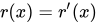 for all
  .
However, this need not be the case. The goal then, is to find a
representation that closely matches the phenotype of the ideal function,
and the spirit of the local search is to allow only small changes in
the genotype. Let the neighborhood
.
However, this need not be the case. The goal then, is to find a
representation that closely matches the phenotype of the ideal function,
and the spirit of the local search is to allow only small changes in
the genotype. Let the neighborhood  of a representation be the set of possible mutations of .
For simplicity, consider Boolean functions on
 , and let
  be a probability distribution on
  . Define the performance in terms of this. Specifically,
 In general, for non-Boolean functions, the performance will not
correspond directly to the probability that the functions agree,
although it will have some relationship.
In general, for non-Boolean functions, the performance will not
correspond directly to the probability that the functions agree,
although it will have some relationship.Throughout an organism's life, it will only experience a limited number of environments, so its performance cannot be determined exactly. The empirical performance is defined by
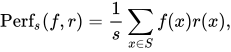 where
where  is a multiset of
  independent selections from according to . If is large enough, evidently
  will be close to the actual performance .
Given an ideal function
, initial representation , sample size , and tolerance  , the mutator
 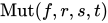 is a random variable defined as follows. Each
  is classified as beneficial, neutral, or deleterious, depending on its empirical performance. Specifically,
is a beneficial mutation if
;
;
.
is equal to one of these at random. If there are no beneficial mutations, then is equal to a random neutral mutation. In light of the similarity to biology, itself is required to be available as a mutation, so there will always be at least one neutral mutation.The intention of this definition is that at each stage of evolution, all possible mutations of the current genome are tested in the environment. Out of the ones who thrive, or at least survive, one is chosen to be the candidate for the next stage. Given
 , we define the sequence
  by
by  . Thus
  is a random variable representing what
  has evolved to after
  generations.
Let
 be a class of functions,
  be a class of representations, and
  a class of distributions on
  . We say that is evolvable by over if there exists polynomials
  ,
,  ,
,  , and
, and  such that for all and all
  , for all ideal functions and representations , with probability at least
  ,
, for
for  are at most
  , the sample size is
  , the tolerance is
  , and the generation size is
  . is evolvable over if it is evolvable by some over . is evolvable if it is evolvable over all distributions .
Results
The class of conjunctions and the class of disjunctions are evolvable over the uniform distribution for short conjunctions and disjunctions, respectively.The class of parity functions (which evaluate to the parity of the number of true literals in a given subset of literals) are not evolvable, even for the uniform distribution.
Evolvability implies PAC learnability.
References
- Valiant, L. G. (2006), Evolvability, ECCC TR06-120.


No comments:
Post a Comment