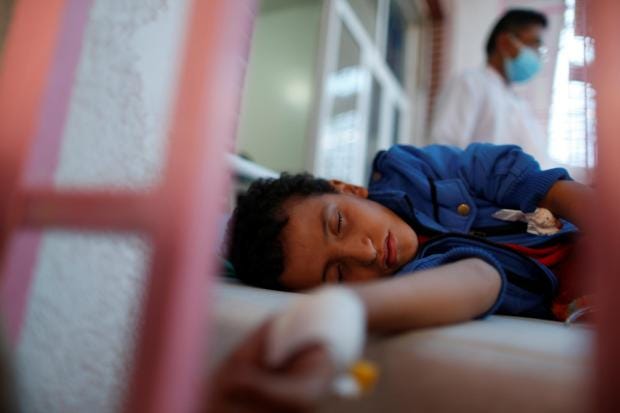
A sick boy rests at a cholera treatment centre in Sanaa, Yemen on 15 May 2017 REUTERS
At least 1,500 people have died due to cholera and more than 246,000 new cases of the disease have been reported in conflict-riven Yemen in just the last two months, the World Health Organisation (WHO) has said.
The
death toll has risen from the 1,300 announced last month, when the
number of suspected cases was around 200,000, and there are now 5,000
new diagnoses a day.
The new figures show the disease has multiplied tenfold in the last
two months, Nevio Zagaria, WHO’s representative in Yemen, said at a news
conference over the weekend, and now affects 21 of the country’s 22
provinces.
Michael Fallon claims Saudi Arabia is only 'defending itself' when attacking Yemen
The
first outbreak in the country was confirmed in October 2016, but by May
new cases were being diagnosed at a rate three times higher than six
months ago. Aid organisations warned last month that the epidemic was
spreading like wildfire, with almost one person an hour dying from the
water-borne infection.
Cholera – an acute diarrhoeal infection caused by ingestion of
contaminated food or water – can kill the young, elderly and otherwise
sick in hours if vital fluids are not replaced.
A quarter of the dead so far are children, the UN health agency said.
While easily treatable and preventable with proper sanitation procedures, after more than two years of war the country’s health, water and sanitation systems are on the verge of collapse, making the epidemic very difficult to treat. Saudi Arabia and its regional partners have used
the spectre of Iran to justify an extensive bombing campaign on Yemen’s
Shia Houthi rebels at the request of the exiled, internationally
recognised Yemeni President Abdrabbuh Mansour Hadi.
The Saudi economic strangulation, blockades on Yemen’s air and
seaports preventing the import of food and medicine and the targeting of
vital infrastructure such as roads and bridges – and in some cases
civilian buildings such as hospitals, and funeral gatherings – have
contributed to the dire situation the country’s 27-million-strong
population is now facing.
Less than half of Yemen’s medical centres are still functional. A
total of 14.5 million people don’t have regular access to clean water
and 7.3 million live on the brink of famine.
The UN estimates $2.1bn (£1.6bn) is needed to bring Yemen back from
the brink of state failure, but donor governments only pledged half that
amount at an aid conference in Geneva in April.
More than 10,000 people have died in the fighting to date, the UN says.


No comments:
Post a Comment