Another way to put this is a majority of Americans do not support a Trump Presidency.
Trump is the least mandated president in my lifetime even though he has a Republican Congress in both houses. He is also the last Baby Boomer president at 70 years of age.
As
President-elect Donald Trump prepares to be sworn in as the country's
commander-in-chief next month, a majority of Americans say they are
either uncertain or pessimistic about his presidency, even as the
country is …
Poll: Majority of Americans Pessimistic or Uncertain About Trump Presidency
byCarrie Dann
As President-elect Donald Trump prepares to be
sworn in as the country's commander-in-chief next month, a majority of
Americans say they are either uncertain or pessimistic about his
presidency, even as the country is sounding a more optimistic tone about
the future of the economy and Trump's ability to bring positive change
to Washington D.C. A new NBC News/Wall Street Journal poll finds
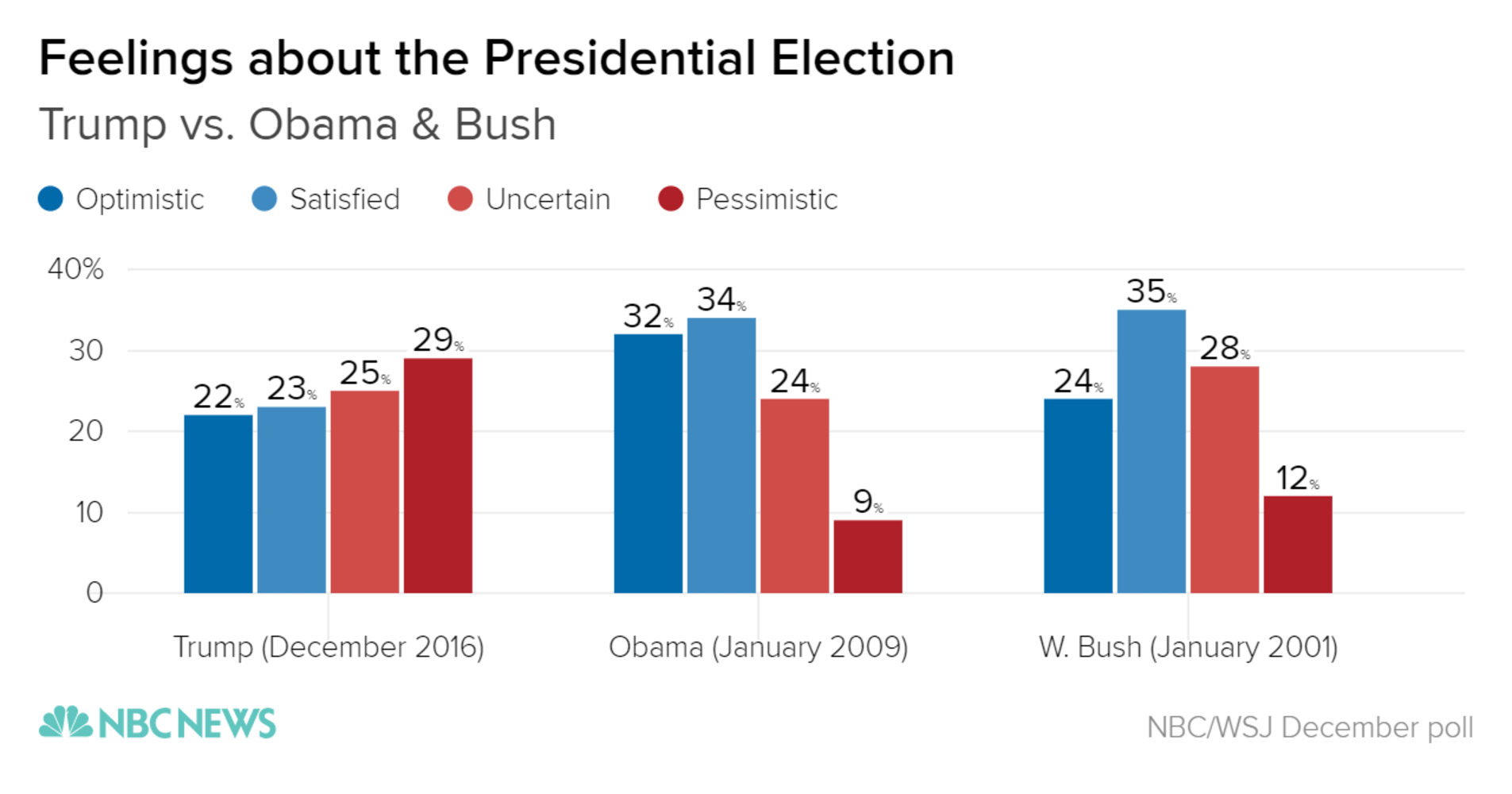
54 percent of adults saying that they are either uncertain (25 percent)
or pessimistic and worried (29 percent) about how Trump will perform
during his presidency, compared with 45 percent with either an
optimistic and confident view (22 percent) or a satisfied and hopeful
view (23 percent).
That's a significantly worse outlook than
Americans expressed after the elections of both Barack Obama and George
W. Bush. A combined 66 percent were either optimistic or hopeful about
Obama in January 2009, according to the same poll, while 59 percent were
optimistic or hopeful about George W. Bush in January 2001.
The data show the extent to which the nation
remains unusually divided even though Election Day is in the rearview
mirror, said Democratic pollster Fred Yang of Hart Research Associates,
which conducted this survey with Republican pollster Bill McInturff and
his firm Public Opinion Strategies.
"Usually elections settle arguments and the
nation comes together, at least in the short term," Yang said. "Today,
hard feelings persist on both sides of the partisan divide. It's as if
the 2016 campaign has never ended."
Those partisan differences are particularly
stark when it comes to public approval ratings of the way Trump is
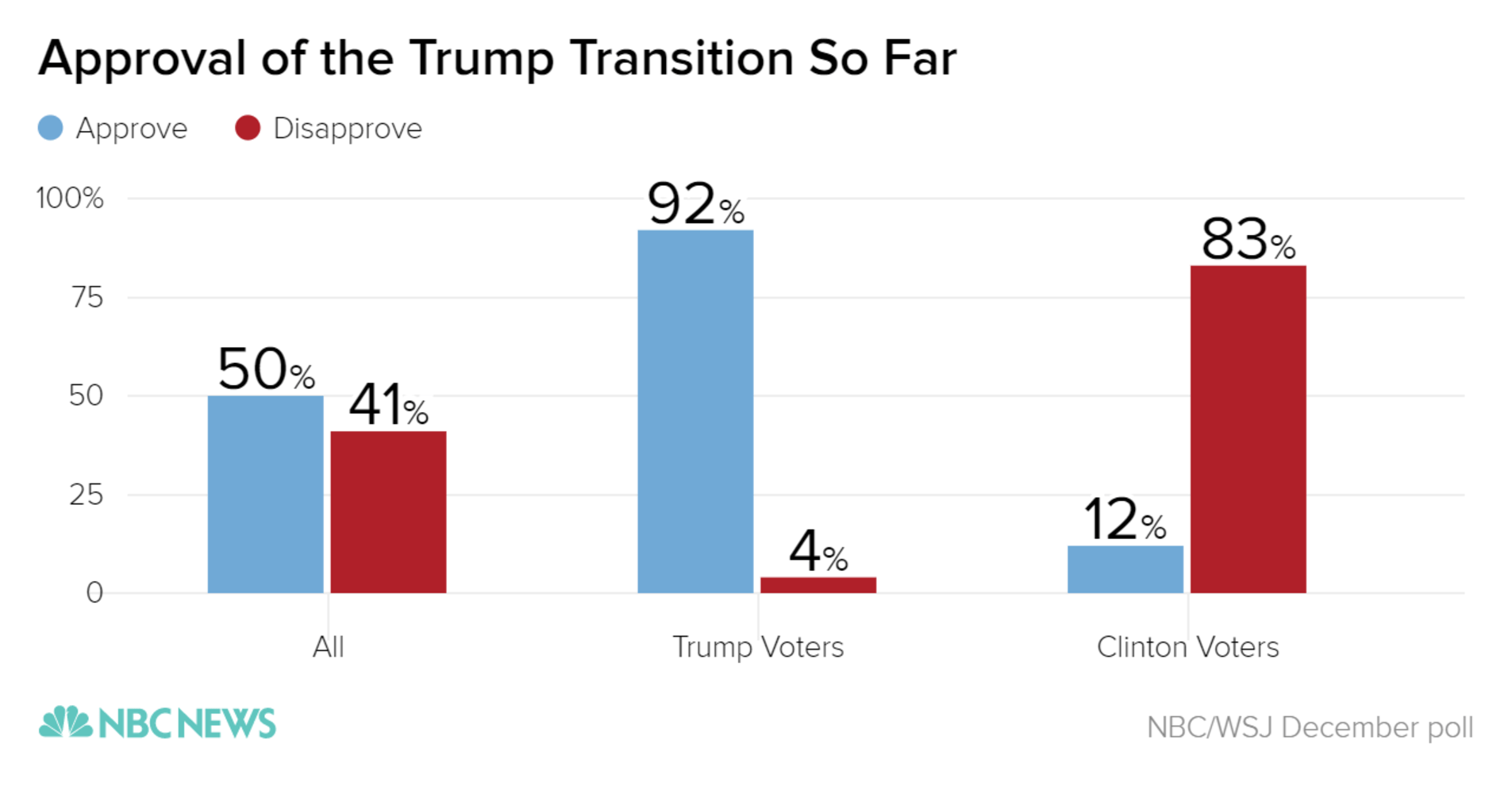
handling his transition. Half of the country overall gives Trump high
marks so far, compared to 41 percent who give him a thumbs down. But
among Hillary Clinton's voters, only 12 percent approve of how he's
handling the transition, compared to 92 percent of Trump voters.
Back in 2008, 50 percent of John McCain's voters
approved of Barack Obama's handling of his presidential transition, and
in 1992, 63 percent of George H.W. Bush's voters backed Bill Clinton's
early moves as president-elect.
The partisan divide extends to views about the
men and women Trump has selected to lead his administration.
Seventy-eight percent of Democrats say they are disappointed with the
administration appointments Trump has made so far, while 80 percent of
Republicans say they are generally pleased with Trump's picks.
While Trump's overall favorability has ticked up
modestly since before the election, he remains underwater, with more
Americans giving him a poor rating (46 percent) than a positive one (40
percent.)
That marks the first time that an incoming
president has been viewed more negatively than positively in the history
of the NBC/WSJ poll. Some bright spots -- but ones mostly driven by enthusiasm from Trump's supporters
While the public is largely apprehensive about
the president-elect, Americans do say that they are more optimistic that
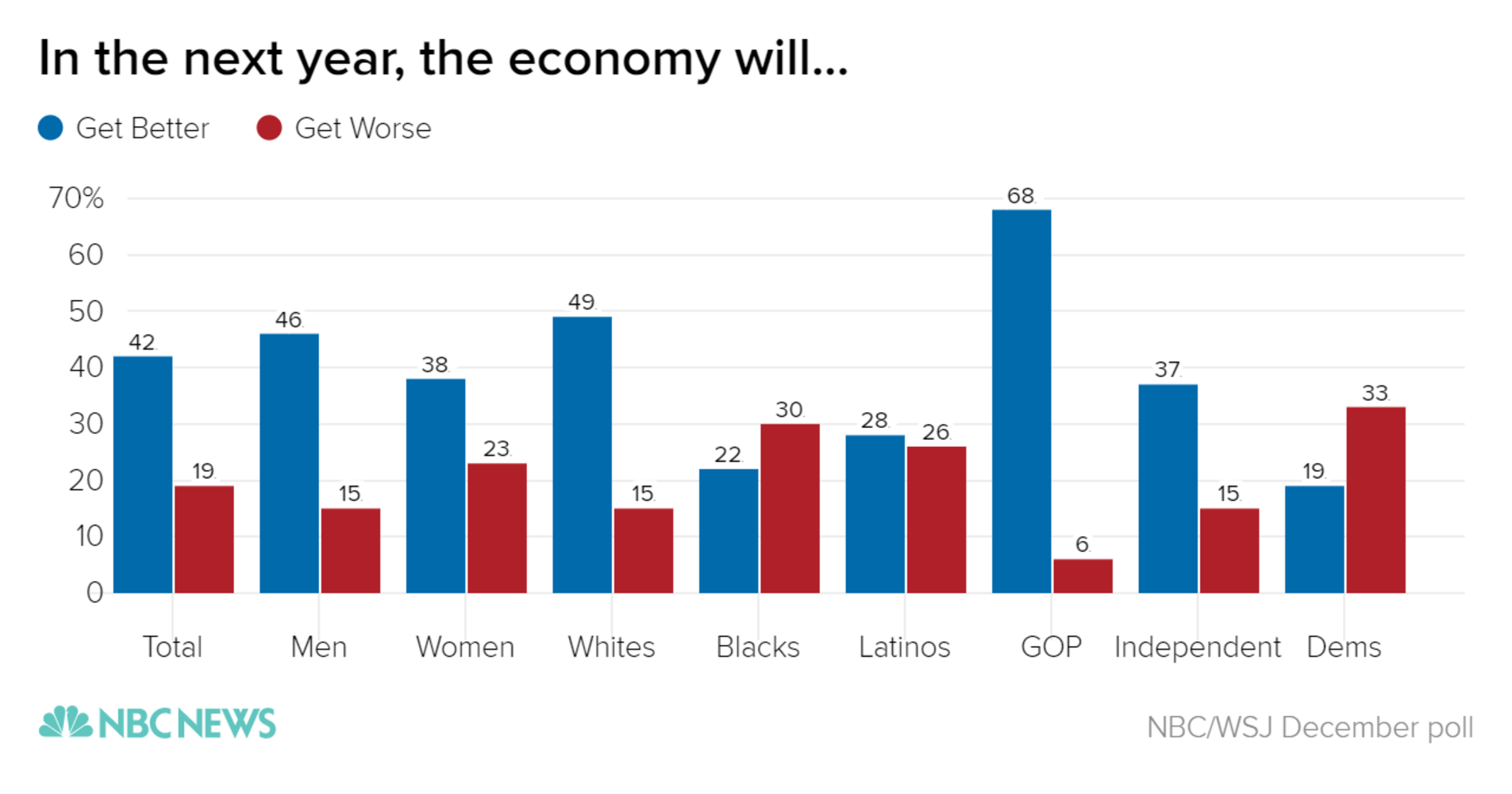
the U.S. economy will improve in the next year. Forty-two percent say
they believe the economy will get better - the highest share since
autumn of 2012 -- while only 19 percent say the economy will get worse
in the next year.
Trump has also generated relatively positive
feelings about his ability to change the federal government for the
better. A majority of Americans say Trump will shake up the way
government operates - and, among that group, they believe that he'll
bring the right kind of change by a two-to-one margin (41 percent to 20
percent).
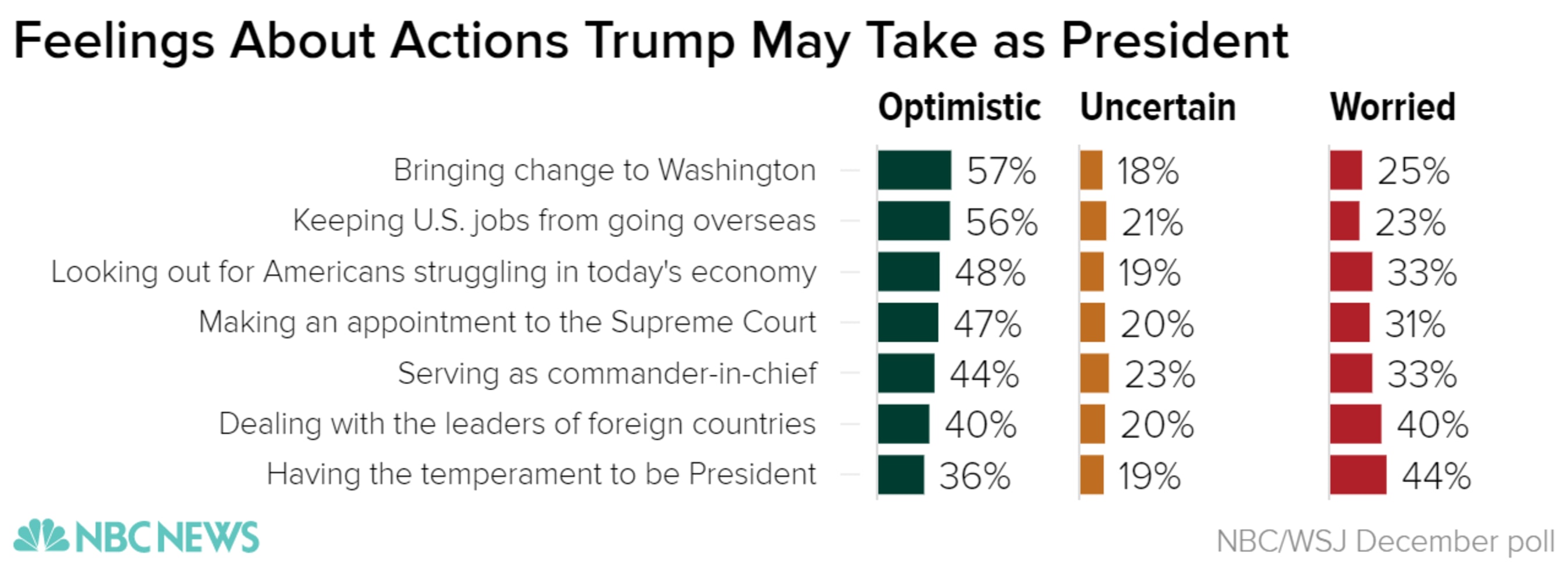
Additionally, a majority - fifty-six percent - say they are optimistic that Trump will keep U.S. jobs from going overseas.
Still, the confidence about Trump's presidency
is mostly fueled by enthusiasm among his base voters rather than by more
hopeful expectations among those who didn't choose him on their ballot
in November.
A whopping 92 percent of Trump voters are
optimistic about his ability to bring change to Washington, while just
20 percent of Clinton voters say the same. The same share of Trump
voters - 92 percent - say they are hopeful that Trump will look out for
those who are struggling in today's economy, while only nine percent of
Clinton voters agree.
Those who say that the economy will get better
in the next year rather than worse include key Trump constituency groups
like whites (49 percent better compared to 15 percent worse),
Republicans (68 percent better to six percent worse), and men (46
percent better to 15 percent worse.) Among Democrats, 33 percent believe
the economy will get worse compared to 19 percent who believe it will
improve, and just 22 percent of African Americans think the economy will
improve compared to a third who say it will deteriorate.
The public also still harbors concerns about
Trump's temperament. Just 36 percent of Americans say they are
optimistic that Trump has the right temperament to be president, while
44 percent say they are worried about the issue. The Republican Party gets a boost - but will it last?
In the wake of the 2016 election, the Republican
Party now has a higher net favorability rating (35 percent positive, 38
percent negative) than the Democratic Party (34 percent positive, 42
percent negative). That's the first time since after the 2010 midterms
that Republicans have scored better on the favorability measure than
their Democratic counterparts.
But it's not clear that Americans' warmer
feelings toward the GOP will endure. After its previous high watermark
six years ago, the party's positive ratings quickly fell back to earth,
with Democrats regaining the advantage the following month.




No comments:
Post a Comment