
- Obama: 'We rise or fall as one'
- His speech is the capstone of a months-long farewell tour

Crowley plagiarized lines in her columns
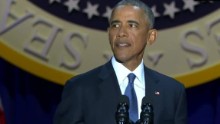
Obama offers optimism -- and warnings -- in farewell address




Story highlights
Watch CNN Films' premiere of its documentary, "The End: Inside the Last Days of the Obama White House," on January 18 at 9 p.m. ET on CNN.
Chicago (CNN)Popular
but politically humbled, President Barack Obama said goodbye to the
nation Tuesday night, declaring during his farewell address that he
hasn't abandoned his vision of progressive change but warning that it
now comes with a new set of caveats.
His
voice at moments catching with emotion, Obama recounted a presidency
that saw setbacks as well as successes. Admitting candidly that
political discourse has soured under his watch, Obama demanded that
Americans renew efforts at reconciliation.
"It
falls to each of us to be those anxious, jealous guardians of our
democracy," the President said. "To embrace the joyous task we've been
given to continually try to improve this great nation of ours."
Obama also stressed solidarity despite a presidency sometimes at odds with Congress.
"Democracy
does not require uniformity," Obama said. "Our founders quarreled and
compromised, and expected us to do the same. But they knew that
democracy does require a basic sense of solidarity -- the idea that for
all our outward differences, we are all in this together; that we rise
or fall as one."
In
a concession that, for now, his brand of progressive politics is
stalled in Washington, Obama admitted "for every two steps forward, it
often feels we take one step back."
He implored his backers to be vigilant in protecting basic American values he warned could come under siege.
"Democracy
can buckle when we give in to fear," he said. "So just as we, as
citizens, must remain vigilant against external aggression, we must
guard against a weakening of the values that make us who we are."
And
he warned against turning inward, telling Democrats that only by
involving themselves in a real political discourse could they hope to
renew the hopeful vision he brought to the White House eight years ago.
"After
eight years as your President, I still believe that," he went on. "And
it's not just my belief. It's the beating heart of our American idea --
our bold experiment in self-government."
Capstone
Obama's
speech is the capstone of a months-long farewell tour, manifested in
extended magazine interviews, lengthy television sit-downs, and the
White House's own efforts to document the President's waning
administration. Through it all, Obama has sought to highlight the
achievements of his presidency using statistics showing the country
better off now than eight years ago.
As
he spoke before a rowdy crowd of supporters, Obama was interrupted
often with screams of "I Love you Obama." When a protester holding a
"Pardon All of Us" sign, chants of "four more years" drowned out the
shouts.
Obama sought to corral his
crowd, listing the accomplishments of the last eight years ranging from
health care to marriage equality, all while insisting that his work
isn't finished.
He recognized his
successor Donald Trump, saying he was committed to a peaceful transition
of power. But he warned that going forward Democrats shouldn't fall in
line with their commander-in-chief.
Obama,
who has addressed race with varying degrees of force during his time in
office, used his farewell to insist Americans work harder to understand
each other's struggles. After presiding over eight years that saw race
relations enter a fraught new era, Obama demanded that differences be
identified and reconciled.
"Brown
kids will represent a larger share of America's workforce" in the years
ahead, Obama proclaimed, calling for better rules that will help the
children of immigrants succeed.
He warned that "laws alone won't be enough" in resolving persistent differences between Americans.
"Hearts must change," he said.
He
called on African-Americans and minorities to view with empathy "the
middle-aged white man who from the outside may seem like he's got all
the advantages, but who's seen his world upended by economic, cultural,
and technological change."

Photos: Malia and Sasha Obama: 2008-present


And
he urged whites to regard the protests of minorities as a fight "not
demanding special treatment, but the equal treatment our Founders
promised."
"Regardless of the
station we occupy, we have to try harder," Obama said. "To start with
the premise that each of our fellow citizens loves this country just as
much as we do; that they value hard work and family like we do; that
their children are just as curious and hopeful and worthy of love as our
own."
Capitalize on goodwill
In
coming to Chicago, Obama hoped to capitalize on a well of goodwill
that's expanded in the final year of his tenure. He discarded the staid
Oval Office or East Room for his last formal set of remarks, choosing
instead the city where his political rise began and where he declared
victory in 2008 and 2012.
Inside a
vast convention hall packed with more than 20,000 of his most ardent
supporters and former staffers, the mood was wistful. Ahead of his
address, aides described the normally unsentimental commander in chief
as nostalgic.
Over the past several
weeks, Obama has offered a rational view of Trump's election and rarely
let on to any apprehension about his future as an ex-president. First
lady Michelle Obama has articulated a more candid view in a scaled-back
version of her own farewell. She sat for an hour-long interview with
Oprah Winfrey, frankly admitting that Democrats were now "feeling what
not having hope feels like."


Michelle Obama's emotional final speech 01:52
And
she became emotional during her final set of formal remarks at the
White House Friday, her voice quaking and eyes welling with tears as she
told a crowd of educators: "I hope I made you proud."
During his speech Tuesday, Obama voice quaked when describing his wife's service.
"You
took on a role you didn't ask for and made it your own with grace and
grit and style and good humor," he said. "You made the White House a
place that belongs to everybody."


Obama tears up talking about Michelle 02:00
Planning for months
The
President had been planning his speech for months, aides said,
formulating the broad themes while on vacation over the holidays in
Hawaii and developing drafts starting last week.
He
told aides months ago that he preferred to deliver his farewell address
in his hometown, a first for a departing President. George W. Bush,
unpopular and facing a financial crisis, delivered his final prime-time
address in the White House East Room to a crowd of 200 supporters and
aides.
Bill Clinton, Ronald Reagan
and Jimmy Carter all used the Oval Office -- a setting Obama has long
spurned for formal remarks. George H.W. Bush traveled outside of
Washington to West Point for a departing address after failing to secure
a second term, though he didn't actually bill it as a farewell.
The
tradition extends back to George Washington, who issued warnings
against unchecked power and partisan entrenchment in a written address
to the nation in 1796.
Like major
addresses in the past, Obama wrote his speech himself, dictating
passages to his chief speechwriter Cody Keenan who puts the President's
words into print. Obama returned the drafts with heavy annotations,
writing his changes in a tightly compressed scrawl on the margins.
The
President and Keenan went through at least four drafts of the farewell
speech, an official told CNN Tuesday. The broad themes of the speech
came together while the President was in Hawaii and he started reading a
first draft on the long flight home last Sunday.


Obamas, Bidens take stage together 00:49
Aside
from Keenan, several familiar names from the past were involved in the
drafting, including former speechwriter Jon Favreau and former senior
adviser David Axelrod.
When he
returns to Washington in the early morning hours of Wednesday, it will
be Obama's 1,293rd -- and final -- flight aboard Air Force One. He'll
use the presidential aircraft on Inauguration Day to depart Washington.
But with only a former president aboard, it's known simply as a "Special
Air Mission."


No comments:
Post a Comment