Grand Duchess Tatiana ... Preliminary testing indicated a "high degree of probability" that the remains belonged to the Tsarevich Alexei and to one of his sisters, ...
Grand Duchess Tatiana Nikolaevna of Russia
From Wikipedia, the free encyclopedia
(Redirected from Tatiana Romanov)
Grand Duchess Tatiana Nikolaevna of Russia (
Tatiana Nikolaevna Romanova) (
Russian:
Великая Княжна Татьяна Николаевна) (10th June (11th after 1900) 1897 –
17 July 1918) (After 1900, Tatiana's birthday was celebrated on 11 June)
was the second daughter of
Tsar Nicholas II, the last monarch of Russia, and of
Tsarina Alexandra. She was born at the
Peterhof,
Saint Petersburg.
She was better known than her three sisters during her lifetime and
headed Red Cross committees during World War I. Like her older sister
Grand Duchess Olga Nikolaevna of Russia, she nursed wounded soldiers in a military hospital from 1914 to 1917, until the family was arrested following the first
Russian Revolution of 1917.
Her murder by revolutionaries on 17 July 1918 resulted in her being named as a
passion bearer by the
Russian Orthodox Church. She was a younger sister of
Grand Duchess Olga Nikolaevna of Russia and an elder sister of
Grand Duchess Maria Nikolaevna of Russia,
Grand Duchess Anastasia Nikolaevna of Russia and
Tsarevich Alexei of Russia.
All sisters were falsely rumored to have survived the assassination and
dozens of imposters claimed to be surviving Romanovs. Author Michael
Occleshaw speculated that a woman named
Larissa Tudor might have been Tatiana; however, all of the Romanovs, including Olga, Tatiana, Maria and Anastasia, were murdered by the
Bolshevik assassination squad.
Early life and characteristics
Grand Duchesses Tatiana, Maria and Olga in a formal portrait taken in 1900
Grand Duchess Tatiana's siblings were
Grand Duchesses Olga,
Maria,
Anastasia, and
Tsarevich Alexei of Russia. All of the children were close to one another and to their parents up until the end of their lives.
Grand Duchess Tatiana in 1904
Tatiana was described as tall and slender, with dark
auburn hair
and dark blue-gray eyes, fine, chiseled features, and a refined,
elegant bearing befitting the daughter of an Emperor. She was considered
the most beautiful of the four grand duchesses by many courtiers.
[1][2][3] Of all her sisters, Tatiana most closely resembled their mother.
Tatiana's title is most precisely translated as "Grand Princess,"
meaning that Tatiana, as an "imperial highness", was higher in rank than
other princesses in Europe, who were "royal highnesses." "Grand
Duchess" became the most widely used translation of the title into
English from Russian.
[4] However, her friends, family and the household servants generally called her by her first name and
patronym, Tatiana Nikolaevna
[5] or by the Russian nicknames "Tanya," "Tatya," "Tatianochka," or "Tanushka."
[6][7]
Like the other Romanov children, Tatiana was raised with some
austerity. She and her sisters slept on camp beds without pillows, took cold baths in the morning,
[8]
and were expected to keep themselves occupied with embroidery or
knitting projects if they had a spare moment. Their work was given as
gifts or sold at charity bazaars.
[9] According to one story, Tatiana, accustomed to being addressed only by her name and
patronymic, was so disconcerted when she was addressed as "Your Imperial Highness" by lady-in-waiting
Baroness Sophie Buxhoeveden
when she was heading a committee meeting that she kicked the woman
under the table and hissed "Are you crazy to speak to me like that?"
[5]
Grand Duchess Tatiana Nikolaevna in a formal portrait taken in 1906
Tatiana and her older sister, Olga, were known in the household as "The Big Pair."
[5] According to a 29 May 1897 diary entry written by her father's distant cousin,
Grand Duke Konstantin Konstantinovich of Russia, she was given the name "Tatiana" as an
homage to the
heroine in
Alexander Pushkin's novel in verse Eugene Onegin. Her father liked the idea of having daughters named Olga and Tatiana, like the sisters in the famous poem.
[10]
Like their two younger sisters, the two older girls shared a bedroom
and were very close to one another from early childhood. In the spring
of 1901, Olga had
typhoid fever
and was confined to the nursery for several weeks away from her younger
sisters. When she began to recover, Tatiana was permitted to see her
older sister for five minutes but didn't recognize her. When her
governess,
Margaretta Eagar,
told her after the visit that the sickly child she had been conversing
so gently with was Olga, four-year-old Tatiana began to cry bitterly and
protested that the pale, thin child couldn't be her adored older
sister. Eagar had difficulty persuading Tatiana that Olga would recover.
[11] French tutor
Pierre Gilliard wrote that the two sisters were "passionately devoted to one another."
[12]
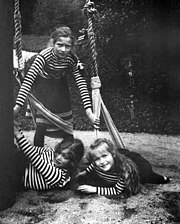
Grand Duchesses Tatiana, standing, Maria, and Anastasia play on a
swing during a summer cruise in Finland in 1908. Courtesy: Beinecke
Library.
Tatiana was practical and had a natural talent for leadership.
[1]
Her sisters gave her the nickname "The Governess" and sent her as their
group representative when they wanted their parents to grant a favor.
Though she was eighteen months Tatiana's senior, Olga had no objection
when Tatiana decided to take charge of a situation.
[1]
She was also closer to her mother than any of her sisters and was
considered by many who knew her to be the Tsarina's favorite daughter.
[3] Tatiana was the conduit of all her mother's decisions.
[13] "It was not that her sisters loved their mother any less," recalled her French tutor
Pierre Gilliard, "but Tatiana knew how to surround her with unwearying attentions and never gave way to her own capricious impulses."
[14]
Alexandra wrote Nicholas on 13 March 1916 that Tatiana was the only one
of their four daughters who "grasped it" when she explained her way of
looking at things.
[15]
Gilliard wrote that Tatiana was reserved and "well balanced" but less
open and spontaneous than Olga. She was also less talented than Olga,
but worked harder and was more dedicated to seeing projects through to
completion than her elder sister.
[12] Colonel
Eugene Kobylinsky,
the family's guard at Tsarskoye Selo and Tobolsk, felt Tatiana "had no
liking for art. Maybe it would have been better for her had she been a
man."
[16]
Others felt Tatiana's artistic talents were better expressed in
handiwork and in her talent for choosing attractive fashions and
creating elegant hair styles. Her mother's friend
Anna Vyrubova
later wrote that Tatiana had a great talent for making clothing,
embroidery and crochet and that she dressed her mother's long hair as
well as any professional hair stylist.
[3]
Relationship with Grigori Rasputin
Grand Duchess Tatiana in 1912 during the family's summer cruise aboard the Standart. Courtesy: Beinecke Library.
Tatiana, like all her family, doted on the long-awaited heir
Tsarevich Alexei, or "Baby", who suffered frequent attacks of hemophilia
and nearly died several times. Tatiana and her three sisters, like
their mother, were all potential carriers of the hemophilia gene; the
Tsarina was a granddaughter of
Queen Victoria,
from whom the trait was inherited. Tatiana's younger sister Maria
reportedly hemorrhaged in December 1914 during an operation to remove
her tonsils, according to her paternal aunt
Grand Duchess Olga Alexandrovna of Russia,
who was interviewed later in her life. The doctor performing the
operation was so unnerved that he had to be ordered to continue by their
mother, Tsarina Alexandra. Olga Alexandrovna said she believed all four
of her nieces bled more than was normal and believed they were carriers
of the
hemophilia gene like their mother.
[17]
Symptomatic carriers of the gene, while not hemophiliacs themselves,
can have symptoms of hemophilia including a lower than normal blood
clotting factor that can lead to heavy bleeding.
[18]
The Tsarina relied on the counsel of
Grigori Rasputin, a Russian peasant and wandering
starets
or "holy man", and credited his prayers with saving the ailing
Tsarevich on numerous occasions. Tatiana and her siblings were also
taught to view Rasputin as "Our Friend" and to share confidences with
him. In the autumn of 1907, Tatiana's aunt
Grand Duchess Olga Alexandrovna of Russia
was escorted to the nursery by the Tsar to meet Rasputin. Tatiana and
her sisters and brother were all wearing their long white nightgowns.
The children appeared to be friendly with Rasputin and comfortable in
his company.
[19]
Rasputin's friendship with the children was also evident in some of the
messages he sent to them. In February 1909, Rasputin sent the imperial
children a telegram, advising them to "Love the whole of God's nature,
the whole of His creation in particular this earth. The Mother of God
was always occupied with flowers and needlework."
[20]
Eleven-year-old Tatiana wrote a letter asking Rasputin to visit her and
telling him how hard it was to see her mother ill. "But you know
because you know everything," she wrote.
[21]
Grand Duchess Tatiana Nikolaevna in about 1911. Courtesy: Beinecke Library.
However, one of the girls' governesses, Sofia Ivanovna Tyutcheva, was
horrified that Rasputin was permitted access to the nursery when the
four girls were in their nightgowns; she wanted him barred. Rasputin's
contacts with the children were, by all accounts, innocent in nature,
but Nicholas did ask Rasputin to avoid going to the nurseries in the
future. Young Tatiana was aware of the tension in the nursery and afraid
of her mother's reaction to Tyutcheva's actions. "I am so afr(aid) that
S.I. can speak ... about our friend something bad," the twelve-year-old
Tatiana wrote to her mother on 8 March 1910. "I hope our nurse will be
nice to our friend now."
[22] Alexandra eventually had Tyutcheva fired.
Tyutcheva took her book to other members of the family.
[23] Nicholas's sister
Grand Duchess Xenia Alexandrovna of Russia
was horrified by Tyutcheva's story. She wrote in her diary on 15 March
1910 that she could not understand the family's regard for Rasputin as
"almost a saint" when she viewed him as only a "
khlyst". Tyutcheva told Grand Duchess Xenia that the
starets
visited when Olga and Tatiana were getting ready for bed and sat there
talking with them and "caressing" them. The girls hid his presence from
their governess and were afraid to talk to her about Rasputin.
[22]
Maria Ivanovna Vishnyakova, another nurse for the royal children, was
at first a devotee of Rasputin, but later was disillusioned by him. She
claimed that she was raped by Rasputin in the spring of 1910. The
empress refused to believe her, Vishnyakova told investigators, and said
everything Rasputin did was holy.
[24]
Grand Duchess Olga Alexandrovna was told that Vishnyakova's claim had
been immediately investigated, but "they caught the young woman in bed
with a Cossack of the Imperial Guard." Vishnyakova was dismissed from
her post in 1913.
[25]
Grand Duchess Tatiana with her mother in about 1914. Her hair was cropped short following a bout of typhoid in 1913.
It was whispered in society that Rasputin had seduced not only the Tsarina but also the four grand duchesses.
[26] Rasputin had released ardent, though completely innocent in nature,
[23]
letters written by the Tsarina and the four grand duchesses to him.
They circulated throughout society, fueling more rumors. Pornographic
cartoons circulated that depicted Rasputin having relations with the
empress, with her four daughters and Anna Vyrubova nude in the
background.
[27]
Nicholas ordered Rasputin to leave St. Petersburg for a time, much to
Alexandra's displeasure, and Rasputin went on a pilgrimage to the Holy
Land.
[28]
Despite the rumors, the imperial family's association with Rasputin
continued until Rasputin was murdered in 1916. "Our Friend is so
contented with our girlies, says they have gone through heavy 'courses'
for their age and their souls have much developed," Alexandra wrote to
Nicholas on 6 December 1916.
[29]
Tatiana was rumored to have been present at Rasputin's murder on 17
December 1916, "disguised as a lieutenant of the Chevaliers-Gardes, so
that she could revenge herself on Rasputin who had tried to violate
her". It was also rumored that Rasputin was castrated in front of
Tatiana, wrote
Maurice Paléologue,
the French ambassador to Russia, in his memoirs. Paléologue was
skeptical at the time about the truth of the wild rumors and attributed
them to the hatred of Rasputin held by people in St. Petersburg.
[30]
In his memoirs, A.A. Mordvinov reported that all four grand duchesses
appeared "cold and visibly terribly upset" by Rasputin's death and sat
"huddled up closely together" on a sofa in one of their bedrooms on the
night they received the news. Mordvinov reported that the young women
were in a gloomy mood and seemed to sense the political upheaval that
was about to be unleashed.
[31] Tatiana attended Rasputin's funeral on 21 December 1916, and Rasputin was buried with an
icon signed on its reverse side by Tatiana, her mother and sisters.
[32]
Tatiana later kept a notebook in which she recorded Rasputin's
sayings: "Love is Light and it has no end. Love is great suffering. It
cannot eat, it cannot sleep. It is mixed with sin in equal parts. And
yet it is better to love. In love one can be mistaken, and through
suffering he expiates for his mistakes. If love is strong—the lovers
happy. Nature herself and the Lord give them happiness. One must ask the
Lord that he teach to love the luminous, bright, so that love be not
torment, but joy. Love pure, Love luminous is the Sun. The Sun makes us
warm, and Love caresses. All is in Love, and even a bullet cannot strike
Love down."
[33]
Tatiana, like her mother, was deeply religious and read her Bible
frequently. She also studied theology and struggled with the meaning of
"good and evil, sorrow and forgiveness, and man's destiny on earth". She
decided that "One has to struggle much because the return for good is
evil, and evil reigns."
[34]
A.A. Mosolov, a court official, felt that Tatiana's reserved nature
gave her a "difficult" character, but one with more spiritual depth than
her sister Olga.
[35] Her English tutor,
Sydney Gibbes,
who later became a Russian Orthodox priest, disagreed and felt that
religion for Tatiana was a duty rather than something she felt in her
heart.
[36]
Young adulthood and World War I
Grand Duchess Tatiana Nikolaevna in the uniform of her regiment, the Vosnesensky (Ascension) Lancers in 1912
As a young teenager, Tatiana was assigned a regiment of soldiers, the Vosnesensky (Ascenscion)
Hussars and given the rank of honorary
colonel.
[37] She and Olga, who was also given her own regiment, would go out and inspect the
soldiers regularly, an occasion they greatly enjoyed.
[38]
When she was nearly fourteen, an ill Tatiana begged her mother to
permit her to get out of bed in time to go to a review so she could
watch a soldier she was infatuated with. "I would like so much to go the
review of the second division as I am also the second daughter and Olga
was at the first so now it is my turn," she wrote to Alexandra on 20
April 1911. "...Yes, Mama, and at the second division I will see whom I
must see ... you know whom ..."
[39]
While she enjoyed the company of the soldiers she met, the young
Tatiana also sometimes found their behavior shocking. A group of
officers aboard the imperial yacht gave her older sister Olga a portrait
of
Michelangelo's nude
David, cut out from a newspaper, as a present for her
name day on 11 July 1911. "Olga laughed at it long and hard," the indignant fourteen-year-old Tatiana wrote to her aunt
Grand Duchess Olga Alexandrovna of Russia. "And not one of the officers wishes to confess that he has done it. Such swine, aren't they?"
[40] The fourteen-year-old found her distant cousin
Prince Ioann Konstantinovich of Russia's engagement to
Helen of Serbia
"touching" but found the thought of Helen kissing him hilarious. "How
funny if they might have children, can (she) be kissing him?" Tatiana
wrote Olga Alexandrovna on 14 July 1911. "What foul, fie!"
[34]
That fall, the fourteen-year-old Tatiana experienced her first brush
with violence when she witnessed the assassination of the government
minister
Pyotr Stolypin
during a performance at the Kiev Opera House. Tatiana and her older
sister Olga had followed their father back to his opera box and
witnessed the shooting. Her father later wrote to his mother,
Dowager Empress Maria, on 10 September 1911, that the event had upset both girls. Tatiana sobbed and both of them had trouble sleeping that night.
[41]
Grand Duchess Tatiana and her mother, Tsarina Alexandra, in about 1914. Courtesy: Beinecke Library.
A few years later, when
World War I broke out, Tatiana became a
Red Cross nurse with her mother and Olga. They cared for wounded soldiers in a private hospital on the grounds of
Tsarskoye Selo.
According to Vyrubova, "Tatiana was almost as skillful and devoted as
her mother, and complained only that on account of her youth she was
spared some of the more trying cases."
[3] Valentina Ivanovna Chebotareva,
who worked with her at the hospital, described in her journal how she
planned to boil silk while Tatiana was otherwise occupied, fearing that
Tatiana would be too tired to help her. But Tatiana guessed what
Chebotareva was doing. "Why can you breathe
carbolic acid and I can't?" she asked Chebotareva and insisted on helping her with the work.
[42]
Tatiana was strongly patriotic and apologized in an 29 October 1914
letter for saying something negative about the Germans in her mother's
presence. She explained that she forgot her mother had been born in
Germany because she thought of Alexandra as only Russian. The Tsarina
responded that she did feel completely Russian and Tatiana had not hurt
her feelings with her sharp words, but Alexandra was hurt by the actions
of her former countrymen and by the gossip she heard about her own
German connections.
[43]
Grand Duchesses Olga and Tatiana in court dress in a formal portrait taken in 1913
On 15 August 1915, Tatiana wrote her mother another letter expressing
her desire to help her bear the burdens brought on by the war: "I
simply can't tell you how awfully sorry I am for you, my beloved ones. I
am so sorry I can in no way help you or be useful. In such moments I am
sorry I'm not a man."
[44]
As Tatiana grew into adulthood, she undertook more public appearances
than her sisters and headed committees. Vyrubova recalled that she
became better known to the public than her three sisters because of her
attention to duty and her ability to engage those she met. In their
memoirs, both her mother's friend, Vyrubova, and lady in waiting
Lili Dehn
recalled that Tatiana, the most social of the sisters, longed for
friends her own age but her social life was restricted by her rank and
her mother's distaste for society. She also had a more introspective
side, known only to her closest friends and family. "With her, as with
her mother, shyness and reserve were accounted as pride, but, once you
knew her and had gained her affection, this reserve disappeared and the
real Tatiana became apparent," Dehn recalled. "She was a poetical
creature, always yearning for the ideal, and dreaming of great
friendships which might be hers."
[2]
Chebotareva, who grew to love "sweet" Tatiana almost like a daughter,
described how the shy grand duchess once reached out to hold her hand
when Tatiana was nervous about walking in front of a large group of
nurses.
[45] "I am so terribly embarrassed and frightened – I do not know whom I greeted and whom not," Tatiana told Chebotareva.
[46]
Tatiana's informality also impressed Chebotareva's son, Gregory.
Tatiana once called Chebotareva at her home on the telephone and spoke
first to her sixteen-year-old son. Gregory was annoyed when the grand
duchess referred to him by his diminutive name, "Grisha." Not realizing
who she was, the affronted Gregory asked the grand duchess to identify
herself and she replied, "Tatiana Nikolaevna." When he asked her again,
still not believing he was talking to a Romanov, Tatiana again failed to
claim the imperial title of Grand Duchess and replied that she was
"Sister Romanova the Second."
[46]
On another occasion during the war, when the lady in waiting who
usually picked them up from the hospital was detained and sent a
carriage without an attendant, Tatiana and her sister Olga decided to go
shopping for the first time. They ordered the carriage to stop near a
group of shops and went into one of the stores, where they were
unrecognized because of their nurses' uniforms. They came back out
without buying anything when they realized they did not have money with
them and wouldn't have known how to use it even if they did. The next
day they asked Chebotareva how to use money.
[46]
Romances with soldiers
Grand Duchess Tatiana wearing her nurse's uniform in a formal portrait taken ca. 1915
Grand Duchess Tatiana Nikolaevna wearing a Red Cross nursing uniform and Dmitri Yakovlevich Malama
Tatiana fell in love on at least one occasion. In an article in the December 2004 edition of the magazine
Royalty Digest: A Journal of Record
Peter de Malama wrote that his cousin, Dmitri Yakovlevich Malama, an
officer in the Imperial Russian Cavalry, met Tatiana when he was wounded
in 1914 and a romance later developed between Tatiana and the young man
when he was appointed an equerry to the court of the Tsar at Tsarskoye
Selo.
[47]
Dmitri Malama gave Tatiana a French bulldog she named "Ortipo" in
September 1914. "Forgive me about the little dog," Tatiana wrote to her
mother on 30 September 1914. "To say the truth, when he asked should I
like to have it if he gave it to me, I at once said yes. You remember, I
always wanted to have one, and only afterwards when we came home I
thought that suddenly you might not like me having one. But I really was
so pleased at the idea that I forgot about everything."
[48]
The dog died, but Malama gave her a replacement puppy. Tatiana took it
with her to Yekaterinburg, where it died with the rest of the family.
[49]
Malama paid the imperial family a visit some eighteen months after he
gave Tatiana the first dog. "My little Malama came for an hour yesterday
evening," wrote Alexandra to Nicholas on 17 March 1916. "...Looks
flourishing more of a man now, an adorable boy still. I must say a
perfect son in law he w(ou)ld have been – why are foreign P(rin)ces not
as nice!"
[50] Malama was killed in August 1919 while commanding a unit of the White Russians fighting the civil war against the
Bolsheviks in the
Ukraine, according to Peter de Malama.
[51]
Tatiana was also fond of an officer named Vladimir Kiknadze, whom she
cared for when he was wounded in 1915 and again in 1916, according to
the diary of Valentina Ivanovna Chebotareva, a nurse who worked with
Tatiana during the war. Chebotareva described how Tatiana sometimes sat
beside "Volodia" at the piano as he played a tune with one finger and
talked to her in a low voice, wearing a mysterious expression on his
face. Chebotareva also described how Tatiana and her sister Olga made
excuses to come to the hospital to see Volodia.
[52]
Chebotareva felt the flirtations between the grand duchesses and the
wounded officers could cause gossip and damage the girls' reputations.
[46]
Negotiations for marriage
According to some sources, Serbian king
Peter I wanted Tatiana as a bride for his younger son, Prince
Alexander. In January 1914, the Serbian prime minister
Nikola Pašić delivered a letter to Tsar Nicholas in which King Peter expressed a desire for his son to marry one of the Grand Duchesses.
[53][54]
Nicholas replied that he would allow his daughters to decide whom to
marry, but he noticed that the Serbian prince Alexander often gazed upon
Tatiana during a family dinner. Marriage negotiations ended due to the
outbreak of World War I. Tatiana exchanged letters with Alexander during
World War I and Alexander was distraught when he learned of her death.
Captivity
Grand Duchess Tatiana in 1916
From left to right, Grand Duchess Olga, Tsar Nicholas II, Grand Duchess
Anastasia, and Grand Duchess Tatiana at Tobolsk in the winter of
1917–1918. Courtesy: Beinecke Library.
The family was arrested during the
Russian Revolution of 1917 and imprisoned first at Tsarskoye Selo and later at private residences in
Tobolsk and
Yekaterinburg,
Siberia.
The drastic change in circumstances and the uncertainty of captivity
took its toll on Tatiana as well as on the rest of her family. "She
pines
without work," wrote her fellow nurse Valentina Chebotareva after
receiving a letter from Tatiana on 16 April 1917. "It is strange to sit
in the morning at home, to be in good health and not to go to the change
of bandages!" Tatiana wrote Chebotareva.
[55]
Tatiana, apparently trying to advocate for her mother, asked her friend
Margarita Khitrovo in a letter on 8 May 1917 why their fellow nurses
did not write to Tsarina Alexandra directly. Chebotareva wrote in her
journal that, while she pitied the family, she could not write directly
to the Tsarina because she blamed her for the Revolution.
[56]
"If anyone wishes to write us, let them write directly," Tatiana wrote
to "my dear dove" Chebotareva on 9 December 1917, after expressing
concern for fellow nurses and a patient they had once treated together.
Chebotareva's son, Gregory P. Tschebotarioff, noted the grand duchess's
"firm, energetic handwriting" and how the letter "reflected the nature
which endeared her so much to my mother."
[57]
Tatiana's English tutor, Sydney Gibbes, recalled that Tatiana had
grown razor thin in captivity and seemed "haughtier" and more
inscrutable to him than ever.
[58]
In April 1918 the Bolsheviks moved Nicholas, Alexandra and Maria to
Yekaterinburg. The remaining children remained behind in Tobolsk because
Alexei, who had suffered another attack of haemophilia, could not be
moved. It was Tatiana who persuaded her mother to "stop tormenting
herself" and make a decision to go with her father and leave Alexei
behind. Alexandra decided that level-headed Tatiana must be left behind
to manage the household and look after Alexei.
[59]
During the month of separation from their parents and sister,
Tatiana, Olga, Anastasia, and ladies in waiting busied themselves sewing
precious stones and jewelry into their clothing, hoping to hide them
from their captors, since Alexandra had written she, Nicholas and Maria
had been heavily searched upon arrival in Ekaterinburg, and items
confiscated. A letter from
Demidova to Tegleva gave the instructions on how to deal with the 'medicines', a predetermined code name for the jewels.
[60] The concealments were successful, as the Bolsheviks were never aware of the jewels in the clothes until after the executions.
[61]
Pierre Gilliard later recalled his last sight of the imperial
children at Yekaterinburg. "The sailor Nagorny, who attended to Alexei
Nikolaevitch, passed my window carrying the sick boy in his arms, behind
him came the Grand Duchesses loaded with valises and small personal
belongings. I tried to get out, but was roughly pushed back into the
carriage by the sentry. I came back to the window. Tatiana Nikolayevna
came last carrying her little dog and struggling to drag a heavy brown
valise. It was raining and I saw her feet sink into the mud at every
step. Nagorny tried to come to her assistance; he was roughly pushed
back by one of the commisars ..."
[62]
Death
Grand Duchesses Tatiana and Anastasia and the dog Ortipo in captivity at Tsarskoe Selo in the spring of 1917
At Yekaterinburg, Tatiana occasionally joined her younger sisters in
chatting with some of the guards over tea, asking them questions about
their families and talking about her hopes for a new life in England
when they were released. On one occasion one of the guards forgot
himself and told the grand duchesses an off-color joke. The shocked
Tatiana ran from the room, "pale as death," and her younger sister Maria
scolded the guards for their bad language.
[63]
She "would be pleasant to the guards if she thought they were behaving
in an acceptable and decorous manner," recalled another of the guards in
his memoirs.
[63] Later, when a new commander was placed in charge of the
Ipatiev House,
the family was forbidden from fraternizing with the guards and the
rules of their confinement became more strict. Tatiana, still the family
leader, was often sent by her parents to question the guards about
rules or what would happen next to the family. She also spent a great
deal of time sitting with her mother and ill brother, reading to her
mother or playing games to occupy the time.
[64]
At the Ipatiev House, Tatiana and her sisters were required to do their
own laundry and make bread. Her nursing skills were called upon at the
end of June 1918 when she gave an injection of
morphine to Dr.
Eugene Botkin to ease his kidney pain.
[65]
Grand Duchesses Tatiana, left, and Olga Nikolaevna, far right, with
their mother, Tsarina Alexandra, center, in captivity at Tobolsk in the
spring of 1918
On 14 July 1918, local priests at Yekaterinburg conducted a private
church service for the family and reported that Tatiana and her family,
contrary to custom, fell on their knees during the
prayer for the dead.
[66]
The final entry in Tatiana's final notebook at Yekaterinburg was a
saying she had copied from the words of a well-known Russian Orthodox
holy man,
Father Ioann of Kronstadt: "Your grief is indescribable, the Savior's grief in the
Gardens of Gethsemane for the world's sins is immeasurable, join your grief to his, in it you will find consolation."
[67]
The following day, on 15 July, Tatiana and her sisters appeared in good
spirits as they joked with one another and moved the beds in their room
so visiting cleaning women could scrub the floor. They got down on
their hands and knees to help the women and whispered to them when the
guards weren't looking. All four young women wore long black skirts and
white silk blouses, the same clothing they had worn the previous day.
Their short hair was "tumbled and disorderly." They told the women how
much they enjoyed physical exertion and wished there was more of it for
them to do in the Ipatiev House.
[68] On the afternoon of 16 July 1918, the last full day of her life, Tatiana sat with her mother and read from the Biblical
Books of Amos and
Obadiah, Alexandra noted in her diary. Later, mother and daughter sat and just talked.
[69] As the family was having dinner that night,
Yakov Yurovsky,
the head of the detachment, came in and announced that the family's
kitchen boy and Alexei's playmate, 14-year-old Leonid Sednev, must
gather his things and go to a family member. The boy had actually been
sent to a hotel across the street because the guards did not want to
kill him along with the rest of the Romanov party. The family, unaware
of the plan to kill them, was upset and unsettled by Sednev's absence.
Tatiana went that evening to Yurovsky's office, for what was to be the
last time, to ask for the return of the kitchen boy who kept Alexei
amused during the long hours of captivity. Yurovsky placated her by
telling her the boy would return soon, but the family was unconvinced.
[70]
A forensic facial reconstruction of Grand Duchess Tatiana by S.A. Nikitin, 1994
Late that night, on the night of 16 July, the family was awakened and
told to come down to the lower level of the house because there was
unrest in the town at large and they would have to be moved for their
own safety. The family emerged from their rooms carrying pillows, bags,
and other items to make Alexandra and Alexei comfortable. The family
paused and crossed themselves when they saw the
stuffed mother
bear
and cubs that stood on the landing, perhaps as a sign of respect for
the dead. Nicholas told the servants and family "Well, we're going to
get out of this place." They asked questions of the guards but did not
appear to suspect they were going to be killed. Yurovsky, who had been a
professional
photographer,
directed the family to take different positions as a photographer
might. Alexandra, who had requested chairs for herself and Alexei, sat
to her son's left. The Tsar stood behind Alexei, Dr. Botkin stood to the
Tsar's right, Tatiana and her sisters stood behind Alexandra along with
the servants. They were left for approximately half an hour while
further preparations were made. The group said little during this time,
but Alexandra whispered to the girls in English, violating the guard's
rules that they must speak in Russian. Yurovsky came in, ordered them to
stand, and read the sentence of execution. Tatiana and her family had
time only to utter a few incoherent sounds of shock or protest before
the death squad under Yurovsky's command began shooting. It was the
early hours of 17 July 1918.
[71]
The initial round of gunfire killed only the Tsar, the Empress and
two male servants, and wounded Grand Duchess Maria, Dr Botkin and the
Empress' maidservant, Demidova. At that point the gunmen had to leave
the room because of smoke and toxic fumes from their guns and plaster
dust their bullets had released from the walls. After allowing the haze
to clear for several minutes, the gunmen returned. Dr Botkin was killed,
and a gunman named Ermakov repeatedly tried to shoot Tsarevich Alexei,
but failed because jewels sewn into the boy's clothes shielded him.
Ermakov tried to stab Alexei with a bayonet but failed again, and
finally Yurovsky fired two shots into the boy's head. Yurovsky and
Ermakov approached Olga and Tatiana, who were crouched against the
room's rear wall, clinging to each other and screaming for their mother.
Ermakov stabbed both young women with his 8-inch bayonet, but had
difficulty penetrating their torsos because of the jewels that had been
sewn into their chemises. The sisters tried to stand, but Tatiana was
killed instantly when Yurovsky shot her in the back of her head. A
moment later, Olga too died when Ermakov shot her in the head.
[72][73]
Author Michael Occleshaw made the claim in his 1995 book
The Romanov Conspiracies: The Romanovs and the House of Windsor that Tatiana might have been rescued and transported to England, where she married a British officer and lived under the name
Larissa Tudor. Occleshaw based this claim on studying the diaries of the British agent
Richard Meinertzhagen, who hinted at the successful liberation of a Grand Duchess, allegedly Tatiana.
[74][75]
However, historians discount this claim. Survival stories persist
because two bodies were missing from the mass grave found in the forest
outside Yekaterinburg and exhumed in 1991. Those bodies were identified
as Tsarevich Alexei and one of the four grand duchesses, generally
thought by Russians to be Grand Duchess Maria and by Americans to be
Grand Duchess Anastasia. Most historians believe that all of the
Romanovs, including Tatiana, were assassinated at Ekaterinburg.
[76]
On 23 August 2007, a Russian archaeologist announced the discovery of
two burned, partial skeletons at a bonfire site near Yekaterinburg that
appeared to match the site described in Yurovsky's memoirs. The
archaeologists said the bones are from a boy who was roughly between the
ages of ten and thirteen years at the time of his death and of a young
woman who was roughly between the ages of eighteen and twenty-three
years old. Anastasia was seventeen years, one month old at the time of
the assassination, while her sister Maria was nineteen years, one month
old and their brother Alexei was two weeks shy of his fourteenth
birthday. Olga and Tatiana were twenty-two and twenty-one years old at
the time of the assassinations. Along with the remains of the two
bodies, archaeologists found "shards of a container of sulfuric acid,
nails, metal strips from a wooden box, and bullets of various caliber."
The bones were found using metal detectors and metal rods as probes.
[77]
Preliminary testing indicated a "high degree of probability" that the
remains belonged to the Tsarevich Alexei and to one of his sisters,
Russian forensic scientists announced on 22 January 2008.
[78]
The Yekaterinburg region's chief forensic expert Nikolai Nevolin
indicated the results would be compared against those obtained by
foreign experts.
[79]
On 30 April 2008, Russian forensic scientists announced that DNA
testing proved that the remains belong to the Tsarevich Alexei and to
one of his sisters.
[80] With this result, all of the Tsar's family are accounted for.
Sainthood
-
- For more information, see Romanov sainthood
In 2000, Tatiana and her family were
canonized as
passion bearers by the
Russian Orthodox Church. The family had previously been canonized in 1981 by the
Russian Orthodox Church Abroad as
holy martyrs.
The bodies of Tsar Nicholas II, Tsarina Alexandra, and three of their daughters were finally interred at
St. Peter and Paul Cathedral in St. Petersburg on 17 July 1998, eighty years to the day after they were murdered.
[81]
Ancestry
| [show]Ancestors of Grand Duchess Tatiana Nikolaevna of Russia |
References
 Grand Duchess Tatiana Nikolaevna, c. 1914
 Grand Duchess Tatiana's siblings were Grand Duchesses Olga, Maria, Anastasia, and Tsarevich Alexei of Russia. All of the children were close to one another and to their parents up until the end of their lives.Grand Duchesses Tatiana, Maria and Olga in a formal portrait taken in 1900
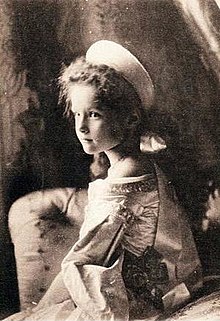 Tatiana was described as tall and slender, with dark auburn hair and dark blue-gray eyes, fine, chiseled features, and a refined, elegant bearing befitting the daughter of an Emperor. She was considered the most beautiful of the four grand duchesses by many courtiers.[1][2][3] Of all her sisters, Tatiana most closely resembled their mother.Grand Duchess Tatiana in 1904
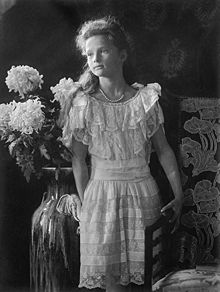 Tatiana and her older sister, Olga, were known in the household as "The Big Pair."[5] According to a 29 May 1897 diary entry written by her father's distant cousin, Grand Duke Konstantin Konstantinovich of Russia, she was given the name "Tatiana" as an homage to the heroine in Alexander Pushkin's novel in verse Eugene Onegin. Her father liked the idea of having daughters named Olga and Tatiana, like the sisters in the famous poem.[10] Like their two younger sisters, the two older girls shared a bedroom and were very close to one another from early childhood. In the spring of 1901, Olga had typhoid fever and was confined to the nursery for several weeks away from her younger sisters. When she began to recover, Tatiana was permitted to see her older sister for five minutes but didn't recognize her. When her governess, Margaretta Eagar, told her after the visit that the sickly child she had been conversing so gently with was Olga, four-year-old Tatiana began to cry bitterly and protested that the pale, thin child couldn't be her adored older sister. Eagar had difficulty persuading Tatiana that Olga would recover.[11] French tutor Pierre Gilliard wrote that the two sisters were "passionately devoted to one another."[12]Grand Duchess Tatiana Nikolaevna in a formal portrait taken in 1906
 Tatiana was practical and had a natural talent for leadership.[1] Her sisters gave her the nickname "The Governess" and sent her as their group representative when they wanted their parents to grant a favor. Though she was eighteen months Tatiana's senior, Olga had no objection when Tatiana decided to take charge of a situation.[1] She was also closer to her mother than any of her sisters and was considered by many who knew her to be the Tsarina's favorite daughter.[3] Tatiana was the conduit of all her mother's decisions.[13] "It was not that her sisters loved their mother any less," recalled her French tutor Pierre Gilliard, "but Tatiana knew how to surround her with unwearying attentions and never gave way to her own capricious impulses."[14] Alexandra wrote Nicholas on 13 March 1916 that Tatiana was the only one of their four daughters who "grasped it" when she explained her way of looking at things.[15]
 Tatiana, like all her family, doted on the long-awaited heir Tsarevich Alexei, or "Baby", who suffered frequent attacks of hemophilia and nearly died several times. Tatiana and her three sisters, like their mother, were all potential carriers of the hemophilia gene; the Tsarina was a granddaughter of Queen Victoria, from whom the trait was inherited. Tatiana's younger sister Maria reportedly hemorrhaged in December 1914 during an operation to remove her tonsils, according to her paternal aunt Grand Duchess Olga Alexandrovna of Russia, who was interviewed later in her life. The doctor performing the operation was so unnerved that he had to be ordered to continue by their mother, Tsarina Alexandra. Olga Alexandrovna said she believed all four of her nieces bled more than was normal and believed they were carriers of the hemophilia gene like their mother.[17] Symptomatic carriers of the gene, while not hemophiliacs themselves, can have symptoms of hemophilia including a lower than normal blood clotting factor that can lead to heavy bleeding.[18]Grand Duchess Tatiana in 1912 during the family's summer cruise aboard the Standart. Courtesy: Beinecke Library.
 However, one of the girls' governesses, Sofia Ivanovna Tyutcheva, was horrified that Rasputin was permitted access to the nursery when the four girls were in their nightgowns; she wanted him barred. Rasputin's contacts with the children were, by all accounts, innocent in nature, but Nicholas did ask Rasputin to avoid going to the nurseries in the future. Young Tatiana was aware of the tension in the nursery and afraid of her mother's reaction to Tyutcheva's actions. "I am so afr(aid) that S.I. can speak ... about our friend something bad," the twelve-year-old Tatiana wrote to her mother on 8 March 1910. "I hope our nurse will be nice to our friend now."[22] Alexandra eventually had Tyutcheva fired.Grand Duchess Tatiana Nikolaevna in about 1911. Courtesy: Beinecke Library.
 It was whispered in society that Rasputin had seduced not only the Tsarina but also the four grand duchesses.[26] Rasputin had released ardent, though completely innocent in nature,[23] letters written by the Tsarina and the four grand duchesses to him. They circulated throughout society, fueling more rumors. Pornographic cartoons circulated that depicted Rasputin having relations with the empress, with her four daughters and Anna Vyrubova nude in the background.[27] Nicholas ordered Rasputin to leave St. Petersburg for a time, much to Alexandra's displeasure, and Rasputin went on a pilgrimage to the Holy Land.[28] Despite the rumors, the imperial family's association with Rasputin continued until Rasputin was murdered in 1916. "Our Friend is so contented with our girlies, says they have gone through heavy 'courses' for their age and their souls have much developed," Alexandra wrote to Nicholas on 6 December 1916.[29] Tatiana was rumored to have been present at Rasputin's murder on 17 December 1916, "disguised as a lieutenant of the Chevaliers-Gardes, so that she could revenge herself on Rasputin who had tried to violate her". It was also rumored that Rasputin was castrated in front of Tatiana, wrote Maurice Paléologue, the French ambassador to Russia, in his memoirs. Paléologue was skeptical at the time about the truth of the wild rumors and attributed them to the hatred of Rasputin held by people in St. Petersburg.[30] In his memoirs, A.A. Mordvinov reported that all four grand duchesses appeared "cold and visibly terribly upset" by Rasputin's death and sat "huddled up closely together" on a sofa in one of their bedrooms on the night they received the news. Mordvinov reported that the young women were in a gloomy mood and seemed to sense the political upheaval that was about to be unleashed.[31] Tatiana attended Rasputin's funeral on 21 December 1916, and Rasputin was buried with an icon signed on its reverse side by Tatiana, her mother and sisters.[32]Grand Duchess Tatiana with her mother in about 1914. Her hair was cropped short following a bout of typhoid in 1913.
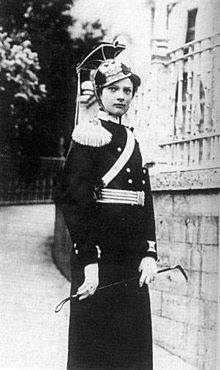 As a young teenager, Tatiana was assigned a regiment of soldiers, the Vosnesensky (Ascenscion) Hussars and given the rank of honorary colonel.[37] She and Olga, who was also given her own regiment, would go out and inspect the soldiers regularly, an occasion they greatly enjoyed.[38] When she was nearly fourteen, an ill Tatiana begged her mother to permit her to get out of bed in time to go to a review so she could watch a soldier she was infatuated with. "I would like so much to go the review of the second division as I am also the second daughter and Olga was at the first so now it is my turn," she wrote to Alexandra on 20 April 1911. "...Yes, Mama, and at the second division I will see whom I must see ... you know whom ..."[39]Grand Duchess Tatiana Nikolaevna in the uniform of her regiment, the Vosnesensky (Ascension) Lancers in 1912
 A few years later, when World War I broke out, Tatiana became a Red Cross nurse with her mother and Olga. They cared for wounded soldiers in a private hospital on the grounds of Tsarskoye Selo. According to Vyrubova, "Tatiana was almost as skillful and devoted as her mother, and complained only that on account of her youth she was spared some of the more trying cases."[3] Valentina Ivanovna Chebotareva, who worked with her at the hospital, described in her journal how she planned to boil silk while Tatiana was otherwise occupied, fearing that Tatiana would be too tired to help her. But Tatiana guessed what Chebotareva was doing. "Why can you breathe carbolic acid and I can't?" she asked Chebotareva and insisted on helping her with the work.[42] Tatiana was strongly patriotic and apologized in an 29 October 1914 letter for saying something negative about the Germans in her mother's presence. She explained that she forgot her mother had been born in Germany because she thought of Alexandra as only Russian. The Tsarina responded that she did feel completely Russian and Tatiana had not hurt her feelings with her sharp words, but Alexandra was hurt by the actions of her former countrymen and by the gossip she heard about her own German connections.[43]Grand Duchess Tatiana and her mother, Tsarina Alexandra, in about 1914. Courtesy: Beinecke Library.
 On 15 August 1915, Tatiana wrote her mother another letter expressing her desire to help her bear the burdens brought on by the war: "I simply can't tell you how awfully sorry I am for you, my beloved ones. I am so sorry I can in no way help you or be useful. In such moments I am sorry I'm not a man."[44] As Tatiana grew into adulthood, she undertook more public appearances than her sisters and headed committees. Vyrubova recalled that she became better known to the public than her three sisters because of her attention to duty and her ability to engage those she met. In their memoirs, both her mother's friend, Vyrubova, and lady in waiting Lili Dehn recalled that Tatiana, the most social of the sisters, longed for friends her own age but her social life was restricted by her rank and her mother's distaste for society. She also had a more introspective side, known only to her closest friends and family. "With her, as with her mother, shyness and reserve were accounted as pride, but, once you knew her and had gained her affection, this reserve disappeared and the real Tatiana became apparent," Dehn recalled. "She was a poetical creature, always yearning for the ideal, and dreaming of great friendships which might be hers."[2]Grand Duchesses Olga and Tatiana in court dress in a formal portrait taken in 1913
 Grand Duchess Tatiana wearing her nurse's uniform in a formal portrait taken ca. 1915
 Tatiana fell in love on at least one occasion. In an article in the December 2004 edition of the magazine Royalty Digest: A Journal of Record Peter de Malama wrote that his cousin, Dmitri Yakovlevich Malama, an officer in the Imperial Russian Cavalry, met Tatiana when he was wounded in 1914 and a romance later developed between Tatiana and the young man when he was appointed an equerry to the court of the Tsar at Tsarskoye Selo.[47] Dmitri Malama gave Tatiana a French bulldog she named "Ortipo" in September 1914. "Forgive me about the little dog," Tatiana wrote to her mother on 30 September 1914. "To say the truth, when he asked should I like to have it if he gave it to me, I at once said yes. You remember, I always wanted to have one, and only afterwards when we came home I thought that suddenly you might not like me having one. But I really was so pleased at the idea that I forgot about everything."[48] The dog died, but Malama gave her a replacement puppy. Tatiana took it with her to Yekaterinburg, where it died with the rest of the family.[49] Malama paid the imperial family a visit some eighteen months after he gave Tatiana the first dog. "My little Malama came for an hour yesterday evening," wrote Alexandra to Nicholas on 17 March 1916. "...Looks flourishing more of a man now, an adorable boy still. I must say a perfect son in law he w(ou)ld have been – why are foreign P(rin)ces not as nice!"[50] Malama was killed in August 1919 while commanding a unit of the White Russians fighting the civil war against the Bolsheviks in the Ukraine, according to Peter de Malama.[51]Grand Duchess Tatiana Nikolaevna wearing a Red Cross nursing uniform and Dmitri Yakovlevich Malama
 Grand Duchess Tatiana in 1916
 The family was arrested during the Russian Revolution of 1917 and imprisoned first at Tsarskoye Selo and later at private residences in Tobolsk and Yekaterinburg, Siberia. The drastic change in circumstances and the uncertainty of captivity took its toll on Tatiana as well as on the rest of her family. "She pines without work," wrote her fellow nurse Valentina Chebotareva after receiving a letter from Tatiana on 16 April 1917. "It is strange to sit in the morning at home, to be in good health and not to go to the change of bandages!" Tatiana wrote Chebotareva.[55] Tatiana, apparently trying to advocate for her mother, asked her friend Margarita Khitrovo in a letter on 8 May 1917 why their fellow nurses did not write to Tsarina Alexandra directly. Chebotareva wrote in her journal that, while she pitied the family, she could not write directly to the Tsarina because she blamed her for the Revolution.[56] "If anyone wishes to write us, let them write directly," Tatiana wrote to "my dear dove" Chebotareva on 9 December 1917, after expressing concern for fellow nurses and a patient they had once treated together. Chebotareva's son, Gregory P. Tschebotarioff, noted the grand duchess's "firm, energetic handwriting" and how the letter "reflected the nature which endeared her so much to my mother."[57]From left to right, Grand Duchess Olga, Tsar Nicholas II, Grand Duchess Anastasia, and Grand Duchess Tatiana at Tobolsk in the winter of 1917–1918. Courtesy: Beinecke Library.
 At Yekaterinburg, Tatiana occasionally joined her younger sisters in chatting with some of the guards over tea, asking them questions about their families and talking about her hopes for a new life in England when they were released. On one occasion one of the guards forgot himself and told the grand duchesses an off-color joke. The shocked Tatiana ran from the room, "pale as death," and her younger sister Maria scolded the guards for their bad language.[63] She "would be pleasant to the guards if she thought they were behaving in an acceptable and decorous manner," recalled another of the guards in his memoirs.[63] Later, when a new commander was placed in charge of the Ipatiev House, the family was forbidden from fraternizing with the guards and the rules of their confinement became more strict. Tatiana, still the family leader, was often sent by her parents to question the guards about rules or what would happen next to the family. She also spent a great deal of time sitting with her mother and ill brother, reading to her mother or playing games to occupy the time.[64] At the Ipatiev House, Tatiana and her sisters were required to do their own laundry and make bread. Her nursing skills were called upon at the end of June 1918 when she gave an injection of morphine to Dr. Eugene Botkin to ease his kidney pain.[65]Grand Duchesses Tatiana and Anastasia and the dog Ortipo in captivity at Tsarskoe Selo in the spring of 1917
 On 14 July 1918, local priests at Yekaterinburg conducted a private church service for the family and reported that Tatiana and her family, contrary to custom, fell on their knees during the prayer for the dead.[66] The final entry in Tatiana's final notebook at Yekaterinburg was a saying she had copied from the words of a well-known Russian Orthodox holy man, Father Ioann of Kronstadt: "Your grief is indescribable, the Savior's grief in the Gardens of Gethsemane for the world's sins is immeasurable, join your grief to his, in it you will find consolation."[67] The following day, on 15 July, Tatiana and her sisters appeared in good spirits as they joked with one another and moved the beds in their room so visiting cleaning women could scrub the floor. They got down on their hands and knees to help the women and whispered to them when the guards weren't looking. All four young women wore long black skirts and white silk blouses, the same clothing they had worn the previous day. Their short hair was "tumbled and disorderly." They told the women how much they enjoyed physical exertion and wished there was more of it for them to do in the Ipatiev House.[68] On the afternoon of 16 July 1918, the last full day of her life, Tatiana sat with her mother and read from the Biblical Books of Amos and Obadiah, Alexandra noted in her diary. Later, mother and daughter sat and just talked.[69] As the family was having dinner that night, Yakov Yurovsky, the head of the detachment, came in and announced that the family's kitchen boy and Alexei's playmate, 14-year-old Leonid Sednev, must gather his things and go to a family member. The boy had actually been sent to a hotel across the street because the guards did not want to kill him along with the rest of the Romanov party. The family, unaware of the plan to kill them, was upset and unsettled by Sednev's absence. Tatiana went that evening to Yurovsky's office, for what was to be the last time, to ask for the return of the kitchen boy who kept Alexei amused during the long hours of captivity. Yurovsky placated her by telling her the boy would return soon, but the family was unconvinced.[70]Grand Duchesses Tatiana, left, and Olga Nikolaevna, far right, with their mother, Tsarina Alexandra, center, in captivity at Tobolsk in the spring of 1918
 Late that night, on the night of 16 July, the family was awakened and told to come down to the lower level of the house because there was unrest in the town at large and they would have to be moved for their own safety. The family emerged from their rooms carrying pillows, bags, and other items to make Alexandra and Alexei comfortable. The family paused and crossed themselves when they saw the stuffed mother bear and cubs that stood on the landing, perhaps as a sign of respect for the dead. Nicholas told the servants and family "Well, we're going to get out of this place." They asked questions of the guards but did not appear to suspect they were going to be killed. Yurovsky, who had been a professional photographer, directed the family to take different positions as a photographer might. Alexandra, who had requested chairs for herself and Alexei, sat to her son's left. The Tsar stood behind Alexei, Dr. Botkin stood to the Tsar's right, Tatiana and her sisters stood behind Alexandra along with the servants. They were left for approximately half an hour while further preparations were made. The group said little during this time, but Alexandra whispered to the girls in English, violating the guard's rules that they must speak in Russian. Yurovsky came in, ordered them to stand, and read the sentence of execution. Tatiana and her family had time only to utter a few incoherent sounds of shock or protest before the death squad under Yurovsky's command began shooting. It was the early hours of 17 July 1918.[71]A forensic facial reconstruction of Grand Duchess Tatiana by S.A. Nikitin, 1994


No comments:
Post a Comment