begin quote from:
Fault lines: GOP civil war deepens
| CNN | - |
Washington
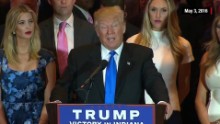
(CNN) Donald Trump is poised to breeze through another round of primary
contests this week -- while the Republican Party splinters around him.
Fault lines: GOP civil war deepens





Story highlights
- It's becoming clear that party unification will be tough to come by, if it happens at all
- Trump questions the need for party unity
Washington (CNN)Donald
Trump is poised to breeze through another round of primary contests
this week -- while the Republican Party splinters around him.
Trump's
ascent to the top of the GOP, which was capped last week with Ted
Cruz's devastating loss in the Indiana primary, happened so fast that
even the billionaire himself was surprised. And the whipsawed party
establishment now faces immediate choices -- none of which particularly
appeal to them.
Will
they unite behind their party's standard-bearer? Will they sit out the
2016 campaign? Or will they fight on, in a quixotic quest to undermine
Trump?
Trump's opponents are still
sorting through the wreckage of the GOP primary season for a path
forward. But it has become painfully clear over the past five days that
party unification will be tough to come by, if it happens at all. Past
presidents, party leaders and prominent Republicans are all choosing
sides, from unenthusiastic acceptance (Bob Dole) to pledges not to vote
for either party in November (former Florida Gov. Jeb Bush and Sen.
Lindsey Graham) to musings about a third-party bid (Bill Kristol).
Trump
himself enters his first full week as the presumptive nominee by
signaling that he has limited patience for or interest in the
establishment's rebellion. He'll meet Thursday with Paul Ryan, after the
House speaker's extraordinary announcement to CNN's Jake Tapper that
he's "just not ready" to support Trump.
Trump's provocative style
But
Trump has also made quite clear he doesn't intend to cast off the
provocative style on the campaign trail that alarmed the Republican
establishment and resonated so deeply with primary voters. After
spending days on the receiving end of criticism from the likes of Ryan,
Romney and Graham, Trump and his supporters hit back -- hard.
Sarah
Palin, a key Trump surrogate and 2008 vice presidential nominee, took
the unusual step of backing the little-known Republican businessman
challenging Ryan for his Wisconsin seat.
"Paul Ryan is soon to be Cantored," Palin told Tapper Sunday on "State of the Union,"
referring to Eric Cantor, the former Republican House majority leader
who was shockingly ousted by a primary challenger in 2014.
"His
political career is over but for a miracle because he has so
disrespected the will of the people, and as the leader of the GOP, the
convention, certainly he is to remain neutral," Palin said. "And for him
to already come out and say who he will not support is not a wise
decision of his."
For
his part, Trump didn't seem too worried about the talk of the GOP
disintegrating because of his nomination. Speaking on ABC's "This Week,"
Trump questioned the need for party unity, arguing that his campaign is
unlike any before and won't rely on the same political calculations.

"Does it have to be
unified?" he asked. "I'm very different than everybody else, perhaps
that's ever run for office. I actually don't think so."
He
went on: "I think it would be better if it were unified. I think ...
there would be something good about it. But I don't think it actually
has to be unified in the traditional sense."
Those
comments underscore the growing debate over whether Trump's unorthodox
candidacy will doom the GOP in the fall or whether the anxious party
leadership has grown so out of touch with the electorate that it's
missing the genuine anger fueling Trump's rise.
'Disconnect'
"You
have to draw the conclusion that there is some distance, if not a
disconnect, between party leaders and members of Congress and the many
voters who have selected Donald Trump to be the nominee of the party,"
John McCain, the GOP's 2008 nominee, told CNN's Manu Raju Sunday on
"State of the Union. "You have to listen to the people that have chosen
the nominee of our Republican Party."
Trump,
meanwhile, is shifting his gaze to the general election by trying to
undercut Clinton's advantage with women. Facing the likelihood of
running against the first female nominee of a major party, Trump sought
to recast Clinton's image by reviving the impeachment saga of the 1990s
and arguing that she was dismissive of women who had extramarital
affairs with her husband.
"Hillary
was an enabler and she treated these women horribly," Trump said
Saturday in Spokane, Washington. "And some of those women were
destroyed, not by (Bill Clinton), but by the way Hillary Clinton treated
them after it went down."
Trump is
taking a risk with such comments, and even Palin seemed to question
their effectiveness. When asked by Tapper about Trump's critique of
Clinton, Palin said, "a lot of people may be obsessed with a public
figure's personal life, and they're going to get all entangled in, you
know, past indiscretions or whatever."
"But
I think, for the most part," she went on, "Americans are concerned
about things like who will be able to appoint the next Supreme Court
justices, which will affect an entire generation coming up. I think
that's what people are concerned about, much more so than Bill Clinton's
obvious indiscretions, and Donald Trump having been divorced a couple
of times, but owning up to it."
Shifting positions
Trump
also caused some confusion over the weekend by taking positions on the
minimum wage and taxes that are not only out of step with GOP tradition
but also his own stances during the primary.
On
taxes, he said levies on the wealthy would go up under his
administration. He argued that while he supports across-the-board tax
cuts, he would likely bargain away cuts for top earners during
negotiations with Congress.
"On my plan, they're doing down," he said on "This Week." "But by the time it's negotiated, they'll go up."
He
added: "We're going to submit the optimum ... That's what I'd like to
get and we'll fight for it. But from a practical standpoint, it's going
to get renegotiated. And in my opinion, the taxes for the rich will go
up somewhat."
And
after he told CNN's Wolf Blitzer last week that he was "looking at"
raising the minimum wage, he told ABC's George Stephanopoulous that he
hasn't "decided in terms of numbers."
"But I think people have to get more," he said, while acknowledging the shift.
"I'm
allowed to change," he said. "You need flexibility, George, whether
it's a tax plan where you're going to -- where you know you're going to
negotiate. But we're going to come up with something."
Such
shifts, however, are deeply unnerving to many of Trump's opponents.
They have argued that he effectively fooled many primary voters into
supporting him and will change his tune once he has to appeal to a
broader electorate ahead of the general election. That fear is partly
what's fueling speculation over a potential third-party run from someone
like Romney, who met privately with Kristol, the editor of the
conservative Weekly Standard, last week to discuss how to get an
independent candidate into the race.
Romney has been publicly mum about the prospect. But he clearly telegraphed his concerns about Trump in a commencement speech Saturday at Trine University in Angola, Indiana, in which he warned of "demagogues."
"Profiteers
tempt and endeavor to hook us with compulsive addictions," Romney said.
"Entertainment media distracts us from the things that bring enduring
achievements and happiness."


No comments:
Post a Comment