Sodium bromide is an inorganic compound with the formula Na Br. ... Sodium bromide can be used as a source of the chemical element bromine.
Sodium bromide
From Wikipedia, the free encyclopedia
Sodium bromide
 |
 |
| Names |
| IUPAC name
Sodium bromide
|
| Identifiers |
|
|
7647-15-6 
13466-08-5 (dihydrate)  |
| 3D model (Jmol) |
Interactive image |
| ChEMBL |
ChEMBL1644694 |
| ChemSpider |
22712 |
| ECHA InfoCard |
100.028.727 |
| PubChem |
253881 |
| RTECS number |
VZ3150000 |
| UNII |
LC1V549NOM |
|
|
|
|
| Properties |
|
|
BrNa |
| Molar mass |
102.89 g·mol−1 |
| Appearance |
White powder, hygroscopic |
| Density |
3.21 g/cm3 (anhydrous)
2.18 g/cm3 (dihydrate) |
| Melting point |
747 °C (1,377 °F; 1,020 K)
(anhydrous)
36 °C (97 °F; 309 K)
(dihydrate) decomposes[1] |
| Boiling point |
1,390 °C (2,530 °F; 1,660 K) [1] |
|
|
71.35 g/100 mL (−20 °C)
79.52 g/100 mL (0 °C)
94.32 g/100 mL (25 °C)[2]
104.9 g/100 mL (40 °C)
116.2 g/100 mL (100 °C)[3] |
| Solubility |
Soluble in alcohol, liquid ammonia, pyridine, hydrazine, SO2, amine
Insoluble in acetone, acetonitrile[2] |
| Solubility in methanol |
17.3 g/100 g (0 °C)
16.8 g/100 g (20 °C)
16.1 g/100 g (40 °C)
15.3 g/100 g (60 °C)[2] |
| Solubility in ethanol |
2.45 g/100 g (0 °C)
2.32 g/100 g (20 °C)
2.29 g/100 g (30 °C)
2.35 g/100 g (70 °C)[2] |
| Solubility in formic acid |
19.3 g/100 g (18 °C)
19.4 g/100 g (25 °C)[2] |
| Solubility in glycerol |
38.7 g/100 g (20 °C)[2] |
| Solubility in dimethylformamide |
3.2 g/100 g (10.3 °C)[2] |
| Vapor pressure |
1 torr (806 °C)
5 torr (903 °C)[1] |
|
|
−41.0·10−6 cm3/mol |
| Thermal conductivity |
5.6 W/m·K (150 K)[4] |
|
|
1.6428 (24 °C)
nKrF = 1.8467 (24 °C)
nHe–Ne = 1.6389 (24 °C)[5] |
| Viscosity |
1.42 cP (762 °C)
1.08 cP (857 °C)
0.96 cP (937 °C)[2] |
| Structure |
|
|
Cubic |
|
|
|
| Thermochemistry |
|
|
51.4 J/mol·K[2] |
|
|
86.82 J/mol·K[2] |
|
|
−361.41 kJ/mol[2] |
|
|
−349.3 kJ/mol[2] |
| Hazards |
| Safety data sheet |
External MSDS |
| R-phrases |
R36 |
| S-phrases |
(S2), S24/25, S46 |
| NFPA 704 |
|
| Flash point |
800 °C (1,470 °F; 1,070 K) |
| Lethal dose or concentration (LD, LC): |
|
|
3500 mg/kg (rats, oral) |
| Related compounds |
|
|
Sodium fluoride
Sodium chloride
Sodium iodide
Sodium astatide |
|
|
Lithium bromide
Potassium bromide
Rubidium bromide
Caesium bromide
Francium bromide |
Except where otherwise noted, data are given for materials in their standard state (at 25 °C [77 °F], 100 kPa).
|
 verify (what is ?) verify (what is ?) |
| Infobox references |
|
|
Sodium bromide is an
inorganic compound with the formula
NaBr. It is a high-melting white, crystalline solid that resembles
sodium chloride. It is a widely used source of the bromide ion and has many applications.
[7]
Synthesis, structure, reactions
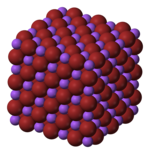
NaBr crystallizes in the same cubic motif as NaCl, NaF and NaI. The
anhydrous salt crystallizes above 50.7 °C.
[7] Dihydrate salts (NaBr·2H
2O) crystallize out of water solution below 50.7 °C.
[8]
NaBr is produced by treating sodium hydroxide with hydrogen bromide.
Sodium bromide can be used as a source of the
chemical element bromine. This can be accomplished by treating an aqueous solution of NaBr with
chlorine gas:
- 2 NaBr + Cl2 → Br2 + 2 NaCl
Applications
Sodium bromide is the most useful inorganic bromide in industry.
[7] It is also used as a catalyst in TEMPO-mediated oxidation reactions.
[9]
Medicine
Also known as Sedoneural, sodium bromide has been used as a
hypnotic,
anticonvulsant, and
sedative in
medicine, widely used as an
anticonvulsant and a
sedative in the late 19th and early 20th centuries. Its action is due to the bromide ion, and for this reason
potassium bromide is equally effective. In 1975, bromides were removed from drugs in the U.S. such as
Bromo-Seltzer due to toxicity.
[10]
Preparation of other bromine compounds
Sodium bromide is widely used for the preparation of other bromides in
organic synthesis and other areas. It is a source of the bromide
nucleophile to convert alkyl chlorides to more reactive alkyl bromides by the
Finkelstein reaction:
- NaBr + RCl → RBr + NaCl (R = alkyl)
Once a large need in
photography, but now shrinking, the photosensitive salt
silver bromide is prepared using NaBr.
Disinfectant
Sodium bromide is used in conjunction with chlorine as a disinfectant for hot tubs and swimming pools.
Petroleum industry
Sodium bromide is used to prepare dense fluids used in oil wells.
Safety
NaBr has a very low toxicity with an oral
LD50 estimated at 3.5 g/kg for rats.
[6]
However, this is a single-dose value. Bromide ion is a cumulative toxin
with a relatively long half life (in excess of a week in humans): see
potassium bromide.
References


No comments:
Post a Comment